What Does a Low HRV Number Mean? How to Interpret Low Heart Rate Variability
Trying to decode today's HRV number? Use the free interpreter first, then build a practical recovery plan. Interpret your HRV
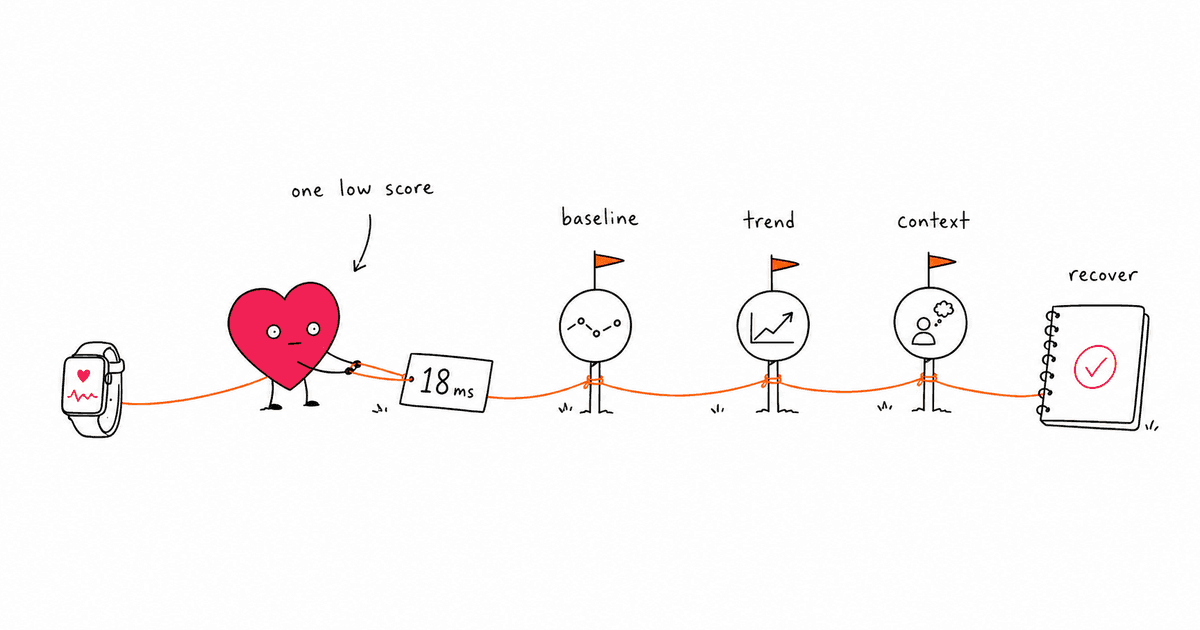
You opened your wearable app and saw a low HRV number: 18 ms, 27 ms, 35 ms, maybe lower than usual by a lot. The obvious question is whether that number is bad, normal, or a sign that something is wrong.
A low HRV number usually means your body is under more strain than usual, but it does not diagnose a disease by itself. The number only makes sense when you compare it with your normal baseline, age, measurement method, sleep, training, illness, stress, alcohol, medications, and symptoms.
This guide explains how to interpret low heart rate variability without panicking over one morning score.
What Is Low HRV?
Low HRV means there is less variation in the timing between your heartbeats than expected for you. In practical terms, your autonomic nervous system may be leaning more toward stress, recovery demand, illness, fatigue, or reduced parasympathetic activity. The key phrase is "for you" because HRV varies widely between people.
HRV is usually measured in milliseconds. Most consumer wearables report either RMSSD or a closely related overnight HRV value. RMSSD emphasizes short-term beat-to-beat variation and is commonly used by Oura, WHOOP, Garmin, and many HRV apps.
If you need the foundation first, read what HRV is and HRV explained for dummies.
Is Low HRV Bad?
Low HRV is not automatically bad. A low reading can be completely normal after a hard workout, poor sleep, alcohol, travel, dehydration, heat, illness, or emotional stress. It becomes more meaningful when it is repeated, unexplained, far below your baseline, or paired with symptoms.
Think of low HRV as a load signal, not a verdict.
| Pattern | What It Usually Means | What To Do |
|---|---|---|
| One low day after obvious stress | Normal short-term response | Recover and watch the next reading |
| Three or more low days | Accumulated strain | Reduce intensity, prioritize sleep, review triggers |
| Low HRV plus high resting heart rate | Stronger stress or illness signal | Take an easier day and monitor symptoms |
| Low HRV for weeks or months | Baseline issue or chronic load | Look at sleep, training, alcohol, health, and medications |
| Low HRV plus concerning symptoms | Needs medical context | Talk with a clinician |
The mistake is treating one number as a diagnosis. The better move is to ask what changed around it.
Why There Is No Universal "Good" HRV Number
People want a clean cutoff: below 20 is bad, above 50 is good, above 80 is elite. HRV does not work that way.
A systematic review on HRV reference values notes that age, sex, measurement duration, method, and population all affect reference ranges. A large photoplethysmography study of more than 8 million people also found that HRV patterns vary with age, sex, time of day, and physical activity.
That means a 35 ms HRV can be normal for one person and low for another. A 70 ms HRV can be excellent for one person and below baseline for a highly trained athlete.
Your personal baseline matters more than any internet chart.
How To Interpret Specific Low HRV Numbers
These examples assume your device is reporting an overnight or resting RMSSD-style value in milliseconds. If your app uses SDNN, a readiness score, or a proprietary scale, the same exact numbers may not apply.
HRV Below 15 ms
An HRV below 15 ms is low for many adults, especially if it is unusual for you. It can show up after illness, heavy alcohol, severe sleep debt, intense training, high stress, or measurement artifact.
Do not panic over one reading. Do take it seriously if it repeats, comes with a higher-than-normal resting heart rate, or appears with symptoms like chest pain, fainting, unusual shortness of breath, new palpitations, fever, or severe fatigue.
HRV Around 20 ms
An HRV around 20 ms can be normal for some older adults or people whose baseline naturally runs low. It can also be a low-recovery signal for younger, fitter, or previously higher-HRV users.
Ask three questions:
- Is 20 ms normal for you?
- Is it part of a downward trend?
- Is your resting heart rate, sleep, respiratory rate, or skin temperature also off?
If the answer to all three points toward stress, treat it as a recovery flag.
HRV Around 30 ms
An HRV around 30 ms sits in a gray zone. It is not automatically alarming, but it is often low for active younger adults if their baseline is usually much higher.
This is where context matters most. A stable 30 ms baseline may be your normal. A drop from 55 to 30 after a rough week is different. That drop is more actionable than the absolute number.
HRV Around 40 ms
An HRV around 40 ms can be a normal, healthy baseline for many adults. It may still be low if your usual overnight HRV is 60 to 80 ms.
If your HRV is 40 ms and you feel good, sleep well, train normally, and have a stable resting heart rate, the number may not need action. If it fell to 40 from a much higher baseline, look for the cause.
HRV Around 50 to 60 ms
For many people, 50 to 60 ms is not low at all. It can be a solid overnight HRV range, especially in midlife or later adulthood.
But athletes and younger users sometimes have baselines much higher than this. If your normal is 90 ms and you wake up at 55 ms, that is a meaningful drop even though 55 ms looks "good" on a general chart.
Check What Your App Is Measuring
Before interpreting a low number, check whether your app is showing RMSSD, SDNN, or a proprietary readiness score.
RMSSD is common in wearables and recovery apps. It reflects short-term beat-to-beat variation and is strongly tied to parasympathetic activity. SDNN captures broader variability across a measurement window and often produces different values, so do not compare SDNN and RMSSD as if they are the same scale.
Chest straps and ECG-based tools measure electrical heart activity. Rings and watches usually use optical PPG sensors. A 2018 systematic review of wearable HRV measurement found that wearable agreement with ECG-derived HRV can be strong at rest, but performance declines under more active or less controlled conditions. For practical device details, read ECG vs PPG for HRV.
The Most Common Reasons HRV Is Low
Low HRV usually has a boring explanation. That is good news because boring explanations are often fixable.
Poor Sleep
Sleep is one of the biggest HRV drivers. Short sleep, fragmented sleep, late bedtime, sleep apnea, a warm bedroom, or a stressful night can all suppress overnight HRV.
Start with HRV and sleep, sleep deprivation and HRV, and sleep apnea and HRV if your low readings cluster around bad nights.
Alcohol
Alcohol is one of the most reliable ways to lower HRV. Even moderate drinking can raise resting heart rate, fragment sleep, and reduce recovery quality.
If your low HRV follows a night out, the explanation is probably not mysterious. See alcohol and HRV.
Hard Training
Hard workouts temporarily lower HRV because your body is repairing tissue, replenishing glycogen, and adapting to stress. That is not bad. It is the point of training.
Problems start when low HRV stacks for days and performance, mood, sleep, or resting heart rate also worsens. Read HRV and overtraining, strength training and HRV, and HRV for athletes for training context.
Illness and Inflammation
HRV often drops when your immune system is activated. Some people notice lower HRV before they feel obviously sick, especially when resting heart rate or respiratory rate rises at the same time.
That pattern can be useful, but it is not a diagnosis. See inflammation and HRV and HRV and the immune system.
Stress and Burnout
Psychological stress can lower HRV by keeping the body in a more sympathetic state. Chronic stress and burnout can make low HRV feel like the default rather than an occasional signal.
For more detail, see HRV and stress, HRV and anxiety, and HRV and burnout.
Dehydration, Heat, and Travel
Fluid loss, heat stress, jet lag, and disrupted routines can all drag HRV down. These factors often show up together after travel, summer workouts, sauna sessions, or poor overnight hydration.
Useful related guides: hydration and HRV, heat and humidity and HRV, and travel, jet lag, and HRV.
Medications and Health Conditions
Some medications and medical conditions change HRV or make wearable interpretation harder. Beta blockers, SSRIs, stimulants, decongestants, thyroid disease, sleep apnea, diabetes, heart rhythm issues, and chronic inflammatory conditions can all affect the bigger picture.
Start with the condition-specific guide if it applies, especially beta blockers and HRV, SSRIs and HRV, decongestants and HRV, atrial fibrillation and HRV, diabetes and HRV, or dysautonomia and HRV.
Low HRV Plus High Resting Heart Rate Matters More
Low HRV is more useful when paired with resting heart rate.
| HRV | Resting Heart Rate | Common Interpretation |
|---|---|---|
| Low | Normal | Mild strain, noise, or personal low baseline |
| Low | High | Stronger recovery, illness, stress, alcohol, or training signal |
| Low | Low | Could be fitness, fatigue, medication, or measurement context |
| High | High | Sometimes artifact, arrhythmia, stress, or unusual physiology |
The clearest yellow flag is low HRV plus higher-than-normal resting heart rate. That combination often means your body is working harder than usual.
Read resting heart rate vs HRV for a fuller breakdown.
What To Do When Your HRV Is Low
Do not try to "force" HRV up in one day. Treat the low reading as information, then check the previous 24 to 48 hours:
- Did you sleep poorly?
- Did you drink alcohol?
- Did you train hard?
- Did you eat late?
- Are you getting sick?
- Are you dehydrated?
- Are you under unusual stress?
- Did you travel?
- Did you change medication or supplement timing?
Most low readings make sense after this review.
Next, compare the number against your baseline. If your baseline is 25 ms, a 22 ms reading is minor. If your baseline is 70 ms, a 22 ms reading is a major drop. Use at least two to three weeks of consistent measurement before making strong conclusions.
Then check other signals:
- resting heart rate
- respiratory rate
- sleep duration and quality
- skin temperature
- training load
- symptoms
- mood and fatigue
The more signals point in the same direction, the more useful the HRV reading becomes.
If HRV is low and the context fits strain, choose recovery:
- keep training easy or rest
- prioritize sleep
- hydrate
- avoid alcohol
- eat normally and avoid a very late heavy meal
- use light movement, stretching, or breathing work
- reduce avoidable stress where possible
For practical tools, see how to improve HRV, breathing exercises for HRV, and HRV biofeedback training.
Finally, watch the trend. If your HRV returns to baseline after sleep, hydration, and easier training, you probably handled the signal well. If it keeps dropping or stays low for weeks, broaden the investigation.
When Low HRV Deserves Medical Context
HRV is not an emergency metric by itself. Still, do not ignore low HRV if it comes with concerning symptoms.
Talk with a qualified clinician if low HRV appears with:
- chest pain or pressure
- fainting or near-fainting
- new or sustained palpitations
- unusual shortness of breath
- severe fatigue that does not improve
- unexplained weight loss
- fever or persistent illness symptoms
- neurological symptoms
- very high or very low heart rate for you
- a new long-term downward trend with no obvious cause
This is especially important if you have known heart disease, atrial fibrillation, diabetes, kidney disease, sleep apnea, pregnancy-related concerns, or are taking medications that affect heart rate.
Best Devices for Tracking Low HRV Trends
The best device is the one you will wear consistently. Low HRV interpretation depends on baseline quality, so consistency matters more than chasing perfect accuracy. Oura Ring, WHOOP, Garmin Forerunner 265, and Apple Watch can all work well if you track trends within the same device. For a broader comparison, see the best HRV monitors for 2026.
Frequently Asked Questions
Is 20 ms HRV bad?
Not always. A 20 ms HRV can be normal for some people, especially if it is stable and you feel well. It is more concerning if your baseline is much higher, it repeats for several days, or it appears with high resting heart rate or symptoms.
Is 30 ms HRV low?
It depends on your baseline, age, device, and measurement method. For some adults, 30 ms is normal. For others, it is a clear drop. Compare it with your own trend rather than a generic chart.
Why did my HRV suddenly drop overnight?
Common reasons include poor sleep, alcohol, hard training, illness, dehydration, late eating, travel, heat, emotional stress, or sensor error. Check the previous day first before assuming something serious.
Should I skip a workout if my HRV is low?
If HRV is low but you feel good and the drop is small, you may only need to reduce intensity. If HRV is much lower than baseline, resting heart rate is elevated, sleep was poor, or you feel off, choose an easier session or rest.
Key Takeaways
- Low HRV is a context signal, not a diagnosis.
- Your baseline matters more than a universal cutoff.
- A drop from your normal is more useful than the raw number.
- Low HRV plus high resting heart rate is a stronger strain signal.
- Sleep, alcohol, training, illness, stress, hydration, heat, and medications are common causes.
- Persistent low HRV with symptoms deserves medical context.
The Bottom Line
A low HRV number means your body may be carrying more load than usual. It does not automatically mean you are unhealthy, overtrained, sick, or in danger.
Use the number the right way: compare it to your baseline, check the trend, look at resting heart rate and symptoms, and connect it to real-life context. If the low reading makes sense, recover. If it repeats without explanation or comes with concerning symptoms, get proper medical guidance.
That is the practical value of HRV. It helps you ask better questions before you overreact to a single score.
Need a quick read on your HRV number first?
Enter your HRV value, age range, device, and recovery context for a plain-English interpretation before you decide what to do next.
Interpret Your HRV NumberBuild the 30-day plan