Strength Training and HRV: Why It Drops After Lifting (and When to Worry)
Trying to decode today's HRV number? Use the free interpreter first, then build a practical recovery plan. Interpret your HRV
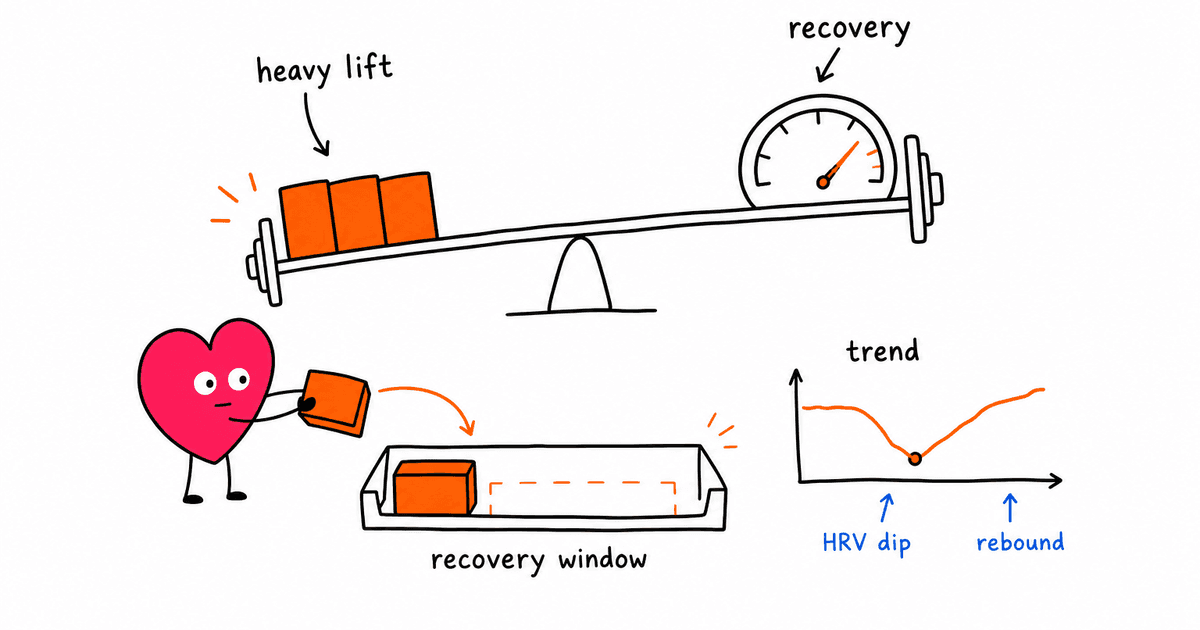
A lower HRV after lifting is usually normal. Heavy strength work pushes your nervous system toward a more sympathetic, high-output state, so a dip the next morning does not automatically mean something is wrong.
What matters is how big the drop is, how long it lasts, and whether it matches the rest of the context. This guide explains what a normal post-lifting HRV dip looks like, when to back off, and how to use HRV without letting one bad reading run your training.
How Strength Training Affects HRV
Strength training temporarily suppresses HRV by shifting your autonomic nervous system toward sympathetic (fight-or-flight) dominance. This is expected. Lifting heavy weights places significant mechanical and metabolic stress on your body, triggering a recovery response that can last 24 to 72 hours depending on intensity.
A 2024 narrative review published in Sports Medicine confirmed that HRV applications in strength and conditioning remain underexplored compared to endurance training, but the available evidence points to consistent acute HRV suppression after resistance exercise sessions.
Why Your HRV Drops After Lifting
Several mechanisms explain the post-lifting HRV dip:
- Sympathetic activation: Heavy compound movements like squats and deadlifts spike cortisol and adrenaline, suppressing parasympathetic activity
- Muscle damage and inflammation: Eccentric loading causes micro-tears that trigger an inflammatory response, further reducing vagal tone
- Metabolic stress: High-rep sets with short rest periods create significant metabolic byproducts that keep the sympathetic nervous system elevated
- Central nervous system fatigue: Maximal lifts tax the CNS, which takes longer to recover than muscles themselves
A 2025 study in Scientific Reports found that even the position you train in matters. Standing strength exercises produced greater vagal suppression compared to seated or lying positions at the same relative intensity.
How Long Does the HRV Dip Last?
The recovery timeline depends on workout intensity and your training status:
| Workout Type | Typical HRV Recovery |
|---|---|
| Light accessory work (2-3 RIR) | 12-24 hours |
| Moderate hypertrophy session | 24-48 hours |
| Heavy compound lifts (RPE 9-10) | 48-72 hours |
| Maximal testing or competition | 72+ hours |
If your HRV hasn't returned to your baseline range within 72 hours, that's a signal you may be pushing too hard or not prioritizing recovery.
Does Strength Training Improve HRV Long-Term?
This is where the research gets nuanced. A meta-analysis published in Sports Medicine (2024) examining exercise training and HRV found that resistance training alone did not significantly improve vagal-related HRV indices in healthy young adults.
However, the picture changes for specific populations:
- Middle-aged and older adults: Resistance training appears to improve parasympathetic modulation in people with reduced autonomic function
- Sedentary individuals: Starting any exercise program, including strength training, tends to improve resting HRV
- Combined training: Pairing resistance work with aerobic exercise (like Zone 2 training or HIIT) shows the strongest HRV improvements
The takeaway: strength training may not boost HRV the same way cardio does, but it contributes to overall autonomic health as part of a well-rounded program. If you want resistance-style training with stronger direct HRV and blood pressure benefits, isometric exercises like wall sits and handgrip training have shown impressive results in research. Monitoring your heart rate recovery after lifting sessions can also provide useful insight into your cardiovascular fitness alongside HRV.
Using HRV to Guide Your Strength Training
HRV-guided training means adjusting your workout based on your morning readings rather than following a rigid program. Here's how to apply it to lifting:
When HRV Is Above Your Baseline
Your nervous system is recovered and ready. This is the day to:
- Hit heavy compound lifts (squats, deadlifts, bench press)
- Push to higher intensities (RPE 8-10)
- Train movements that require high coordination and CNS demand
- Add volume if you're in an accumulation phase
When HRV Is at Your Baseline
Stick to the plan. Your body is in a normal state, and moderate training is appropriate:
- Follow your programmed workout as written
- Moderate intensity (RPE 6-8)
- Standard volume and rest periods
When HRV Is Below Your Baseline
Your body is still recovering. Adjust accordingly:
- Reduce intensity by 10-20%
- Swap heavy compounds for lighter accessory work
- Focus on technique and mobility
- Consider an active recovery day with walking, yoga, stretching, or Pilates
HRV Trends Matter More Than Single Readings
A single low HRV reading after leg day is normal. What you're really watching for is the trend over days and weeks. Track your:
- 7-day rolling average: This smooths out daily fluctuations and shows your true recovery trajectory
- Baseline range: Most wearables calculate this automatically. Readings within your normal range are fine, even if they're lower than yesterday
- Recovery patterns: How quickly does your HRV bounce back after training? Faster recovery over time indicates improving fitness
If your 7-day average is trending downward for two or more weeks, it may be time to deload or reduce training volume.
Best Practices for Strength Training and HRV
Measure at the Same Time Daily
Take your HRV reading first thing in the morning, before coffee or exercise. Consistency matters more than the absolute number. Most HRV monitors will prompt you to take a morning reading.
Don't Skip Recovery Work
Strength athletes often neglect the parasympathetic side. Activities that boost vagal tone between sessions include:
- Breathing exercises (especially slow, diaphragmatic breathing)
- Meditation
- Adequate sleep (7-9 hours)
- Proper nutrition and hydration (if you use creatine, track dose, sleep, and training load before blaming HRV changes on the supplement alone)
Program Rest Days Strategically
Rather than arbitrary rest days, use your HRV data to decide when to rest. Some weeks you might train four days and feel great. Other weeks, three sessions with extra recovery might be smarter.
Pair Lifting with Aerobic Work
Since aerobic exercise has a stronger direct effect on HRV than resistance training alone, consider including 2-3 sessions of low-intensity cardio per week. Walking and Zone 2 training are ideal complements to a strength program. If plain walks feel too easy, light rucking can work as a conditioning option, but a heavy pack is training, not recovery. If your program blends lifting, running, and station work, use our HYROX and HRV guide to keep hybrid conditioning from quietly becoming too much high-intensity stress.
Tracking Strength Training Recovery with Wearables
Modern wearables make HRV-guided strength training practical. Here are the best options for lifters:
- Oura Ring 4: Comfortable for lifting with no wrist interference. Tracks overnight HRV and provides a daily readiness score
- Whoop 5: Strain tracking pairs well with resistance training. The recovery score accounts for HRV, resting heart rate, and sleep
- Garmin Forerunner 265: Morning HRV status with training load metrics. Good for athletes who also run or cycle
- Apple Watch: Overnight HRV tracking with health app integration. Works well for general fitness tracking
For the most accurate HRV during actual lifting sessions, a chest strap like the Garmin HRM-600 paired with a compatible app provides research-grade data.
Sample Weekly Schedule: HRV-Guided Strength Training
Here's what an HRV-informed training week might look like:
| Day | HRV Status | Workout |
|---|---|---|
| Monday | Above baseline | Heavy squats and accessories |
| Tuesday | At baseline | Upper body moderate |
| Wednesday | Below baseline | Active recovery, walking, mobility |
| Thursday | At baseline | Deadlifts and posterior chain |
| Friday | Above baseline | Push day, higher volume |
| Saturday | At baseline | Zone 2 cardio (30-45 min) |
| Sunday | Rest | Full rest day |
The key is flexibility. If Thursday's reading is still suppressed from Monday's session, swap the heavy deadlifts for lighter work and adjust Friday accordingly.
Common Mistakes
Chasing High HRV Numbers
A temporarily lower HRV after training is the stimulus your body needs to adapt. If you only train when HRV is high, you'll never accumulate enough training stress to get stronger. The goal is smart management, not avoidance.
Ignoring Context
Low HRV might be from last night's poor sleep, alcohol, or stress, not from training. Consider the full picture before making training adjustments.
Not Tracking Long Enough
HRV baselines take 2-4 weeks to establish. Don't make drastic program changes based on a few days of data.
The Bottom Line
Strength training and HRV have a complementary relationship. Resistance exercise temporarily suppresses HRV as part of the adaptation process, and tracking that recovery gives you a powerful tool for programming. While lifting alone may not boost resting HRV the way aerobic training does, it contributes to overall autonomic health, especially when combined with cardio, recovery practices, and smart programming.
Use your morning HRV readings to guide intensity, not to avoid hard training. Over time, you'll learn your body's recovery patterns and train more effectively as a result.
Need a quick read on your HRV number first?
Enter your HRV value, age range, device, and recovery context for a plain-English interpretation before you decide what to do next.
Interpret Your HRV NumberBuild the 30-day plan