Breathing Exercises for HRV: 5 Science-Backed Techniques to Boost Your Score
Trying to decode today's HRV number? Use the free interpreter first, then build a practical recovery plan. Interpret your HRV
Do Breathing Exercises Improve HRV?
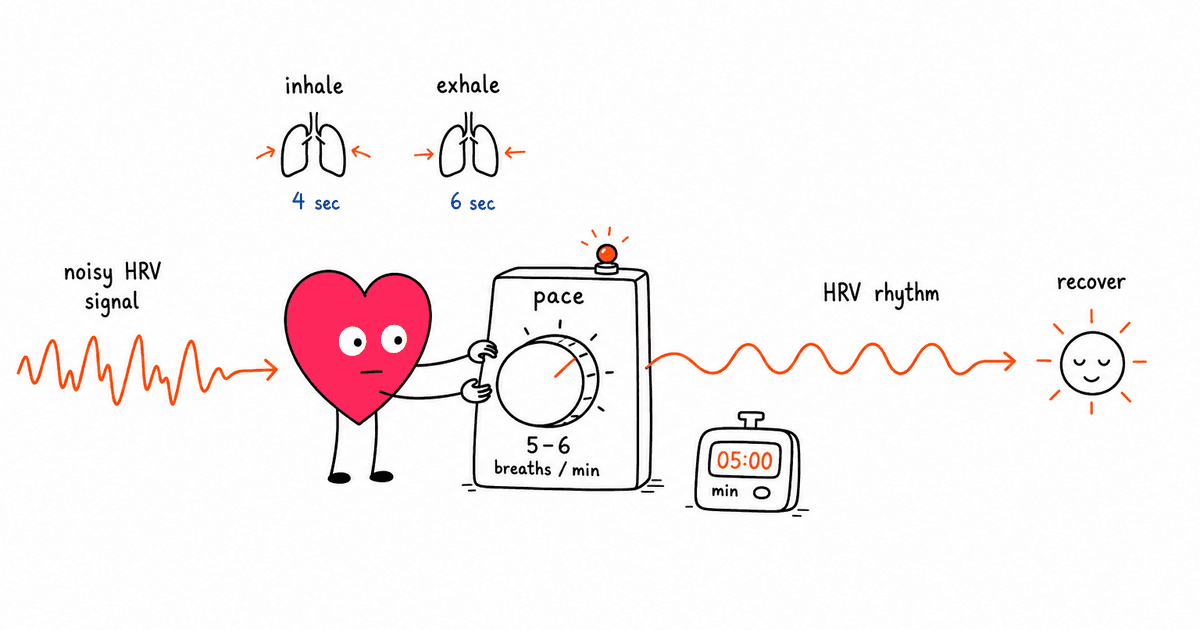
Yes, breathing exercises can improve HRV within minutes. Slow, controlled breathing at 4.5-7 breaths per minute, the same breathing-speed range covered in our guide to respiratory rate and HRV, activates your parasympathetic nervous system and increases heart rate variability. Research shows that just 5 minutes of daily practice produces measurable improvements in HRV, stress resilience, and autonomic function within 2-4 weeks.
Your breath is one of the most powerful tools you have for improving heart rate variability. Unlike diet changes or exercise programs that take weeks to show results, breathing exercises can boost your HRV within minutes, and regular practice creates lasting improvements in autonomic function.
The connection is simple: breathing directly influences your autonomic nervous system. When you breathe slowly and deliberately, you activate the parasympathetic "rest and digest" response, which increases HRV. Research shows that just 5 minutes of structured breathing per day can produce measurable improvements in mood, stress resilience, and HRV metrics.
In this guide, we'll cover five breathing techniques backed by peer-reviewed research, explain the science behind each one, and show you exactly how to practice them.
Why Breathing Affects HRV
Every time you inhale, your heart rate speeds up slightly. Every time you exhale, it slows down. This natural rhythm is called respiratory sinus arrhythmia (RSA), and it's a key driver of heart rate variability.
When you breathe slowly, typically at 4.5 to 7 breaths per minute, you maximize this effect. The longer, slower breaths create larger swings between your heart rate peaks and valleys, which shows up as higher HRV on your tracker.
This mechanism is central to polyvagal theory, which explains how the vagus nerve mediates the connection between breath and heart rate.
But there's more to it than just slowing down. The ratio of inhale to exhale matters, as does whether you breathe through your nose or mouth. Different techniques emphasize different aspects, giving you tools for various situations.
1. Resonance Breathing (The HRV Maximizer)
Best for: Maximizing HRV, daily practice, stress recovery
Resonance breathing, also called coherent breathing, is the gold standard for improving HRV. The technique involves breathing at your personal "resonance frequency," typically around 6 breaths per minute, where your cardiovascular and respiratory systems sync up perfectly. It's also the foundation of HRV biofeedback training, where real-time feedback helps you find your exact resonance rate.
The Research
A 2022 randomized controlled trial published in Cureus found that young adults who practiced resonance breathing for 20 minutes daily showed significant improvements in SDNN, pNN50, and total HRV power after just four weeks. The intervention group also showed reduced perceived stress and improved cognitive function compared to controls.
A 2024 meta-analysis in Mindfulness confirmed these findings, showing that slow-paced breathing produces moderate effect sizes for time-domain HRV measures like RMSSD and SDNN.
How to Practice
- Sit or lie in a comfortable position with good posture to allow full lung expansion
- Breathe in through your nose for 5 seconds
- Breathe out through your nose for 5 seconds
- Continue for 10 to 20 minutes
This creates a breathing rate of 6 breaths per minute. Some people find their optimal rate is slightly faster (7 breaths/minute) or slower (5 breaths/minute). Experiment to find what feels natural while still producing that deep, rhythmic feeling.
Pro tip: Use a breathing app like Paced Breathing or the breathing features built into Oura or Whoop to guide your timing.
When to Use It
Practice resonance breathing in the morning before checking your phone, or in the evening before bed. The research suggests 20 minutes is ideal, but even 5 to 10 minutes provides benefits. Many people also use this technique during stressful moments throughout the day.
2. Cyclic Sighing (The Mood Booster)
Best for: Reducing stress quickly, improving mood, daily maintenance
Cyclic sighing, also called the "physiological sigh," was popularized by Stanford neuroscientist Andrew Huberman. This technique emphasizes extended exhales, which activate the parasympathetic nervous system and quickly reduce physiological arousal.
The Research
A 2023 randomized controlled trial from Stanford, published in Cell Reports Medicine, compared three breathing techniques against mindfulness meditation. The study found that cyclic sighing produced greater improvements in mood (relevant for those managing depression) and larger reductions in respiratory rate than both other breathing techniques and meditation.
Notably, participants only practiced for 5 minutes per day, making this one of the most time-efficient breathing protocols studied.
How to Practice
- Inhale through your nose until your lungs are half full
- Take a second, shorter inhale to fully expand your lungs
- Slowly exhale all the air through your mouth
- Repeat for 5 minutes
The double inhale followed by a long exhale mimics the natural sighing pattern your body uses to reset your respiratory system. The extended exhale is key, as this is what activates the calming parasympathetic response.
When to Use It
Cyclic sighing works best as an acute stress intervention. Use it before a presentation, during a tense meeting, or anytime you feel your stress response activating. It's also excellent as a 5-minute morning routine to set a calm baseline for the day.
3. Box Breathing (The Focus Builder)
Best for: Concentration, pre-performance preparation, stress inoculation
Box breathing, also called tactical breathing or square breathing, involves equal-length inhales, holds, exhales, and holds. It's used by Navy SEALs, elite athletes, and first responders to maintain composure under pressure.
The Research
A 2025 comparative study published in Applied Psychophysiology and Biofeedback found that while 6-breaths-per-minute breathing produced larger HRV increases, box breathing still improved HRV and was particularly effective for enhancing focus and sense of control.
The structured nature of box breathing may engage the prefrontal cortex more actively than simpler techniques, which could explain its benefits for concentration and decision-making under stress.
How to Practice
- Inhale through your nose for 4 seconds
- Hold your breath for 4 seconds
- Exhale through your mouth for 4 seconds
- Hold your breath for 4 seconds
- Repeat for 4 to 8 cycles
As you become more comfortable, you can extend each phase to 5 or 6 seconds. The key is maintaining equal duration across all four phases.
When to Use It
Box breathing excels as a pre-performance ritual. Practice it before important meetings, athletic competitions, or any situation requiring sustained focus. The breath holds add a challenge that helps train your stress tolerance over time.
4. 4-7-8 Breathing (The Sleep Enhancer)
Best for: Falling asleep, calming anxiety, evening wind-down
Developed by Dr. Andrew Weil, the 4-7-8 technique uses an extended exhale ratio to activate deep relaxation. The long breath hold followed by the even longer exhale creates a strong parasympathetic shift.
The Research
While less studied than resonance breathing, the 4-7-8 pattern has shown effectiveness in clinical settings. A 2023 study in Obesity Surgery found that patients who practiced 4-7-8 breathing before and after bariatric surgery experienced reduced anxiety and improved quality of life compared to controls.
The technique's effectiveness likely stems from the 1:1.75:2 ratio of inhale to hold to exhale, which maximizes parasympathetic activation.
How to Practice
- Place the tip of your tongue behind your upper front teeth
- Exhale completely through your mouth
- Inhale quietly through your nose for 4 seconds
- Hold your breath for 7 seconds
- Exhale forcefully through your mouth for 8 seconds
- Repeat for 4 cycles
The tongue position is part of the original protocol and may help relax the jaw, though the breathing pattern itself is the active ingredient.
When to Use It
The 4-7-8 technique works best when you're already in a low-stimulation environment. Practice it in bed when you can't fall asleep, or before a power nap when you need deep recovery. It's too sedating for most daytime situations.
5. Slow Nasal Breathing (The All-Day Foundation)
Best for: Baseline nervous system health, exercise recovery, general wellness
Sometimes the simplest approach is the most sustainable. Slow nasal breathing, without any specific timing pattern, can improve HRV when practiced consistently.
The Research
A 2022 systematic review and meta-analysis in Neuroscience and Biobehavioral Reviews analyzed multiple studies on voluntary slow breathing. The researchers found that breathing at 6 breaths per minute or slower consistently increased HRV during practice, and some benefits persisted afterward.
Nasal breathing specifically has additional benefits: it filters and humidifies air, produces nitric oxide (which dilates blood vessels), and synchronizes neural activity in the limbic system.
How to Practice
- Close your mouth and breathe only through your nose
- Slow your breath to a comfortable pace (aim for 10 seconds per breath cycle or longer)
- Keep your breathing smooth and quiet
- Continue for any duration
Unlike the structured techniques above, slow nasal breathing can be practiced during almost any activity: working, walking, light exercise, yoga, or watching TV.
When to Use It
Make slow nasal breathing your default. Check in with your breath periodically throughout the day and notice if you're breathing through your mouth or taking shallow, rapid breaths. Gentle course-correction toward slow nasal breathing accumulates benefits over time.
Building a Breathing Practice
The best breathing practice is one you'll actually do. Here's a practical framework:
Morning (5 to 10 minutes): Start with cyclic sighing or resonance breathing to set a calm baseline for the day.
Throughout the day: Practice slow nasal breathing as your default. When stress spikes, use box breathing or cyclic sighing for quick relief.
Evening (10 to 20 minutes): Wind down with resonance breathing or 4-7-8 to prepare for sleep. Pairing with slow-tempo music can deepen the relaxation response.
Track your results: Use your HRV tracker to monitor changes. Many people see improvements in their morning HRV readings within 1 to 2 weeks of consistent practice.
What to Expect
Acute effects happen immediately. During and right after a breathing session, you'll likely feel calmer, and if you check your HRV, you'll see it spike higher than baseline.
Chronic effects take time. The real goal is improving your resting HRV, which reflects your overall autonomic health. Most research shows this takes 4 to 8 weeks of consistent practice to manifest.
Some people respond more dramatically than others. If you currently have low HRV or high stress levels, you may see bigger improvements than someone who's already well-regulated.
Common Questions
How long should I practice each day? Research suggests 5 to 20 minutes is the sweet spot. The Stanford study showed benefits from just 5 minutes, while the resonance breathing studies used 20 minutes. Start with what feels sustainable.
Should I breathe through my nose or mouth? Nose breathing is generally preferred for all techniques except the exhale portion of cyclic sighing, which uses mouth breathing. Nasal breathing activates different neural pathways and has additional health benefits.
Can I do this during exercise? Light to moderate exercise pairs well with slow nasal breathing, especially walking. Athletes monitoring their recovery often combine breathing protocols with their training. For structured techniques like box breathing or resonance breathing, practice them separately in a calm environment.
Will this help me sleep better? Yes. Better HRV correlates with better sleep quality, and the parasympathetic activation from breathing exercises helps your body transition into sleep mode. The 4-7-8 technique is specifically designed for this purpose.
The Bottom Line
Breathing exercises are one of the most accessible and effective ways to improve your HRV. Unlike supplements or expensive interventions, your breath is always available, completely free, and backed by solid research. Combined with other parasympathetic tools like cold exposure, singing or humming, and vagus nerve stimulation devices, breathing can be a cornerstone of your recovery routine.
Start with one technique that appeals to you. Practice it consistently for two weeks. Track your HRV to see the results. Then expand your toolkit as needed.
Your autonomic nervous system is always listening to how you breathe. With deliberate practice, you can use this connection to build resilience, reduce stress, and optimize your health.
For more strategies, see our complete guide to improving your HRV, or learn about the powerful connection between HRV and sleep.
Need a quick read on your HRV number first?
Enter your HRV value, age range, device, and recovery context for a plain-English interpretation before you decide what to do next.
Interpret Your HRV NumberBuild the 30-day plan