Polyvagal Theory and HRV: Understanding Your Nervous System's Three States
Trying to decode today's HRV number? Use the free interpreter first, then build a practical recovery plan. Interpret your HRV
If you track HRV, you've probably noticed that your readings fluctuate based on more than just sleep and exercise. Sometimes your HRV drops during a stressful meeting. Other times it rises while you're laughing with friends. Polyvagal theory offers a powerful framework for understanding why.
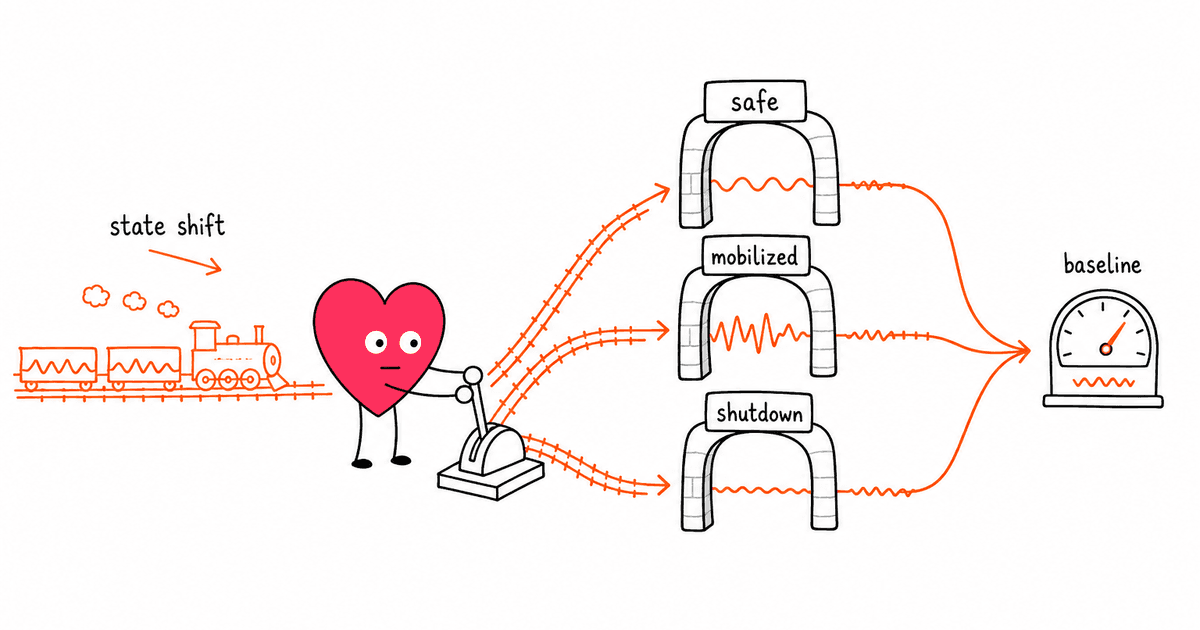
Developed by neuroscientist Dr. Stephen Porges in the 1990s, polyvagal theory describes how your autonomic nervous system operates through three distinct states, each with measurable effects on your heart rate variability. Understanding these states can transform how you interpret your HRV data and respond to it.
What Is Polyvagal Theory?
Polyvagal theory is a neurophysiological framework that describes three hierarchical states of the autonomic nervous system, each governed by different branches of the vagus nerve. Unlike the traditional two-part model (sympathetic vs. parasympathetic), polyvagal theory splits the parasympathetic system into two separate circuits with very different functions.
The word "polyvagal" literally means "many vagus," referring to the multiple pathways of the vagus nerve, the longest cranial nerve in the body. This nerve connects your brainstem to your heart, lungs, gut, and other organs, serving as the primary communication highway between your brain and body.
The Three Autonomic States
Polyvagal theory identifies three states that your nervous system cycles through. Each state produces distinct HRV patterns that modern wearables can detect.
Ventral Vagal State (Safety and Connection)
The ventral vagal state is your optimal operating mode. When you feel safe and socially connected, the ventral branch of the vagus nerve is active. In this state, your heart rate is calm but flexible, breathing is rhythmic, and your body is primed for social engagement.
HRV is typically highest in the ventral vagal state. The myelinated ventral vagal pathway acts as a "vagal brake" on the heart, creating the beat-to-beat variability that shows up as high RMSSD and HF power on your tracker.
Sympathetic State (Fight or Flight)
When your nervous system detects a threat, it shifts into sympathetic activation. Heart rate increases, breathing becomes shallow, and your body prepares for action. This is the classic fight-or-flight response.
HRV drops during sympathetic activation because the vagal brake releases, allowing the heart to beat faster and more uniformly. If you've ever seen your HRV plummet during a high-pressure presentation or argument, you were likely in this state.
Dorsal Vagal State (Shutdown)
The dorsal vagal state represents the oldest evolutionary response: immobilization. When the nervous system perceives an overwhelming, inescapable threat, the unmyelinated dorsal branch of the vagus nerve triggers a shutdown response. This can manifest as numbness, dissociation, fatigue, or collapse.
HRV in the dorsal vagal state can appear paradoxically variable. Heart rate may slow dramatically, and some HRV metrics may appear elevated due to the slowing, even though this is not a healthy state. This distinction is important for interpreting HRV data accurately.
Why Polyvagal Theory Matters for HRV Tracking
Traditional HRV interpretation often boils down to "higher is better." Polyvagal theory adds crucial nuance to this picture.
Context Changes Everything
A high RMSSD reading during a relaxed evening with friends (ventral vagal) means something very different from a high reading during a freeze response (dorsal vagal). Similarly, a temporary HRV dip during an intense workout (healthy sympathetic activation) is not the same as a chronic dip from ongoing stress.
Chronic States Affect Baseline HRV
People who spend most of their time in sympathetic activation, due to chronic stress, unresolved trauma, or an overloaded schedule, tend to have consistently lower HRV baselines. A 2024 study published in Psychophysiology found that individuals with higher trait anxiety showed reduced vagal tone and lower resting HRV compared to controls.
Your Nervous System Has a Default
Everyone has a "home base" state where their nervous system tends to rest. For some, it's ventral vagal (calm and engaged). For others, chronic stress has shifted the default toward sympathetic hypervigilance. Your HRV trends over weeks and months can reveal which state your nervous system favors.
How the Vagus Nerve Influences HRV
The vagus nerve is the primary driver of HRV. Understanding its two branches helps explain why HRV patterns vary so widely between individuals.
The Ventral Vagal Pathway
The ventral (front) branch of the vagus nerve is myelinated, meaning it's wrapped in a fatty sheath that allows rapid signal transmission. This pathway evolved more recently in mammals and is associated with social engagement, facial expression, and vocal communication.
When the ventral vagal pathway is active, it modulates heart rate on a beat-by-beat basis. This creates the rhythmic variability measured by time-domain metrics like RMSSD and frequency-domain metrics like HF power.
The Dorsal Vagal Pathway
The dorsal (back) branch is unmyelinated and much older evolutionarily. It's shared with reptiles and serves as a last-resort defense mechanism. When activated strongly, it can cause dramatic slowing of the heart, drops in blood pressure, and the "freeze" or "faint" response.
Vagal Tone as a Measure of Resilience
High vagal tone, the ability of the ventral vagal pathway to efficiently regulate the heart, is one of the best indicators of autonomic resilience. Research published in Frontiers in Behavioral Neuroscience in 2025 confirmed that vagal tone, measured through respiratory sinus arrhythmia (RSA), correlates strongly with emotional regulation capacity and stress recovery speed.
HRV Metrics Through a Polyvagal Lens
Here's how common HRV metrics map to polyvagal states:
| Metric | Ventral Vagal (Safe) | Sympathetic (Threat) | Dorsal Vagal (Shutdown) |
|---|---|---|---|
| RMSSD | High (healthy range) | Low | Variable |
| HF Power | Elevated | Suppressed | May appear elevated |
| LF/HF Ratio | Balanced | High | Variable |
| Resting HR | Low-normal | Elevated | Very low |
| HRV Trend | Stable, consistent | Declining | Erratic |
This table is a simplified guide. Real-world HRV data involves many overlapping factors, but polyvagal theory provides a useful interpretive framework.
Practical Ways to Shift Toward the Ventral Vagal State
The goal of understanding polyvagal theory isn't just intellectual. It's about learning to actively support your nervous system's return to safety.
Slow, Extended Exhale Breathing
Breathing with a longer exhale than inhale directly stimulates the ventral vagal pathway. Try inhaling for 4 counts and exhaling for 6-8 counts. Even 2-3 minutes of this pattern can measurably increase HRV. For a deeper dive, see our guide on breathing exercises and HRV.
Social Connection
The ventral vagal system is fundamentally a social engagement system. Face-to-face conversations, laughter, and physical touch (like hugging) activate this pathway. Research shows that positive social interactions are associated with higher HRV, as covered in our post on social connection and HRV.
Humming, Singing, and Chanting
The vagus nerve innervates the muscles of the throat and larynx. Humming, singing, and chanting create vibrations that directly stimulate vagal fibers. This is one reason why choral singing and mantra meditation have such profound calming effects.
Cold Water Face Immersion
Briefly immersing your face in cold water triggers the mammalian dive reflex, a powerful vagal activation response. This technique can rapidly shift the nervous system from sympathetic back to ventral vagal. Learn more in our guide to cold exposure and HRV.
Gentle Movement
Yoga, tai chi, and slow walking activate the ventral vagal state through rhythmic, predictable movement patterns. These activities combine breathing, body awareness, and gentle physical engagement, all of which support vagal tone. Dancing is another powerful option, as it combines rhythmic movement with social connection and emotional expression, activating the ventral vagal system through multiple pathways simultaneously. For more, check out our posts on yoga and HRV and tai chi and HRV.
Using Your HRV Tracker to Monitor Nervous System States
Modern wearables like the Oura Ring 4, Whoop 5, and Apple Watch track HRV continuously, giving you real-time data on your autonomic state.
What to Look For
Track your HRV alongside daily notes about your emotional state and activities. Over time, patterns emerge. You might notice that your HRV is highest on days with strong social connections and lowest during weeks of isolation or conflict.
Morning Readiness Scores
Most wearables calculate a morning readiness or recovery score based partly on overnight HRV. This score reflects how much time your nervous system spent in ventral vagal (restorative) mode during sleep versus sympathetic activation.
Trend Analysis Over Weeks
Single-day HRV readings are less meaningful than trends. A gradually declining HRV baseline over several weeks may indicate that your nervous system is spending more time in sympathetic or dorsal vagal states, a signal to prioritize recovery and safety-promoting activities.
Polyvagal Theory and Mental Health
The connection between polyvagal theory and mental health has significant implications for HRV tracking.
Anxiety and the Sympathetic State
Chronic anxiety often reflects a nervous system stuck in sympathetic activation. Research consistently shows that anxiety disorders are associated with lower resting HRV. Our article on HRV and anxiety covers this relationship in detail.
Depression and the Dorsal Vagal State
Depression may involve a dominant dorsal vagal state, characterized by low energy, withdrawal, and emotional numbness. Our article on HRV and depression explores this further. A 2023 meta-analysis in JAMA Psychiatry found that individuals with major depressive disorder had significantly lower HRV than healthy controls, suggesting impaired vagal regulation.
ADHD and Autonomic Dysregulation
ADHD provides another lens on polyvagal dysfunction. Research shows that people with ADHD have reduced vagal tone and difficulty maintaining ventral vagal engagement, contributing to challenges with sustained attention and emotional regulation. The same prefrontal cortex that governs vagal braking is hypoactive in ADHD, linking the attention and autonomic deficits through a shared mechanism.
When autonomic regulation breaks down more broadly, the result is dysautonomia, a group of conditions including POTS and orthostatic hypotension where the nervous system fails to properly coordinate involuntary functions. HRV is one of the most accessible tools for identifying and tracking these conditions.
Trauma and Nervous System Flexibility
Trauma can reduce the nervous system's ability to flexibly move between states. People with PTSD often oscillate between sympathetic hyperarousal and dorsal vagal shutdown, with limited access to the ventral vagal state. HRV biofeedback training has shown promise in helping restore this flexibility.
Criticisms and Limitations
While polyvagal theory offers a useful framework, it's worth noting some scientific debates. Some researchers have challenged specific neuroanatomical claims, arguing that the distinction between myelinated and unmyelinated vagal fibers is more complex than the theory suggests. Others point out that autonomic states exist on a continuum rather than as three discrete categories.
That said, the core insight, that the vagus nerve plays a central role in emotional regulation and that HRV reflects this regulation, is well supported by decades of research. For practical HRV tracking, polyvagal theory remains a valuable interpretive tool.
Key Takeaways
Polyvagal theory provides a richer framework for understanding HRV than the simple "higher is better" approach. By recognizing your nervous system's three states, ventral vagal (safety), sympathetic (fight or flight), and dorsal vagal (shutdown), you can better interpret what your HRV data is telling you and take targeted steps to support your autonomic health.
The practical applications are straightforward: prioritize activities that activate the ventral vagal pathway (slow breathing, social connection, gentle movement), track your HRV trends for nervous system patterns, and use your data to build greater autonomic resilience over time.
Frequently Asked Questions
What is the difference between polyvagal theory and traditional autonomic nervous system models?
Traditional models describe two branches: sympathetic (fight or flight) and parasympathetic (rest and digest). Polyvagal theory adds a third distinction by splitting the parasympathetic system into ventral vagal (social engagement) and dorsal vagal (shutdown), providing a more nuanced understanding of how the nervous system affects HRV.
Can I tell which polyvagal state I'm in from my HRV data alone?
HRV data provides clues but not definitive answers. High HRV with a stable trend generally suggests ventral vagal activation, while low HRV with elevated resting heart rate points to sympathetic dominance. However, context matters: how you feel emotionally and physically is an important complement to the numbers.
How long does it take to improve vagal tone?
Consistent practices like slow breathing, meditation, and exercise can improve vagal tone within 4-12 weeks. A 2024 review found that HRV biofeedback training produced measurable improvements in vagal tone after 6-10 sessions. For a more direct approach, vagus nerve stimulation devices use mild electrical pulses to activate vagal pathways non-invasively. The key is regular practice rather than occasional effort.
Is polyvagal theory scientifically proven?
Polyvagal theory is widely used in clinical psychology and neuroscience, though some specific claims remain debated. The core principles, that the vagus nerve has distinct branches with different functions and that vagal tone influences emotional regulation, are supported by substantial research. As with any evolving theory, some details continue to be refined.
Need a quick read on your HRV number first?
Enter your HRV value, age range, device, and recovery context for a plain-English interpretation before you decide what to do next.
Interpret Your HRV NumberBuild the 30-day plan