HRV and Anxiety: What Your Heart Rate Variability Reveals About Your Mental Health
Trying to decode today's HRV number? Use the free interpreter first, then build a practical recovery plan. Interpret your HRV
Are Anxiety and HRV Connected?
Yes, anxiety disorders are consistently associated with lower heart rate variability. Multiple meta-analyses confirm that people with generalized anxiety disorder (GAD), panic disorder, and social anxiety have reduced HRV compared to healthy controls. This reflects an autonomic nervous system stuck in "fight or flight" mode, with diminished parasympathetic activity. The good news: HRV is trainable, and improving it may help reduce anxiety symptoms.
If you've ever felt your heart racing during an anxious moment, you've experienced the connection between your mental state and your cardiovascular system firsthand. What you may not realize is that this connection works both ways, and your HRV data can reveal it.
For the millions of people living with anxiety, HRV monitoring offers something powerful: objective insight into your nervous system's state, and a way to track whether your interventions are working.
The Science: Why Anxiety Lowers HRV
The Autonomic Imbalance
Your autonomic nervous system has two branches:
- Sympathetic: The "fight or flight" system that activates during stress
- Parasympathetic: The "rest and digest" system that promotes calm and recovery
Heart rate variability reflects the balance between these two systems. Higher HRV indicates strong parasympathetic activity and autonomic flexibility. Lower HRV suggests sympathetic dominance and reduced adaptability.
In anxiety disorders, this balance is disrupted. The sympathetic system stays chronically activated, keeping the body in a state of vigilance even when there's no real threat. This persistent "alert mode" suppresses HRV.
What the Research Shows
The evidence is substantial and consistent:
2014 Meta-Analysis (Frontiers in Psychiatry): Analyzed 36 studies and found that anxiety disorders are associated with reduced HRV, with a small-to-moderate effect size. The researchers noted this has "important implications for future physical health and well-being."
2023 Network Meta-Analysis (Journal of Affective Disorders): Compared HRV across major depressive disorder, generalized anxiety disorder, and panic disorder. All three conditions showed lower HRV than healthy controls. For more on the depression connection, see our guide on HRV and depression.
2024 Systematic Review (Psychophysiology): Evaluated HRV as a potential biomarker for anxiety disorders. Found that patients with social anxiety disorder had a greater LF/HF ratio (indicating sympathetic hyperactivity) compared to controls, especially under social stress.
2025 Umbrella Review (Translational Psychiatry): The most comprehensive analysis to date, examining multiple meta-analyses. Confirmed that "no two diseases exhibited identical altered HRV patterns," suggesting HRV profiles could help distinguish between different mental health conditions. This includes conditions like PTSD and burnout, each showing unique HRV signatures.
Anxiety also deserves extra context in neurodevelopmental conditions. Our autism and HRV guide explains how anxiety, sensory overload, and social masking can shape recovery patterns.
Which HRV Metrics Matter for Anxiety?
Research has identified several HRV markers associated with anxiety:
- RMSSD: Often lower in anxious individuals (reflects parasympathetic activity)
- SDNN: Reduced in anxiety disorders (overall HRV variability)
- HF (High Frequency) Power: Chronically low in anxiety (parasympathetic marker)
- LF/HF Ratio: Often elevated in anxiety (suggests sympathetic dominance)
When tracking your own HRV, focus on trends in RMSSD and overall variability rather than single readings. Our guide to understanding HRV numbers explains these metrics in detail.
How Anxiety Affects Your HRV Day-to-Day
The Chronic Pattern
People with anxiety often show:
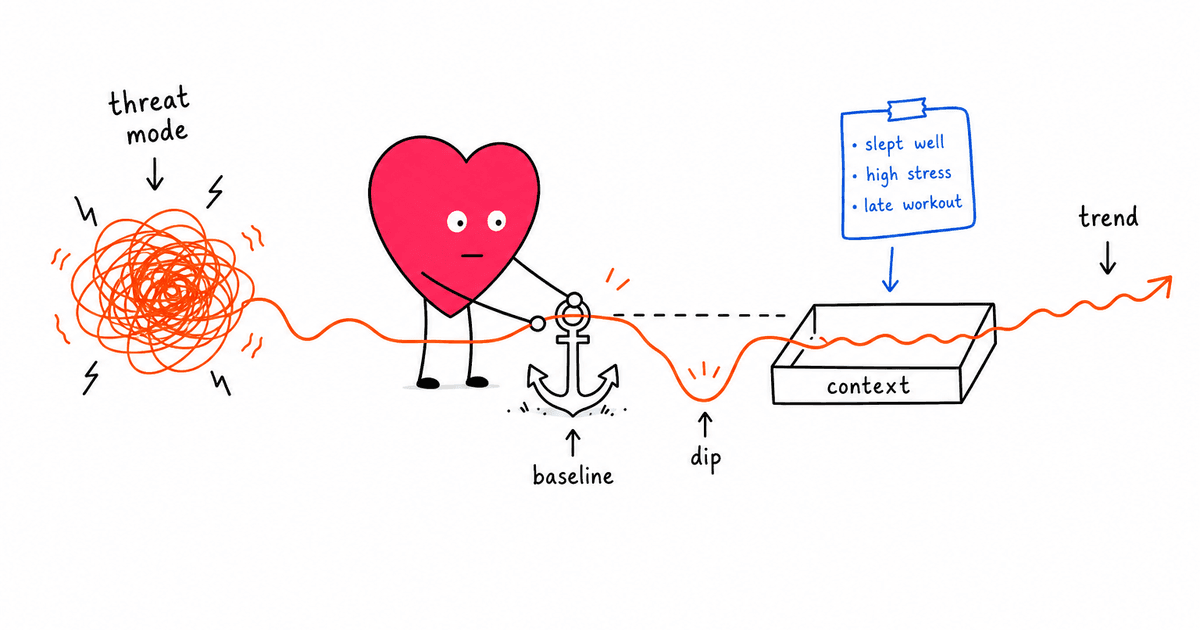
- Lower baseline HRV: Even on "good" days
- Exaggerated stress response: Bigger HRV drops during stressful events
- Slower recovery: Takes longer for HRV to return to baseline after stress
- Less variability: HRV stays flat rather than fluctuating naturally
The Vicious Cycle
Low HRV and anxiety create a feedback loop:
- Anxiety activates the sympathetic nervous system
- Chronic sympathetic activation lowers HRV
- Low HRV reduces stress resilience
- Reduced resilience makes anxiety worse
- Cycle repeats
This is why addressing HRV directly (not just anxiety symptoms) can be powerful. Breaking the cycle at the physiological level can complement traditional mental health approaches.
What You Might Notice
If you track HRV while managing anxiety, you may observe:
- Lower morning readings on days after anxious evenings
- Sudden drops during anticipatory anxiety (before stressful events)
- Slow recovery after anxiety triggers or major life stressors like grief
- Improved readings on days when anxiety is well-managed
These patterns provide valuable feedback that subjective feelings alone can't offer.
Using HRV Tracking to Understand Your Anxiety
Why Track HRV for Anxiety?
HRV monitoring offers several benefits for anxiety management:
Objective measurement: Anxiety can distort self-perception. You might feel fine when your nervous system is actually stressed, or feel terrible when you're physiologically okay. HRV provides ground truth.
Early warning: HRV often drops before you consciously feel anxious. Tracking can help you intervene earlier.
Feedback on interventions: Does meditation help? Does exercise make a difference? Your HRV data can answer these questions objectively.
Motivation: Seeing improvement in your numbers can reinforce healthy behaviors and provide hope during difficult periods.
Important caveat: While HRV tracking can be a powerful ally in managing anxiety, it is possible for tracking itself to become a source of stress. If you find yourself obsessing over daily scores or feeling worse after checking your data, read our guide on HRV tracking anxiety and orthosomnia for strategies to build a healthier relationship with your wearable data.
Choosing a Tracking Device
For anxiety management, continuous or daily HRV tracking is most useful:
- Oura Ring: Tracks HRV overnight and provides morning readiness scores. Unobtrusive for daily wear.
- Whoop: Continuous monitoring with stress scores and recovery metrics. Shows how daily activities affect your nervous system.
- Apple Watch: Tracks HRV throughout the day and night with the native Health app.
- Garmin watches: Offer Body Battery and HRV status for daily monitoring.
For active HRV biofeedback training (more on this below), a chest strap like the Polar H10 paired with a biofeedback app provides the most accurate real-time data. See our best HRV monitors guide for a full comparison.
Establishing Your Baseline
Before drawing conclusions, track consistently for 2-4 weeks:
- Measure at the same time daily (morning is most consistent)
- Note your subjective anxiety level alongside HRV readings
- Record sleep, exercise, alcohol, and other variables
- Look for patterns, not individual readings
Your personal baseline matters more than population averages. HRV also varies significantly by age, so someone with naturally lower HRV might function fine at 30ms RMSSD, while someone else might feel anxious at 50ms if their baseline is usually 70ms.
Evidence-Based Strategies to Improve HRV and Reduce Anxiety
HRV Biofeedback Training
HRV biofeedback is the most direct intervention for improving HRV in anxiety. It involves:
- Monitoring your HRV in real-time
- Using slow, paced breathing to increase HRV
- Receiving visual or auditory feedback as you practice
- Building the skill of voluntary nervous system regulation
Research supports its effectiveness:
- A study in Applied Psychophysiology and Biofeedback found HRV biofeedback significantly reduced anxiety symptoms in participants with generalized anxiety
- Meta-analyses show HRV biofeedback improves both HRV metrics and self-reported anxiety
- Benefits persist after training ends, suggesting lasting nervous system changes
For a deeper dive, see our guide on HRV biofeedback training.
Breathing Exercises
Controlled breathing is the most accessible way to acutely increase HRV and activate parasympathetic activity. Key techniques:
Resonance breathing (most researched for HRV):
- Breathe at approximately 6 breaths per minute
- 5 seconds inhale, 5 seconds exhale
- Practice for 10-20 minutes daily
Extended exhale breathing:
- Make your exhale longer than your inhale
- Example: 4 seconds in, 6-8 seconds out
- Stimulates the vagus nerve
Box breathing:
- 4 seconds inhale, 4 seconds hold, 4 seconds exhale, 4 seconds hold
- Popular for acute anxiety relief
See our complete guide: Breathing Exercises to Improve Your HRV.
Regular Exercise
Physical activity is one of the most reliable ways to improve both HRV and anxiety:
- Aerobic exercise: 150+ minutes weekly of moderate activity improves resting HRV. Even daily walking makes a measurable difference
- Zone 2 training: Low-intensity steady-state cardio is particularly effective
- Consistency matters: Regular moderate exercise beats occasional intense workouts. Activities like yoga combine physical movement with mindfulness for dual benefits
Research shows exercise reduces anxiety symptoms while simultaneously improving autonomic function. The benefits compound over time.
Sleep Optimization
Poor sleep both worsens anxiety and lowers HRV. Prioritize:
- Consistent sleep schedule (same bedtime and wake time)
- 7-9 hours of sleep opportunity
- Cool, dark sleep environment
- Limited screens 1-2 hours before bed
Monitor your overnight HRV to see how sleep quality affects your nervous system. For more, see HRV and Sleep: What Your Data Reveals.
Meditation and Mindfulness
Regular mindfulness practice improves HRV and reduces anxiety through multiple pathways:
- Activates parasympathetic response during practice
- Builds awareness of stress triggers
- Reduces rumination and worry
- Improves emotional regulation
Even 10 minutes daily shows benefits. Apps like Headspace, Calm, or Insight Timer can help establish a practice.
For more on this connection, see Meditation and HRV: The Science of Mindfulness.
Vagal Nerve Stimulation Techniques
The vagus nerve is the primary pathway for parasympathetic activity. Stimulating it can acutely increase HRV:
- Cold water on face: Triggers the dive reflex and vagal activation. This relates to the broader polyvagal theory framework
- Gargling, singing, or humming: Activates vagal motor fibers in the throat
- Gentle massage: Carotid sinus massage (with caution and guidance)
These techniques can provide quick relief during acute anxiety while you build longer-term HRV through other practices.
Cold and Heat Exposure
Both cold exposure and sauna can improve HRV through controlled stress and parasympathetic rebound. Start gently and progress gradually.
What Improvement Looks Like
As you implement these strategies, watch for:
Short-Term (Days to Weeks)
- Acute HRV increases after breathing exercises and meditation
- Better recovery from stressful events
- Fewer dramatic HRV drops during anxious moments
Medium-Term (Weeks to Months)
- Rising baseline HRV (your 7-day or 30-day average)
- Greater day-to-day variability (a sign of autonomic flexibility)
- Improved subjective sense of calm
Long-Term (Months to Years)
- Sustainably higher HRV baseline
- Reduced frequency and intensity of anxiety episodes
- Better overall stress resilience
Progress isn't linear. You'll have setbacks. What matters is the trend over time.
HRV Tracking as Part of Anxiety Treatment
Complementing Therapy
HRV monitoring doesn't replace professional mental health treatment. Instead, it complements it by:
- Providing objective data to discuss with your therapist
- Tracking the physiological effects of therapy
- Identifying triggers that might be worth exploring
- Reinforcing progress when subjective feelings lag behind
If you're working with a therapist, consider sharing your HRV trends. Many clinicians find this data valuable for treatment planning.
Working with Medication
If you take medication for anxiety, HRV tracking can help you understand its effects:
- Some medications may improve HRV as anxiety decreases
- SSRIs and other antidepressants can have mixed HRV effects depending on medication class, dose, sleep, and symptom changes
- Beta-blockers can affect HRV readings directly
- Track before and after medication changes to see physiological effects
Always discuss medication questions with your prescribing provider.
When to Seek Help
HRV tracking is a tool, not a treatment. Seek professional support if:
- Anxiety significantly impairs daily functioning
- You experience panic attacks
- You have thoughts of self-harm
- Your HRV remains chronically suppressed despite interventions
- You need guidance creating a comprehensive treatment plan
The Bottom Line
The connection between HRV and anxiety is well-established: anxiety disorders are associated with chronically low heart rate variability, reflecting an autonomic nervous system stuck in stress mode. But this isn't a one-way street.
By improving your HRV through biofeedback, breathing exercises, exercise, sleep, and mindfulness, you can directly influence your nervous system and potentially reduce anxiety symptoms. Your HRV data provides objective feedback on what's working.
Key takeaways:
- Anxiety lowers HRV through chronic sympathetic activation
- Low HRV reduces resilience, creating a vicious cycle
- HRV is trainable through specific interventions
- Tracking provides feedback that subjective feelings can't offer
- Improvement takes time but is achievable
Your heart rate variability isn't just a number. It's a window into your nervous system's state, and a lever you can pull to support your mental health.
Related Reading
- HRV Tracking Anxiety and Orthosomnia: When Wearable Data Does More Harm Than Good
- HRV and Stress Management: The Complete Guide
- HRV Biofeedback Training: A Complete Guide
- 5 Breathing Exercises to Improve Your HRV
- Meditation and HRV: The Science of Mindfulness
- How to Improve Your HRV: Evidence-Based Strategies
Need a quick read on your HRV number first?
Enter your HRV value, age range, device, and recovery context for a plain-English interpretation before you decide what to do next.
Interpret Your HRV NumberBuild the 30-day plan