HRV Biofeedback Training: How to Raise Your HRV in Minutes
Trying to decode today's HRV number? Use the free interpreter first, then build a practical recovery plan. Interpret your HRV
Most HRV tracking is passive. You wear a device, check your numbers in the morning, and hope they improve over time. But what if you could actively train your HRV in real-time, watching it respond to your breath and learning to control your autonomic nervous system?
That's exactly what HRV biofeedback training offers. It's one of the most powerful, research-backed techniques for improving HRV, reducing stress, and strengthening your parasympathetic nervous system. And the best part? You can do it at home with just a smartphone and a heart rate sensor.
What Is HRV Biofeedback Training?
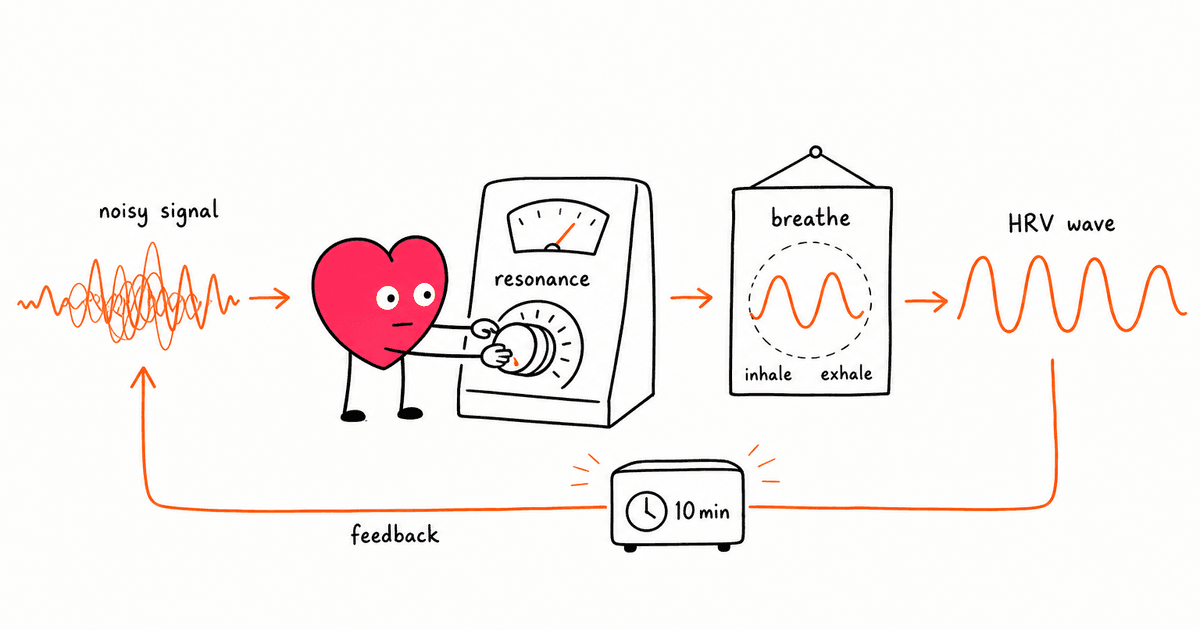
HRV biofeedback is a technique where you receive real-time feedback on your heart rate variability while practicing controlled breathing exercises. By watching your HRV respond to each breath, you learn to optimize your breathing pattern and activate your parasympathetic nervous system on demand.
The core principle is simple: when you breathe at a specific rate, your heart rate naturally rises on the inhale and falls on the exhale. This phenomenon, called respiratory sinus arrhythmia (RSA), becomes most pronounced at your personal "resonance frequency," a breathing rate that maximizes this natural variation.
For most adults, the resonance frequency falls between 4.5 and 6.5 breaths per minute. Children typically have a higher resonance frequency, ranging from 6.5 to 9.5 breaths per minute.
When you breathe at your resonance frequency:
- Your HRV amplitude increases dramatically
- Your heart rate and breathing become synchronized
- Your baroreflex (blood pressure regulation system) is stimulated
- Your parasympathetic nervous system becomes more active
With regular practice, these acute effects lead to lasting improvements in baseline HRV and stress resilience.
The Science Behind HRV Biofeedback
Research-Backed Benefits
The evidence for HRV biofeedback is substantial. A 2023 systematic review in the journal Applied Psychophysiology and Biofeedback found that HRV biofeedback training produces:
- Significant increases in resting HRV (particularly RMSSD and HF power)
- Reduced symptoms of anxiety and depression
- Improved cognitive performance
- Better stress recovery
- Enhanced athletic performance
A randomized controlled study published in JMIR Mental Health found that participants using a smartphone biofeedback app showed measurable improvements in physiological stress recovery after just brief training sessions.
Research from multiple institutions has documented:
- 25% improvement in cognitive performance
- 2 to 3 times improvement in HRV metrics
- 40 to 50% reductions in stress and anxiety levels
How It Works Physiologically
When you breathe slowly at your resonance frequency, several mechanisms kick in:
-
Baroreflex stimulation: The oscillations in blood pressure activate your baroreflex, which strengthens the communication between your heart and brain.
-
Vagal tone enhancement: Slow breathing activates the vagus nerve, the main driver of parasympathetic activity, increasing its tone over time. This mechanism is central to polyvagal theory.
-
RSA amplification: Breathing at resonance maximizes the natural heart rate fluctuations that indicate a healthy, adaptable cardiovascular system.
-
Autonomic balance restoration: Regular practice shifts the balance from sympathetic (stress) dominance toward parasympathetic (recovery) dominance.
The key insight is that this isn't just relaxation. You're actually training your nervous system to become more flexible and responsive, much like strength training for your autonomic nervous system.
Finding Your Resonance Frequency
While most people's resonance frequency falls around 6 breaths per minute, individual variation means you'll get better results by finding your personal sweet spot.
The Assessment Process
-
Start with a baseline: Measure your HRV while breathing normally for 2 minutes
-
Test different rates: Breathe at each rate for 2 to 3 minutes while monitoring HRV:
- 6.5 breaths per minute
- 6.0 breaths per minute
- 5.5 breaths per minute
- 5.0 breaths per minute
- 4.5 breaths per minute
-
Identify your peak: Your resonance frequency is the rate that produces the highest HRV amplitude (largest oscillations in heart rate)
-
Confirm with repetition: Test your suspected resonance frequency on multiple days to confirm consistency
Many HRV biofeedback apps include built-in resonance frequency assessments that automate this process.
Signs You've Found Your Resonance Frequency
- Heart rate clearly rises and falls with each breath cycle
- HRV amplitude reaches its maximum
- You feel a sense of calm alertness
- Breathing feels natural and effortless, not forced
How to Practice HRV Biofeedback
Basic Protocol
- Find a quiet space where you won't be interrupted
- Sit comfortably with good posture (or lie down)
- Apply your heart rate sensor (chest strap or finger sensor)
- Open your biofeedback app and start the session
- Follow the breathing pacer at your resonance frequency
- Watch your HRV feedback and try to maximize the oscillations
- Practice for 10 to 20 minutes per session
Breathing Technique Tips
Breathe through your nose when possible, as nasal breathing activates the parasympathetic system more effectively than mouth breathing.
Use diaphragmatic breathing: Let your belly expand on the inhale rather than lifting your chest. Place a hand on your stomach to feel it rise and fall.
Keep it smooth: Avoid holding your breath at the top or bottom. Aim for continuous, wave-like breathing.
Don't force it: If a breathing rate feels uncomfortable, try a slightly faster rate. Discomfort creates tension that defeats the purpose.
Equal inhale and exhale: Start with equal durations (e.g., 5 seconds in, 5 seconds out for 6 breaths per minute). Some people later find slight variations work better.
Recommended Practice Schedule
Week 1 to 2: Practice 10 minutes daily to learn the technique and find your resonance frequency.
Week 3 to 4: Increase to 15 to 20 minutes daily. You should notice improvements in your acute HRV response.
Week 5+: Maintain with 10 to 20 minutes daily or at least 3 to 4 times per week. Benefits compound with consistent practice.
Research suggests that meaningful baseline HRV improvements typically appear after 4 to 6 weeks of regular practice.
Best HRV Biofeedback Apps
Several apps provide quality HRV biofeedback training. Here are the top options:
HRV4Biofeedback
Developed by Marco Altini, a respected researcher in the HRV field, HRV4Biofeedback uses your phone's camera to measure HRV without additional hardware. It provides real-time feedback during breathing exercises and tracks your progress over time.
Best for: Those who want a scientifically-grounded approach without extra hardware Platform: iOS
Elite HRV
Elite HRV offers both morning readiness measurements and biofeedback training sessions. The app works with most Bluetooth heart rate monitors and provides detailed analytics.
Best for: Athletes who want combined tracking and training Platform: iOS and Android
HeartMath Inner Balance
HeartMath has been researching HRV biofeedback for decades. Their Inner Balance app, paired with their proprietary ear sensor, provides "coherence" training that focuses on achieving a smooth, sine-wave-like HRV pattern.
Best for: Those who want an all-in-one hardware and software solution Platform: iOS and Android
Optimal HRV
Designed for both personal use and clinical applications, Optimal HRV offers comprehensive biofeedback training modules and works with their dedicated monitor or standard chest straps.
Best for: Those wanting detailed analysis and professional-grade features Platform: iOS and Android
Best Devices for HRV Biofeedback
Dedicated Biofeedback Sensors
HeartMath Inner Balance sensor: A clip-on ear sensor designed specifically for HRV biofeedback. Convenient and reasonably accurate for biofeedback purposes.
Optimal HRV Monitor: A dedicated fingertip sensor optimized for HRV biofeedback training.
Chest Strap Heart Rate Monitors
For the most accurate HRV biofeedback, chest straps remain the gold standard:
Garmin HRM-600: Excellent accuracy with Bluetooth connectivity for biofeedback apps. Also doubles as a running dynamics sensor.
Polar H10: Widely regarded as the most accurate consumer heart rate monitor. Works with virtually all HRV apps.
Wearables with Biofeedback Features
Some wearables include built-in breathing exercises with HRV feedback:
Garmin Forerunner 265: Includes breathing exercises and HRV status tracking, though real-time biofeedback is limited compared to dedicated apps.
Apple Watch Series 11: The Breathe app provides basic guided breathing, though dedicated biofeedback apps with an external sensor will provide better training.
Oura Ring 4: Offers breathing exercises but is better suited for overnight HRV tracking than real-time biofeedback training.
For serious biofeedback training, we recommend using a chest strap paired with a dedicated biofeedback app rather than relying solely on wrist-based sensors.
HRV Biofeedback for Specific Goals
Stress Management
If your primary goal is reducing stress and anxiety:
- Practice during or after stressful situations
- Use brief "mini sessions" (2 to 5 minutes) throughout the day
- Focus on achieving a calm, coherent state rather than maximum HRV amplitude
- Consider tracking subjective stress levels alongside HRV data
Athletic Performance
For athletes looking to optimize recovery and performance (including those doing altitude training):
- Practice in the evening to enhance overnight recovery
- Use biofeedback as part of your warm-up to achieve optimal readiness
- Practice post-workout to accelerate recovery
- Track correlations between biofeedback consistency and training adaptation
Sleep Improvement
To improve sleep quality:
- Practice 10 to 20 minutes before bed
- Keep lighting dim during evening sessions
- Focus on activating your parasympathetic system to prepare for sleep
- Avoid looking at detailed metrics (stimulating), just follow the breathing guide
Cognitive Performance
For mental clarity and focus:
- Practice in the morning to start the day in a balanced state
- Use brief sessions before important meetings or tasks
- Focus on achieving "coherence" (smooth, consistent HRV waves)
- Practice regularly, as cognitive benefits compound over time
Early research also suggests HRV biofeedback may benefit people with ADHD, where autonomic dysregulation contributes to attention and impulse control difficulties.
Common Mistakes and How to Avoid Them
Trying to Force It
Many beginners try too hard, tensing muscles and forcing deep breaths. This activates your sympathetic nervous system, the opposite of what you want. Keep breathing gentle and relaxed.
Inconsistent Practice
Biofeedback benefits require consistent practice. Sporadic sessions won't produce lasting changes. Commit to daily practice for at least 4 to 6 weeks before evaluating results.
Wrong Breathing Rate
Using a generic 6 breaths per minute without finding your personal resonance frequency leaves benefits on the table. Take time to assess your individual optimal rate.
Poor Sensor Placement
Inaccurate readings lead to misleading feedback. Ensure chest straps are positioned correctly (just below the chest muscles) and that sensors have good contact.
Expecting Immediate Results
Some people feel benefits immediately; others need weeks of practice. Baseline HRV improvements typically take 4 to 6 weeks to appear. Be patient and trust the process.
Measuring Your Progress
Track these metrics to monitor your biofeedback training progress:
During Sessions
- Peak HRV amplitude: Should increase as your technique improves
- Coherence score: If your app provides this, aim for higher scores over time
- Subjective ease: Breathing at resonance should feel more natural with practice
Baseline Changes
- Morning HRV: Compare 7-day averages before and after starting biofeedback
- Resting heart rate: Should gradually decrease as parasympathetic tone improves
- HRV recovery time: Track how quickly HRV returns to normal after stress
Subjective Measures
- Perceived stress levels: Rate daily on a 1 to 10 scale
- Sleep quality: Note any improvements in falling asleep or sleep depth
- Energy levels: Track changes in daily energy and fatigue
Integrating Biofeedback with Other HRV Practices
HRV biofeedback works synergistically with other HRV-improving practices:
Morning HRV tracking: Measure your morning HRV to assess baseline changes from biofeedback practice.
Breathing exercises: Biofeedback provides feedback on techniques you can then practice without a device.
Meditation: Combine biofeedback with meditation for enhanced benefits. Many find biofeedback helps them achieve meditative states more quickly.
Cold exposure: Use biofeedback to practice maintaining parasympathetic activation during mild cold exposure.
Sleep optimization: Evening biofeedback practice complements good sleep hygiene for better overnight recovery.
Vagus nerve stimulation: Some practitioners combine HRV biofeedback with transcutaneous vagus nerve stimulation (tVNS) devices for a dual approach to vagal tone enhancement.
The Bottom Line
HRV biofeedback training is one of the most direct, effective ways to improve your heart rate variability and build stress resilience. Unlike passive tracking, biofeedback lets you actively train your autonomic nervous system, creating lasting improvements in how your body handles stress.
The research is clear: consistent biofeedback practice improves baseline HRV, reduces anxiety and depression symptoms, enhances cognitive performance, and helps you recover faster from stress.
Start with a simple setup: a chest strap heart rate monitor and a biofeedback app. Find your resonance frequency, commit to 10 to 20 minutes of daily practice, and give it 4 to 6 weeks. The investment in time and equipment is minimal compared to the potential benefits for your health, performance, and well-being.
Your nervous system is trainable. HRV biofeedback is how you train it.
Related Articles
- Breathing Exercises to Improve HRV
- Meditation and HRV: The Mind-Body Connection
- How to Improve Your HRV: 10 Evidence-Based Strategies
- Best HRV Monitors in 2026
Need a quick read on your HRV number first?
Enter your HRV value, age range, device, and recovery context for a plain-English interpretation before you decide what to do next.
Interpret Your HRV NumberBuild the 30-day plan