What Is HRV? Understanding Heart Rate Variability
Trying to decode today's HRV number? Use the free interpreter first, then build a practical recovery plan. Interpret your HRV
If you've ever looked at a fitness tracker or heard someone mention "HRV," you might have wondered what all the fuss is about. Heart rate variability sounds complicated, but it's actually one of the most intuitive health metrics once you understand what it's measuring.
In this guide, we'll break down everything you need to know about HRV, no medical degree required. If you want the shortest plain-English version first, read HRV explained for dummies.
What Is Heart Rate Variability?
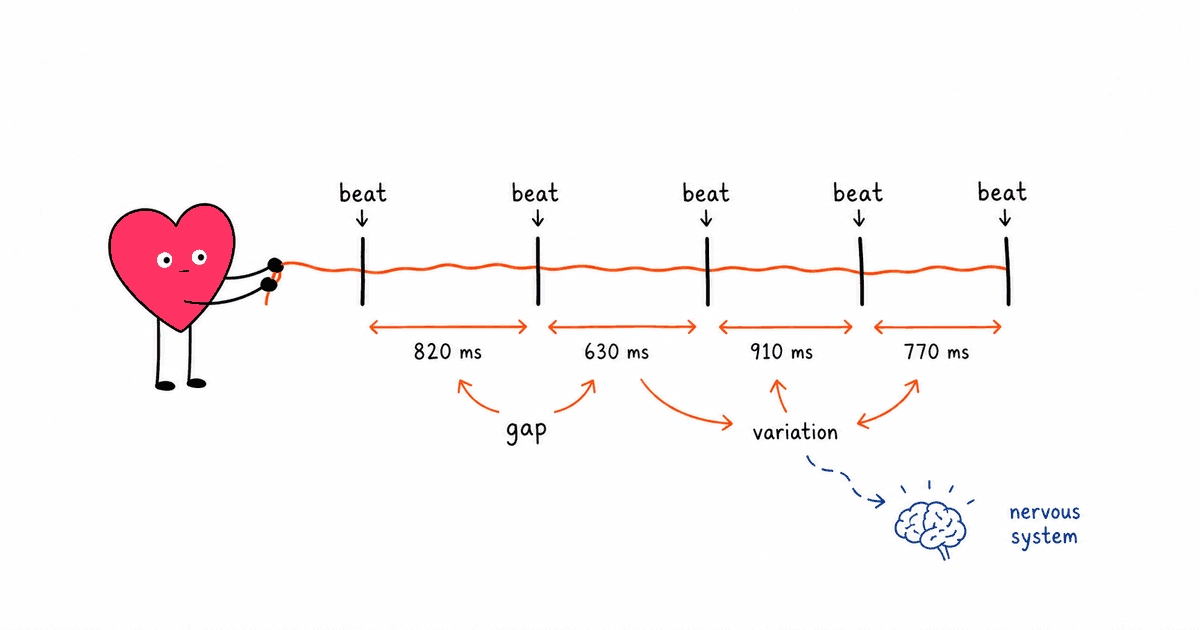
Heart rate variability (HRV) is the measurement of time variation between consecutive heartbeats, expressed in milliseconds. Unlike your heart rate (beats per minute), HRV captures the subtle fluctuations in timing between each beat. Higher HRV generally indicates better cardiovascular fitness, stress resilience, and recovery capacity, while lower HRV may signal stress, fatigue, or illness.
Here's a common misconception: most people think their heart beats like a metronome, perfectly steady at, say, 60 beats per minute. But a healthy heart actually has slight irregularities between beats.
For example, if your heart rate is 60 BPM, you might expect one beat every second. But in reality, the gaps might look like this:
- Beat 1 to Beat 2: 0.95 seconds
- Beat 2 to Beat 3: 1.05 seconds
- Beat 3 to Beat 4: 0.98 seconds
This natural variation is HRV, and surprisingly, more variation is usually better.
Why Does HRV Matter?
Your heart doesn't operate on autopilot. It's constantly adjusting based on signals from your autonomic nervous system (ANS), which has two branches:
- Sympathetic nervous system: Your "fight or flight" response. It speeds up your heart rate when you're stressed, exercising, or in danger.
- Parasympathetic nervous system: Your "rest and digest" mode. It slows your heart rate when you're relaxed, recovering, or sleeping.
HRV reflects the balance between these two systems. When both branches are working well and your body can easily switch between them, you'll see higher HRV. When you're stressed, sick, or overtrained, your HRV typically drops.
Think of it this way: High HRV means your body is adaptable and resilient. Low HRV suggests your body is under stress and may need more recovery.
What Can HRV Tell You About Your Health?
HRV has been studied extensively, and research shows it's connected to:
1. Stress Levels
Chronic stress keeps your sympathetic nervous system activated, which reduces HRV. Tracking your HRV can reveal hidden stress you might not even notice. Learn more in our guide to HRV and stress management.
2. Recovery Status
Athletes use HRV to know when to train hard and when to rest. A low HRV reading might mean your body hasn't fully recovered from yesterday's workout. See our complete guide to HRV for athletes.
3. Sleep Quality
Poor sleep lowers HRV. By tracking your overnight HRV, you can see how your sleep habits actually affect your recovery. Dive deeper with our guide on HRV and sleep quality.
4. Overall Health
Studies have linked low HRV to various health conditions, including cardiovascular disease, diabetes, depression, ADHD, and PTSD. While HRV alone isn't diagnostic, it's a useful indicator of overall wellbeing.
5. Aging
HRV naturally decreases with age. However, lifestyle factors like exercise, good sleep, and stress management can help maintain healthy HRV as you get older. Explore the connection between HRV and longevity.
6. Cognitive Performance
Higher HRV is associated with better attention, working memory, and executive function. When your autonomic nervous system is balanced, your brain performs at its best. Learn more in our guide to HRV and cognitive performance.
What's a "Good" HRV?
Here's the tricky part: there's no universal "good" HRV number. HRV varies dramatically based on:
- Age: Younger people typically have higher HRV
- Fitness level: Regular exercisers usually have higher HRV
- Genetics: Some people naturally have higher or lower baselines
- Sex: Men and women often have different typical ranges
- Measurement method: Different devices use different algorithms
The most important thing is your personal trend. A 25-year-old athlete might have an HRV of 80ms, while a 55-year-old might average 35ms, and both could be perfectly healthy.
What matters is:
- How your HRV compares to your own baseline
- Whether it's trending up or down over time
- How it responds to lifestyle changes
How Is HRV Measured?
HRV is measured in milliseconds (ms), and there are several common metrics:
RMSSD (Root Mean Square of Successive Differences)
The most common HRV metric for consumer devices. It captures beat-to-beat variation and is good for short-term measurements.
SDNN (Standard Deviation of NN Intervals)
Measures overall variability over longer periods. Often used in clinical settings.
HRV Score
Many apps and wearables convert raw HRV data into a simplified score (often 1-100) to make it easier to understand.
How to Measure Your HRV
You have several options for tracking HRV:
Wearable Devices
Smart watches and fitness bands from brands like Garmin, Whoop, and Oura Ring measure HRV automatically, often while you sleep for the most accurate readings.
Chest Strap Monitors
Chest straps (like Polar) provide the most accurate HRV readings and are preferred by serious athletes and researchers.
Smartphone Apps
Some apps use your phone's camera and flash to detect your pulse and calculate HRV. These are less accurate but can work for general trends.
Pro tip: For the most reliable data, measure your HRV at the same time each day, ideally first thing in the morning or during sleep.
What Affects Your HRV?
Many factors can influence your HRV from day to day:
Factors That Can Lower HRV
- Poor sleep
- Alcohol consumption
- Illness or infection
- Overtraining
- Chronic stress
- Dehydration
- Late meals
Factors That Can Raise HRV
- Regular exercise (but not overtraining)
- Quality sleep
- Meditation and breathwork
- Proper hydration
- Good nutrition
- Time in nature
- Social connection (even time with pets)
- Swimming and other aerobic activities
- Maintaining a healthy body weight
How to Improve Your HRV
If you want to boost your HRV, focus on these evidence-based strategies. For a comprehensive guide, see our 10 science-backed ways to improve HRV:
1. Prioritize Sleep
Aim for 7-9 hours of quality sleep. Keep a consistent sleep schedule and create a dark, cool sleeping environment.
2. Exercise Regularly (But Recover Too)
Aerobic exercise improves HRV over time, but don't forget rest days. Overtraining can tank your HRV.
3. Practice Breathwork
Slow, deep breathing activates your parasympathetic nervous system. Try 5-10 minutes of breathing exercises daily.
4. Manage Stress
Chronic stress is an HRV killer. Find stress management techniques that work for you: meditation, yoga, walking, journaling, or time with loved ones.
5. Limit Alcohol
Even moderate alcohol consumption can significantly lower HRV, especially when consumed close to bedtime.
6. Stay Hydrated
Dehydration stresses your cardiovascular system and reduces HRV.
The Bottom Line
Heart rate variability is a simple but powerful window into your body's stress and recovery status. While the science behind it is complex, the practical application is straightforward:
- Higher HRV generally indicates better health, fitness, and recovery
- Lower HRV suggests stress, illness, or need for more rest
- Your personal trend matters more than any single number
Whether you're an athlete optimizing performance, someone managing stress, or just curious about your health, tracking HRV can provide valuable insights that help you make better decisions about sleep, exercise, and recovery.
Ready to start tracking? Check out our guide to the best HRV monitors to find the right device for your needs.
Frequently Asked Questions
Is a higher HRV always better?
Generally yes, but context matters. Extremely high HRV readings can sometimes indicate irregular heart rhythms. What's most important is understanding your personal baseline and trends.
Can I improve my HRV?
Absolutely. Lifestyle factors like sleep, exercise, stress management, and nutrition all influence HRV. Most people see improvements within weeks of making positive changes.
Why is my HRV different every day?
Daily fluctuations are normal! HRV responds to everything from sleep quality to stress to what you ate for dinner. Focus on weekly averages rather than obsessing over daily numbers.
When should I be concerned about low HRV?
Consistently low HRV (compared to your baseline) combined with other symptoms like fatigue, poor sleep, or mood changes might warrant a conversation with your doctor. HRV alone isn't diagnostic, but it can be a useful data point.
Do I need an expensive device to measure HRV?
Not necessarily. While dedicated devices like Whoop or Oura Ring offer the most features, many affordable fitness trackers now include HRV monitoring. Even some free smartphone apps can give you a general sense of your HRV trends.
Need a quick read on your HRV number first?
Enter your HRV value, age range, device, and recovery context for a plain-English interpretation before you decide what to do next.
Interpret Your HRV NumberBuild the 30-day plan