HRV by Age: Normal Ranges for Every Decade (2026)
Trying to decode today's HRV number? Use the free interpreter first, then build a practical recovery plan. Interpret your HRV
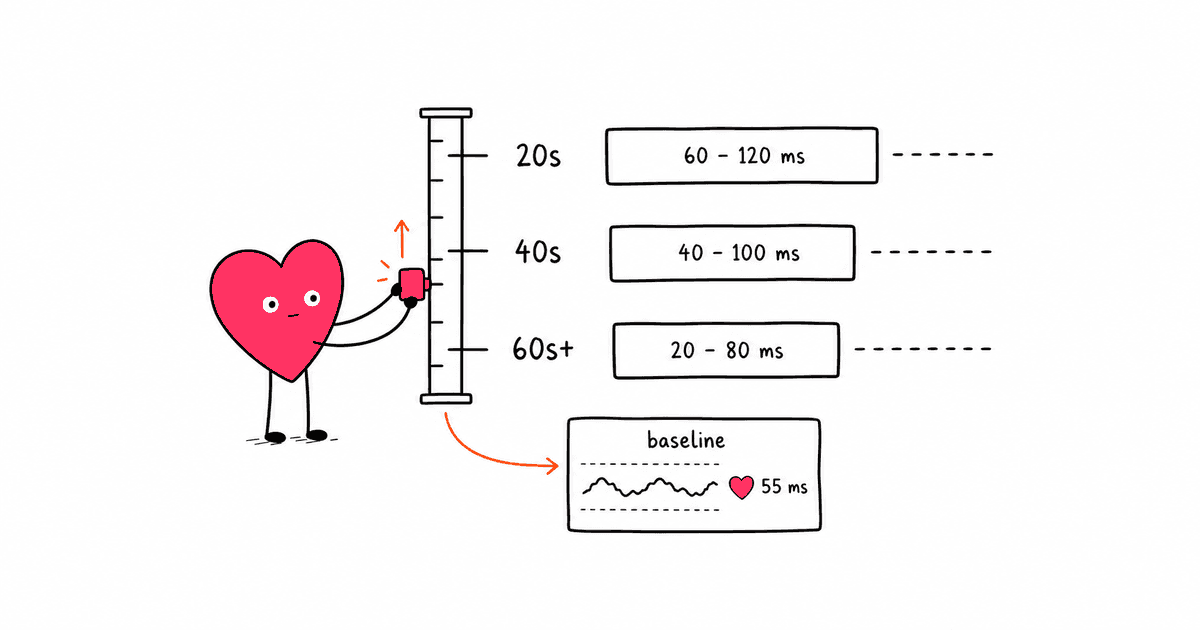
If you want the short answer, HRV normally gets lower with age. A resting SDNN around 55 to 65 ms can be common in your 20s, while 25 to 40 ms is more typical in your 50s and 15 to 25 ms is common in your 70s.
That age effect is why the same HRV number can mean very different things in different people. The table below gives you normal HRV ranges by age, explains the Apple Watch SDNN context, and shows when a low value is likely normal variation versus a pattern worth paying attention to. For a detailed walkthrough of Apple Watch tracking, see our Apple Watch HRV guide. Looking for younger age groups? See our guide on HRV in children.
If you are trying to interpret a specific low reading, see what a low HRV number means for examples from 15 ms to 60 ms and how baseline changes the meaning.
Normal HRV Ranges by Age Decade
The following table shows typical SDNN values (the metric Apple Watch reports) based on population averages from clinical research. These represent the middle 50% of healthy adults.
| Age Group | Average HRV (SDNN) | Typical Range |
|---|---|---|
| 20-29 | 55-65 ms | 35-95 ms |
| 30-39 | 45-55 ms | 30-80 ms |
| 40-49 | 35-50 ms | 25-70 ms |
| 50-59 | 25-40 ms | 15-55 ms |
| 60-69 | 20-35 ms | 12-45 ms |
| 70+ | 15-25 ms | 10-35 ms |
These are resting values, typically measured during sleep or quiet wakefulness. Your personal baseline may fall outside these ranges and still be perfectly healthy.
What Your Apple Watch HRV Reading Actually Means
The Apple Watch measures HRV using SDNN, the standard deviation of normal-to-normal heartbeat intervals. It captures this data primarily during sleep and periodic background measurements throughout the day.
Here is what to understand about Apple Watch HRV readings:
- The watch uses the optical heart rate sensor (photoplethysmography) on your wrist
- Readings are taken in short windows, typically 60 seconds to a few minutes
- The Health app displays your average and range over time
- Apple Watch reports SDNN in milliseconds, which is the most widely used HRV metric
A 2022 study in Journal of Medical Internet Research found that Apple Watch HRV measurements correlate well with clinical-grade ECG monitors, though wrist-based readings tend to slightly underestimate HRV compared to chest straps.
How to Get the Most Accurate Readings
For consistent Apple Watch HRV data, wear the watch during sleep every night. Morning readings taken during the last sleep cycle are the most reliable for tracking trends. Avoid checking single daytime readings in isolation, as these fluctuate significantly based on activity, posture, and stress.
Typical Apple Watch HRV Values for Ages 50-59
Since this is one of the most commonly searched age brackets, here is a deeper look. If you are in your 50s, a typical Apple Watch HRV reading falls between 15 and 55ms, with most people landing around 25-40ms.
Factors that push your reading toward the higher end include regular cardiovascular exercise, healthy sleep habits, low chronic stress, and maintaining a healthy weight. Factors that push readings lower include sedentary lifestyle, poor sleep quality, high alcohol consumption, and chronic health conditions.
If your Apple Watch consistently shows HRV below 15ms in your 50s, it is worth discussing with your doctor, particularly if you notice a sustained downward trend over weeks or months.
HRV in Your 20s and 30s
Younger adults typically see the highest HRV values. In your 20s, readings of 50-90ms are common, with athletic individuals sometimes exceeding 100ms. This reflects a highly responsive autonomic nervous system with strong vagal tone.
By your 30s, a gradual decline begins, though active individuals often maintain higher values well into this decade. Most people in their 30s will not notice a dramatic shift unless they are tracking consistently. The decline at this stage is subtle, often just a few milliseconds per year.
The key insight for younger adults: your HRV now is not just a health metric. It is a baseline you can reference for decades to come. Starting to track early gives you long-term trend data that becomes increasingly valuable.
HRV in Your 40s
The 40s represent a transition decade where age-related HRV decline becomes more noticeable. Average values drop to 35-50ms, and the gap between fit and sedentary individuals widens considerably. A sedentary 45-year-old might read 25ms while an active peer of the same age reads 55ms.
Research shows that regular exercise can slow the rate of decline significantly during this period. This decade is often when people first start paying attention to HRV, and the good news is that lifestyle interventions still have a major impact on where you fall within the range.
HRV in Your 60s and Beyond
By your 60s, average HRV typically falls to 20-35ms. In your 70s and beyond, readings of 15-25ms are common. While these numbers are lower, they still carry important information. Relative changes from your personal baseline matter more than absolute values at any age.
A 2020 study in Frontiers in Physiology found that seniors who maintained regular physical activity had HRV values 20-40% higher than sedentary peers of the same age. For more on HRV considerations for older adults, see our guide on HRV for seniors.
If low HRV appears alongside cognitive changes, blood pressure instability, or neurological symptoms, discuss the pattern clinically rather than treating it as a normal age effect. Our guides to dementia and HRV and Parkinson's disease and HRV cover those condition-specific contexts.
Gender Differences in HRV by Age
Research consistently shows that men tend to have slightly higher HRV than women in younger age groups, but this gap narrows and sometimes reverses after menopause.
| Age Group | Men (Average SDNN) | Women (Average SDNN) |
|---|---|---|
| 20-39 | 50-65 ms | 45-60 ms |
| 40-59 | 35-50 ms | 30-45 ms |
| 60+ | 20-35 ms | 20-35 ms |
Hormonal differences play a significant role. Estrogen has a protective effect on parasympathetic nervous system function, and fluctuations during the menstrual cycle can cause HRV variations of 10-20% within a single month. After menopause, the decline in estrogen accelerates HRV reduction, which is why the gender gap narrows in older adults.
For women, menstrual cycle phase adds another layer of variability on top of age-related changes. Pregnancy also causes significant temporary HRV changes, with readings typically dropping 15-30% by the third trimester before recovering postpartum.
Why HRV Declines with Age
The decline in HRV with age is driven by several physiological changes:
Autonomic Nervous System Changes
The parasympathetic (vagal) branch of the autonomic nervous system becomes less responsive over time. Vagal tone, which drives the "rest and digest" response, naturally decreases with aging.
Cardiovascular Stiffening
Arteries lose elasticity with age, reducing the heart's ability to vary its rhythm in response to changing demands. This arterial stiffness directly limits beat-to-beat variability and contributes to cardiovascular disease risk.
Reduced Fitness Capacity
Maximum heart rate and VO2 max both decline with age, which correlates with lower HRV. The cardiovascular system has less dynamic range to work with. This is one reason why maintaining aerobic fitness is so critical for preserving HRV.
Chronic Inflammation
Low-grade systemic inflammation increases with age (sometimes called "inflammaging"), which suppresses parasympathetic activity and lowers HRV. This is closely linked to diet, sleep quality, and overall metabolic health. See our guide on inflammation and HRV for a deeper look.
Declining Hormone Levels
Both testosterone and estrogen influence autonomic function. As these hormones decline with age, their protective effects on vagal tone diminish, contributing to lower HRV readings across both genders.
How to Interpret Your Numbers
Comparing yourself to population averages is a starting point, but your personal trend matters far more. Here is a practical framework (see also our guide to understanding HRV numbers for metric definitions):
- Establish your baseline. Track HRV daily for at least 4-6 weeks to find your average and normal range.
- Watch for trends, not single readings. A 7-day rolling average is more meaningful than any individual measurement.
- Context matters. A low reading after a poor night of sleep is expected, not alarming.
- Compare within your age group. If you are 55 and consistently reading 40ms, you are performing well above average for your decade.
- Track the slope. A gradual decline over months may warrant attention. A stable or improving trend, even at lower absolute values, is a positive sign.
How to Improve HRV at Any Age
Research supports several evidence-based strategies for improving HRV regardless of your current age.
Aerobic Exercise
Consistent cardiovascular exercise is the single most effective intervention. A meta-analysis in Sports Medicine found that regular aerobic training increased HRV by 10-20% across all age groups. Aim for 150+ minutes of moderate activity per week. Walking and zone 2 training are excellent starting points.
Sleep Optimization
Poor sleep is one of the fastest ways to tank your HRV. Prioritize 7-9 hours of quality sleep, maintain consistent bed and wake times, and keep your room cool and dark. Since the prevalence of sleep apnea increases significantly with age, consider screening if your overnight HRV remains low despite good sleep habits. For more detail, see our guide on HRV and sleep.
Breathing Exercises
Slow, paced breathing at around 6 breaths per minute directly stimulates the vagus nerve and can acutely raise HRV. Regular practice builds lasting improvements. Our breathing exercises guide covers the best techniques.
Stress Management
Chronic stress suppresses parasympathetic activity. Meditation, time in nature, and social connection all help. See our posts on HRV and stress and meditation and HRV.
Nutrition and Hydration
Anti-inflammatory diets rich in omega-3 fatty acids support higher HRV. Staying properly hydrated also matters more than most people realize. Learn more in our guides on omega-3s and HRV and hydration and HRV.
Limit Alcohol
Even moderate alcohol consumption measurably lowers HRV for 24-72 hours. Reducing intake is one of the simplest ways to see improvement. See our deep dive on alcohol and HRV.
Best Devices for Tracking HRV by Age
While the Apple Watch is an excellent starting point, several devices offer HRV tracking with different strengths:
- Apple Watch Series 11: Best for iPhone users who want seamless health integration
- Apple Watch Ultra: More durable with longer battery life for continuous tracking
- Oura Ring: Best for sleep-focused HRV tracking with minimal wrist bulk
- Whoop: Best for athletes who want recovery-focused analytics
- Garmin Forerunner 265: Strong option for runners who want HRV plus advanced training metrics
- Polar Vantage V3: Clinical-grade accuracy with overnight HRV tracking
For a full comparison, check our best HRV monitors guide.
Frequently Asked Questions
What is a good HRV for a 50 year old?
A good HRV for someone in their 50s is generally 30-55ms (SDNN). The population average falls around 25-40ms, so anything above 40ms indicates strong cardiovascular fitness for this age group.
Does Apple Watch measure HRV accurately?
Yes, Apple Watch provides clinically validated HRV measurements using optical sensors. While chest straps offer slightly higher precision, Apple Watch readings are reliable enough for daily tracking and trend analysis.
Can you increase HRV after age 60?
Yes. Research shows that exercise, breathing practices, and lifestyle modifications can improve HRV at any age. Seniors who begin regular aerobic exercise often see 15-25% improvements within 8-12 weeks.
Why is my HRV so low compared to others my age?
Several factors beyond age affect HRV, including fitness level, sleep quality, stress, medications, and underlying health conditions. Focus on your personal trend rather than comparisons. If your HRV is consistently declining, consult your healthcare provider.
Should I worry if my HRV is below average for my age?
Not necessarily. HRV varies widely between individuals. A consistently low but stable reading is less concerning than a sudden or sustained drop from your personal baseline. If you have concerns, discuss them with your doctor.
How often should I check my HRV?
Daily tracking provides the most useful data. The Apple Watch does this automatically during sleep. Review your 7-day and 30-day trends in the Health app rather than fixating on individual readings.
Is RMSSD or SDNN better for tracking HRV by age?
Both metrics are valid. Apple Watch uses SDNN, which captures overall variability. RMSSD, used by Whoop and Oura, emphasizes parasympathetic activity. Either works well for tracking personal trends over time. The age-related decline patterns are similar for both metrics.
Does HRV predict lifespan?
Research suggests that higher HRV is associated with lower all-cause mortality risk. A large population study found that individuals in the lowest HRV quartile had significantly higher cardiovascular mortality. However, HRV is one of many health indicators, not a crystal ball. For more, see our post on HRV and longevity.
Need a quick read on your HRV number first?
Enter your HRV value, age range, device, and recovery context for a plain-English interpretation before you decide what to do next.
Interpret Your HRV NumberBuild the 30-day plan