Inflammation and HRV: The Vagal Anti-Inflammatory Pathway Explained
Trying to decode today's HRV number? Use the free interpreter first, then build a practical recovery plan. Interpret your HRV
If you have been tracking your HRV, you have probably noticed it drops when you are getting sick, recovering from a hard workout, or dealing with chronic stress. There is a deeper reason for this pattern: your heart rate variability is directly linked to your body's inflammatory state through a biological mechanism called the vagal anti-inflammatory pathway.
Understanding this connection can change how you interpret your HRV data and give you practical tools for managing chronic inflammation, one of the biggest threats to long-term health.
What Is the Vagal Anti-Inflammatory Pathway?
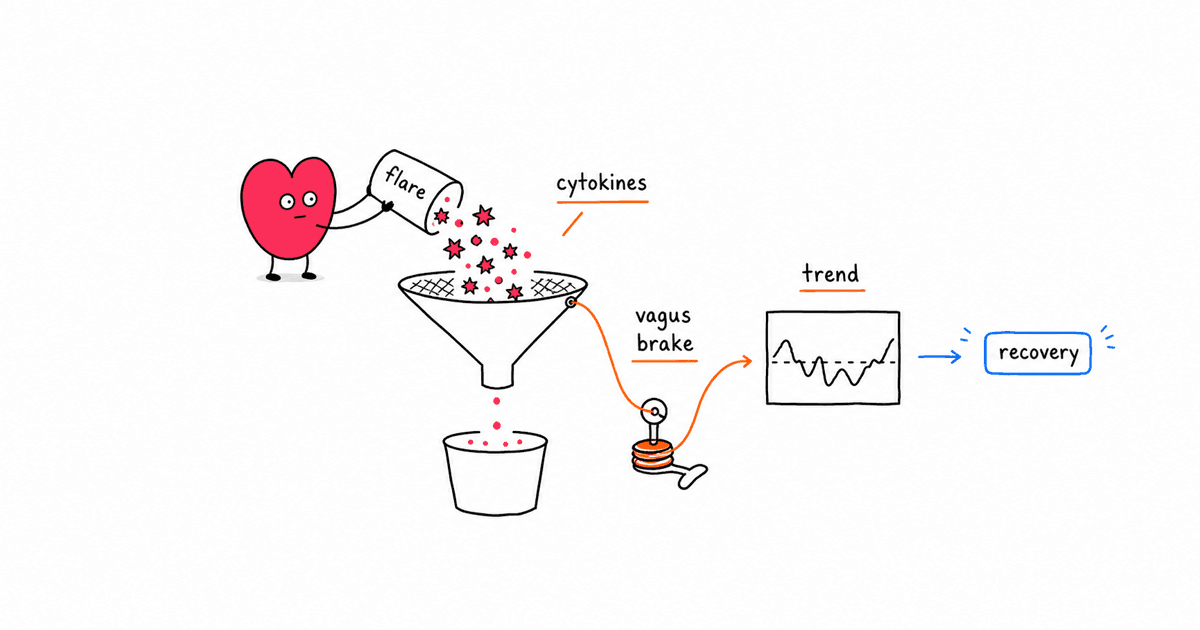
The vagal anti-inflammatory pathway is a biological mechanism through which the vagus nerve detects and suppresses inflammatory responses by inhibiting the release of pro-inflammatory cytokines like TNF, IL-6, and CRP. This pathway explains why higher HRV, which reflects stronger vagal activity, is consistently associated with lower inflammation throughout the body.
The discovery of this pathway was a breakthrough in understanding how the nervous system and immune system communicate. Here is how it works:
- Detection: Sensory fibers of the vagus nerve detect inflammatory molecules (cytokines) in tissues and organs
- Signal relay: This information travels to the brainstem, which processes the immune status of the body
- Anti-inflammatory response: Motor fibers of the vagus nerve release acetylcholine, which binds to alpha-7 nicotinic acetylcholine receptors (a7nAChR) on immune cells, particularly macrophages
- Cytokine suppression: This binding inhibits the production of pro-inflammatory cytokines, reducing inflammation
Animal studies have confirmed this powerfully. Mice with severed vagus nerves or knockout a7nAChR receptors show uncontrolled inflammatory responses when exposed to endotoxins. Conversely, vagal nerve stimulation dramatically reduces cytokine release (Borovikova et al., 2000; Wang et al., 2003).
The Research: HRV Predicts Inflammation
The evidence linking HRV to inflammatory markers is substantial and consistent across populations.
Key Findings
A landmark study using data from the MIDUS II study (1,255 participants) found that after controlling for sympathetic nervous system effects and numerous other factors (Williams et al., 2015):
- LF-HRV was inversely associated with fibrinogen, CRP, and IL-6
- HF-HRV was inversely associated with fibrinogen and CRP
- These relationships held for both men and women
A systematic review in Autonomic Neuroscience (2023) examined the evidence across multiple clinical settings and confirmed that in the majority of studies, increased heart rate and reduced HRV were associated with elevated levels of at least one inflammatory marker including CRP, white blood cell count, IL-6, TNF-alpha, or fibrinogen.
Additional research has shown:
| Study | Population | Key Finding |
|---|---|---|
| Haarala et al., 2011 | 1,601 healthy young adults | Decreased LF-HRV associated with higher CRP |
| Singh et al., 2009 | 188 middle-aged/older adults | Inverse relationship between HF-HRV and CRP (p < 0.01) |
| Lampert et al., 2008 | 264 middle-aged male twins | Ultra-low and very-low frequency HRV inversely related to CRP and IL-6 |
| Frasure-Smith et al., 2009 | 682 cardiac patients | IL-6 inversely related to both HF-HRV and LF-HRV |
The Correlation Strength
Across cardiovascular disease populations, inflammatory markers show inverse correlations with HRV, with correlation coefficients typically ranging from -0.2 to -0.5 (Psychoneuroendocrinology, 2009). While these are moderate correlations, they are remarkably consistent across different populations, age groups, and health conditions.
What This Means for Your HRV Data
Understanding the inflammation-HRV connection gives you a new lens for interpreting your readings:
Low HRV May Signal Hidden Inflammation
A persistently low HRV baseline, even without obvious symptoms, could indicate chronic low-grade inflammation. This type of "silent" inflammation is associated with:
- Cardiovascular disease
- Type 2 diabetes
- Autoimmune conditions (where the immune system drives persistent inflammation)
- Neurodegenerative conditions
- Some cancer and treatment recovery contexts, where inflammation, fatigue, pain, and sleep disruption can all suppress HRV
- Accelerated aging (sometimes called "inflammaging")
Often-overlooked sources of chronic inflammation include poor oral health, where periodontal disease introduces bacteria and inflammatory molecules into the bloodstream, air pollution exposure, where fine particulate matter triggers sustained sympathetic activation, and seasonal allergies, where histamine and immune activation create sustained inflammatory responses that suppress HRV. Smoking and nicotine use also drive chronic inflammation through oxidative stress, compounding the direct sympathetic activation that nicotine causes.
A 2024 review in Ageing Research Reviews highlighted HRV as a potential biomarker for "inflammaging," the chronic, low-grade inflammation that accelerates biological aging and drives many age-related diseases.
HRV Drops During Acute Illness and Injury
When your body fights an infection, inflammatory cytokines surge and HRV drops. This is why your wearable might detect illness before you feel symptoms. That same pattern can apply to bacterial and tick-borne illnesses too, including Lyme disease and HRV, where inflammation and autonomic strain can make recovery data harder to interpret. The vagal anti-inflammatory pathway becomes overwhelmed, and your autonomic balance shifts toward sympathetic dominance. A similar neuroinflammatory response occurs after concussions and traumatic brain injuries, where damaged brain tissue triggers an inflammatory cascade that suppresses HRV for weeks or even months beyond the initial injury.
Recovery HRV Reflects Inflammation Resolution
After illness, injury, surgery, or intense exercise, watching your HRV return to baseline is essentially watching your body's inflammatory response resolve. A slow HRV recovery may indicate ongoing inflammation that needs attention. In some cases, such as long COVID, persistent inflammation can suppress HRV for months after the initial infection.
How to Reduce Inflammation and Improve HRV
The good news: because the vagal anti-inflammatory pathway is a two-way street, interventions that improve vagal tone (and therefore HRV) also reduce inflammation. Here are evidence-based strategies:
1. Anti-Inflammatory Nutrition
Diet is one of the most powerful levers for controlling inflammation:
- Increase omega-3 fatty acids: EPA and DHA from fatty fish directly reduce inflammatory cytokines and have been shown to improve HRV
- Eat colorful fruits and vegetables: Polyphenols and antioxidants combat oxidative stress, a key driver of inflammation
- Reduce ultra-processed foods: These promote inflammation through advanced glycation end products (AGEs) and disrupted gut health
- Consider anti-inflammatory supplements: Curcumin, ginger, and certain adaptogens have demonstrated anti-inflammatory effects
2. Regular Exercise (But Not Too Much)
Moderate exercise is powerfully anti-inflammatory. It increases vagal tone, improves HRV, and reduces CRP and IL-6 levels over time. Walking and zone 2 training are excellent starting points.
However, overtraining triggers excessive inflammation and drops HRV. Use your HRV readings to find the sweet spot between enough exercise to reduce inflammation and too much that creates it.
3. Prioritize Sleep
Sleep deprivation is strongly pro-inflammatory. Even one night of poor sleep can increase CRP and IL-6 levels. Consistently getting 7 to 9 hours of quality sleep supports both vagal tone and inflammatory resolution.
4. Manage Chronic Stress
Psychological stress activates the sympathetic nervous system and promotes inflammation through multiple pathways. Effective stress management strategies include:
- Meditation and mindfulness
- Breathing exercises (especially slow, deep breathing that directly stimulates the vagus nerve)
- Yoga
- HRV biofeedback training
5. Cold Exposure
Cold exposure activates the vagal anti-inflammatory pathway directly through the dive reflex and has been shown to reduce inflammatory markers while increasing HRV. Similarly, grounding (earthing) has been shown to reduce inflammatory markers by transferring free electrons from the earth's surface, which may help neutralize reactive oxygen species.
6. Maintain a Healthy Gut
The gut contains a major branch of the vagus nerve, and gut health directly influences systemic inflammation. A diverse microbiome supports vagal tone, while gut dysbiosis promotes inflammation and lowers HRV.
HRV as an Inflammation Tracker
One of the most practical applications of this research is using your HRV as a daily inflammation check-in. While HRV cannot replace blood tests for CRP or IL-6, it provides a continuous, non-invasive signal about your body's inflammatory state.
Here is a simple framework:
- Baseline HRV stable or trending up: Your anti-inflammatory strategies are working
- Baseline HRV declining over days/weeks: Something is driving inflammation. Review your sleep, stress, diet, and exercise load
- Sudden HRV drop: Acute inflammation, possibly from illness, injury, or a particularly stressful event. Prioritize recovery
- HRV not recovering after expected timeline: Consider getting inflammatory markers checked with your doctor
The Bigger Picture: Inflammation, Aging, and HRV
The connection between inflammation, HRV, and aging creates a feedback loop:
- Aging naturally increases chronic inflammation (inflammaging)
- Chronic inflammation reduces vagal tone and HRV
- Reduced vagal tone weakens the anti-inflammatory pathway
- Weakened anti-inflammatory control allows more inflammation
This cycle helps explain why HRV tends to decline with age and why interventions that break this loop, like exercise, anti-inflammatory nutrition, and stress management, are so important for longevity.
The encouraging finding from recent research is that this pathway remains modifiable throughout life. Even in older adults, interventions that improve vagal tone can reduce inflammatory markers and improve HRV.
The Bottom Line
Your HRV is not just a fitness metric. It is a real-time readout of your body's inflammatory balance, connected through the remarkable vagal anti-inflammatory pathway. Lower HRV is consistently associated with higher levels of inflammatory markers like CRP and IL-6, while higher HRV reflects a well-functioning vagal brake on inflammation.
The practical implication is powerful: by tracking your HRV and implementing strategies that improve vagal tone, you are simultaneously monitoring and managing one of the most important drivers of chronic disease. Every point of HRV improvement represents a real shift in your body's ability to control inflammation.
Frequently Asked Questions
Can I use HRV to detect inflammation before I feel sick?
Yes, many people notice their HRV drops 1 to 2 days before cold or flu symptoms appear. The vagal anti-inflammatory pathway responds to early inflammatory signals before they produce noticeable symptoms, making HRV one of the earliest indicators of illness.
What CRP level corresponds to low HRV?
There is no exact conversion, as the relationship varies by individual. However, research shows that people with HRV in the lowest quartile tend to have CRP levels 2 to 3 times higher than those in the highest HRV quartile. A CRP level above 3.0 mg/L is considered high-risk for cardiovascular disease and is commonly associated with lower HRV.
Does improving HRV actually reduce inflammation, or is it just a correlation?
Evidence suggests it is causal, not just correlational. Vagal nerve stimulation studies in animals directly demonstrate that activating the vagus nerve suppresses cytokine production. In humans, interventions that increase vagal tone (like breathing exercises and meditation) have been shown to reduce inflammatory markers independently.
How long does it take for anti-inflammatory changes to show up in HRV?
Acute interventions like slow breathing exercises can improve HRV within minutes. Dietary and lifestyle changes that reduce chronic inflammation typically take 2 to 8 weeks to produce noticeable and sustained HRV improvements. Consistency matters more than intensity.
Should I get my inflammatory markers tested if my HRV is consistently low?
It is worth discussing with your doctor, especially if your HRV remains low despite good sleep, moderate exercise, and healthy nutrition. A basic panel including CRP, IL-6, and a complete blood count can provide useful context alongside your HRV data.
Need a quick read on your HRV number first?
Enter your HRV value, age range, device, and recovery context for a plain-English interpretation before you decide what to do next.
Interpret Your HRV NumberBuild the 30-day plan