Sleep Deprivation and HRV: How Poor Sleep Wrecks Your Heart Rate Variability
Does Sleep Deprivation Lower HRV?
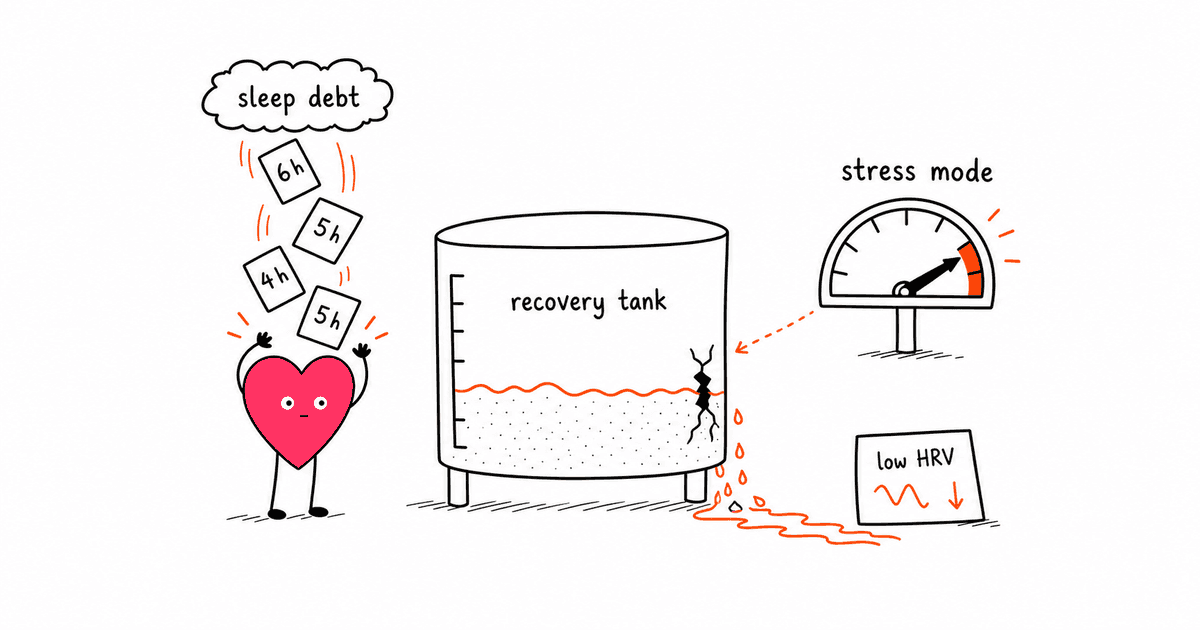
Yes, sleep deprivation significantly lowers HRV by shifting your autonomic nervous system toward sympathetic dominance and suppressing parasympathetic (vagal) activity. A 2025 meta-analysis of randomized controlled trials found that sleep deprivation causes a significant decrease in RMSSD (a key parasympathetic marker) and significant increases in low-frequency power and the LF/HF ratio, indicating heightened sympathetic nervous system activity.
If you've ever tracked your HRV and noticed a dramatic drop after a bad night of sleep, you weren't imagining things. Sleep deprivation is one of the most potent suppressors of heart rate variability, and its effects can persist for days after a single night of insufficient sleep.
What Happens to Your Autonomic Nervous System During Sleep Deprivation
To understand why sleep deprivation crushes HRV, you need to understand what happens inside your nervous system when you don't get enough rest.
The Sympathetic Takeover
During normal sleep, your parasympathetic nervous system dominates. Heart rate drops, blood pressure falls, and your vagus nerve becomes highly active, reflected in elevated nighttime HRV readings. This is when your body repairs, consolidates memories, and restores autonomic balance.
When you cut sleep short or skip it entirely, this parasympathetic recovery window shrinks. Your body compensates by keeping the sympathetic nervous system (fight-or-flight) engaged longer. The result:
- Elevated resting heart rate that persists through the following day
- Reduced RMSSD, the most sensitive marker of parasympathetic withdrawal
- Increased LF/HF ratio, indicating a shift in autonomic balance toward sympathetic dominance
- Elevated cortisol levels, particularly in the evening when cortisol should be declining
- Increased norepinephrine, a sympathetic neurotransmitter that directly suppresses HRV
The Cascade Effect
Sleep deprivation doesn't just affect one night's HRV readings. It triggers a cascade of physiological disruptions:
- HPA axis activation: Sleep loss activates the hypothalamic-pituitary-adrenal axis, increasing cortisol secretion
- Inflammatory response: Pro-inflammatory cytokines increase, further suppressing vagal tone
- Blood sugar dysregulation: Insulin sensitivity decreases, leading to larger glucose swings that stress the autonomic system
- Immune suppression: T-cell activity drops and key immune cytokines (IL-1β, TNF-α) decrease
- Emotional dysregulation: Anxiety and mood disturbances increase, which themselves lower HRV
This cascade explains why a single night of poor sleep can affect your HRV for 2-3 days afterward. It also explains why short-term immune stressors, including a temporary HRV dip after vaccination, often look worse when they disrupt sleep.
What the Research Shows
The 2025 Meta-Analysis
The most comprehensive analysis to date, published in Frontiers in Neurology (2025), reviewed 11 randomized controlled trials involving 549 participants. Key findings:
| HRV Metric | Effect of Sleep Deprivation | Statistical Significance |
|---|---|---|
| RMSSD | Significant decrease | p < 0.05 |
| SDNN | Decreased (trend) | p > 0.05 |
| LF power | Significant increase | p < 0.05 |
| HF power | Decreased (trend) | p > 0.05 |
| LF/HF ratio | Significant increase | p < 0.05 |
The significant decrease in RMSSD is particularly important because RMSSD is the gold standard marker for parasympathetic activity and the metric most consumer wearables use to report HRV.
Partial vs. Total Sleep Deprivation
Not all sleep loss affects HRV equally:
- Total sleep deprivation (0 hours): Produces the most dramatic HRV suppression. Research shows a 24-hour period without sleep markedly elevates sympathetic nervous system activity and significantly impairs cardiovascular function.
- Partial sleep deprivation (4-5 hours): Still causes measurable HRV decline. A study published in Scientific Reports found that both sleep restriction (5 hours) and sleep fragmentation (hourly awakenings) reduced nighttime HRV, with sleep fragmentation showing particularly harmful effects on autonomic balance.
- Chronic partial deprivation (6 hours/night over weeks): Produces cumulative HRV decline. Research shows that chronic sleep deprivation decreases HRV indices while increasing norepinephrine levels, indicating sustained sympathetic activation.
REM Sleep Deprivation Specifically
Even if you get enough total sleep hours, disruption of REM sleep specifically damages autonomic regulation. Animal studies have demonstrated that selective REM sleep deprivation leads to significant deterioration in cardiac autonomic regulation, suggesting that sleep quality matters as much as quantity for HRV.
How Many Hours of Sleep Do You Need to Protect HRV?
Research and wearable data converge on clear sleep duration thresholds for HRV:
| Sleep Duration | Expected HRV Impact |
|---|---|
| Less than 5 hours | Severe HRV suppression, significant sympathetic shift |
| 5-6 hours | Moderate HRV decline, noticeable next-day drop |
| 6-7 hours | Mild HRV reduction, may be tolerable short-term |
| 7-8 hours | Optimal for most adults, supports full autonomic recovery |
| 8-9 hours | Maximum HRV recovery potential, especially for athletes |
| 9+ hours | Diminishing returns (excessive sleep can also indicate health issues) |
The sweet spot for most adults is 7-8.5 hours of actual sleep (not just time in bed). Athletes and people recovering from illness or intense training may benefit from the upper end of this range.
Sleep Debt: Does It Accumulate?
Yes. Sleep debt, the cumulative deficit from consistently sleeping less than your body needs, progressively erodes HRV over time.
Here's what makes sleep debt particularly insidious:
- You stop noticing it. After several days of restricted sleep, subjective sleepiness plateaus even as cognitive performance and HRV continue to decline. You feel "fine" while your autonomic function deteriorates.
- It takes longer to repay than to accumulate. One night of 4-hour sleep might require 2-3 nights of quality sleep to fully recover HRV baseline.
- It compounds with other stressors. Sleep debt amplifies the HRV impact of alcohol, stress, and intense exercise.
If your HRV has been trending downward for weeks and you can't identify a cause, chronic mild sleep deprivation (regularly sleeping 30-60 minutes less than you need) is often the culprit.
How Long Does HRV Take to Recover After Sleep Deprivation?
Recovery timelines depend on the severity and duration of sleep loss:
After One Bad Night (4-5 Hours)
- Day 1: HRV typically drops 10-30% below baseline
- Day 2: Partial recovery with adequate sleep (7-8 hours)
- Day 3: Most people return to baseline
After Several Bad Nights (3-5 Days of 5-6 Hours)
- Recovery time: 3-5 nights of quality sleep
- Pattern: Gradual upward trend rather than immediate bounce-back
- Note: First recovery night often shows rebound effect with unusually high deep sleep percentage
After Chronic Sleep Deprivation (Weeks to Months of Insufficient Sleep)
- Recovery time: 1-4 weeks of consistent quality sleep
- Pattern: Slow, steady baseline improvement
- Note: May require addressing underlying causes (sleep hygiene, stress, sleep disorders)
Sleep Quality Factors That Affect HRV
Total sleep hours are only part of the equation. These quality factors significantly impact overnight HRV:
Sleep Fragmentation
Waking up multiple times during the night can be worse for HRV than sleeping fewer hours continuously. Each awakening triggers a brief sympathetic surge that interrupts parasympathetic recovery. Common causes include:
- Sleep apnea (one of the most common and underdiagnosed HRV suppressors)
- Noise disturbances
- Temperature discomfort
- Bladder issues
- Pets or children
Sleep Timing Consistency
Your circadian rhythm strongly influences autonomic function. Irregular sleep schedules, even with adequate total hours, can reduce HRV by disrupting the timing of parasympathetic peaks.
Going to bed and waking up within the same 30-minute window each day (including weekends) is one of the most impactful changes you can make for HRV. Even the one-hour shift from daylight saving time can suppress HRV for several days.
Sleep Architecture
The distribution of sleep stages matters:
- Deep sleep (N3): This is when HRV peaks and parasympathetic recovery is strongest. Factors that reduce deep sleep (alcohol, late meals, blue light) directly suppress overnight HRV.
- REM sleep: Important for emotional regulation and autonomic balance. REM-suppressing factors (certain medications, alcohol, cannabis) can reduce morning HRV.
- Light sleep (N1/N2): Less impactful for HRV recovery, but excessive time in light sleep (at the expense of deep sleep) indicates suboptimal sleep quality.
How to Track Sleep's Impact on Your HRV
Modern wearables make it easy to correlate sleep quality with HRV trends.
Best Devices for Sleep-HRV Tracking
The Oura Ring 4 is particularly strong for sleep-HRV analysis because it tracks overnight HRV continuously and provides sleep stage breakdowns. The Whoop 5 offers similar capabilities with its recovery score, which heavily weights sleep quality and HRV. The Apple Watch also tracks sleep stages and nighttime HRV, though with less granularity than dedicated sleep trackers.
What to Monitor
- Overnight HRV trend: Look at average nighttime RMSSD, not just a single morning reading
- HRV by sleep stage: If available, check HRV during deep sleep specifically
- Sleep efficiency: Time asleep divided by time in bed (aim for 85%+)
- Sleep latency: How long it takes to fall asleep (should be 10-20 minutes)
- Wake after sleep onset (WASO): Total time spent awake during the night
Evidence-Based Strategies to Protect Sleep and HRV
Sleep Hygiene Fundamentals
- Consistent schedule: Same bedtime and wake time within 30 minutes, 7 days a week
- Cool bedroom: 65-68°F (18-20°C) supports deeper sleep and higher nighttime HRV
- Dark environment: Blackout curtains or a sleep mask eliminate light disruption
- No screens 60 minutes before bed: Blue light suppresses melatonin and delays sleep onset
- No caffeine after 2 PM: Caffeine's half-life is 5-6 hours, meaning an afternoon coffee still affects nighttime sleep architecture
Supplements with Research Support
- Magnesium: Magnesium glycinate or threonate (200-400mg before bed) supports muscle relaxation and sleep quality
- Omega-3 fatty acids: Regular omega-3 intake is associated with both improved sleep quality and higher HRV
Behavioral Strategies
- 4-7-8 breathing before bed: Research shows this technique can partially offset the HRV effects of sleep deprivation
- Meditation or body scan: 10-15 minutes of mindfulness practice before bed activates the parasympathetic nervous system
- Consistent wind-down routine: A predictable pre-sleep routine signals your nervous system to begin the transition to parasympathetic dominance
When to See a Doctor
If you consistently get 7+ hours of sleep but your overnight HRV remains low, consider evaluation for:
- Sleep apnea: Extremely common and often undiagnosed, sleep apnea causes repeated sympathetic surges throughout the night
- Restless leg syndrome: Disrupts sleep architecture and autonomic function
- Chronic insomnia: May require cognitive behavioral therapy for insomnia (CBT-I), which has been shown to improve both sleep quality and HRV
The Compounding Effect: Sleep + Other HRV Factors
Sleep deprivation doesn't exist in isolation. It amplifies the negative HRV effects of other factors:
- Sleep deprivation + alcohol: Alcohol already suppresses HRV for 24-72 hours. Combined with poor sleep, the effect is compounded significantly.
- Sleep deprivation + intense exercise: Your body needs sleep to recover from hard training. Training hard on poor sleep accelerates overtraining and deepens HRV suppression.
- Sleep deprivation + psychological stress: Chronic stress and poor sleep create a feedback loop where each worsens the other, progressively lowering HRV baseline.
Conversely, prioritizing sleep amplifies the positive HRV effects of good habits like breathing exercises, cold exposure, and regular exercise.
The Bottom Line
Sleep is the single most powerful lever you have for HRV optimization. A 2025 meta-analysis confirms that sleep deprivation significantly decreases RMSSD and increases sympathetic markers, shifting your autonomic balance away from the parasympathetic state your cardiovascular system needs to thrive.
The prescription is straightforward: aim for 7-8.5 hours of quality sleep on a consistent schedule. Protect your sleep environment, manage factors that disrupt sleep architecture, and track your overnight HRV to catch emerging sleep debt before it compounds.
If your HRV has been declining and you're looking for the highest-impact intervention, start with your sleep. Everything else builds on that foundation.
FAQ
How much does one night of bad sleep drop HRV?
One night of 4-5 hours of sleep typically drops HRV by 10-30% below your personal baseline. The exact magnitude depends on your fitness level, age, and other stressors. Well-trained athletes may see smaller absolute drops but still experience significant relative declines.
Can naps help recover HRV after poor sleep?
Short naps (20-30 minutes) can partially buffer the HRV effects of sleep deprivation by providing a brief window of parasympathetic recovery. However, naps don't fully replace nighttime sleep because they typically lack sufficient deep sleep and REM cycles. Use naps as a supplement, not a replacement.
Why is my HRV low even when I sleep 8 hours?
Several factors can suppress overnight HRV despite adequate sleep duration: sleep apnea (very common), alcohol consumption within 3-4 hours of bed, late heavy meals, an overly warm bedroom, or fragmented sleep that you don't remember. If this pattern persists, consider a sleep study to rule out sleep-disordered breathing.
Does sleeping in on weekends help recover HRV?
Somewhat, but irregular sleep timing itself disrupts circadian-mediated HRV patterns. A consistent 7.5-hour sleep schedule outperforms a pattern of 6 hours on weekdays and 9 hours on weekends. If you need to catch up, extend sleep by 30-60 minutes rather than dramatically shifting your schedule.
Is sleep or exercise more important for HRV?
Sleep is more foundational. Exercise improves HRV over time, but exercising on chronically poor sleep can actually worsen HRV by preventing adequate recovery. Fix sleep first, then layer in exercise for compounding benefits.
Need a quick read on your HRV number first?
Enter your HRV value, age range, device, and recovery context for a plain-English interpretation before you decide what to do next.
Interpret Your HRV NumberBuild the 30-day plan