HRV and Overtraining: How to Detect and Prevent Overtraining Syndrome
Trying to decode today's HRV number? Use the free interpreter first, then build a practical recovery plan. Interpret your HRV
You've been training hard, pushing your limits, and expecting gains. But instead of getting stronger, you're feeling exhausted, unmotivated, and your performance is declining. Sound familiar? You might be experiencing overtraining syndrome, and your heart rate variability (HRV) could have warned you weeks before you hit this wall.
In this guide, we'll explore how HRV serves as an early warning system for overtraining, what the research says, and practical strategies to use HRV data to optimize your training load.
What Is Overtraining Syndrome?
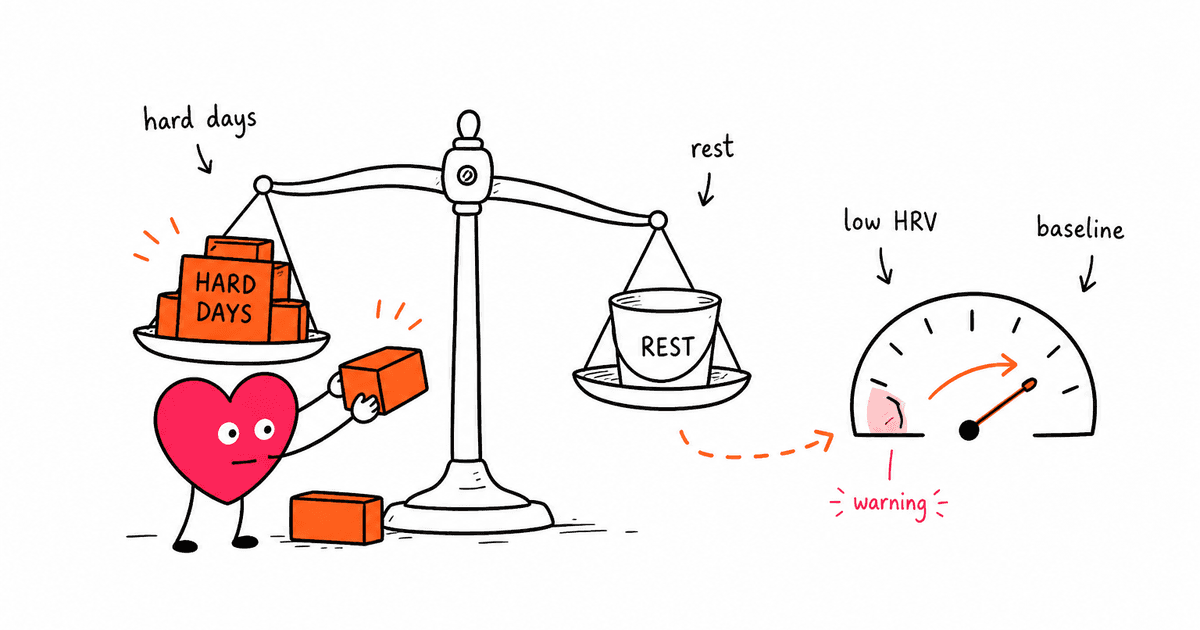
Overtraining syndrome (OTS) occurs when the balance between training stress and recovery tips too far toward stress. It's not just feeling tired after a hard workout. It's a chronic state where your body can no longer adapt positively to training demands.
The progression typically looks like this:
- Functional overreaching: Short-term performance decrease that recovers within days
- Nonfunctional overreaching: Extended performance decline lasting weeks
- Overtraining syndrome: Severe, prolonged performance impairment taking months to recover
Common symptoms include:
- Persistent fatigue despite adequate sleep
- Declining performance despite continued training
- Mood disturbances (irritability, depression, anxiety)
- Increased resting heart rate
- Sleep disruptions
- Frequent illness or weakened immune response
- Loss of motivation and burnout
The challenge? By the time most athletes recognize these symptoms, they're already deep into overtraining. This is where HRV monitoring becomes invaluable.
How HRV Reflects Your Recovery Status
Your heart rate variability reflects the balance between your sympathetic (fight-or-flight) and parasympathetic (rest-and-digest) nervous systems. In a well-recovered state, your parasympathetic system dominates at rest, creating higher HRV with more variation between heartbeats.
When you're accumulating fatigue or stress, this balance shifts:
- Acute training stress: Temporary HRV suppression that recovers within 24 to 72 hours (particularly pronounced after HIIT sessions)
- Accumulated fatigue: Persistent HRV suppression over multiple days
- Overtraining: Paradoxical changes, either chronically suppressed or abnormally elevated HRV
A 2025 systematic review published in Physiological Reports found that declining HRV trends, particularly in RMSSD (the most common HRV metric), correlate with overtraining symptoms in athletes. The key insight is that changes in HRV often precede noticeable performance decline by days or even weeks.
What the Research Shows
The Paradox of Overtrained Athletes
One of the fascinating findings from overtraining research is that severely overtrained athletes can actually show paradoxically high HRV values. A study in the European Journal of Applied Physiology found that overtrained athletes displayed HRV patterns similar to untrained individuals, suggesting their bodies had essentially "given up" on adapting to training stress.
This means you can't just look for low HRV. You need to watch for deviations from your personal baseline in either direction.
The 7-Day Rolling Average Advantage
Research from the National Center for Biotechnology Information suggests that evaluating 7-day rolling averages provides more meaningful insights than daily measurements. Day-to-day HRV can fluctuate significantly based on factors like sleep position, hydration, and measurement timing. The weekly trend smooths out this noise and reveals true adaptation patterns.
A 2025 study in Scientific Reports on cyclists found that HRV-guided training, using rolling averages, led to better performance outcomes than following fixed training plans.
Early Warning Signs in HRV Data
A 2025 MDPI study on track and field athletes identified specific HRV patterns associated with overtraining:
- Reduced Mean RR intervals (increased heart rate) after training indicates sympathetic activation
- Prolonged decreases during recovery may reflect incomplete recovery
- Decreased HRV trend over weeks corresponds with accumulated fatigue
The key finding: shifts in weekly mean HRV can signal whether your training program is effective or if adjustments are needed.
How to Use HRV to Prevent Overtraining
1. Establish Your Personal Baseline
Your HRV is unique to you. Population averages don't matter. What matters is your individual baseline and how your readings deviate from it. For help interpreting your numbers, see our guide to understanding HRV numbers.
Take consistent morning measurements for at least 2 to 4 weeks during a period of normal training. This establishes your typical range and helps you identify meaningful deviations.
2. Track Your Smallest Worthwhile Change (SWC)
The smallest worthwhile change represents the threshold at which HRV changes become meaningful rather than just normal variation. Typically calculated as 0.5 times the standard deviation of your baseline, readings outside this range warrant attention.
- HRV above the upper SWC band: You're well-recovered and ready for hard training
- HRV within the band: Normal variation, proceed as planned
- HRV below the lower SWC band: Consider reducing intensity or adding recovery
3. Watch the Weekly Trend, Not Daily Numbers
A single low HRV reading isn't cause for alarm. Look at your 7-day rolling average:
- Stable or rising trend: Training is producing positive adaptations
- Declining trend over 1 to 2 weeks: Accumulated fatigue, time to back off
- Sudden jump upward: Could indicate illness or excessive parasympathetic activity
4. Combine HRV with Subjective Measures
HRV works best when paired with subjective wellness scores. Rate these daily on a 1 to 5 scale:
- Sleep quality
- Energy level
- Mood
- Muscle soreness
- Stress level
When both HRV and subjective scores decline together, the signal is stronger. Sometimes subjective feelings catch issues that HRV misses, and vice versa.
5. Implement HRV-Guided Training
Rather than following a rigid training plan, let your HRV inform daily decisions. This approach, sometimes called HRV biofeedback training, has been shown to improve outcomes:
- High HRV + feeling good: Green light for high-intensity work or strength training
- Low HRV + feeling okay: Moderate intensity, zone 2 training, or skill work
- Low HRV + feeling bad: Active recovery, light yoga, or rest day
Research shows this adaptive approach leads to better outcomes than ignoring physiological feedback.
Red Flags That Indicate Overtraining
Watch for these warning signs in your HRV data:
- HRV consistently below your lower SWC band for more than a week
- Resting heart rate elevated by 5+ BPM above normal (check your heart rate recovery time after workouts too)
- HRV fails to recover after rest days
- Weekly average declining for 2+ consecutive weeks
- Paradoxically high HRV with poor performance and fatigue
If you notice these patterns, it's time to take immediate action.
Recovery Strategies When You've Pushed Too Hard
If your HRV data suggests you're sliding toward overtraining:
Short-term (1 to 3 days)
- Take complete rest days
- Focus on sleep (aim for 8+ hours)
- Stay well-hydrated
- Gentle movement only (walking, light stretching)
Medium-term (1 to 2 weeks)
- Reduce training volume by 40 to 60%
- Eliminate high-intensity sessions
- Add extra recovery modalities (massage, sauna, cold exposure)
- Address any life stressors if possible
- Support recovery with proper nutrition
- Keep low-intensity movement truly easy, not a disguised workout like heavy rucking
Long-term (full overtraining syndrome)
- Consult with a sports medicine professional
- Take extended time off (potentially months)
- Incorporate meditation and stress management practices
- Gradual return with careful HRV monitoring
The key is catching the early signs. An extra rest day when your HRV first dips is far better than months of forced recovery later.
Best HRV Devices for Overtraining Prevention
For athletes serious about preventing overtraining, you need a device that tracks HRV accurately and consistently. Here are top options:
For 24/7 Monitoring
The Whoop 5.0 excels at continuous monitoring and provides daily strain and recovery scores based on HRV data. Its sleep tracking helps you correlate recovery with sleep quality.
The Oura Ring 4 offers overnight HRV tracking in a comfortable, unobtrusive form factor. Its readiness score integrates HRV with other recovery metrics.
For Morning Spot Checks
The Garmin Forerunner 265 provides morning HRV status and training readiness scores. The color-coded feedback makes it easy to interpret your data at a glance.
The Polar Vantage V3 offers excellent HRV analysis with Polar's orthostatic test feature, specifically designed for athletes monitoring training load.
For Maximum Accuracy
For the most precise measurements, consider using a Polar H10 or Garmin HRM-600 chest strap with a dedicated HRV app. Chest straps provide ECG-level accuracy that wrist-based optical sensors can't match. For a detailed breakdown of sensor accuracy and features, see our HRV monitor comparison guide.
Sample Weekly HRV Monitoring Protocol
Here's a practical framework for using HRV to prevent overtraining:
Daily (every morning):
- Wake naturally or to gentle alarm
- Use the bathroom if needed
- Lie down for 2 to 3 minutes
- Take HRV measurement in the same position
- Rate subjective wellness (1 to 5)
Consider incorporating breathing exercises into your morning routine to activate parasympathetic recovery before training.
Weekly review:
- Compare 7-day average to previous weeks
- Note any readings outside your SWC band
- Correlate with training volume and intensity
- Adjust next week's plan based on trends
Monthly assessment:
- Review overall HRV trend
- Compare to training phases and goals
- Identify patterns (what improves/decreases HRV)
- Adjust long-term training approach
Common Mistakes to Avoid
Obsessing Over Daily Numbers
A single low reading doesn't mean you're overtrained. Look at patterns over time.
Ignoring Context
Poor sleep, alcohol, travel, and life stress all affect HRV. Consider the whole picture.
Only Watching for Low HRV
Paradoxically high HRV can also indicate problems. Watch for any significant deviations from baseline.
Not Acting on the Data
The data is only valuable if you use it. If your HRV says rest, actually rest.
Inconsistent Measurement
Take readings at the same time, in the same position, using the same device. Inconsistency introduces noise.
The Bottom Line
Heart rate variability is one of the most valuable tools athletes have for preventing overtraining syndrome. By establishing your personal baseline, tracking trends rather than daily fluctuations, and combining HRV data with subjective wellness measures, you can catch the early signs of accumulated fatigue before it becomes a serious problem.
The research is clear: athletes who use HRV-guided training approaches tend to achieve better outcomes than those following rigid plans. Your body knows when it needs rest. HRV gives you a window into that wisdom.
Start monitoring your HRV today, learn your patterns, and give yourself permission to back off when the data suggests you should. Your future performance depends on it.
Related Articles
- HRV for Athletes: Optimizing Training and Recovery
- How to Improve Your HRV: 10 Evidence-Based Strategies
- HRV and Sleep: The Critical Recovery Connection
- Strength Training and HRV: Building Fitness Without Burnout
- HIIT and HRV: Managing High-Intensity Training
- Running and HRV: Training Smarter
- Zone 2 Training and HRV: The Foundation of Endurance
- Best HRV Monitors in 2026
Need a quick read on your HRV number first?
Enter your HRV value, age range, device, and recovery context for a plain-English interpretation before you decide what to do next.
Interpret Your HRV NumberBuild the 30-day plan