Adaptogens and HRV: Can Ashwagandha, Rhodiola, and Other Herbs Improve Your Heart Rate Variability?
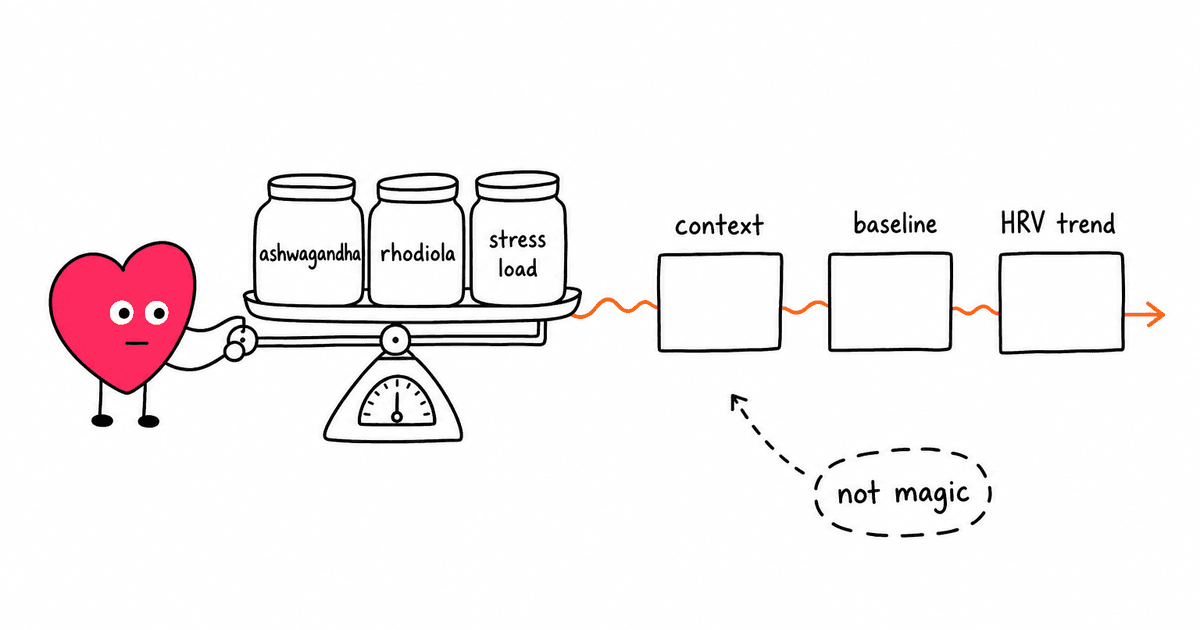
If you've been exploring ways to improve your HRV, you've likely encountered the usual advice: sleep better, exercise consistently, and manage stress. But what about supplements? Specifically, what about adaptogens, a class of herbs that have been used for centuries in traditional medicine systems and are now gaining attention in modern research?
Adaptogens like ashwagandha, rhodiola rosea, and holy basil have long been valued for their ability to help the body cope with stress. And since stress is one of the biggest drivers of low HRV, it's natural to wonder whether these herbs could help shift your autonomic nervous system toward a healthier balance.
In this article, we'll explore what adaptogens are, how they work at a physiological level, and what the current research says about their effects on heart rate variability. If your supplement question is about training performance instead of stress resilience, the creatine and HRV guide covers that separate use case.
What Are Adaptogens?
Adaptogens are a specific category of herbs and mushrooms that help the body adapt to physical, chemical, and biological stressors. The term was first coined by Soviet scientist Nikolai Lazarev in 1947, and the concept was later refined by pharmacologist Israel Brekhman, who established three criteria that a substance must meet to qualify as an adaptogen:
- It must be non-toxic at normal doses
- It must produce a nonspecific response that increases resistance to a broad range of stressors
- It must have a normalizing effect, meaning it helps restore balance regardless of the direction of the imbalance
This last point is key. Unlike stimulants (which push you in one direction) or sedatives (which push you in the other), adaptogens work bidirectionally. They help calm an overactive stress response while also supporting energy and resilience when you're depleted.
Some of the most well-known adaptogens include ashwagandha (Withania somnifera), rhodiola rosea, holy basil (tulsi), reishi mushroom, eleuthero, and schisandra. While traditional use of these herbs spans thousands of years across Ayurvedic, Chinese, and Siberian medicine traditions, modern science is only now beginning to understand their mechanisms and validate their effects.
How Adaptogens Affect the Stress Response
To understand how adaptogens might influence HRV, we first need to understand how they interact with the body's stress systems.
The HPA Axis Connection
When you encounter a stressor, your hypothalamic-pituitary-adrenal (HPA) axis activates. The hypothalamus signals the pituitary gland, which signals the adrenal glands to release cortisol and other stress hormones. This is your classic "fight or flight" response, driven by the sympathetic branch of the autonomic nervous system. (For a deeper look at how cortisol and other hormones affect HRV, see our guide on hormones and HRV.)
Under normal circumstances, this response is short-lived. Cortisol levels rise, you deal with the stressor, and the system resets. But chronic stress keeps the HPA axis in a state of prolonged activation, leading to elevated cortisol, sympathetic dominance, and (you guessed it) lower HRV.
Adaptogens appear to work by modulating the HPA axis at multiple points. Research suggests they can:
- Regulate cortisol production, preventing both excessive spikes and chronic elevation
- Support adrenal function, helping the glands respond appropriately without becoming depleted
- Influence stress-signaling molecules like heat shock proteins (Hsp70) and cortisol receptors
- Reduce inflammatory markers that are elevated during chronic stress
By helping the HPA axis function more efficiently, adaptogens may indirectly support a shift from sympathetic dominance toward greater parasympathetic activity, which is exactly what shows up as higher HRV.
The Autonomic Nervous System Link
Your autonomic nervous system (ANS) has two branches: the sympathetic ("fight or flight") and the parasympathetic ("rest and digest"). HRV is essentially a real-time readout of the balance between these two branches. Higher HRV generally reflects greater parasympathetic tone and better autonomic flexibility. For a deeper explanation of what these metrics mean, see our guide to understanding HRV numbers.
Since adaptogens help regulate the stress response, they have the potential to influence ANS balance. By reducing chronic sympathetic activation and supporting parasympathetic recovery, adaptogens could theoretically improve HRV over time. But does the research support this? Let's look at the evidence for each major adaptogen.
Ashwagandha: The Most Studied Adaptogen for HRV
Of all the adaptogens, ashwagandha (Withania somnifera) has the strongest body of evidence linking it to improvements in HRV and autonomic balance. This ancient Ayurvedic herb has been the subject of numerous clinical trials examining its effects on stress, anxiety, cortisol, and cardiovascular markers.
Key Research Findings
A clinical study conducted by Verdure Sciences examined the effects of ashwagandha supplementation on autonomic nervous system markers. The results were striking: participants taking ashwagandha showed a 9.1% increase in HRV, while the placebo group experienced an 18.8% reduction in HRV over the same period. This means the difference between the two groups was substantial, suggesting that ashwagandha didn't just prevent HRV decline but actively improved autonomic balance.
Smith et al. (2023), in a randomized controlled trial published in SAGE journals, investigated ashwagandha (specifically a standardized extract called Witholytin) in stressed adults. The study found significant improvements in HRV parameters among those taking the supplement compared to placebo, alongside reductions in perceived stress and cortisol levels.
Earlier research by Auddy et al. (2008) also demonstrated that ashwagandha supplementation was associated with improvements in stress markers and autonomic function. Participants showed reduced serum cortisol levels, which correlates with the HRV improvements seen in later studies.
How Ashwagandha Works
Ashwagandha's active compounds, called withanolides, appear to work through several mechanisms:
- Cortisol reduction: Multiple studies have shown ashwagandha can reduce cortisol levels by 20-30% in chronically stressed individuals
- GABAergic activity: Ashwagandha may enhance GABA receptor signaling, promoting parasympathetic activation and calm
- Anti-inflammatory effects: By reducing systemic inflammation, ashwagandha supports healthier autonomic function
- Thyroid support: Ashwagandha has been shown to support healthy thyroid function, which plays a role in metabolic and autonomic regulation
The combination of these effects makes ashwagandha one of the most promising natural compounds for supporting HRV, particularly in people dealing with chronic stress.
Rhodiola Rosea: The Fatigue Fighter
Rhodiola rosea, sometimes called "golden root" or "arctic root," has a long history of use in Scandinavian and Russian traditional medicine for combating fatigue, enhancing mental performance, and building resilience to stress.
What the Research Shows
While rhodiola hasn't been studied as directly for HRV outcomes as ashwagandha, the evidence for its stress-reducing and fatigue-fighting properties is robust. Cropley et al. studied rhodiola's effects on stress resilience and found that supplementation was associated with reduced fatigue, improved mood, and better stress coping, all factors that are closely linked to autonomic balance and HRV.
Rhodiola appears to work primarily by:
- Modulating cortisol and stress hormones: Rhodiola has been shown to flatten the cortisol curve, reducing excessive peaks while supporting healthy baseline levels
- Enhancing mental performance under stress: By reducing the cognitive impact of stress, rhodiola may help break the cycle of mental stress leading to physiological strain
- Supporting serotonin and dopamine balance: These neurotransmitters play important roles in mood regulation and autonomic function
The indirect pathway here is clear: by reducing the physiological burden of chronic stress and fatigue, rhodiola creates conditions that are favorable for improved parasympathetic tone and, by extension, higher HRV. If you're someone whose HRV drops notably during high-stress periods, rhodiola may be worth exploring as part of your overall stress management strategy.
Holy Basil (Tulsi): The Sacred Adaptogen
Holy basil, known as tulsi in Ayurvedic medicine, is revered as the "Queen of Herbs" in India. It has been used for thousands of years as a general tonic for promoting wellness and resilience.
The Evidence for Tulsi and HRV
Holy basil helps the body adapt to stress through several pathways. Research suggests it can lower cortisol levels, reduce anxiety, and support balanced blood sugar, all of which influence autonomic function. While direct HRV studies on tulsi are more limited than those on ashwagandha, the physiological mechanisms strongly suggest a positive effect.
Tulsi's active compounds (eugenol, rosmarinic acid, and ocimumosides) have demonstrated:
- Cortisol-lowering effects in human studies
- Anxiolytic (anti-anxiety) properties comparable to some pharmaceutical interventions, relevant for those managing anxiety and HRV
- Antioxidant activity that may protect the cardiovascular system
- Blood sugar regulation, which supports stable autonomic function (see also blood sugar and HRV)
For HRV optimization, tulsi may be particularly useful as an evening supplement due to its calming properties. It pairs well with other relaxation practices like meditation and breathing exercises.
Reishi Mushroom: The Calming Adaptogen
Reishi (Ganoderma lucidum) is a medicinal mushroom that has been used in Traditional Chinese Medicine for over 2,000 years. Often called the "mushroom of immortality," reishi is valued for its calming, immune-supporting properties.
Reishi and Autonomic Balance
Reishi's triterpenes and polysaccharides have been shown to:
- Support the parasympathetic nervous system, promoting a state of calm
- Modulate the immune system, reducing chronic low-grade inflammation
- Improve sleep quality, which is one of the strongest determinants of morning HRV
- Lower blood pressure in some studies, suggesting improved cardiovascular autonomic control
While clinical trials directly measuring reishi's effects on HRV are limited, its calming properties and sleep-enhancing effects make it a logical candidate for supporting autonomic balance. Poor sleep is one of the most reliable ways to tank your HRV, so anything that genuinely improves sleep quality is likely to show up in your HRV data over time.
Practical Recommendations for Using Adaptogens to Support HRV
If the research has piqued your interest, here are some practical considerations for incorporating adaptogens into your routine.
Dosage Guidelines
These are general ranges based on clinical research. Always follow the specific dosing instructions on your chosen product and consult with a healthcare provider:
- Ashwagandha: 300-600 mg per day of a standardized root extract (look for products standardized to withanolide content, typically 5% or higher)
- Rhodiola rosea: 200-600 mg per day of a standardized extract (look for 3% rosavins and 1% salidroside)
- Holy basil (tulsi): 300-600 mg of extract per day, or 2-3 cups of tulsi tea
- Reishi: 1,000-3,000 mg per day of extract, or 1-2 grams of concentrated dual extract
Timing Considerations
- Ashwagandha can be taken morning or evening. Some people find it mildly sedating, making evening dosing preferable. Others take it in the morning for stress resilience throughout the day
- Rhodiola is best taken in the morning or early afternoon, as it has mildly stimulating properties that could interfere with sleep if taken too late
- Tulsi works well as an evening tea or supplement due to its calming nature
- Reishi is typically best in the evening, given its sleep-supporting properties
Quality Matters
The supplement industry is not uniformly regulated, so quality varies enormously. Look for:
- Third-party testing (NSF, USP, or ConsumerLab certification)
- Standardized extracts with specified active compound levels
- Reputable manufacturers with transparent sourcing
- Clinical-grade formulations that match the extracts used in research
Give It Time
Adaptogens are not quick fixes. Most clinical studies showing benefits used supplementation periods of 8 to 12 weeks. Don't expect overnight changes in your HRV. Instead, look for gradual trends over weeks and months.
Stack Strategically
Adaptogens can complement other evidence-based HRV strategies. Consider combining supplementation with:
- Breathing exercises for acute parasympathetic activation
- Meditation practice for long-term stress resilience
- Nutritional optimization, including magnesium supplementation
- Consistent sleep and regular exercise habits
Who Should Be Cautious
Adaptogens are generally well-tolerated, but they're not appropriate for everyone. You should consult a healthcare provider before using adaptogens if you:
- Are pregnant or breastfeeding (most adaptogens lack sufficient safety data for these populations)
- Take thyroid medications (ashwagandha can influence thyroid hormone levels)
- Take immunosuppressant drugs (reishi and other adaptogens can modulate immune function)
- Have autoimmune conditions (immune-modulating effects could theoretically trigger flares)
- Take sedatives, anti-anxiety medications, or blood pressure medications (potential interactions)
- Are scheduled for surgery (some adaptogens may affect blood clotting or interact with anesthesia)
- Have nightshade sensitivity (ashwagandha is in the nightshade family)
This is not an exhaustive list. When in doubt, talk to your doctor or pharmacist before adding any new supplement to your routine.
How to Track the Effects with HRV
One of the great things about HRV monitoring is that it gives you an objective way to evaluate whether a new intervention is actually working. Here's how to approach tracking adaptogens:
- Establish a baseline: Track your HRV consistently for at least 2-3 weeks before starting any new supplement. This gives you a reliable baseline to compare against
- Change one thing at a time: If you start an adaptogen, try not to make other major lifestyle changes simultaneously. This makes it easier to attribute any HRV changes to the supplement
- Track consistently: Measure your HRV at the same time each day (morning readings upon waking are most reliable) using the same device and method. A dedicated wearable like the ones in our best HRV monitors of 2026 roundup makes this easier
- Look at trends, not individual readings: Daily HRV fluctuates for many reasons. Focus on your 7-day and 30-day rolling averages
- Give it at least 8 weeks: Based on the research timelines, plan to evaluate your data after a minimum of 8 weeks of consistent use
- Note subjective markers too: Track your perceived stress, sleep quality, energy levels, and mood alongside your HRV data. Sometimes subjective improvements precede measurable HRV changes
For a broader guide to improving your HRV through multiple approaches, check out our comprehensive post on how to improve your HRV.
The Bottom Line
The research on adaptogens and HRV is still in its early stages, but the evidence so far is encouraging, particularly for ashwagandha. The Verdure Sciences study showing a 9.1% HRV increase (compared to an 18.8% decline in placebo) is compelling, and the work by Smith et al. (2023) and Auddy et al. (2008) adds further support.
Rhodiola, holy basil, and reishi have less direct HRV evidence but strong mechanistic rationale. By modulating the HPA axis, reducing cortisol, supporting the parasympathetic nervous system, and improving sleep quality, these herbs address many of the root causes of low HRV.
That said, adaptogens are best viewed as one tool among many. They're unlikely to overcome the effects of chronic sleep deprivation, a sedentary lifestyle, or unmanaged psychological stress on their own. If you're dealing with burnout, adaptogens alone won't be enough. The most effective approach combines adaptogens with the foundational habits that support autonomic health: quality sleep, regular exercise, stress management, and good nutrition.
If you decide to try adaptogens, start with one (ashwagandha has the strongest evidence), use a quality product at researched doses, track your HRV consistently, and give it time. Your data will tell you whether it's making a meaningful difference.
Need a quick read on your HRV number first?
Enter your HRV value, age range, device, and recovery context for a plain-English interpretation before you decide what to do next.
Interpret Your HRV NumberBuild the 30-day plan