HRV and the Menstrual Cycle: How Your Hormones Affect Heart Rate Variability
Trying to decode today's HRV number? Use the free interpreter first, then build a practical recovery plan. Interpret your HRV
If you've been tracking your HRV consistently, you may have noticed a pattern: your readings seem to fluctuate in a somewhat predictable rhythm each month. This isn't random noise. It's your menstrual cycle influencing your autonomic nervous system.
How Does the Menstrual Cycle Affect HRV?
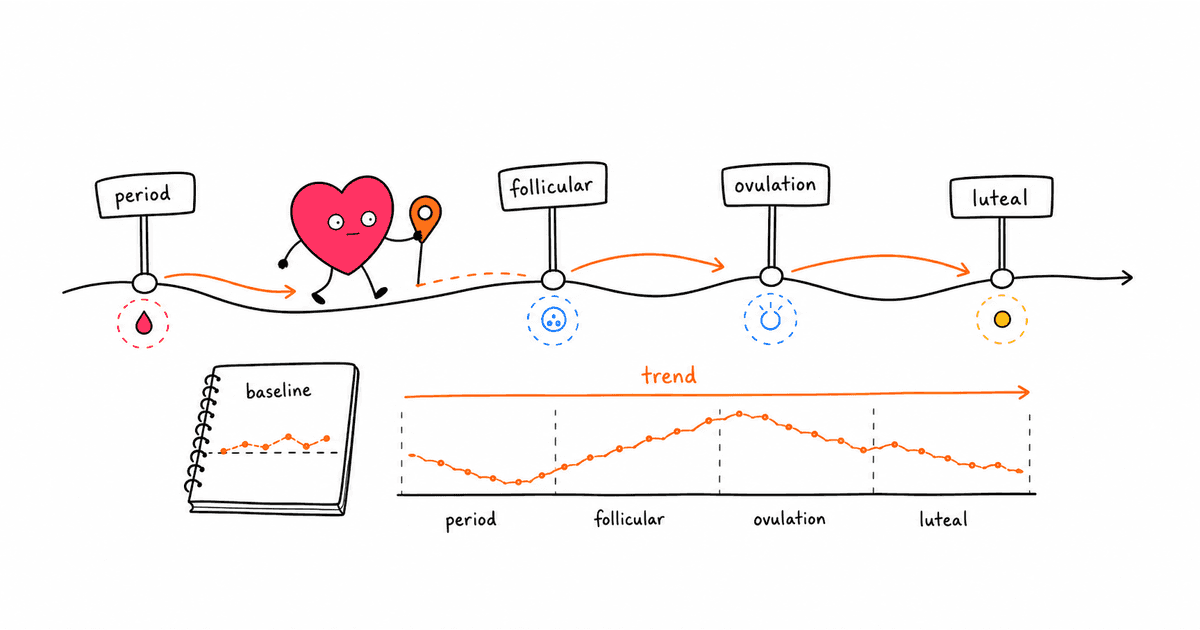
HRV typically decreases during the luteal phase (after ovulation) and increases during the follicular phase (after your period begins). This pattern is driven primarily by progesterone, which rises after ovulation and shifts your autonomic nervous system toward sympathetic dominance.
A meta-analysis of over 1,000 participants found a statistically significant decrease in HRV from the follicular to luteal phase, with a medium effect size. This means the change is meaningful, not just a statistical artifact.
The Hormonal Connection: Progesterone Is the Key
Research has long suggested that hormonal fluctuations affect HRV, but which hormone is responsible? A rigorous study published in the Journal of Clinical Medicine measured estradiol (E2), progesterone (P4), and HRV repeatedly across the menstrual cycle to answer this question.
The findings were clear:
- Progesterone was significantly correlated with HRV changes
- Higher-than-usual progesterone predicted lower-than-usual HRV within individuals
- Estradiol showed no significant effect on HRV, either alone or in combination with progesterone
This means the HRV dip you might experience in the second half of your cycle is primarily driven by progesterone, not estrogen. For a broader look at how different hormones shape your readings, see our guide on hormones and HRV.
Understanding Your Cycle Phases and HRV
Your menstrual cycle consists of distinct phases, each with different hormonal profiles that affect your nervous system:
| Phase | Days (approx.) | Hormones | Typical HRV |
|---|---|---|---|
| Menstrual | 1-5 | Low E2 and P4 | Variable, often rising |
| Follicular | 6-13 | Rising E2, low P4 | Generally higher |
| Ovulation | 14 | Peak E2, rising P4 | May begin to decrease |
| Luteal | 15-28 | High P4, moderate E2 | Generally lower |
The Follicular Advantage
During the follicular phase (from the start of your period until ovulation), progesterone is low and estradiol is gradually rising. This hormonal environment supports higher parasympathetic (vagal) activity, which typically means:
- Higher HRV readings
- Better stress resilience
- Potentially better recovery capacity
Many athletes report feeling stronger and recovering faster during this phase.
The Luteal Challenge
After ovulation, progesterone surges to prepare the body for potential pregnancy. This shift tips the autonomic balance toward sympathetic activation:
- Lower HRV readings
- Increased baseline heart rate
- Potentially slower recovery
This doesn't mean something is wrong. Your body is simply in a different physiological state.
Why Individual Variation Matters
While population-level research shows clear patterns, individual responses vary significantly. As HRV researcher Marco Altini notes, between-individual variability (people respond differently) and within-individual variability (your own response changes cycle to cycle) are both substantial.
Factors that can amplify or mask cycle-related HRV changes:
- Sleep quality: Poor sleep during the luteal phase (a common complaint) compounds HRV reduction
- Training load: Heavy training stress may overwhelm hormonal effects
- Psychological stress: Work or life stress interacts with cycle phase
- Diet and nutrition: Caffeine, alcohol, and food timing all influence HRV
- Cycle irregularity: Irregular cycles make patterns harder to detect
- Inflammation: Luteal-phase inflammatory changes can further affect HRV
This is why some women see dramatic HRV fluctuations across their cycle while others notice almost nothing. If irregular cycles come with insulin resistance, acne, or other signs that raise the question of PCOS, our guide to PCOS and HRV goes deeper on that overlap. If the bigger pattern is severe period pain or chronic pelvic pain, see our guide to endometriosis and HRV.
Practical Applications for Training and Recovery
Understanding your cycle's impact on HRV can help you make smarter decisions about training and recovery, though the research on cycle-based training periodization remains mixed.
Follicular Phase Strategy
When HRV tends to be higher:
- Consider scheduling intense training sessions, heavy lifts, or competition
- Your body may handle higher training loads more efficiently
- Recovery between sessions may be faster
Luteal Phase Strategy
When HRV tends to be lower:
- Don't panic if your HRV drops, this may be normal for you
- Consider emphasizing recovery, mobility work, or lower-intensity training like walking or yoga
- Pay extra attention to sleep quality (which often suffers in this phase)
- Monitor for signs of overreaching if you maintain high training loads
The Context Matters
Importantly, a lower HRV during the luteal phase doesn't automatically mean you should train less. The HRV value provides context, not a direct prescription. An athlete with a "low" luteal phase HRV might still be well-recovered and ready to train, while someone with "normal" HRV might be accumulating fatigue.
Use your cycle phase as one data point among many: subjective energy levels, sleep quality, and training history all matter.
How to Track HRV Across Your Cycle
To understand your personal patterns, consistent tracking is essential. Here's how to get meaningful data:
1. Track Daily (or Near-Daily)
Single measurements during each phase miss the dynamics of how your HRV changes. Daily morning measurements give you the full picture.
2. Log Your Cycle Phase
Most HRV apps allow you to log menstrual bleeding. Some integrate with cycle tracking apps. At minimum, note the first day of your period so you can map HRV to cycle days later.
3. Give It Time
You'll need at least 2-3 complete cycles to start seeing your personal patterns. One cycle isn't enough because within-individual variability is high.
4. Control Other Variables
Try to measure under consistent conditions:
- Same time each morning
- Before caffeine, food, or significant activity
- After similar sleep timing
The more consistent your measurement routine, the clearer your cycle patterns will emerge. If you're new to HRV tracking, our beginner's guide covers the fundamentals, and our guide to understanding HRV numbers will help you interpret what you see.
Recommended HRV Trackers for Cycle Monitoring
For tracking HRV alongside your menstrual cycle, you'll want a device that offers daily measurements and easy logging capabilities:
| Device | Best For | Cycle Tracking |
|---|---|---|
| Oura Ring | Sleep and overnight HRV | Built-in cycle tracking |
| Whoop | Athletes and recovery | Integrates menstrual data |
| Apple Watch Ultra | General wellness | Cycle tracking in Health app |
| Garmin Forerunner 265 | Runners and multisport | Cycle tracking integration |
The best device is one you'll wear consistently. All of these can provide the daily HRV data you need.
Special Considerations
Hormonal Birth Control
Hormonal contraceptives suppress natural hormone fluctuations, which typically reduces or eliminates cycle-related HRV patterns. If you're on the pill, patch, or hormonal IUD, you may not see the same follicular-luteal differences as naturally cycling women.
Perimenopause and Menopause
During perimenopause, erratic hormone fluctuations can cause more unpredictable HRV patterns. Post-menopause, when ovarian hormone production drops significantly, the cyclical pattern disappears, though other factors (sleep, stress, exercise) continue to influence HRV.
Pregnancy
Pregnancy causes substantial HRV changes as the cardiovascular system adapts to support the developing fetus. Blood volume increases, heart rate rises, and HRV typically decreases, especially in the second and third trimesters. If you're pregnant, interpret HRV data with this context in mind.
The Bottom Line
Your menstrual cycle naturally affects your HRV, primarily through progesterone's influence after ovulation. Expect lower readings during the luteal phase and higher readings during the follicular phase, though individual variation is substantial.
This knowledge isn't about limiting yourself during certain phases. It's about understanding your body better so you can:
- Avoid panicking when HRV dips mid-cycle
- Interpret your data with appropriate context
- Make more informed decisions about training and recovery
- Appreciate the remarkable complexity of your physiology
Techniques like breathing exercises and meditation can support HRV throughout every phase of your cycle.
Track consistently, look for your personal patterns, and use cycle phase as helpful context rather than a rigid rule. For general strategies that support HRV regardless of cycle phase, see our guide on how to improve your HRV.
Frequently Asked Questions
Is it normal for my HRV to drop before my period?
Yes, this is common and expected. Progesterone peaks in the mid-luteal phase (about a week before your period), which typically corresponds to lower HRV readings. This isn't a sign of poor health or fitness.
Should I train differently based on my cycle phase?
The research on cycle-based training periodization is still mixed. While HRV patterns suggest the follicular phase may support harder training and better recovery, individual variation is high. Use your HRV data as one input alongside how you feel, sleep quality, and training history.
Why don't I see clear HRV patterns across my cycle?
Several factors can obscure cycle-related patterns: irregular cycles, hormonal birth control, high life stress, variable sleep, or inconsistent measurement timing. Try tracking for 3+ cycles with consistent morning measurements before concluding you don't have a pattern.
Does the pill affect my HRV?
Hormonal contraceptives suppress natural progesterone and estrogen fluctuations, which typically reduces or eliminates the cyclical HRV pattern seen in naturally cycling women. Your HRV may be more stable throughout the month.
Which cycle phase is best for competition?
Based on HRV patterns, the late follicular phase (just before ovulation) may offer optimal parasympathetic support for performance and recovery. However, individual responses vary significantly, and psychological factors often matter more than hormonal timing for competition performance.
Need a quick read on your HRV number first?
Enter your HRV value, age range, device, and recovery context for a plain-English interpretation before you decide what to do next.
Interpret Your HRV NumberBuild the 30-day plan