HRV and Cognitive Performance: How Your Heart Rate Variability Affects Focus, Memory, and Decision Making
Trying to decode today's HRV number? Use the free interpreter first, then build a practical recovery plan. Interpret your HRV
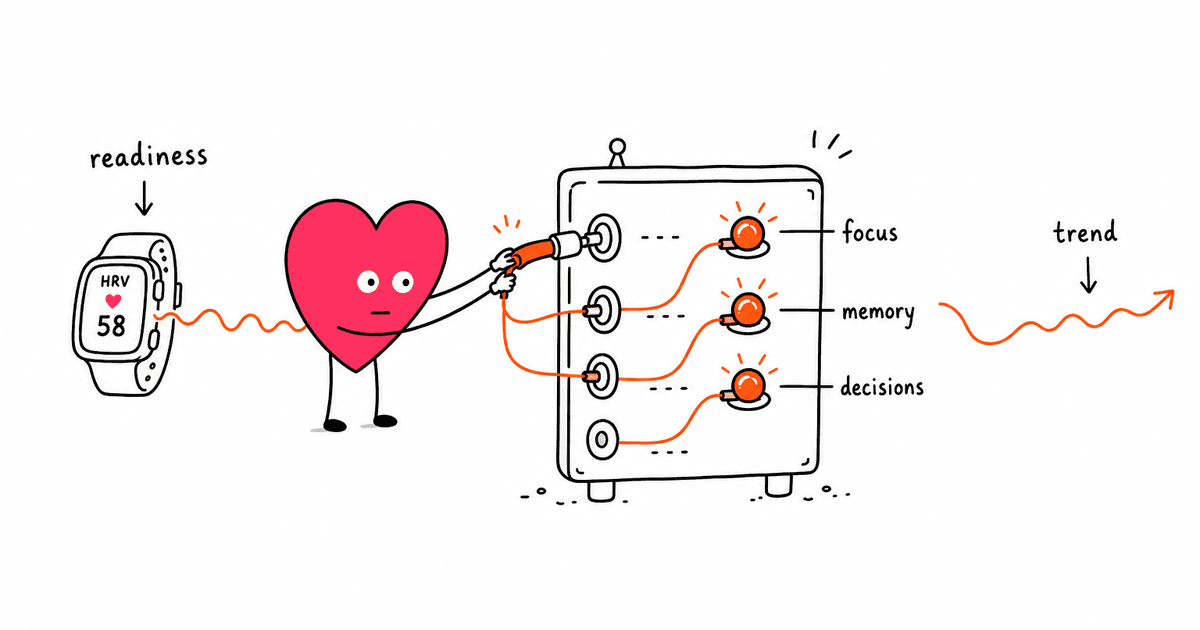
When people think about heart rate variability, they usually think about physical health: recovery, fitness, stress. But a growing body of research reveals that HRV is deeply connected to how well your brain works. Higher HRV is consistently associated with better executive function, sharper attention, stronger working memory, and more effective decision making, especially under pressure.
This isn't a coincidence. Your heart and brain are connected through a sophisticated neural network, and HRV provides a real-time window into how well that network is functioning.
The Neurovisceral Integration Model: Why Your Heart Reflects Your Brain
The neurovisceral integration model, developed by researchers Julian Thayer and Richard Lane, proposes that heart rate variability reflects the functional state of the prefrontal cortex, the brain region responsible for executive control, attention, and self-regulation. This model has become one of the most influential frameworks in psychophysiology over the past two decades.
The core idea is straightforward: the same neural circuits that regulate your heartbeat also regulate your thoughts. The prefrontal cortex exerts top-down inhibitory control over subcortical structures like the amygdala (which drives fear and stress responses). This inhibitory control is transmitted to the heart via the vagus nerve, producing the beat-to-beat variability measured as HRV.
When prefrontal function is strong, you get:
- Effective emotional regulation
- Better impulse control
- Flexible attention
- Higher resting HRV
When prefrontal function is compromised (by stress, sleep deprivation, or illness), both cognitive performance and HRV decline together. As Thayer's research summarized: "HRV is important not so much for what it tells us about the state of the heart as for what it tells us about the state of the brain."
What the Research Shows: HRV and Specific Cognitive Abilities
Executive Function
A 2022 meta-analysis published in Psychophysiology examined 13 studies and found a significant positive association between vagally mediated HRV and executive functioning (r = .19, p < .0001). The analysis revealed that HRV predicts cognitive inhibition and cognitive flexibility more strongly than working memory, suggesting that the heart-brain connection is particularly important for tasks requiring you to suppress distractions, switch between tasks, and adapt to changing demands.
Attention and Focus
A systematic review in Frontiers in Neuroscience (2023) found that individuals with higher HF-HRV (high-frequency power, a marker of vagal tone) demonstrated superior sustained attention and reduced susceptibility to distraction. The researchers linked this to stronger prefrontal regulation of sensory processing. In practical terms, higher HRV means your brain is better at filtering out irrelevant information and staying locked on the task at hand.
Decision Making Under Pressure
A 2022 review in Applied Cognitive Psychology examined the relationship between HRV and decision making across multiple study types. The findings showed that higher resting HRV was associated with better decisions under risk and uncertainty. People with higher HRV were less likely to make impulsive choices, less susceptible to cognitive biases, and more effective at weighing options when the stakes were high.
Working Memory
Research published in ScienceDirect (2024) confirmed the association between HRV and cognitive control, noting that higher HRV correlates with improved conflict resolution abilities and stronger working memory performance. The relationship held across age groups, though the effect size was smaller for working memory than for inhibitory control.
How Low HRV Impairs Your Thinking
The flip side of the HRV-cognition connection is equally important. When HRV drops, cognitive performance suffers in predictable ways:
Reduced attention span: Low HRV is associated with difficulty sustaining focus, particularly on monotonous or complex tasks. The prefrontal cortex struggles to maintain inhibitory control over wandering thoughts.
Poor impulse control: With reduced vagal tone, the amygdala and other subcortical structures exert greater influence over behavior. This manifests as reactive decision making, difficulty resisting distractions, and reduced willpower. This pattern mirrors the autonomic profile seen in ADHD, where prefrontal hypofunction drives both attention deficits and measurably lower HRV.
Impaired cognitive flexibility: Switching between tasks or adapting to new information requires prefrontal resources. When HRV is suppressed, this cognitive flexibility declines, making it harder to adjust your approach when circumstances change.
Increased mental fatigue: A 2025 study in Sensors found that lower resting HRV measured by consumer wearables was significantly associated with greater mental exhaustion and less recovery from work. The autonomic depletion reflected in low HRV directly maps to the subjective experience of being mentally drained.
These cognitive effects are especially pronounced after concussions and traumatic brain injuries, which directly damage the prefrontal-brainstem circuits that regulate both HRV and executive function. Research shows that HRV suppression after a brain injury often outlasts subjective symptoms, making it a valuable objective marker of cognitive recovery.
The Workplace Connection: HRV and Professional Performance
A 2023 study in Behavioral Sciences compared neurocognitive performance between workers with high and low HRV. The researchers assessed 48 white-collar and 53 blue-collar workers and found that those with higher HRV showed better performance on neurocognitive tests, regardless of the type of work they performed. This suggests that HRV-linked cognitive advantages apply broadly, whether your work is primarily mental or physical.
What This Means for Knowledge Workers
For anyone whose job depends on thinking clearly, the implications are significant:
Meetings and collaboration: Higher HRV supports better listening, more thoughtful responses, and reduced reactivity during disagreements.
Deep work and problem-solving: The sustained attention associated with higher HRV directly supports the kind of focused, uninterrupted thinking required for complex problem-solving, writing, coding, or analysis.
High-pressure decisions: When deadlines tighten or stakes rise, people with higher resting HRV maintain better cognitive function. Their prefrontal cortex continues to regulate subcortical stress responses, allowing clearer thinking when it matters most.
Creative thinking: While less studied, the cognitive flexibility associated with higher HRV may also support divergent thinking and creative problem-solving, both of which require the ability to inhibit dominant responses and explore novel connections.
Factors That Tank Both HRV and Cognitive Performance
Several common lifestyle factors simultaneously impair HRV and cognitive function, often creating a downward spiral:
Sleep Deprivation
Even one night of poor sleep can reduce HRV by 10 to 20% and impair attention, working memory, and executive function. Chronic sleep deprivation compounds these effects. Research consistently shows that sleep is the single most important factor for both HRV and cognitive performance.
Chronic Stress
Sustained stress drives sympathetic dominance, lowering HRV and simultaneously impairing prefrontal function. The result is a vicious cycle: stress reduces cognitive resources, which leads to worse decision making, which creates more stress.
Alcohol Consumption
Alcohol is a double hit to HRV and cognition. Even moderate drinking suppresses vagal tone for 24 to 72 hours and impairs executive function, attention, and memory consolidation during that window.
Sedentary Behavior
Prolonged sitting without movement reduces autonomic flexibility and is associated with lower HRV and reduced cognitive performance over time. That is especially relevant for knowledge workers spending long hours at a desk, which we cover in more depth in our guide to sitting all day and HRV. Regular movement breaks have been shown to partially offset these effects.
Poor Nutrition
Nutritional deficiencies, blood sugar instability, and pro-inflammatory diets all contribute to both lower HRV and impaired cognitive function. The gut-brain-heart axis links dietary quality to autonomic balance and mental clarity.
Strategies to Improve Both HRV and Cognitive Performance
The good news: because HRV and cognition share underlying neural mechanisms, interventions that improve one tend to improve the other.
Prioritize Sleep Quality
Optimizing sleep is the highest-leverage intervention for both HRV and cognitive performance. Aim for 7 to 9 hours per night, maintain consistent sleep and wake times, and monitor your overnight HRV trends for feedback.
Aerobic Exercise
Regular cardiovascular exercise, particularly zone 2 training, is one of the most evidence-supported methods for improving both resting HRV and cognitive function. A 2024 meta-analysis confirmed that long-term exercise interventions increase parasympathetic HRV metrics, and separate research links aerobic fitness to improved executive function across all age groups.
Breathing Practices
Slow breathing exercises at 5 to 6 breaths per minute directly stimulate the vagus nerve, acutely boosting HRV. Research on HRV biofeedback training shows that regular practice can improve both autonomic balance and attentional control over time.
Meditation and Mindfulness
Meditation trains the prefrontal cortex to maintain inhibitory control over subcortical activity. Regular meditators show both higher resting HRV and better performance on executive function tasks, suggesting that the practice strengthens the neural circuits linking heart and brain.
Strategic Caffeine Use
Caffeine can temporarily improve focus and attention, but excessive consumption or poor timing may suppress HRV. The optimal approach: moderate caffeine intake (200 to 400mg) consumed before early afternoon, avoiding it within 8 hours of bedtime.
Cold Exposure
Cold exposure activates the vagus nerve through the mammalian dive reflex, acutely raising HRV. While the cognitive benefits are less directly studied, the autonomic shift toward parasympathetic dominance supports the kind of calm alertness associated with peak cognitive performance.
Using HRV Data to Optimize Your Cognitive Day
One of the most practical applications of the HRV-cognition connection is using your daily HRV reading to inform how you structure your day.
When HRV Is Above Your Baseline
Your prefrontal cortex is well-resourced. This is the day to:
- Tackle your most challenging intellectual work
- Make important decisions
- Engage in creative problem-solving
- Schedule difficult conversations or negotiations
When HRV Is Below Your Baseline
Your cognitive resources are depleted. Consider:
- Focusing on routine, low-complexity tasks
- Avoiding major decisions if possible
- Building in more breaks and recovery time
- Skipping the intense workout in favor of walking or light movement
Tracking Tools for the HRV-Cognition Connection
The Oura Ring provides overnight HRV trends and a daily readiness score that integrates HRV with sleep quality. The Whoop offers similar recovery scoring with detailed HRV analytics. Both devices can help you identify patterns between your HRV trends and subjective cognitive performance.
For more active monitoring, the Apple Watch tracks HRV throughout the day, which can reveal how specific activities (meetings, exercise, meals) affect your autonomic state in real time. The Garmin Forerunner 265 also provides body battery and HRV status features that correlate with energy and readiness.
HRV, Aging, and Cognitive Decline
The HRV-cognition connection has important implications for long-term brain health. A 2024 longitudinal systematic review in the Journal of Clinical Medicine found that lower HRV predicted faster cognitive decline over time, independent of traditional risk factors like cardiovascular disease and diabetes. For cognitive decline specifically, our guide to dementia and HRV explains why HRV is useful context, not a diagnostic test.
This finding aligns with research on HRV and longevity, which shows that maintaining higher HRV throughout life is associated with better health outcomes across multiple domains. For older adults, lifestyle interventions that preserve or improve HRV may also help protect against age-related cognitive decline.
The prefrontal cortex is particularly vulnerable to aging, and its function is reflected in HRV metrics. Interventions that maintain vagal tone, such as regular exercise, meditation, and good sleep, may serve a dual purpose: protecting both cardiovascular and cognitive health as the decades pass.
The Role of Stress Recovery in Cognitive Resilience
It's not just your resting HRV that matters for cognition, but also how quickly your HRV recovers after stressors. Research on autonomic flexibility shows that people who recover quickly from stress (returning to high HRV rapidly) demonstrate better cognitive resilience, meaning their thinking holds up better under repeated pressure.
This has practical implications for anyone in a demanding role. Building stress resilience through regular HRV-boosting practices doesn't just make you feel calmer; it literally preserves your ability to think clearly during and after difficult situations.
Consider tracking not just your baseline HRV but also your recovery patterns. Do you bounce back after a stressful meeting? Does your HRV normalize quickly after exercise? These recovery dynamics may be even more predictive of real-world cognitive performance than resting values alone.
The Bottom Line
HRV is not just a fitness metric. It's a real-time indicator of your brain's capacity for focus, decision making, emotional regulation, and cognitive flexibility. The neurovisceral integration model provides a clear framework: the same neural circuits that produce HRV also drive the executive functions that underpin thinking clearly.
By tracking your HRV and optimizing the lifestyle factors that support it (sleep, exercise, stress management, nutrition), you're not just improving your cardiovascular health. You're investing in your ability to think well, work effectively, and make better decisions every day.
Frequently Asked Questions
Can improving HRV directly improve cognitive function?
Evidence suggests the relationship works in both directions. Interventions that improve HRV (like aerobic exercise, breathing exercises, and better sleep) also tend to improve cognitive performance. While the causal mechanisms are still being studied, the shared neural circuits make it likely that improving one supports the other.
What HRV metric best predicts cognitive performance?
Research most consistently links vagally mediated HRV measures, specifically RMSSD and HF power, to cognitive performance. These metrics reflect parasympathetic activity and prefrontal cortex function more directly than time-domain measures like SDNN.
How quickly can HRV changes affect my thinking?
Acute effects are immediate. A single poor night of sleep can lower both HRV and cognitive performance the next day. Conversely, a single breathing exercise session can acutely boost HRV and improve attention within minutes. Sustained improvements in baseline HRV typically require 4 to 8 weeks of consistent lifestyle changes.
Does this mean people with naturally low HRV have worse cognitive abilities?
Not necessarily. HRV is highly individual and influenced by genetics, age, and fitness level. The research describes population-level trends, not individual determinism. What matters most is your HRV relative to your own baseline and whether it's trending in the right direction over time.
Need a quick read on your HRV number first?
Enter your HRV value, age range, device, and recovery context for a plain-English interpretation before you decide what to do next.
Interpret Your HRV NumberBuild the 30-day plan