Social Connection and HRV: How Relationships Affect Heart Rate Variability
Trying to decode today's HRV number? Use the free interpreter first, then build a practical recovery plan. Interpret your HRV
Your HRV is shaped by more than sleep, exercise, and nutrition. A growing body of research suggests that social connection, or the lack of it, plays a significant role in autonomic nervous system function. Loneliness is now recognized as a cardiovascular risk factor on par with smoking, and the mechanism may run directly through your vagal tone.
What Social Connection Does to Your Nervous System
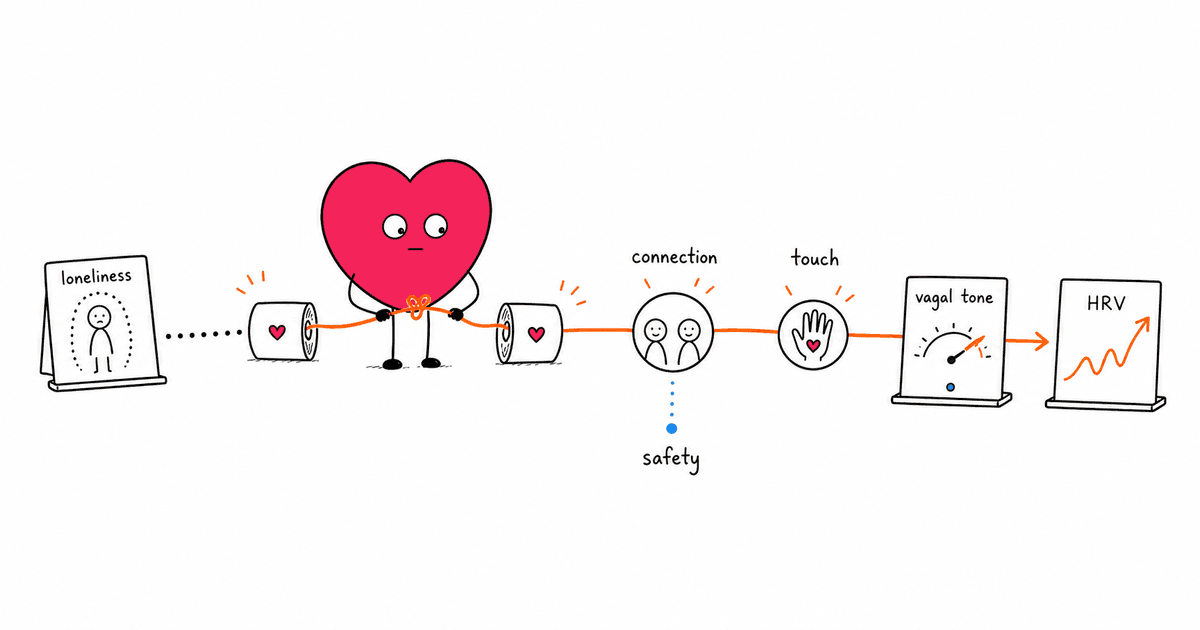
Social connection activates the parasympathetic nervous system, increasing vagal tone and raising HRV. When you engage in positive social interactions, your body shifts toward a "rest and digest" state, promoting cardiovascular resilience and emotional regulation. Chronic loneliness does the opposite, keeping you locked in sympathetic overdrive.
This relationship is rooted in what neuroscientist Stephen Porges calls polyvagal theory. The vagus nerve, which regulates HRV, is deeply involved in social engagement. Facial expressions, vocal tone, and eye contact all activate vagal pathways that directly influence heart rhythm patterns.
The Research on Loneliness and HRV
Multiple studies have established a clear link between loneliness and reduced HRV:
- A 2024 study published in Biological Psychology found that loneliness is negatively correlated with resting RMSSD, with sex being a significant moderator of the relationship
- Research published in Annals of Behavioral Medicine (2021) examined chronic and state loneliness in women, finding that both types were associated with reduced parasympathetic nervous system activity
- A 2021 study in International Journal of Psychophysiology found that individuals susceptible to perceived loneliness had resting HRV below healthy thresholds established in the literature
- A meta-analysis of 13 studies with 787 participants confirmed that increased vagal activity (higher HRV) is associated with better social interaction skills and decreased stress
The takeaway is consistent: loneliness suppresses vagal tone, and social connection enhances it.
Why Loneliness Is a Heart Health Risk
Researcher James Lynch found that loneliness is a greater risk factor for heart disease than lack of exercise, smoking, excessive alcohol consumption, and obesity combined. While that finding is striking, the mechanism makes physiological sense.
When you feel socially isolated, your body interprets it as a threat. The sympathetic nervous system ramps up, cortisol levels rise, inflammation increases, and HRV drops. Over time, this chronic stress response contributes to:
- Elevated resting heart rate
- Reduced heart rate variability
- Increased blood pressure
- Higher levels of systemic inflammation
- Greater risk of cardiovascular events
This is not just a psychological experience. Loneliness produces measurable, physiological changes that show up clearly in HRV data.
How Social Interaction Raises HRV in Real Time
The effect of social connection on HRV is not just a long-term trend. Research shows it happens in real time during interactions.
A 2017 study in Frontiers in Public Health explored the concept of "social coherence," where groups of people in positive interactions begin to synchronize their heart rhythms. This phenomenon, called heart rhythm synchronization, appears to boost individual HRV coherence during the interaction itself.
Conversational engagement also makes a difference. The 2021 International Journal of Psychophysiology study found that even a simple conversational task increased HRV in individuals who were susceptible to loneliness, suggesting that social interaction can temporarily reverse some of the autonomic effects of isolation.
Types of Social Connection That Matter Most
Not all social interaction is equal when it comes to HRV benefits. Research and clinical observation point to several key factors:
Deep, Meaningful Relationships
Surface-level interactions (small talk, social media scrolling) do not activate vagal pathways the same way deeper connections do. Face-to-face conversations with people you trust and care about produce the strongest parasympathetic response.
Physical Touch
Hugging, holding hands, and other forms of physical affection activate the vagus nerve directly. Studies show that couples who engage in more physical touch have higher resting HRV compared to those who do not.
Group Activities
Shared experiences, whether team sports like soccer, racket sports like tennis, group meditation, choir singing, or community volunteering, create a sense of belonging that supports autonomic balance. Group breathing exercises and HRV biofeedback sessions are particularly effective because they combine social connection with direct vagal stimulation. Laughter is another powerful group activity that stimulates the vagus nerve and reduces cortisol, with research showing people laugh 30 times more often in social settings than alone.
Pet Companionship
For those without close human relationships, animal companionship provides measurable benefits. Petting a dog or cat activates the parasympathetic nervous system and has been shown to increase HRV in multiple studies.
Social Media: Connection or Isolation
One of the most relevant questions for modern health is whether digital social interaction provides the same HRV benefits as in-person connection.
The short answer is: probably not. While video calls preserve some vagal engagement through facial expressions and voice tone, text-based social media interaction lacks the sensory cues that activate the social engagement system. Excessive social media use is actually associated with increased feelings of loneliness, anxiety, and depression, which would lower HRV rather than raise it.
That said, maintaining long-distance relationships through video calls is likely far better than no contact at all. The key is prioritizing interactions that involve voice, face, and genuine emotional exchange.
How to Track the Social Connection Effect on Your HRV
If you wear an HRV tracker like the Oura Ring 4 or Whoop 5, you can observe the social connection effect in your own data.
What to Look For
- Morning HRV after social evenings: Compare your overnight HRV after spending time with close friends or family versus evenings spent alone. Many people notice a meaningful increase after quality social time.
- Weekly trends: Track whether weeks with more social engagement show higher average HRV compared to more isolated weeks.
- Stress recovery: Notice how quickly your HRV recovers after a stressful event when you have social support versus when you handle it alone.
A Simple Experiment
For two weeks, alternate between a "social week" (at least one meaningful in-person interaction per day) and a "baseline week" (your normal routine). Compare your average overnight HRV between the two periods. While individual results vary, the research suggests you will likely see a measurable difference.
Practical Steps to Improve HRV Through Social Connection
1. Prioritize In-Person Interaction
Schedule regular face-to-face time with people who matter to you. Even one quality social interaction per day can make a difference for autonomic health.
2. Join a Group Activity
Whether it is a running club, a walking group, a yoga class, a dance class, or a volunteer organization, shared activities provide both social connection and a sense of purpose.
3. Practice Active Listening
During conversations, focus on truly listening rather than planning your response. This deeper engagement activates vagal pathways more effectively than distracted interaction. Research on gratitude shows that expressing appreciation during social interactions further amplifies the parasympathetic benefits.
4. Reduce Passive Social Media Use
Replace mindless scrolling with intentional communication. A five-minute phone call provides more autonomic benefit than an hour on social media.
5. Cultivate Physical Affection
If you have close relationships where it is appropriate, increase physical touch through hugs, handshakes, or simply sitting close together. Physical contact is one of the most direct vagal activators.
6. Consider a Pet
If your living situation allows it, pet ownership provides consistent daily opportunities for parasympathetic activation through touch, routine, and companionship.
The Bigger Picture: HRV as a Social Health Metric
HRV is often discussed in the context of fitness and recovery, but it may be equally valuable as an indicator of social health. A persistently low HRV with no clear physical explanation (adequate sleep, moderate exercise, good nutrition) could be a signal that your social needs are not being met.
This reframes HRV tracking from a purely physical health tool to something more holistic. Your heart rhythm reflects not just how well you slept or trained, but how connected you feel to the people around you. For a broader view of factors that influence your readings, see our guide on how to improve HRV.
Key Takeaways
- Social connection boosts parasympathetic activity and raises HRV through vagal nerve pathways
- Loneliness is associated with lower resting HRV, higher resting heart rate, and increased cardiovascular risk
- The effect is measurable in real time during positive social interactions
- In-person, emotionally meaningful connections provide the strongest HRV benefits
- Social media interaction does not appear to replicate the autonomic benefits of face-to-face connection
- HRV tracking can serve as a useful feedback tool for monitoring your social health
- Even small increases in daily social engagement can produce measurable changes in autonomic function
Your HRV is a reflection of your whole life, not just your workouts. If you are optimizing sleep, nutrition, and exercise but ignoring your social connections, you may be missing one of the most powerful levers available for improving autonomic health.
Frequently Asked Questions
Can video calls provide the same HRV benefits as in-person connection?
Video calls preserve some vagal engagement through facial expressions and voice tone, but they lack physical touch and full sensory presence. Research suggests video calls are better than text-only communication but not as effective as face-to-face interaction for autonomic benefits.
How quickly does social interaction affect HRV?
Studies show HRV changes can occur in real time during positive social interactions. You may notice improved overnight HRV after an evening with close friends, and the effect is often visible in morning readings from devices like the Oura Ring or Whoop.
Is quality or quantity of social connections more important for HRV?
Quality matters more. Deep, meaningful relationships with a few trusted people provide stronger parasympathetic activation than many superficial interactions. Focus on the depth of connection rather than the number of contacts.
Need a quick read on your HRV number first?
Enter your HRV value, age range, device, and recovery context for a plain-English interpretation before you decide what to do next.
Interpret Your HRV NumberBuild the 30-day plan