PTSD and HRV: How Trauma Reshapes Your Autonomic Nervous System
Trying to decode today's HRV number? Use the free interpreter first, then build a practical recovery plan. Interpret your HRV
Post-traumatic stress disorder (PTSD) affects approximately 13 million Americans in any given year, according to the National Institute of Mental Health. But PTSD isn't purely psychological. It leaves a measurable imprint on the body, particularly in the autonomic nervous system.
Heart rate variability provides a direct window into this autonomic disruption. A growing body of research reveals that PTSD consistently lowers HRV, reflecting a nervous system stuck in survival mode. Understanding this connection can change how people approach both tracking and recovery.
Whether you're a veteran, first responder, survivor of assault, or anyone working through trauma, the relationship between PTSD and HRV offers both a clearer picture of what's happening in your body and practical pathways toward healing.
How PTSD Affects the Autonomic Nervous System
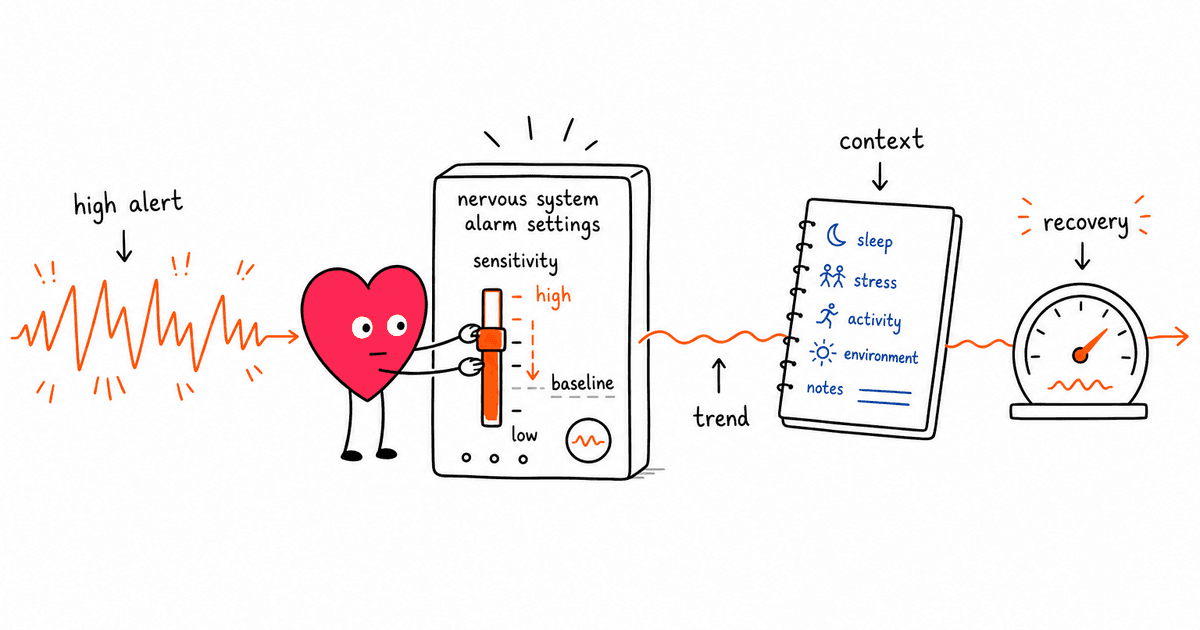
PTSD causes chronic autonomic dysregulation, shifting the nervous system toward sustained sympathetic (fight-or-flight) dominance while suppressing parasympathetic (rest-and-digest) activity. This imbalance is measurable through reduced heart rate variability and elevated resting heart rate.
In a healthy nervous system, the sympathetic and parasympathetic branches work in balance. The vagus nerve acts as a brake, calming the heart after a perceived threat passes. In PTSD, this brake weakens. The body stays on alert even when the danger is long gone.
This isn't a choice or a failure of willpower. Trauma physically changes how the brain communicates with the heart through the autonomic nervous system, creating patterns that persist for months, years, or even decades after the original traumatic event.
What the Research Shows About PTSD and Low HRV
A major meta-analysis published in Psychological Medicine (Cambridge University Press, 2020) analyzed decades of research and confirmed that PTSD is consistently associated with lower resting HRV. The findings showed reductions across multiple HRV metrics, including RMSSD, high-frequency (HF) power, and SDNN, suggesting a broad pattern of autonomic dysfunction rather than a single-metric issue.
A 2024 review in Frontiers in Psychiatry further demonstrated that low HRV measured shortly after a physical injury can predict who goes on to develop PTSD, with childhood trauma history amplifying the risk. This suggests HRV isn't just a consequence of PTSD; it may serve as an early warning signal.
The umbrella review published in Translational Psychiatry (Nature, 2025) confirmed that among all mental health conditions studied, PTSD shows some of the most significant HRV reductions, highlighting the depth of autonomic disruption that trauma creates.
Why PTSD Lowers HRV: The Mechanisms
Several interconnected mechanisms explain why trauma suppresses heart rate variability.
Chronic Sympathetic Activation
PTSD keeps the sympathetic nervous system in a state of hyperarousal. The brain's threat detection system, particularly the amygdala, becomes overactive. It fires alarm signals even in safe environments, maintaining elevated cortisol and adrenaline levels that suppress vagal tone and reduce HRV.
Reduced Vagal Tone
The vagus nerve is the primary driver of HRV. In PTSD, vagal tone decreases as the parasympathetic nervous system takes a back seat to the sympathetic stress response. Lower vagal tone means less beat-to-beat variation in heart rate, which appears as chronically low HRV readings.
Neuroinflammation
Decreased HRV in PTSD is linked to increased systemic inflammation. Research suggests that the vagal anti-inflammatory pathway becomes impaired, allowing pro-inflammatory cytokines to circulate at higher levels. This creates a feedback loop: inflammation further suppresses vagal activity, which further lowers HRV, which further increases inflammation.
Studies have found elevated levels of C-reactive protein (CRP) and interleukin-6 (IL-6) in people with PTSD, both of which correlate with reduced HRV. This inflammatory burden also increases cardiovascular risk, which may partly explain why PTSD is associated with higher rates of heart disease.
Altered Brain-Heart Communication
Brain imaging studies show that PTSD alters activity in the prefrontal cortex, the brain region responsible for top-down regulation of autonomic responses. When prefrontal control weakens, the body loses its ability to modulate heart rate in response to changing environments, a capacity directly reflected in HRV measurements.
PTSD vs. Anxiety and Depression: Different HRV Patterns
While anxiety and depression both lower HRV, PTSD presents a distinct autonomic profile.
| Condition | HRV Pattern | Key Distinction |
|---|---|---|
| Anxiety | Reduced HF-HRV, elevated resting HR | Primarily parasympathetic withdrawal |
| Depression | Reduced overall HRV (SDNN, RMSSD) | Associated with behavioral withdrawal |
| PTSD | Broad reductions across all metrics | Hyperarousal + dissociation + blunted reactivity |
PTSD is unique because it can produce both hyperarousal (extremely low HRV during triggers) and dissociative states (paradoxically flat or unresponsive HRV). This dual pattern reflects the polyvagal theory concept of the nervous system shifting between mobilization (fight/flight) and immobilization (freeze/shutdown) responses.
People with PTSD may also show blunted HRV reactivity, meaning their heart rate variability fails to respond normally to both stressors and relaxation. The system becomes stuck, neither revving up nor calming down appropriately.
Complex PTSD and HRV: A Deeper Pattern
Complex PTSD (C-PTSD) develops from prolonged, repeated trauma rather than a single event. Common causes include childhood abuse, domestic violence, and prolonged captivity. Research using real-time HRV monitoring during psychological intervention (published in Applied Sciences, 2024) found that C-PTSD may produce even more severe autonomic disruption than standard PTSD.
People with C-PTSD often show difficulty with emotional regulation that goes beyond typical PTSD hyperarousal. Their HRV patterns may reflect rapid shifts between sympathetic dominance and dorsal vagal shutdown, the freeze response described in polyvagal theory. This creates erratic HRV readings that swing between very low values during dissociative episodes and slightly higher values during periods of relative calm.
Understanding the difference matters for treatment planning. C-PTSD often requires longer intervention timelines and more gradual approaches to vagal nerve stimulation, as the nervous system may be more sensitive to perceived threats during recovery work.
HRV as a Biomarker for PTSD
One of the most promising applications of HRV in PTSD research is its potential as a biomarker, an objective, measurable indicator that complements symptom-based diagnosis.
Predicting PTSD Risk
Research from 2024 in Frontiers in Psychiatry found that low HRV measured shortly after a traumatic event (such as a physical injury) can predict who will go on to develop PTSD. This is significant because early intervention dramatically improves outcomes, and HRV could identify at-risk individuals before symptoms fully manifest.
Tracking Treatment Progress
A 2024 study in Applied Psychophysiology and Biofeedback demonstrated that baseline RMSSD values predicted how well veterans would respond to biofeedback treatment. Those with RMSSD in the normal range before treatment showed the greatest improvements in both PTSD and depression symptoms. HRV tracking could help clinicians personalize treatment approaches based on autonomic function.
Monitoring Recovery
Because HRV reflects real-time autonomic state, it offers a way to track recovery progress that doesn't rely solely on self-reported symptoms. As the nervous system heals, HRV typically increases. Tracking this over weeks and months provides tangible evidence that the body's stress response is normalizing.
This is particularly meaningful for PTSD recovery, where progress can feel invisible. Therapy may not produce dramatic shifts in how someone feels day to day, but HRV data can reveal subtle autonomic improvements that precede noticeable symptom relief. Seeing objective evidence of physiological change can reinforce motivation to continue treatment.
HRV Biofeedback for PTSD Recovery
HRV biofeedback training has emerged as one of the most studied complementary treatments for PTSD, and the results are encouraging.
How It Works for Trauma Recovery
HRV biofeedback involves breathing at your resonance frequency (typically 4.5 to 6.5 breaths per minute) while monitoring real-time HRV data. This practice directly stimulates the vagus nerve and trains the parasympathetic nervous system to become more active.
For people with PTSD, this is particularly relevant because it targets the exact mechanism that trauma disrupts: vagal tone and parasympathetic function.
Sessions typically last 10 to 20 minutes and are performed daily during the initial training phase. Over time, the autonomic nervous system begins to respond more readily to parasympathetic activation, gradually restoring the flexibility that trauma suppressed. Many clinicians start with guided sessions before transitioning to independent practice.
Evidence From Military Studies
A 2024 meta-analysis published in Military Medicine examined HRV biofeedback specifically as a treatment for military PTSD. The analysis found that HRV biofeedback significantly increased HRV while reducing PTSD symptoms when added to standard treatment.
The VA's Whole Health program has incorporated biofeedback based on findings that veterans receiving HRV biofeedback plus treatment as usual showed greater improvements than those receiving standard treatment alone.
A pilot study from Applied Psychophysiology and Biofeedback (2022) found that even a brief three-session HRV biofeedback protocol produced significant improvements in depression and SDNN values among veterans with PTSD, with notable reductions in intrusion symptoms (flashbacks and unwanted memories).
Practical Considerations
HRV biofeedback is not a standalone treatment for PTSD. It works best alongside evidence-based therapies like Cognitive Processing Therapy (CPT), Prolonged Exposure (PE), or EMDR. Think of it as a tool that helps restore the autonomic foundation that makes other therapies more effective.
The 2024 Frontiers in Psychiatry study on emotion regulation and HRV suggested that baseline HRV levels could help clinicians determine which type of therapy might work best for a given patient. Those with higher pre-treatment HRV responded better to certain approaches, opening the door to more personalized treatment matching.
Other Evidence-Based Approaches That Improve HRV in PTSD
Beyond biofeedback, several interventions have shown the ability to improve both HRV and PTSD symptoms.
Slow Breathing Exercises
Controlled breathing techniques at 5 to 6 breaths per minute directly stimulate vagal pathways. Research on trauma-sensitive breathing protocols shows improvements in both HRV and self-reported PTSD severity.
Meditation and Mindfulness
Meditation practices, particularly those designed for trauma (such as Trauma-Sensitive Mindfulness), can gradually increase vagal tone. Consistency matters: research suggests 8 to 12 weeks of regular practice before significant HRV changes appear.
Physical Exercise
Regular aerobic exercise increases vagal tone and HRV over time. For people with PTSD, zone 2 training offers a low-intensity option that improves autonomic function without triggering the hyperarousal that intense exercise can sometimes produce in trauma survivors. Activities like walking and swimming are particularly well-suited because they combine rhythmic movement with natural breath regulation.
Sleep Optimization
PTSD frequently disrupts sleep, and poor sleep further lowers HRV. Addressing sleep disturbances, whether through CBT for insomnia, sleep hygiene, or medical intervention, is often a critical component of restoring healthy HRV patterns.
How to Track HRV If You Have PTSD
If you're living with PTSD or recovering from trauma, tracking HRV can provide useful insights, but context matters.
Choosing a Device
Wearables like the Oura Ring or Whoop provide overnight HRV tracking that captures your baseline autonomic state during sleep. This is particularly valuable for PTSD, where nighttime hyperarousal often disrupts recovery.
For HRV biofeedback sessions, a chest strap like the Garmin HRM-600 paired with a biofeedback app provides the real-time accuracy needed for training.
What to Watch For
Focus on trends rather than single readings. Key patterns to track include:
- Overnight HRV baseline: Is your average trending upward over weeks and months?
- HRV recovery after triggers: Does your HRV bounce back within hours, or does it stay suppressed for days?
- Morning readiness scores: Consistent low scores may indicate that your nervous system isn't recovering during sleep.
- Correlation with symptoms: Note whether HRV dips align with flashbacks, nightmares, or periods of heightened anxiety.
Important Caveats
HRV tracking is a wellness tool, not a diagnostic instrument. Low HRV alone does not mean you have PTSD, and normal HRV doesn't mean you don't. Always work with a qualified mental health professional for PTSD diagnosis and treatment.
Avoid obsessively checking HRV data, especially during acute symptom periods. For some people, daily number-watching can increase health anxiety. Weekly or monthly trend reviews are often more helpful.
If your HRV data shows a pattern of chronically low readings combined with poor sleep metrics and elevated resting heart rate, consider sharing this data with your therapist or healthcare provider. While HRV alone isn't diagnostic, it provides objective physiological context that can inform treatment decisions.
The Bigger Picture: Why This Research Matters
The connection between PTSD and HRV highlights something important about trauma: it is a whole-body experience. The autonomic nervous system, the immune system, the cardiovascular system, and the brain are all involved.
HRV provides one of the most accessible, non-invasive ways to measure the physiological impact of trauma and track progress toward recovery. As wearable technology continues to improve, the potential for HRV monitoring to support trauma-informed care, from early identification to treatment personalization to recovery tracking, becomes increasingly practical.
For the millions of people living with PTSD, this research offers a message grounded in physiology: the nervous system's response to trauma is real, measurable, and changeable. Recovery is not just about changing thoughts. It's about restoring balance to the autonomic nervous system, one heartbeat at a time.
If you or someone you know is experiencing symptoms of PTSD, the National PTSD Helpline and the 988 Suicide & Crisis Lifeline (call or text 988) provide free, confidential support.
Need a quick read on your HRV number first?
Enter your HRV value, age range, device, and recovery context for a plain-English interpretation before you decide what to do next.
Interpret Your HRV NumberBuild the 30-day plan