Tai Chi and HRV: How This Ancient Practice Improves Heart Rate Variability
What Is Tai Chi?
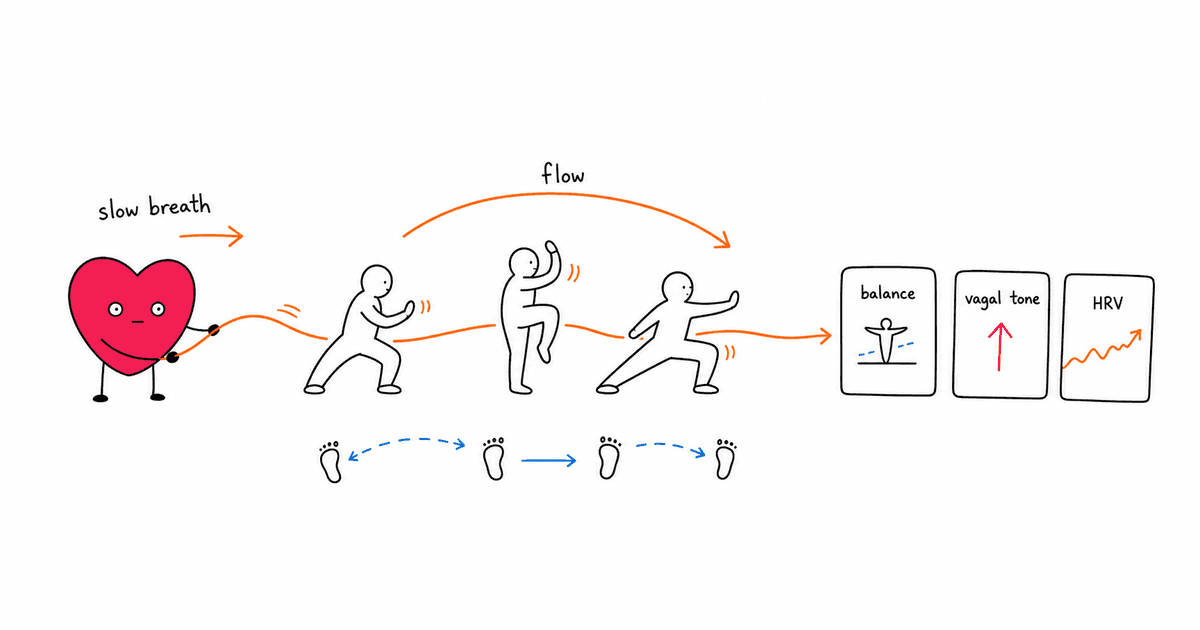
Tai Chi is a centuries-old Chinese martial art that combines slow, deliberate movements with deep breathing and meditation. Originally developed for self-defense, it has evolved into a gentle form of exercise practiced by millions worldwide for its physical and mental health benefits. Unlike high-intensity workouts, Tai Chi works with your body's natural rhythms to promote balance, flexibility, and inner calm.
A standard Tai Chi routine consists of 24 distinct postures performed in a flowing sequence. Each movement emphasizes coordination between the upper body and a stable lower-body stance, creating a low-impact workout that is accessible to people of all ages and fitness levels.
Does Tai Chi Improve HRV?
Yes, research consistently shows that Tai Chi improves heart rate variability by enhancing parasympathetic (vagal) nervous system activity and restoring balance to the autonomic nervous system. Multiple systematic reviews and meta-analyses have confirmed these benefits across diverse populations.
A 2023 systematic review and meta-analysis published in the International Journal of Environmental Research and Public Health evaluated the effects of Tai Chi on HRV across multiple studies. The findings showed that Tai Chi, compared with non-active control conditions, had a positive impact on key HRV parameters associated with autonomic nervous system balance.
A 2024 study published in Scientific Reports examined the acute effects of different Tai Chi practice protocols on cardiac autonomic modulation. Researchers found that Tai Chi practice shifted the autonomic balance toward parasympathetic dominance, the branch of the nervous system associated with rest, recovery, and higher HRV.
Another 2024 systematic review published in Heart and Mind synthesized existing literature on Tai Chi and Qigong, confirming that these mind-body practices positively influence HRV parameters in adult populations across both clinical and nonclinical settings.
How Tai Chi Improves HRV
Tai Chi affects heart rate variability through several interconnected mechanisms:
1. Deep, Diaphragmatic Breathing
Every Tai Chi movement is coordinated with slow, intentional breathing. This type of breathing directly stimulates the vagus nerve, the primary driver of parasympathetic activity. When you breathe slowly (typically 4 to 6 breaths per minute during practice), you activate what researchers call respiratory sinus arrhythmia, a natural rhythm where your heart rate rises slightly on inhalation and falls on exhalation. This is one of the most reliable ways to boost HRV in real time.
If you want to learn more about this mechanism, check out our guide on breathing exercises and HRV.
2. Slow, Mindful Movement
The deliberate, flowing movements of Tai Chi engage your muscles at low to moderate intensity without triggering a strong sympathetic (fight-or-flight) response. This allows your body to maintain parasympathetic tone even while exercising, something that rarely happens during conventional workouts.
3. Meditative Focus
Tai Chi requires sustained attention to body position, movement transitions, and breath coordination. This focused awareness activates the prefrontal cortex and reduces activity in the amygdala (your brain's stress center), leading to reduced cortisol output and improved vagal tone over time.
4. Stress Reduction
Chronic stress is one of the biggest drivers of low HRV. Regular Tai Chi practice has been shown to reduce perceived stress, anxiety, and depression, all of which contribute to sympathetic overactivation. By lowering your baseline stress level, Tai Chi creates conditions for your HRV to improve naturally.
For more on the stress-HRV connection, see our article on HRV and stress.
What the Research Says: Key Findings
Here is a summary of the most relevant research on Tai Chi and HRV:
| Study | Year | Key Finding |
|---|---|---|
| Systematic Review & Meta-Analysis (IJERPH) | 2023 | Tai Chi significantly improved HRV parameters vs. non-active controls |
| Acute Effects Study (Scientific Reports) | 2024 | Different Tai Chi protocols shifted autonomic balance toward parasympathetic dominance |
| Tai Chi & Qigong Review (Heart and Mind) | 2024 | Both practices positively influenced HRV across clinical and nonclinical populations |
| Tai Chi & Depression in Older Adults (Int J Geriatr Psychiatry) | 2018 | Tai Chi improved both depression scores and HRV in older Chinese adults |
| Tai Chi Synergy T1 Study (eCAM) | 2018 | Tai Chi shifted autonomic balance from sympathetic to parasympathetic tone |
The evidence is particularly strong for older adults, people with cardiovascular risk factors, and those dealing with chronic stress or depression.
Tai Chi vs. Other Mind-Body Practices for HRV
How does Tai Chi compare to other practices known to improve HRV?
| Practice | HRV Benefit | Intensity | Accessibility | Additional Benefits |
|---|---|---|---|---|
| Tai Chi | Strong | Low to moderate | Very high (no equipment needed) | Balance, flexibility, fall prevention |
| Yoga | Strong | Low to moderate | High | Flexibility, strength |
| Meditation | Moderate | None (seated) | Very high | Mental clarity, focus |
| Breathing exercises | Strong (acute) | None | Very high | Immediate stress relief |
| Walking | Moderate | Low | Very high | Cardiovascular fitness |
Tai Chi stands out because it combines the breathing and meditative components (which directly stimulate the vagus nerve) with gentle physical movement (which adds cardiovascular and musculoskeletal benefits). For a deeper look at yoga's effects, see our guide on yoga and HRV.
How to Start a Tai Chi Practice for Better HRV
Getting Started
You do not need any special equipment, a gym membership, or prior experience to begin Tai Chi. Here is a practical roadmap:
-
Start with a beginner class or video series. Look for "Yang style" Tai Chi, which is the most widely taught and researched form. Many community centers, senior centers, and YMCAs offer beginner classes.
-
Practice for 20 to 30 minutes, 3 to 5 times per week. Most studies showing HRV improvements used protocols of 3 or more sessions per week for 8 to 12 weeks.
-
Focus on your breath. The HRV benefits of Tai Chi are closely tied to the breathing component. Aim for slow, deep diaphragmatic breaths coordinated with each movement.
-
Be patient. Autonomic nervous system adaptations take time. Most research shows measurable HRV improvements after 8 to 12 weeks of consistent practice.
-
Practice outdoors when possible. Combining Tai Chi with nature exposure may amplify the parasympathetic benefits. Our article on nature exposure and HRV explores this connection.
Tracking Your Progress
Use an HRV-capable wearable to monitor your progress over time. Take a baseline reading before starting your practice, then track trends over weeks and months rather than day-to-day fluctuations.
Good options for HRV tracking include:
- Oura Ring 4 for overnight HRV tracking with minimal disruption to your practice (full review)
- Apple Watch Ultra 2 for continuous daytime and nighttime HRV monitoring
- Garmin Forerunner 265 for detailed HRV status trends alongside fitness metrics
For a full breakdown of tracking options, see our best HRV monitors guide.
Tips for Maximizing HRV Benefits
- Practice at the same time each day. Consistency helps your body establish a rhythm and makes it easier to track HRV trends.
- Combine with other HRV-friendly habits. Pair your Tai Chi practice with good sleep hygiene, proper hydration, and balanced nutrition.
- Avoid practicing immediately after eating. Wait at least an hour after a meal to allow digestion before practicing.
- Do not rush. Slower movements with longer, deeper breaths tend to produce greater parasympathetic activation than faster routines.
Who Benefits Most from Tai Chi for HRV?
While anyone can benefit from Tai Chi, the research suggests certain groups may see particularly strong HRV improvements:
- Older adults. Age-related decline in HRV is well-documented, and Tai Chi has been extensively studied in this population with consistently positive results. See our guide on HRV for seniors.
- People with cardiovascular risk factors. Tai Chi has been shown to lower blood pressure, improve lipid profiles, and enhance autonomic function in people at risk for heart disease.
- Those dealing with chronic stress, anxiety, or depression. The mind-body integration of Tai Chi addresses both the psychological and physiological components of these conditions. Learn more in our articles on HRV and anxiety and HRV and depression.
- People recovering from cardiac events. The low-impact nature of Tai Chi makes it safe and effective for cardiac rehabilitation programs.
- Anyone who finds high-intensity exercise difficult or unappealing. Tai Chi provides real cardiovascular and autonomic benefits without the intensity barrier.
Frequently Asked Questions
How long does it take for Tai Chi to improve HRV?
Most studies show measurable HRV improvements after 8 to 12 weeks of regular practice (3 or more sessions per week). Some acute improvements in parasympathetic activity can be measured immediately after a single session, but lasting changes to resting HRV take consistent practice.
Is Tai Chi better than walking for HRV?
Both are beneficial, but Tai Chi has a distinct advantage because it combines physical movement with deep breathing and meditative focus. The breathing component directly stimulates the vagus nerve in a way that regular walking does not. That said, walking is still excellent for cardiovascular health and can complement a Tai Chi practice.
Can I do Tai Chi every day?
Yes. Unlike high-intensity exercise, Tai Chi does not require recovery days because it does not place significant stress on your muscles or joints. Daily practice is safe and may accelerate HRV improvements.
Do I need a specific style of Tai Chi for HRV benefits?
Yang style is the most widely studied and is recommended for beginners. However, any style that emphasizes slow movements with coordinated breathing should provide similar autonomic benefits. The key is consistency and proper breathing technique.
Can I combine Tai Chi with other HRV-improving practices?
Absolutely. Tai Chi pairs well with meditation, breathing exercises, and good sleep habits. Many practitioners find that starting the day with Tai Chi and ending with a brief meditation creates a strong foundation for higher HRV.
Need a quick read on your HRV number first?
Enter your HRV value, age range, device, and recovery context for a plain-English interpretation before you decide what to do next.
Interpret Your HRV NumberBuild the 30-day plan