Nature Exposure and HRV: How Time Outdoors Boosts Your Nervous System
Trying to decode today's HRV number? Use the free interpreter first, then build a practical recovery plan. Interpret your HRV
If you track your HRV, you have probably noticed that vacations, weekend hikes, or simply spending a morning outside tend to produce some of your best readings. That pattern is not a coincidence. A growing body of research shows that exposure to natural environments directly activates the parasympathetic nervous system, the branch of your autonomic nervous system that drives higher HRV.
The Japanese practice of "shinrin-yoku," or forest bathing, has been studied extensively over the past two decades. The findings are consistent: time in nature produces measurable, dose-dependent improvements in heart rate variability, stress hormones, blood pressure, and immune function.
What Does the Research Say?
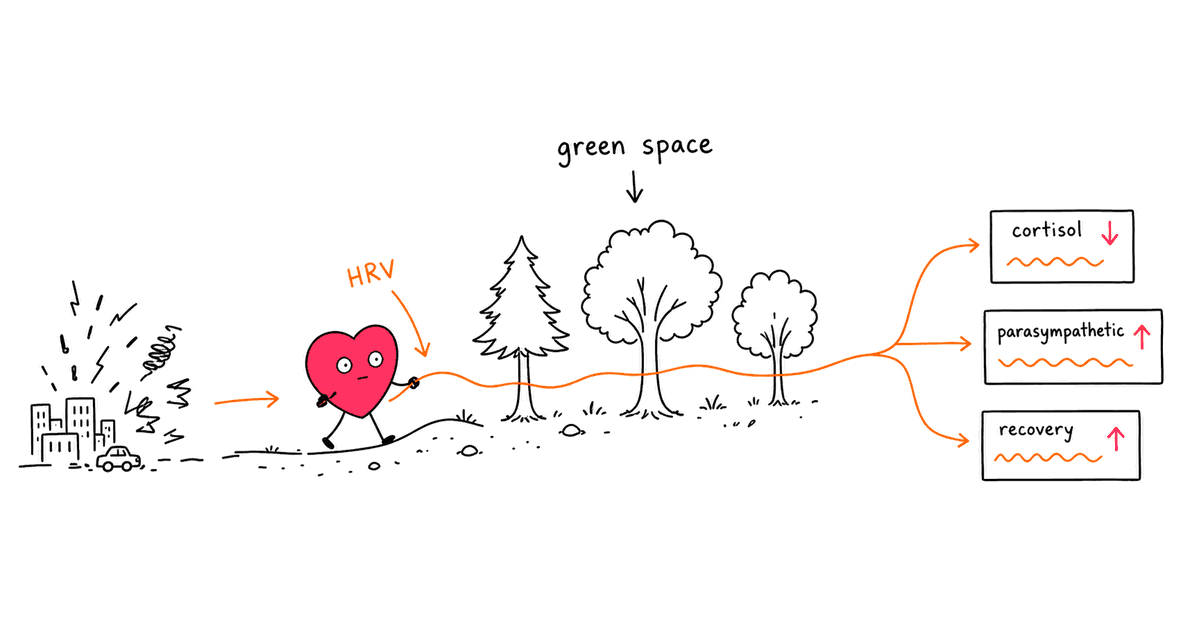
Nature exposure increases heart rate variability by activating the parasympathetic nervous system, reducing cortisol, and lowering sympathetic arousal. A 2024 study in Frontiers in Psychology found that a single forest bathing session increased HRV by an average of 9.7 ms in stressed participants, with corresponding reductions in blood pressure and self-reported anxiety (Lopez-Pousa et al., 2024).
A comprehensive review by Farrow and Washburn (2019) analyzed multiple field experiments and concluded that forest environments, compared to urban settings, consistently reduce heart rate, lower cortisol levels, decrease blood pressure, and increase parasympathetic nervous system activity as measured by HRV. The key marker in most studies is an increase in HF-HRV (high-frequency heart rate variability), which reflects vagal tone.
The Autonomic Shift
When you step into a natural environment, several things happen to your nervous system:
- Sympathetic activity decreases. Your fight-or-flight response dials down. Cortisol and norepinephrine levels drop.
- Parasympathetic activity increases. Vagal tone improves, reflected in higher HF-HRV.
- Heart rate slows. Resting heart rate typically drops within 15 to 20 minutes of nature exposure.
- Blood pressure normalizes. Both systolic and diastolic blood pressure decrease.
This autonomic shift is not subtle. Studies using continuous ECG monitoring have shown statistically significant changes in HRV within the first 15 minutes of forest exposure compared to urban environments (Li et al., 2011).
Why Does Nature Affect HRV?
Researchers have identified several mechanisms through which natural environments influence autonomic function.
Phytoncides and Terpenes
Trees release volatile organic compounds called phytoncides and terpenes as part of their natural defense system. When you breathe forest air, you inhale these compounds. Research shows that phytoncides like alpha-pinene and D-limonene have direct effects on the autonomic nervous system, reducing sympathetic activity and boosting natural killer (NK) cell function (Li, 2010).
A controlled study found that exposure to phytoncides in a hotel room (simulating forest air) significantly increased HRV and NK cell activity compared to a control room, suggesting the compounds themselves, not just the visual environment, drive part of the effect (Li et al., 2009).
Attention Restoration
According to Attention Restoration Theory (ART), natural environments allow your brain to shift from directed attention (which is mentally taxing) to "soft fascination," a gentle, effortless engagement with the environment. This cognitive shift reduces mental fatigue and lowers sympathetic arousal, both of which improve HRV.
Urban environments demand constant directed attention: traffic, noise, crowds, screens. This sustained cognitive load keeps your sympathetic nervous system elevated. Urban air pollution adds another layer of autonomic stress through fine particulate matter that directly suppresses parasympathetic activity. Nature provides the opposite signal on both fronts.
Reduced Sensory Stress
Natural soundscapes (birdsong, running water, wind through leaves) activate parasympathetic pathways in the brain. A 2017 study published in Scientific Reports found that natural sounds increased vagal tone and shifted attention outward, while artificial sounds increased sympathetic activity and inward-focused attention (Gould van Praag et al., 2017).
Even visual exposure to greenery through a window has been shown to improve recovery from stress and reduce cortisol, though the effects are smaller than direct immersion.
Negative Ion Exposure
Natural environments, especially near moving water and forests, have higher concentrations of negative air ions. While the research is still emerging, some studies suggest negative ions may improve serotonin regulation and autonomic balance.
How Much Nature Exposure Do You Need?
The research suggests a clear dose-response relationship, but even small doses matter.
Minimum Effective Dose
- 15 to 20 minutes of walking in a green space produces measurable increases in HRV and reductions in cortisol (Park et al., 2010)
- 2 hours per week is the threshold identified by a large UK study (White et al., 2019) as the point where people report significantly better health and wellbeing
- Effects appear to be cumulative: regular short exposures may be as beneficial as occasional long ones
Optimal Protocols From Research
| Duration | Setting | HRV Effect | Source |
|---|---|---|---|
| 15 min walk | Forest vs. urban | Significant HF-HRV increase | Park et al., 2010 |
| 2-hour session | Forest bathing | +9.7 ms RMSSD increase | Lopez-Pousa et al., 2024 |
| 3-day retreat | Forest immersion | Sustained HRV improvement + NK cell boost | Li, 2010 |
| 120 min/week | Any green space | Health threshold met | White et al., 2019 |
Forest vs. Urban Green Space vs. Indoor Plants
Not all nature exposure is equal:
- Forest environments produce the strongest effects due to phytoncide exposure, biodiversity, and deeper immersion
- Urban parks and green spaces still improve HRV significantly compared to built environments, especially when they include trees and water features
- Indoor plants and nature views provide modest benefits, primarily through visual stress reduction
- Nature sounds and videos can partially activate parasympathetic responses but are less effective than real exposure
Practical Ways to Use Nature for Better HRV
1. Morning Green Time
Start your day with 15 to 20 minutes outside in a natural setting. Combine this with your morning HRV reading to track the effect over time. Morning nature exposure also helps set your circadian rhythm through light exposure, which independently supports better sleep and HRV.
2. Walking Meetings and Outdoor Work
If your schedule makes dedicated nature time difficult, shift existing activities outdoors. Walking meetings in a park, reading outside, or working from a garden provide passive nature exposure throughout the day. Gardening itself combines nature exposure with moderate physical activity and soil microbe contact, making it one of the most HRV-friendly outdoor activities.
3. Weekend Forest Bathing
Dedicate one weekend session per week to deeper nature immersion. The practice of shinrin-yoku involves:
- Walking slowly and deliberately through a forested area
- Engaging all senses: smell the air, listen to sounds, feel textures
- Leaving your phone behind or in airplane mode
- Spending at least 2 hours in the environment
- Sitting quietly for periods rather than constantly moving
4. Stack Nature With Other HRV Boosters
Nature exposure combines well with other evidence-based HRV interventions:
- Breathing exercises in a natural setting amplify both effects
- Meditation outdoors combines attention restoration with mindfulness benefits
- Walking in green spaces provides both exercise and nature exposure simultaneously
- Cold exposure in natural settings (cold water swimming) adds parasympathetic stimulus
- Grounding (earthing) barefoot on grass or soil adds electron transfer benefits to your nature session
5. Green Your Indoor Environment
For times when outdoor access is limited:
- Add plants to your workspace and living areas
- Use nature soundscape apps during work or sleep
- Position your desk near a window with a view of greenery if possible
- Consider an air purifier with natural essential oils (not synthetic fragrances)
Tracking the Nature-HRV Connection
To see how nature exposure affects your personal HRV:
- Establish a baseline. Track your morning HRV for at least two weeks with your normal routine
- Add consistent nature exposure. Introduce a daily 20-minute outdoor session for two weeks
- Compare trends. Look at your HRV trend line, not individual readings
- Note context. Log when and where you spent time outdoors to identify which settings produce the strongest response
Wearables like the Oura Ring and Whoop make this tracking straightforward with automatic nightly HRV measurement. If you are comparing devices, our HRV monitor guide covers the best options.
Who Benefits Most?
While nature exposure benefits nearly everyone, certain groups may see larger HRV improvements:
- People with high chronic stress. The autonomic shift from nature is most pronounced when baseline sympathetic activity is elevated
- Urban dwellers. Those with less regular nature exposure tend to show larger responses when they do get outside
- Older adults. Nature exposure has been shown to improve HRV in seniors, a population that typically shows age-related vagal decline
- People with anxiety or depression. The combination of parasympathetic activation and attention restoration is particularly therapeutic
The Bottom Line
Nature exposure is one of the most accessible and evidence-based ways to improve your HRV. Unlike supplements or intense training protocols, it requires no equipment, carries no side effects, and scales from a 15-minute park walk to a multi-day forest retreat.
The research is clear: spending time in natural environments shifts your autonomic nervous system toward parasympathetic dominance, lowers stress hormones, reduces inflammation, and improves the vagal tone that drives higher HRV readings.
If you are serious about optimizing your HRV, make regular nature exposure a non-negotiable part of your routine. Your nervous system evolved in natural environments. Give it what it expects.
Need a quick read on your HRV number first?
Enter your HRV value, age range, device, and recovery context for a plain-English interpretation before you decide what to do next.
Interpret Your HRV NumberBuild the 30-day plan