Posture and HRV: How Body Position Affects Heart Rate Variability
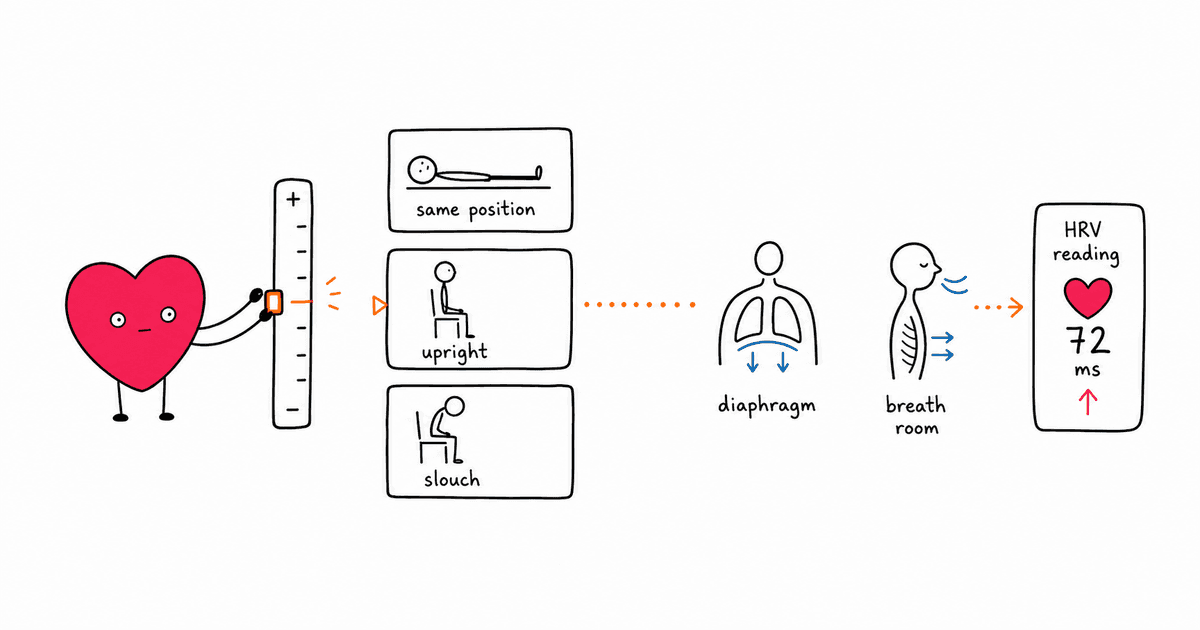
If you have ever taken an HRV reading while lying down and then again while standing, you already know that body position changes your numbers. But posture's influence on heart rate variability goes far beyond measurement position. How you hold your body throughout the day, whether you slouch at a desk, stand upright, or spend hours hunched over a phone, affects your autonomic nervous system in ways that accumulate over time.
Research shows that posture influences HRV through multiple pathways: gravitational blood distribution, vagus nerve function, respiratory mechanics, and even psychological state. Understanding these connections can help you interpret your HRV data more accurately and make simple changes that support better autonomic health.
Does Posture Affect HRV?
Yes, posture significantly affects HRV through changes in autonomic nervous system balance. Moving from supine (lying down) to standing typically reduces RMSSD and high-frequency HRV power by shifting your autonomic system toward sympathetic dominance. Poor postural habits like chronic slouching can further suppress parasympathetic activity by compressing the diaphragm, restricting breathing, and potentially irritating the vagus nerve.
The relationship works in two directions. First, your measurement position directly influences HRV readings, making consistency essential for accurate tracking. Second, your habitual posture throughout the day influences your actual autonomic health, not just the numbers on your wearable.
How Body Position Changes HRV Readings
Supine (Lying Down)
Lying flat produces the highest HRV readings in most people. When you are horizontal, gravity distributes blood more evenly throughout your body, reducing the cardiovascular workload. Your heart does not need to pump against gravity to supply the brain, and blood return from the legs increases. This creates optimal conditions for parasympathetic dominance:
- RMSSD values are typically highest in the supine position
- High-frequency (HF) power increases, reflecting strong vagal tone
- Heart rate decreases, allowing more beat-to-beat variation
- Respiratory sinus arrhythmia (the natural HRV linked to breathing) is most pronounced
This is why devices like the Oura Ring and Whoop measure HRV during sleep: the supine position provides the most stable baseline for tracking autonomic health over time.
Sitting
Sitting produces intermediate HRV values. Compared to lying down, sitting requires more cardiovascular work to maintain blood pressure, which shifts autonomic balance slightly toward sympathetic activity. However, research published in Marco Altini's analysis of HRV measurement positions found that RMSSD reliability is comparable between sitting and supine positions, meaning sitting is a valid measurement position as long as you use it consistently.
The quality of your seated posture matters here. An upright, supported seated position produces different autonomic readings than a slouched position (more on this below).
Standing
Standing produces the lowest HRV values in most healthy adults. The gravitational challenge of maintaining blood pressure while upright activates the sympathetic nervous system and reduces parasympathetic tone:
- SDNN, RMSSD, and HF power all decrease compared to sitting or lying down
- LF power may increase due to baroreceptor-mediated blood pressure regulation
- Heart rate rises to compensate for gravitational blood pooling in the lower body
A 2024 study in American Journal of Physiology found that the magnitude of HR increase when moving from supine to standing correlated inversely with HF-HRV power, meaning people with stronger parasympathetic tone showed smaller heart rate jumps during postural changes.
This postural HRV response (called the "orthostatic challenge") is actually used clinically to assess autonomic nervous system health. An exaggerated HRV drop or heart rate spike when standing can indicate autonomic dysfunction.
Why Measurement Consistency Matters
The practical takeaway for HRV tracking is simple: always measure in the same position. A 20-point RMSSD difference between your lying and standing readings does not reflect a change in health. It reflects physics.
| Position | Typical RMSSD Range (Healthy Adult) | Best For |
|---|---|---|
| Supine | Highest values | Overnight/sleep tracking |
| Sitting | Moderate values | Morning spot checks |
| Standing | Lowest values | Orthostatic testing |
If you use a wearable that measures overnight HRV (Oura, Whoop, Garmin, Apple Watch), your position is automatically controlled. For manual morning readings, choose sitting or lying down and stick with it.
How Poor Posture Suppresses HRV Throughout the Day
Beyond measurement effects, your habitual posture throughout the day influences your actual autonomic function. This is where posture becomes a modifiable health factor, not just a data interpretation issue.
Diaphragm Compression and Shallow Breathing
When you slouch forward (rounded shoulders, collapsed chest, forward head position), your ribcage compresses and your diaphragm loses its ability to move freely. Research from Physiopedia confirms that slouched postures restrict diaphragmatic excursion, forcing you into shallow, chest-dominant breathing patterns.
This matters for HRV because deep diaphragmatic breathing drives respiratory sinus arrhythmia, the natural variation in heart rate that contributes to high HRV. When slouching restricts your breath:
- Tidal volume decreases, reducing the vagal stimulation from each breath cycle
- Breathing rate increases to compensate, which shifts autonomic balance toward sympathetic activity
- Breathing exercises become less effective because the mechanical capacity for deep breaths is compromised
Vagus Nerve Compression
The vagus nerve runs from the brainstem through the neck, past the chest, and into the abdomen. Forward head posture and chronic neck tension can compress or irritate the vagus nerve where it passes through cervical structures. The sternocleidomastoid and anterior scalene muscles, which often become tight with poor posture, are close to the vagus nerve pathway.
While direct vagal compression from posture is difficult to measure in studies, clinical observations suggest that chronic forward head posture correlates with reduced vagal tone. A pilot study published in Frontiers in Physiology (2022) found that different trunk postures produced measurable changes in cardiovascular and autonomic parameters, with flexed (slouched) positions showing altered HRV frequency-domain metrics compared to neutral postures.
Sympathetic Activation from Musculoskeletal Stress
Sustained poor posture creates chronic low-grade musculoskeletal tension in the neck, shoulders, and upper back. This persistent physical stress contributes to sympathetic nervous system activation through pain and discomfort pathways. Over hours of desk work, this cumulative tension can suppress HRV in the same way that psychological stress does.
An IEEE conference paper on posture and mental workload found that maintaining poor postures under high mental workload conditions led to reduced heart rate variability, suggesting that the combination of physical and cognitive stress compounds the autonomic effect.
The Desk Worker's Posture Problem
Most adults spend 6-10 hours per day sitting, and the majority of that time involves suboptimal posture. If that sounds familiar, our guide to sitting all day and HRV covers the broader recovery cost of a sedentary routine. The typical desk posture pattern includes:
- Forward head position (ears ahead of shoulders) increasing neck muscle tension
- Rounded shoulders compressing the chest cavity
- Thoracic kyphosis (upper back rounding) restricting rib expansion
- Posterior pelvic tilt (slouching into the lower back) reducing core engagement
Each of these elements independently affects respiratory mechanics and autonomic function. Combined across a full workday, they create a persistent state of mild sympathetic activation and reduced parasympathetic tone. If that pattern sounds like your normal routine, our guide to sitting all day and HRV breaks down why uninterrupted desk time becomes a recovery issue, not just a posture issue.
How to Improve Posture for Better HRV
Optimize Your Workspace
- Monitor at eye level to reduce forward head position
- Keyboard and mouse at elbow height to prevent shoulder rounding
- Feet flat on the floor with knees at approximately 90 degrees
- Lumbar support to maintain the natural curve of your lower back
- Screen distance at arm's length to avoid leaning forward
Build Postural Awareness
- Set hourly reminders to check and correct your posture
- Use the "string from the crown" cue: imagine a string pulling the top of your head toward the ceiling
- Check your breathing: if you notice shallow chest breathing, it is often a sign of collapsed posture
- Practice wall checks: stand with your back against a wall, with your head, shoulders, and hips touching, to recalibrate your sense of neutral posture
Incorporate Movement Breaks
Sustained sitting, even with good posture, reduces HRV over time. Regular movement breaks counteract this:
- Stand and move every 30-60 minutes for at least 2-3 minutes
- Perform shoulder rolls and chest openers to reverse rounding
- Take short walks to reset autonomic balance
- Do neck stretches (gentle lateral flexion, rotation) to release tension around the vagus nerve pathway
Strengthen Postural Muscles
Long-term posture improvement requires strengthening the muscles that hold you upright:
- Upper back rows and reverse flies to counter rounded shoulders
- Deep neck flexor exercises to correct forward head position
- Core engagement through planks and dead bugs to support spinal alignment
- Yoga and Pilates both emphasize postural alignment and have demonstrated HRV benefits in research
- Chiropractic care may help address structural misalignments that contribute to chronic postural tension and autonomic dysfunction
Combine Posture with Breathing Practice
The most effective approach combines postural correction with intentional breathing:
- Sit or stand in a neutral, upright position
- Perform 5-10 minutes of slow diaphragmatic breathing (5-6 breaths per minute)
- Notice how much more freely your diaphragm moves compared to a slouched position
- Use this practice as both a posture reset and an HRV-boosting breathing exercise
This combination leverages the postural benefit (unrestricted diaphragm) and the breathing benefit (vagal stimulation) simultaneously.
Sleep Position and Overnight HRV
Your sleep position also influences HRV, though the effect is smaller than the supine-to-standing shift:
- Back sleeping (supine) generally produces the highest overnight HRV
- Side sleeping produces slightly lower values due to mild gravitational asymmetry and potential airway changes
- Stomach sleeping (prone) can restrict breathing and reduce HRV, particularly if it involves neck rotation
For most people, the difference between back and side sleeping is small enough that comfort should take priority. However, if you consistently sleep on your stomach and notice lower overnight HRV, experimenting with back or side sleeping may help.
Posture as an HRV Tracking Variable
Consider logging your posture conditions alongside your HRV data:
- Did you take your morning reading sitting or lying down? The difference can be 10-30+ ms in RMSSD
- Was it a heavy desk day? Prolonged poor posture may suppress your next morning's HRV
- Did you do any postural correction exercises? Track whether they correlate with HRV improvements
Over time, this data helps you distinguish between genuine autonomic changes and posture-related measurement artifacts.
Frequently Asked Questions
Should I always measure HRV lying down?
Not necessarily. The best position is whichever one you can do consistently every day. Lying down gives the highest and most stable readings, which is why overnight wearable measurements are considered the gold standard. But a consistent sitting measurement taken at the same time each morning is perfectly valid for tracking trends.
How much does posture affect HRV compared to other factors?
The measurement position effect (lying vs. standing) is substantial, often 20-50% or more in RMSSD. The effect of poor habitual posture (slouching) on your baseline HRV is more subtle, likely in the 5-15% range, comparable to the effect of mild dehydration or a poor night of sleep.
Can correcting posture alone improve HRV?
Posture correction, particularly when combined with deeper breathing it enables, can produce measurable HRV improvements over weeks. It is unlikely to be a dramatic change on its own, but it complements other strategies like meditation, exercise, and sleep optimization.
Does a standing desk help HRV?
Standing desks reduce the postural compression issues of slouched sitting, but standing itself produces lower HRV than sitting due to gravitational cardiovascular demands. The ideal approach is alternating between sitting with good posture and standing throughout the day, with regular movement breaks regardless of position.
Why is my HRV different when I measure it in different positions?
This is completely normal and expected. The autonomic nervous system adjusts to different gravitational demands. Supine readings reflect your parasympathetic capacity without gravitational stress, while standing readings show how your autonomic system handles postural challenge. Both are valid measurements; they just answer different questions about your autonomic health.
Need a quick read on your HRV number first?
Enter your HRV value, age range, device, and recovery context for a plain-English interpretation before you decide what to do next.
Interpret Your HRV NumberBuild the 30-day plan