Garmin vs Polar for HRV: Which Sports Watch Tracks Recovery Better?
Ready to start tracking your HRV? Check out our top picks: Whoop | Oura Ring 5 | Polar H10
Quick Verdict: Garmin vs Polar for HRV
| Feature | Garmin | Polar |
|---|---|---|
| Best For | Multi-sport athletes | Serious runners |
| HRV Accuracy | ★★★★☆ | ★★★★★ |
| Recovery Features | Body Battery, HRV Status | Nightly Recharge, Recovery Pro |
| Sleep Analysis | ★★★★☆ | ★★★★★ |
| Ecosystem | Garmin Connect | Polar Flow |
| Price Range | $249-$799 | $279-$599 |
| Our Pick | Best overall ecosystem | Best HRV accuracy |
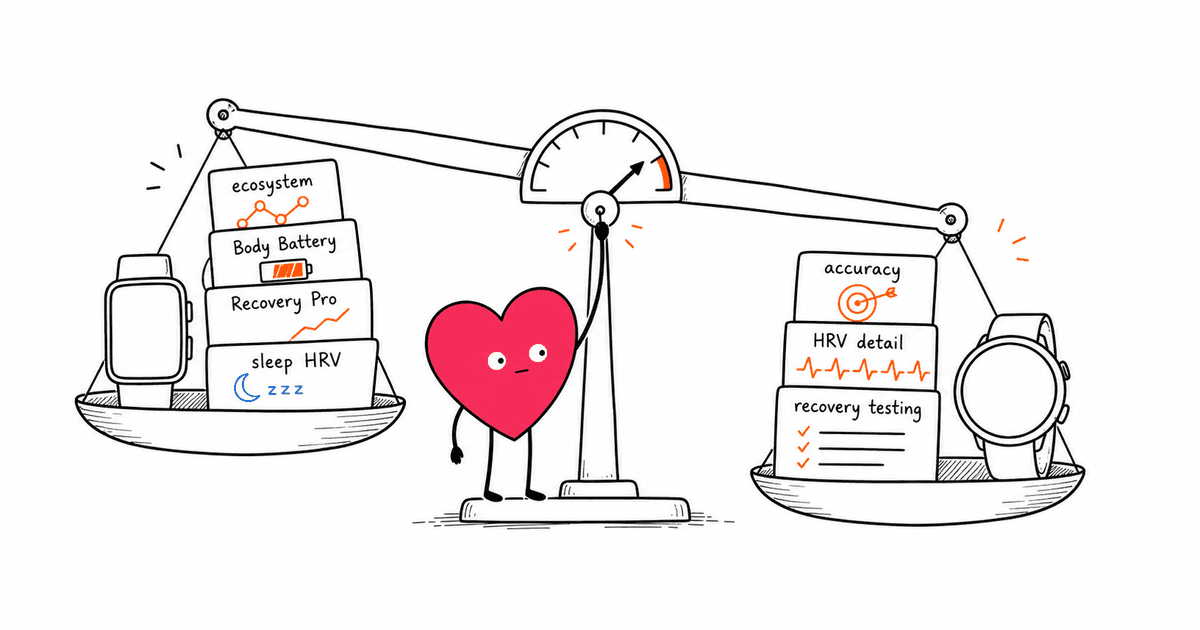
Both Garmin and Polar offer excellent HRV tracking for athletes, but they take different approaches. Garmin provides broader fitness tracking with HRV as one component, while Polar has built its entire recovery system around HRV analysis. For pure HRV accuracy and recovery insights, Polar edges ahead. For a complete training ecosystem with good HRV features, Garmin wins.
How Garmin and Polar Measure HRV
Both brands use optical heart rate sensors (PPG) to measure heart rate variability, not chest-strap ECG. Our ECG vs PPG for HRV guide explains why that distinction matters before you compare device accuracy. Garmin and Polar also differ significantly in how they interpret the signal.
Garmin's HRV Approach
Garmin measures HRV primarily during sleep using its "HRV Status" feature. The system:
- Records HRV throughout the night
- Calculates your 7-day rolling average
- Compares current readings to your baseline
- Factors HRV into the Body Battery algorithm
Garmin's HRV Status requires at least 3 weeks of data before providing readings, as it needs to establish your personal baseline. If you're new to HRV tracking, our beginner's guide covers the fundamentals.
Polar's HRV Approach
Polar pioneered consumer HRV tracking and takes a more granular approach:
- Measures HRV every night during the first 4 hours of sleep
- Provides ANS (Autonomic Nervous System) charge metric
- Includes both parasympathetic and sympathetic activity
- Integrates HRV into the Nightly Recharge and Recovery Pro systems
Polar's Orthostatic Test also allows morning HRV measurements for athletes who want precise daily readings.
HRV Accuracy Comparison
Polar has the edge in raw HRV accuracy. Multiple validation studies have shown Polar's optical sensors correlate well with ECG reference measurements.
| Metric | Garmin | Polar |
|---|---|---|
| RMSSD Correlation | 0.89-0.93 | 0.92-0.96 |
| Night Measurement | Yes | Yes |
| Morning Test Option | No | Yes (Orthostatic) |
| Continuous Tracking | Limited | Yes (Vantage V3) |
Garmin's accuracy is solid for most users, but athletes requiring precise HRV data for training optimization may prefer Polar's more validated approach.
Recovery Features Comparison
Garmin: Body Battery
Garmin's flagship recovery metric is Body Battery, which combines:
- HRV data
- Stress levels
- Activity data
- Sleep quality
Body Battery displays as a 0-100 score that depletes with activity and stress, then recharges during rest. It's intuitive and easy to understand at a glance.
Pros:
- Simple, actionable daily score
- Considers multiple inputs beyond HRV
- Updates throughout the day
Cons:
- Less HRV-specific detail
- Algorithm is somewhat opaque
- No structured Orthostatic test
Polar: Nightly Recharge & Recovery Pro
Polar offers two recovery systems:
Nightly Recharge analyzes:
- ANS charge (HRV-based)
- Sleep charge (sleep quality)
- Combined recovery status
Recovery Pro (higher-end models) provides:
- Training load analysis
- Recovery status
- Strain tolerance
- Personalized training suggestions
Pros:
- More detailed HRV breakdown
- Orthostatic Test for morning readings
- Research-backed algorithms
Cons:
- Can be overwhelming for casual users
- Best features require premium models
- Less intuitive than Body Battery
Best Garmin Watches for HRV
Garmin Forerunner 265
The Forerunner 265 offers the best balance of HRV features and value:
- Full HRV Status tracking
- Body Battery with HRV integration
- Excellent GPS and training metrics
- AMOLED display
- $449
Check the Garmin Forerunner 265 on Amazon
Garmin Fenix 8
For serious athletes wanting everything:
- All HRV features from Forerunner
- More durable construction
- Longer battery life
- Advanced training features
- $799+
Check the Garmin Fenix 8 on Amazon
Garmin Venu 3
Best for health-focused users:
- HRV tracking with Body Battery
- Strong sleep analysis
- Smartwatch features
- Wheelchair mode and nap detection
- $449
Check the Garmin Venu 3 on Amazon
Best Polar Watches for HRV
Polar Vantage V3
Polar's flagship offers the most comprehensive HRV tracking:
- Continuous HRV monitoring
- Nightly Recharge and Recovery Pro
- Orthostatic Test
- Dual-frequency GPS
- AMOLED display
- $599
Check the Polar Vantage V3 on Amazon
Polar Grit X2 Pro
For outdoor athletes:
- All HRV features from Vantage V3
- Military-grade durability
- Turn-by-turn navigation
- 140+ hour GPS battery
- $549
Check the Polar Grit X2 Pro on Amazon
Polar Pacer Pro
Best value for runners:
- Nightly Recharge
- Running Index
- Hill Splitter
- Lightweight design
- $299
Check the Polar Pacer Pro on Amazon
Sleep Tracking Comparison
Sleep is when HRV measurement matters most. Here's how each brand handles it:
| Feature | Garmin | Polar |
|---|---|---|
| Sleep Stages | Yes | Yes |
| HRV During Sleep | Yes | Yes |
| Sleep Score | Yes | Yes |
| ANS Activity | No | Yes |
| Respiratory Rate | Yes | Yes |
| SpO2 Tracking | Yes (select models) | No |
Polar provides more detailed sleep HRV analysis, breaking down ANS activity into parasympathetic (recovery) and sympathetic (stress) components. This gives athletes more insight into sleep quality beyond basic metrics.
Garmin offers broader health tracking with SpO2 monitoring on select models, which can identify sleep apnea symptoms. For more on optimizing your sleep HRV, see our guide on circadian rhythm and HRV.
Ecosystem and App Comparison
Garmin Connect
Strengths:
- Massive user community
- Connect IQ app store
- Excellent third-party integrations (Strava, TrainingPeaks, etc.)
- Free web and mobile apps
- Long-term trend analysis
Weaknesses:
- Can feel overwhelming with data
- HRV insights buried in menus
- Premium features require Garmin Connect+ subscription
Polar Flow
Strengths:
- Clean, focused interface
- Excellent training load visualization
- Strong running program integration
- Free web and mobile apps
Weaknesses:
- Smaller user community
- Fewer third-party integrations
- Less customization
Who Should Choose Garmin?
Choose Garmin if you:
- Want a versatile multi-sport watch
- Value a large ecosystem and community
- Use third-party training platforms
- Prefer intuitive metrics like Body Battery
- Need features beyond HRV (golf, swimming, hiking maps)
Best Garmin for HRV: Forerunner 265
Who Should Choose Polar?
Choose Polar if you:
- Prioritize HRV accuracy above all else
- Want detailed ANS and recovery breakdowns
- Are a serious runner or triathlete
- Prefer research-backed algorithms
- Want the Orthostatic Test option
Best Polar for HRV: Polar Vantage V3
The Chest Strap Option
For maximum HRV accuracy from either brand, consider adding a chest strap:
- Polar H10: The gold standard for HRV accuracy. Works with both Garmin and Polar watches via Bluetooth.
- Garmin HRM-600: Excellent running dynamics, but the H10 edges it out for pure HRV accuracy.
Using a chest strap for sleep isn't practical, but for morning Orthostatic Tests or during training, the H10 provides ECG-level accuracy. If you want the full breakdown on fit, battery life, and app support, read our Polar H10 review. For a broader comparison of all HRV-capable devices, see our HRV monitor comparison guide.
Frequently Asked Questions
Is Garmin or Polar more accurate for HRV?
Polar is generally more accurate for HRV, with validation studies showing higher correlation with ECG reference measurements. However, Garmin's accuracy is sufficient for most users tracking recovery trends. Whichever you choose, see our guide on how to improve your HRV to make the most of your data.
Can I use a Polar chest strap with a Garmin watch?
Yes. The Polar H10 connects via Bluetooth to any compatible device, including Garmin watches. This gives you Polar's superior HRV sensor accuracy with Garmin's ecosystem.
Which is better for running, Garmin or Polar?
Both excel for running. Garmin offers more navigation and training features, while Polar provides more detailed running-specific recovery metrics. Serious runners often prefer Polar; multi-sport athletes typically choose Garmin.
Do I need HRV Status or is Body Battery enough?
For most users, Body Battery provides actionable recovery insights without diving into HRV details. If you want to understand the "why" behind your recovery scores, enabling HRV Status adds valuable context.
How long until I see meaningful HRV data?
Garmin requires 3 weeks to establish your baseline for HRV Status. Polar can provide insights sooner but also benefits from 2-3 weeks of data to understand your patterns.
Final Verdict
For pure HRV tracking and recovery optimization: Polar wins. The Vantage V3 offers the most comprehensive HRV analysis, with detailed ANS breakdowns, Orthostatic Testing, and research-backed recovery algorithms.
For a complete training ecosystem with solid HRV features: Garmin wins. The Forerunner 265 or Fenix 8 provide excellent HRV tracking alongside a massive ecosystem, superior navigation, and broader third-party integration.
Both brands represent excellent choices for athletes serious about recovery. Your decision should depend on whether you prioritize HRV depth (Polar) or ecosystem breadth (Garmin). See our complete best HRV monitors of 2026 guide for more options, or check out our Apple Watch HRV guide if you're also considering Apple's ecosystem.
Ready to improve your health with HRV monitoring?
We've tested and compared the top HRV monitors on the market. Find the right one for you.
See Our Top Picks for 2026