Music and HRV: How Listening to Music Affects Heart Rate Variability
Trying to decode today's HRV number? Use the free interpreter first, then build a practical recovery plan. Interpret your HRV
Most people listen to music to feel better. But music does more than shift your mood. It directly influences your autonomic nervous system, the same system that controls your heart rate variability.
A growing body of research confirms that certain types of music can increase parasympathetic activity, boost HRV, and promote recovery. Here's what the science says, and how to use it.
How Music Affects Your Autonomic Nervous System
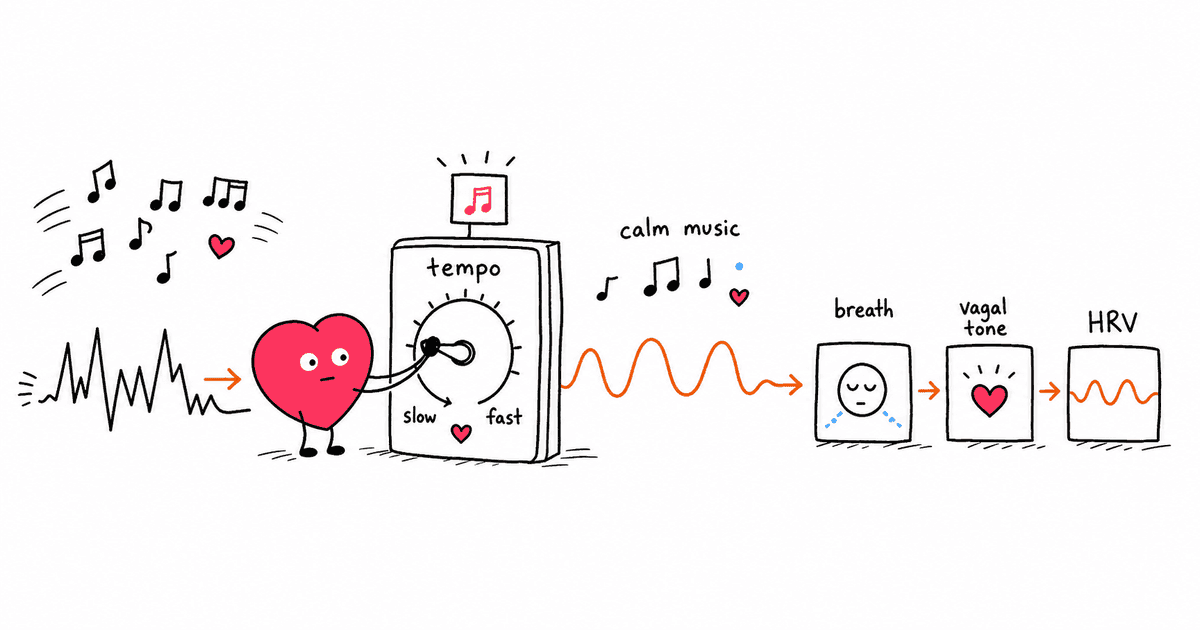
Music influences HRV by modulating the autonomic nervous system (ANS), shifting the balance between sympathetic (fight-or-flight) and parasympathetic (rest-and-digest) activity. Slow, calming music tends to increase vagal tone and raise HRV, while fast, intense music can activate the sympathetic branch.
This happens through several mechanisms. Auditory signals travel from your ears to the brainstem, where they interact with the vagus nerve and cardiovascular control centers. Your breathing naturally synchronizes with musical tempo, and slower breathing directly stimulates the parasympathetic nervous system.
What the Research Shows
A systematic review published in the International Journal of Environmental Research and Public Health analyzed multiple studies on music and cardiac autonomic function. The conclusion: music acts as a stimulus that increases parasympathetic activity and HRV, particularly when the music is slow-tempo and self-selected.
A 2025 systematic review on music therapy and vagally mediated HRV found similar patterns. Studies consistently showed that music interventions improved vagal HRV metrics, with positive effects on both RMSSD and high-frequency HRV power.
Research from Frontiers in Neuroscience (2025) explored "music mindfulness," combining music listening with mindfulness practices. Participants showed acute improvements in autonomic activity and psychological state, suggesting that intentional listening amplifies the benefits.
Tempo Matters More Than Genre
The single most important factor is tempo, not genre. Research consistently shows:
- Slow tempo (60-80 BPM): Increases parasympathetic activity, raises HRV, and promotes relaxation
- Moderate tempo (80-120 BPM): Neutral or mildly stimulating effects on the ANS
- Fast tempo (120+ BPM): Tends to increase sympathetic activity and lower HRV
A 2021 study in the Journal of Cognitive Enhancement tested three genres of focus music against a no-music control. This aligns with research on HRV and cognitive performance, which shows that higher parasympathetic activity supports better focus and mental clarity. All three music groups showed increased parasympathetic activity compared to silence, regardless of genre. The common factor was a moderate-to-slow tempo.
Self-Selected Music Has Stronger Effects
Your personal preference matters. Studies show that self-selected music, songs you choose and enjoy, produces stronger parasympathetic responses than researcher-assigned tracks. This likely connects to emotional familiarity and positive associations, which reduce stress hormones and promote vagal tone.
This means the "best" music for HRV is not a specific playlist. It is music you genuinely enjoy that happens to be slow or moderate in tempo. The same sound logic cuts the other way too: unwanted or intrusive sound, including tinnitus-related ringing, can become a stressor rather than a recovery cue.
Classical Music and the "Mozart Effect" on HRV
Classical music has been the most studied genre in HRV research, partly because of its structural predictability and wide tempo range. Slow classical pieces (adagios, nocturnes) consistently show positive effects on HRV across studies.
However, this does not mean classical music is uniquely beneficial. Ambient, acoustic, and even slow jazz tracks produce similar effects when matched for tempo. The "Mozart effect" on HRV is really a slow-tempo effect.
Music During Sleep: Does It Help HRV
Listening to calming music before or during sleep has shown promising effects on overnight HRV. Sleep is already the most important time for parasympathetic recovery, and adding slow music can amplify that response.
Practical tips for using music at bedtime:
- Choose tracks at 60-80 BPM (matching a resting heart rate)
- Set a sleep timer so music stops after 30-45 minutes
- Keep volume low to avoid disrupting deep sleep stages
- Avoid lyrics that engage cognitive processing
If you track your overnight HRV with a wearable, you can directly measure how pre-sleep music routines affect your recovery scores.
Music During Exercise: A Different Story
During workouts, fast-tempo music serves a different purpose. It increases sympathetic drive, which is exactly what you want for performance. Research shows upbeat music during exercise can improve endurance, reduce perceived exertion, and boost motivation.
The HRV effects here are intentionally stimulatory. Save the slow music for recovery windows.
For athletes tracking HRV to manage training load, the distinction matters. Use energizing music during training and switch to calming music during cooldowns and recovery periods to support parasympathetic rebound. This is especially relevant for preventing overtraining, where recovery between sessions is critical.
How to Build an HRV-Boosting Music Practice
You do not need a complicated protocol. Here's a simple approach:
Morning Routine
Play slow, instrumental music during your morning HRV reading. This sets a calm baseline and reduces measurement noise from stress or distraction.
Post-Workout Recovery
Switch from your workout playlist to something slow and calming within 10-15 minutes of finishing exercise. This supports faster parasympathetic reactivation.
Evening Wind-Down
Build a 30-minute pre-sleep playlist of songs at 60-80 BPM. Use this consistently so your nervous system learns to associate the music with relaxation.
Stressful Moments
Keep a short playlist of calming tracks accessible for acute stress. Even 5-10 minutes of slow music can shift your ANS toward parasympathetic dominance.
Combining Music with Other HRV Practices
Music pairs well with other evidence-based HRV interventions:
- Breathing exercises: Slow music at 60 BPM naturally guides breathing to about 6 breaths per minute, the optimal rate for HRV coherence
- Meditation: Background music can deepen meditative states and enhance vagal tone
- Yoga: Slow music during yoga practice amplifies parasympathetic activation
- Singing and humming: Singing along to music adds direct vagal stimulation through laryngeal activation on top of the listening benefits
- Nature exposure: Natural soundscapes combined with music create a powerful relaxation response
Other recovery-boosting practices that pair well with calming music include cold exposure and social connection, both of which shift the autonomic nervous system toward parasympathetic dominance.
Tracking the Impact with Your Wearable
The best way to know if music is working for you is to measure it. Use an HRV-capable wearable like the Oura Ring 4, Whoop 5, or Apple Watch to track changes over time.
Try a simple experiment: spend one week doing your evening routine with calming music and one week without. Compare your overnight RMSSD or HRV scores. Most people notice a measurable difference within days.
What About Binaural Beats
Binaural beats are a related but distinct intervention. They use slightly different frequencies in each ear to create a perceived "beat" that may influence brainwave activity. Some studies suggest binaural beats in the theta range (4-8 Hz) can improve HRV, but the evidence is less consistent than for standard music listening.
If you are curious, binaural beats can be combined with slow music. But regular music on its own is well-supported and simpler to implement.
Key Takeaways
- Music directly influences your autonomic nervous system and HRV through brainstem pathways and breathing entrainment
- Slow-tempo music (60-80 BPM) consistently increases parasympathetic activity and raises HRV
- Self-selected music produces stronger effects than prescribed tracks
- Genre matters less than tempo for HRV benefits
- Combining music with breathing exercises, meditation, or yoga amplifies the effect
- Use your HRV wearable to measure and optimize your personal music protocol
Frequently Asked Questions
What type of music is best for HRV?
Slow-tempo music between 60-80 BPM is most effective for boosting HRV. Genre is less important than tempo, so choose music you enjoy within that BPM range. Classical adagios, ambient, acoustic, and slow jazz all work well.
How quickly does music affect HRV?
Research shows HRV changes can occur within minutes of listening to calming music. Most studies measure effects after 10-20 minutes of continuous listening. Acute effects are real, but building a consistent practice produces the most meaningful long-term improvements.
Can music replace other HRV interventions?
Music is best used as a complement to other practices like exercise, sleep optimization, and stress management. It is a powerful tool in your recovery toolkit, but not a standalone replacement for foundational health habits.
Need a quick read on your HRV number first?
Enter your HRV value, age range, device, and recovery context for a plain-English interpretation before you decide what to do next.
Interpret Your HRV NumberBuild the 30-day plan