Travel, Jet Lag, and HRV: How Flying Affects Your Heart Rate Variability
Trying to decode today's HRV number? Use the free interpreter first, then build a practical recovery plan. Interpret your HRV
If you track your HRV with a wearable, you have probably noticed something after a long flight: your numbers drop. Sometimes significantly. Travel, especially across time zones, creates a measurable stress response that shows up clearly in heart rate variability data. Understanding why this happens and how to speed recovery can help you bounce back faster.
How Travel Affects HRV
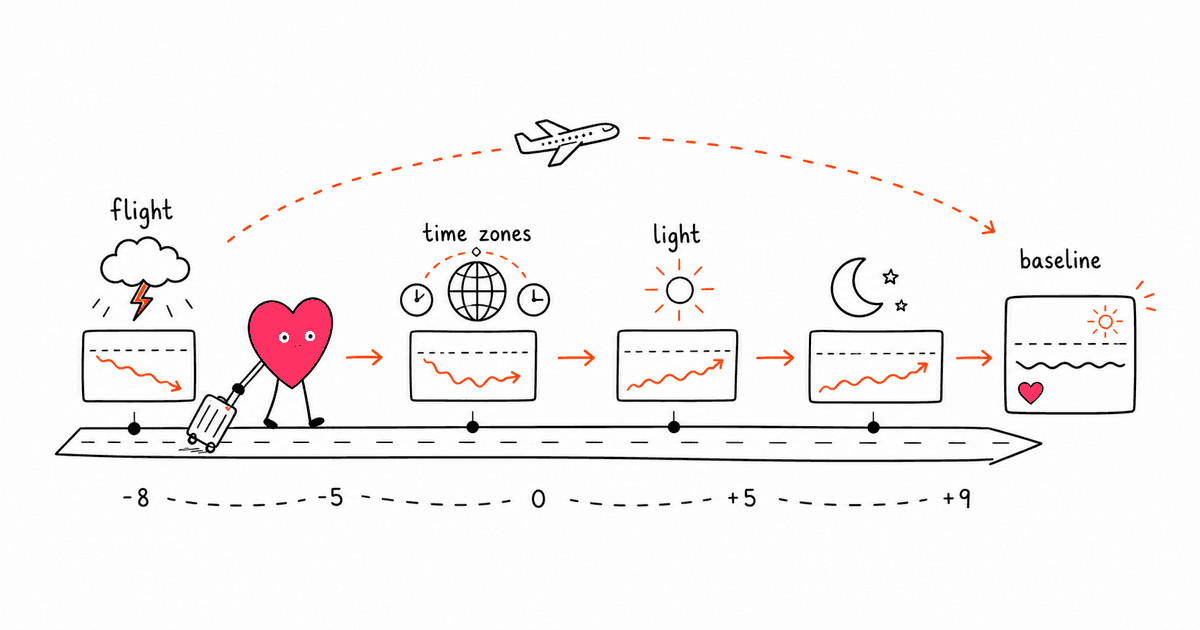
Travel lowers HRV by shifting the autonomic nervous system toward sympathetic dominance. The combination of circadian disruption, cabin pressure changes, dehydration, sleep loss, and the general stress of airports and flights suppresses parasympathetic activity, resulting in lower HRV and higher resting heart rate that can persist for several days after arrival.
A study by WHOOP and CLEAR analyzing wearable data from frequent travelers found that travel is associated with slightly increased resting heart rate and decreased HRV, consistent with a sympathetic stress response. Interestingly, the effects often peaked on nights two and three after travel rather than the first night, suggesting accumulated fatigue plays a larger role than the flight itself.
Why Jet Lag Hits Your HRV So Hard
Jet lag is more than just feeling tired. It represents a fundamental mismatch between your internal circadian clock and the external environment. This desynchronization affects nearly every system in your body, including autonomic nervous system regulation.
Circadian Disruption
Your body's master clock in the suprachiasmatic nucleus regulates the daily rhythm of sympathetic and parasympathetic activity. (For a deeper look at this system, see our guide on circadian rhythm and HRV.) Normally, parasympathetic tone (and HRV) peaks during nighttime sleep and drops during the day. When you cross time zones, this rhythm gets scrambled. Your nervous system may be in "daytime mode" when you are trying to sleep, resulting in poor sleep quality and suppressed overnight HRV.
Sleep Architecture Changes
Jet lag disrupts not just sleep duration but sleep architecture. The deep sleep and REM stages that are most important for HRV recovery get compressed or shifted. Even if you manage to sleep for seven or eight hours, the quality of that sleep may be significantly reduced for several nights.
Dehydration and Cabin Environment
Aircraft cabins typically maintain humidity levels around 10-20%, far below the 30-60% range considered comfortable. This environment promotes dehydration, which independently lowers HRV. Combine this with the common tendency to consume alcohol or caffeine during flights, and the autonomic impact compounds.
Stress and Cortisol
The travel experience itself, from navigating airports to sitting in cramped seats for hours, elevates cortisol. Research on transmeridian travel shows that cortisol rhythms can take 5-7 days to fully resynchronize after crossing six or more time zones.
Eastward vs. Westward Travel
Not all jet lag is created equal. The direction of travel matters significantly for both subjective symptoms and HRV impact.
Eastward Travel (Harder)
Flying east requires you to advance your circadian clock, essentially shortening your day. Most people find this more difficult because the human circadian cycle naturally runs slightly longer than 24 hours. Eastward travel across six or more time zones can suppress HRV for 5-7 days.
Westward Travel (Easier)
Flying west extends your day, which aligns better with the body's natural tendency. HRV typically recovers faster after westward travel, often within 2-4 days for the same number of time zones crossed.
The General Rule
The commonly cited guideline is that it takes roughly one day per time zone crossed to fully adjust when traveling east, and about half that when traveling west. HRV data from wearables generally supports this pattern.
What HRV Data Looks Like During Jet Lag Recovery
If you are tracking with a device like the Oura Ring 4, Whoop 5, or a Garmin watch, here is what you can expect to see after a long-haul flight:
Days 1-2: The Drop
- Overnight HRV drops 10-30% below your baseline
- Resting heart rate increases by 3-8 bpm
- Sleep scores decline due to reduced deep sleep and REM
- Body temperature readings may be slightly elevated
Days 3-5: Partial Recovery
- HRV begins trending back toward baseline
- Sleep architecture starts normalizing
- Resting heart rate gradually decreases
- You may still see night-to-night variability that is higher than usual
Days 5-10: Full Recovery
- HRV returns to baseline (faster for westward travel)
- Sleep patterns normalize
- Resting heart rate and body temperature return to typical ranges
The exact timeline depends on the number of time zones crossed, your fitness level, age, and how well you manage the recovery strategies below.
How to Minimize Travel's Impact on HRV
Before the Flight
Shift your schedule gradually. In the 2-3 days before departure, begin shifting your sleep and meal times by 30-60 minutes per day in the direction of your destination time zone. This gives your circadian clock a head start on adjusting.
Hydrate aggressively. Start increasing your water intake the day before travel. Being well-hydrated going into a dehydrating cabin environment makes a measurable difference for hydration and HRV.
Prioritize sleep. Do not start a trip sleep-deprived. Get at least one night of quality sleep before flying, as sleep deprivation compounds the impact of jet lag on HRV.
During the Flight
Set your watch to the destination time zone immediately. Begin eating and sleeping (or staying awake) according to destination time as soon as you board.
Avoid alcohol and limit caffeine. Both impair sleep quality and further dehydrate you. Stick to water and herbal tea.
Move regularly. Walk the aisle every 1-2 hours. Even simple stretching in your seat helps maintain circulation and reduces the sympathetic stress of prolonged immobility.
Use breathing exercises. Slow, diaphragmatic breathing at 5-6 breaths per minute activates the vagus nerve and can counteract some of the sympathetic activation from flying.
After Arrival
Get sunlight at the right time. Light exposure is the most powerful circadian resetter. For eastward travel, get bright morning light. For westward travel, seek afternoon and evening light. Avoid bright light at the wrong times, as it can delay adjustment.
Exercise gently. A 20-30 minute walk outdoors after arrival helps reset circadian rhythms through both light exposure and physical activity. Avoid intense training for the first 2-3 days, as your body is already under stress.
Maintain meal timing. Eat meals according to local time from day one. The gut has its own circadian clock, and meal timing is a strong zeitgeber (time cue) for the peripheral circadian system.
Consider magnesium supplementation. Magnesium supports sleep quality and parasympathetic activity. Taking 200-400mg of magnesium glycinate before bed in the days after arrival may help improve sleep and accelerate HRV recovery.
Avoid napping after 2 PM local time. Short naps (20-30 minutes) before 2 PM can help with acute fatigue without disrupting nighttime sleep. Longer or later naps make circadian adjustment harder.
Using HRV to Know When You Have Adjusted
One of the most practical uses of HRV tracking during travel is knowing when your body has truly adjusted, not just when you feel adjusted. Subjective feelings of alertness can normalize before your autonomic nervous system has fully resynchronized.
Watch for these signals in your data:
- Overnight HRV returns to your 30-day baseline average. This is the clearest indicator that circadian adjustment is complete.
- Resting heart rate normalizes. When your resting heart rate drops back to its typical range, sympathetic overdrive has resolved.
- Sleep metrics stabilize. Consistent deep sleep and REM percentages indicate your sleep architecture has resynchronized.
Until these markers return to baseline, your body is still adjusting, even if you feel fine. This is particularly relevant for athletes who need to know when they can resume full training intensity after travel, especially in travel-heavy sports like soccer and tennis.
Frequent Travel and Long-Term HRV
For people who travel across time zones regularly, the cumulative effect on HRV is worth considering. Chronic circadian disruption, similar to what shift workers experience, is associated with lower baseline HRV over time and increased cardiovascular risk.
If frequent travel is unavoidable, the recovery strategies above become even more important. Prioritizing sleep, maintaining consistent exercise habits between trips, and monitoring your HRV trends over months can help you identify whether your travel schedule is taking a toll on your autonomic health.
Key Takeaways
- Travel lowers HRV through circadian disruption, dehydration, sleep loss, and stress
- The HRV impact typically peaks 2-3 days after arrival, not immediately
- Eastward travel is harder on HRV than westward travel
- Full HRV recovery takes roughly one day per time zone crossed (eastward) or half that (westward)
- Pre-flight hydration, schedule shifting, and strategic light exposure after arrival are the most effective countermeasures
- HRV tracking provides an objective measure of when your body has truly adjusted, beyond just feeling normal
- Frequent travelers should monitor long-term HRV trends to catch cumulative circadian stress
Your wearable can be one of your best travel tools. For help choosing one, see our best HRV monitors guide. By watching your HRV data before, during, and after trips, you can optimize your recovery strategy and know exactly when your body has caught up to the new time zone. For more strategies, explore our comprehensive guide on how to improve your HRV.
Need a quick read on your HRV number first?
Enter your HRV value, age range, device, and recovery context for a plain-English interpretation before you decide what to do next.
Interpret Your HRV NumberBuild the 30-day plan