Heat and Humidity and HRV: Why Hot Weather Can Lower Your Recovery Score
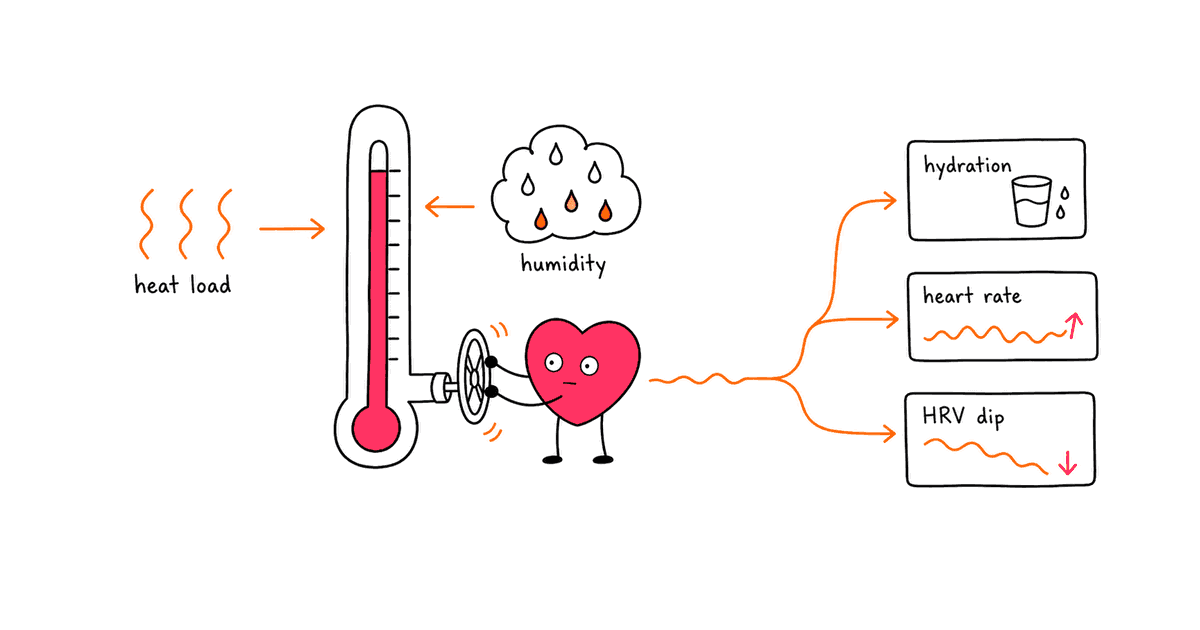
Hot weather can make a well-managed routine look worse on your wearable. You might keep the same training load, sleep schedule, and nutrition, then see lower HRV, a higher resting heart rate, and a worse readiness score anyway.
That does not necessarily mean you're overtraining or getting sick. Often, it means your body is spending more effort on one basic job: staying cool.
Does Hot Weather Lower HRV?
Yes. Heat and humidity can lower HRV by increasing cardiovascular strain, shifting the nervous system toward sympathetic activity, and slowing recovery. The effect is often stronger when high temperature is paired with humidity, dehydration, poor sleep, or hard exercise.
In plain English, heat is stress. HRV tends to drop when total stress load rises, even if the stressor is environmental rather than emotional.
Why Heat Changes Your HRV in the First Place
Your body wants to keep core temperature in a narrow range. When the environment gets hot, it has to work harder to dump heat through the skin and through sweat. That shifts physiology in a few predictable ways:
- Heart rate rises to move more blood to the skin. That helps with cooling, but it also increases cardiovascular workload.
- Sympathetic activity increases. Hot conditions tend to push your nervous system toward a more activated state and away from parasympathetic recovery.
- Sweat losses reduce plasma volume. If you do not replace fluids, the same pace or workload starts to feel harder.
- Humidity makes cooling less efficient. Sweat only helps if it can evaporate. When the air is already loaded with moisture, cooling gets harder.
- Sleep can suffer on hot nights. If you sleep worse, you get a second HRV hit on top of the heat exposure itself.
That combination is why summer HRV dips can show up even when your habits are mostly fine.
What the Research Shows
The research here is not subtle.
A 2006 study in Aviation, Space, and Environmental Medicine exposed healthy men to very high dry heat for 15 minutes and found a sharp shift in autonomic balance. Heart rate jumped from about 66 bpm to 106 bpm, while parasympathetic markers like RMSSD and high-frequency power fell dramatically. That was an extreme exposure, not a normal summer day, but it clearly shows the direction of the response: heat pushes HRV down by increasing sympathetic drive and reducing vagal tone.
A more practical 2019 study in Wilderness & Environmental Medicine looked at recreational runners exercising for 30 minutes at 38°C in hot-dry versus hot-humid conditions. HRV recovered to baseline within about 4 hours after the hot-dry session, but recovery took between 8 and 24 hours in the hot-humid condition. Same temperature, slower recovery when humidity was higher.
That second point matters. Many people blame the thermometer, but the sticky, humid version of heat is often what really drags recovery out.
Why Humidity Makes Everything Worse
Humidity is the multiplier.
Your main cooling tool is sweat evaporation. When humidity is high, sweat does not evaporate as efficiently, so your body has to keep working harder to regulate temperature. That usually means:
- more cardiovascular drift during exercise
- a higher perceived effort at the same pace
- slower cooldown afterward
- more lingering fatigue into the evening
- worse overnight recovery metrics
This is one reason a workout that feels manageable at 85°F in dry air can feel brutal at the same temperature in humid air.
Who Is Most Likely to Notice a Summer HRV Drop
Some people have less margin for heat stress than others. The effect tends to be more obvious in:
- outdoor runners, cyclists, and field-sport athletes
- people doing zone 2 training or long endurance sessions
- outdoor workers
- people with cardiovascular conditions or high blood pressure
- adults taking medications that affect hydration or heat tolerance
- people already dealing with poor sleep or sleep deprivation
- anyone stacking heat with dehydration, travel, alcohol, or hard training
The CDC also notes that heat can worsen existing heart conditions and that some medications can increase dehydration or overheating risk. So if your recovery is worse during heat waves, that is not you being weak. It is physiology.
What a Hot-Weather HRV Dip Usually Means
A lower HRV in summer does not always mean you are doing something wrong.
Often it means one of four things:
- Your body is still adapting to the heat. Acclimatization takes time.
- You are under-replacing fluids or sodium.
- The workout cost more than the pace suggests.
- Your sleep took a hit because the night stayed warm.
This is where context matters. If HRV is down, resting heart rate is up, and the weather has been hot and humid for three straight days, the most likely explanation may be environmental load, not a mysterious decline in fitness.
How to Interpret HRV During Heat Waves
Treat hot-weather HRV like you would altitude, travel, or illness. Use it as context, not as a verdict.
A few good rules:
- compare against your recent 2 to 4 week baseline, not your best reading from a cool month
- look at HRV together with resting heart rate, sleep quality, and subjective fatigue
- pay more attention to multi-day trends than one ugly morning score
- assume heat raises the cost of training, even when pace and duration look normal on paper
If your HRV drops for a day after a hot run, that is not surprising. If it stays suppressed for several days, it may be a sign to scale back until the weather or your recovery improves.
8 Ways to Protect HRV in Hot Weather
1. Train During the Coolest Part of the Day
Early morning or later evening sessions are often the easiest win. Lower temperature, lower radiant heat, and usually lower heart rate drift.
If the only available time is midday and conditions are brutal, it may be smarter to shorten the session or move it indoors.
2. Acclimatize Instead of Forcing Summer Fitness in One Week
The CDC and NIOSH recommend gradual heat acclimatization over roughly 7 to 14 days. In practice, that means easing into hot-weather exposure instead of doing your usual full workload on the first hot week of the year.
Start with shorter or easier sessions, then build up. Your sweat response, plasma volume, and heat tolerance improve with repeated exposure, but they do not improve instantly.
3. Take Hydration Seriously Before Thirst Becomes the Only Signal
Mild dehydration can amplify the HRV hit from heat. That is one reason hydration and electrolytes matter more in summer.
NIOSH guidance for moderate activity in the heat suggests roughly 8 ounces of water every 15 to 20 minutes as a starting point for shorter efforts. If you are sweating heavily for several hours, plain water alone may not be enough. You may also need sodium and other electrolytes, especially if you are a salty sweater.
The point is not to obsess over a perfect formula. It is to stop treating summer hydration like winter hydration.
4. Adjust Intensity When Humidity Is High
Humidity is not just uncomfortable. It can materially slow HRV recovery.
On very humid days, think in terms of effort, not ego. If heart rate is unusually high at an easy pace, or if the session feels harder than it should, back off. This is especially relevant for running, cycling, and long outdoor sessions.
5. Cool Down Aggressively After Hard Sessions
Getting core temperature down faster can help recovery feel less wrecked later.
Useful basics include:
- getting into shade quickly
- changing out of sweat-soaked clothes
- using cool water or a cool shower
- drinking fluids
- sitting in an air-conditioned space if available
CDC guidance also notes that fans are only useful indoors when temperatures are below 90°F. Above that, fans can actually increase body temperature.
6. Protect Sleep on Hot Nights
If the bedroom stays warm, HRV often pays for it. You do not need a perfect biohacking setup. You need a cooler sleep environment.
A few simple moves help:
- lower the thermostat if you can
- use breathable bedding
- take a lukewarm or cool shower before bed
- avoid heavy late meals and alcohol, which can worsen both heat stress and sleep quality
This is one reason heat waves can produce a multi-day HRV slump. You get hit during the day, then recover worse at night.
7. Check Heat Risk and Air Quality Together
The CDC's HeatRisk tool is useful, and so is checking AQI. Hot weather and poor air quality often show up together, especially during ozone spikes and wildfire season.
If both are bad, the smartest move may be an easier indoor session. You are not losing toughness points. You are making a better recovery decision.
For the air side of the equation, see our guides to air quality and HRV and air pollution and HRV.
8. Know When This Is More Than a Recovery Issue
Heat illness is not the same as a low readiness score.
The CDC lists warning signs such as muscle cramping, heavy sweating, dizziness, headache, nausea, weakness, and shortness of breath. If those show up, stop treating the situation like a training optimization problem and start treating it like a safety problem.
HRV is useful, but it is not the main event when someone is overheating.
What Your Wearable Can and Cannot Tell You
A wearable can be helpful here, especially if you consistently track:
- morning HRV
- resting heart rate
- sleep quality
- perceived exertion
What it can tell you:
- whether hot days reliably lower your HRV
- whether humid sessions cost more recovery than dry ones
- whether your heat acclimatization is improving over time
- whether you bounce back after easier, cooler days
What it cannot tell you:
- your core body temperature
- whether you are safely hydrated
- whether symptoms of heat illness can be ignored
Use your wearable as an early warning system, not as a substitute for judgment.
A Useful Reframing for Summer Training
Many people read a lower HRV in hot weather as proof that fitness is slipping. Often the opposite is true. The environment got harder.
A summer run at the same pace as a cool-weather run is not the same physiological task. The same goes for yard work, outdoor lifting, long walks, rucking, or labor-intensive job shifts. Heat adds hidden load.
Once you understand that, your HRV data gets easier to interpret. A lower score may be telling you to respect the conditions, not panic about your routine.
The Bottom Line
Heat and humidity can absolutely lower HRV. The mechanism is straightforward: more thermal stress, higher cardiovascular demand, slower cooling, and often worse sleep. Humidity makes the problem worse because it blunts evaporative cooling and extends recovery time.
So if your HRV dips when the weather turns hot, do not jump straight to overtraining, burnout, or some supplement problem. First ask the obvious question: how much of this is just heat?
Sometimes the smartest recovery move is not more optimization. It is earlier workouts, more fluids, a cooler bedroom, and enough humility to admit that August is harder than April.
Need a quick read on your HRV number first?
Enter your HRV value, age range, device, and recovery context for a plain-English interpretation before you decide what to do next.
Interpret Your HRV NumberBuild the 30-day plan