Altitude Training and HRV: How Elevation Affects Heart Rate Variability
Trying to decode today's HRV number? Use the free interpreter first, then build a practical recovery plan. Interpret your HRV
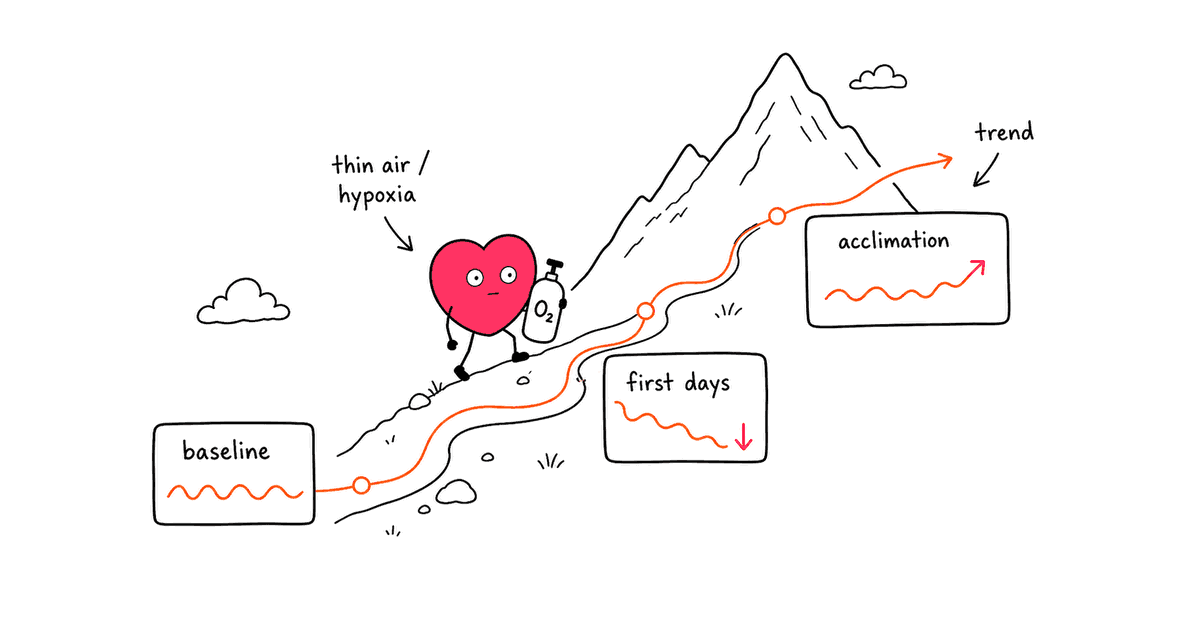
Athletes have traveled to altitude training camps for decades, chasing the performance benefits that come from training in thinner air. But if you track your heart rate variability, you will notice something initially alarming when you ascend: your HRV drops, sometimes significantly.
This response is normal and expected. Reduced oxygen availability (hypoxia) at altitude triggers a cascade of autonomic changes that temporarily shift your nervous system toward sympathetic dominance. Understanding how and why this happens, and how your body adapts over time, can help you use HRV as a powerful tool for monitoring altitude acclimatization and optimizing training at elevation.
Does Altitude Affect Heart Rate Variability?
Yes, altitude exposure significantly reduces heart rate variability by activating the sympathetic nervous system in response to lower oxygen levels. A 2025 systematic review and meta-analysis published in Frontiers in Physiology confirmed that acute high-altitude exposure decreases vagal-related HRV indices (RMSSD and HF power) while increasing sympathetic-related indices (LF power and LF/HF ratio). The magnitude of these changes correlates with the severity of hypoxia and the speed of ascent.
How Altitude Changes Your Autonomic Nervous System
The air at sea level contains approximately 20.9 percent oxygen. This percentage stays the same at altitude, but lower atmospheric pressure means each breath delivers fewer oxygen molecules to the lungs. Your body detects this reduction through peripheral chemoreceptors in the carotid body and responds with a series of autonomic adjustments.
The Acute Response (First 24 to 72 Hours)
When you first arrive at altitude, your body initiates a survival response:
- Increased heart rate: Resting heart rate rises 10 to 20 percent to compensate for reduced oxygen per heartbeat
- Sympathetic activation: The sympathetic nervous system ramps up, redirecting blood flow and increasing cardiac output
- Reduced vagal tone: Parasympathetic activity decreases, directly lowering RMSSD and HF power
- Elevated breathing rate: Respiratory drive increases, which further modulates HRV patterns
These changes produce a measurable HRV signature: lower overall variability, reduced time-domain metrics, and a shift in frequency-domain balance toward sympathetic dominance.
The Altitude-HRV Relationship by Elevation
Research shows the HRV response scales with altitude:
| Elevation | Oxygen Equivalent | Typical HRV Response |
|---|---|---|
| Sea level to 1,500 m | Normal | Minimal change |
| 1,500 to 2,500 m | Moderate hypoxia | 10 to 20% RMSSD reduction |
| 2,500 to 3,500 m | Significant hypoxia | 20 to 40% RMSSD reduction |
| 3,500 to 5,000 m | Severe hypoxia | 40%+ RMSSD reduction, elevated resting HR |
| Above 5,000 m | Extreme hypoxia | Profoundly suppressed HRV |
A 2022 study published in Frontiers in Cardiovascular Medicine found that HRV suppression becomes most pronounced above 3,600 meters, correlating directly with the degree of blood oxygen desaturation.
Acclimatization and HRV Recovery
The initial HRV drop at altitude is not permanent. As your body acclimatizes over days to weeks, several physiological adaptations occur that gradually restore autonomic balance.
What Happens During Acclimatization
- Increased red blood cell production: Erythropoietin (EPO) stimulates the production of new red blood cells, improving oxygen-carrying capacity
- Enhanced capillary density: New blood vessels form in muscle tissue, improving oxygen delivery
- Improved mitochondrial efficiency: Cells adapt to extract more energy from available oxygen
- Respiratory adaptation: Breathing patterns optimize for the reduced oxygen environment
- Autonomic rebalancing: As oxygen delivery improves, sympathetic overdrive decreases and parasympathetic tone begins to recover
The Acclimatization Timeline
HRV recovery during acclimatization follows a general pattern:
| Phase | Timeframe | HRV Response |
|---|---|---|
| Acute stress | Days 1 to 3 | Lowest HRV, highest resting HR |
| Early adaptation | Days 4 to 7 | HRV begins recovering, resting HR starts declining |
| Active acclimatization | Weeks 2 to 3 | HRV approaches 70 to 80% of sea-level baseline |
| Full acclimatization | Weeks 3 to 6 | HRV stabilizes near or at sea-level values |
| Post-altitude return | Days 1 to 7 back at sea level | HRV often rebounds above pre-altitude baseline |
The post-altitude rebound is particularly interesting. Many athletes report their highest HRV readings in the week after returning from altitude camps, likely reflecting improved oxygen-carrying capacity combined with removal of the hypoxic stress stimulus.
Live High, Train Low: The Gold Standard
The "live high, train low" (LHTL) model, developed by researchers Ben Levine and Jim Stray-Gundersen, is the most well-supported altitude training strategy. The concept is straightforward: live and sleep at moderate altitude (2,000 to 2,500 meters) to stimulate physiological adaptations, but descend to lower elevation for high-intensity training sessions.
Why LHTL Works for HRV
This approach balances the autonomic stress of altitude with the recovery needs of training:
- Living at altitude provides continuous hypoxic stimulus that drives EPO production and cardiovascular adaptation
- Training at low altitude allows athletes to maintain workout intensity without the compounding stress of hypoxia during exercise
- HRV recovery is faster because high-intensity sessions occur in oxygen-rich environments
Research published in the Journal of Applied Physiology found that LHTL improved sea-level endurance performance in elite runners by 1 to 3 percent, a significant margin at the elite level.
Alternative Altitude Training Models
| Model | Description | HRV Impact |
|---|---|---|
| Live High, Train Low (LHTL) | Sleep at altitude, train below | Moderate initial suppression, good recovery |
| Live High, Train High (LHTH) | Full-time altitude residence | Prolonged suppression, risk of overtraining |
| Live Low, Train High (LLTH) | Live at sea level, train at altitude | Brief HRV dips around sessions only |
| Intermittent Hypoxic Training (IHT) | Short hypoxic exposures | Minimal sustained HRV impact |
Using HRV to Monitor Altitude Adaptation
Your HRV tracker becomes an essential tool during altitude training because it provides objective data on how your body is handling the hypoxic stress.
Establish Your Sea-Level Baseline
Before traveling to altitude, record at least two weeks of morning HRV measurements at your normal elevation. This baseline gives you a reference point for tracking both the initial decline and subsequent recovery.
Track the Recovery Curve
Monitor your HRV daily at altitude. A healthy acclimatization pattern shows:
- An initial drop in the first 2 to 3 days
- A gradual upward trend starting around day 4 to 7
- Stabilization near baseline by week 2 to 3
If your HRV remains suppressed beyond 7 to 10 days without improvement, it may signal that the altitude is too aggressive or that you need more recovery between training sessions.
Watch for Warning Signs
Sustained HRV suppression at altitude can indicate problems:
- Altitude sickness: HRV that continues declining after day 3 may precede symptoms of acute mountain sickness
- Overtraining: Combining altitude stress with high training loads can push the autonomic nervous system into sustained overtraining
- Poor sleep: Altitude commonly disrupts sleep quality, which independently suppresses HRV. If sleep HRV is particularly low, focus on sleep hygiene strategies
Adjust Training Based on HRV
Use your daily HRV readings to modulate training intensity at altitude:
- HRV within or above baseline range: Proceed with planned training
- HRV moderately below baseline: Reduce intensity, focus on zone 2 work
- HRV significantly below baseline: Take a recovery day with light walking or stretching
Simulated Altitude Training
Not everyone can travel to the mountains. Simulated altitude training attempts to recreate the hypoxic stimulus through technology.
Altitude Tents and Generators
Hypoxic generators reduce the oxygen concentration in enclosed spaces (tents, rooms, or masks), simulating the reduced oxygen availability of altitude. Research on intermittent hypoxic training shows that these devices can trigger some acclimatization responses, including sympathetic activation and subsequent autonomic adaptation.
A study published in BMC Sports Science, Medicine and Rehabilitation found that training with an elevation mask induced modest hypoxemia during cycling but did not significantly affect HRV during exercise. However, it did delay post-exercise cardiac-autonomic recovery, suggesting some hypoxic stress effect.
Altitude Masks: Limited Evidence
Simple resistance masks (not connected to hypoxic generators) restrict airflow but do not meaningfully reduce the percentage of oxygen breathed. Research suggests they function more as respiratory muscle trainers than true altitude simulators. Their effect on HRV is primarily through increased breathing effort rather than genuine hypoxia.
Practical Recommendations for Altitude and HRV
If You Are Traveling to Altitude
- Ascend gradually when possible (no more than 300 to 500 meters per day above 2,500 meters)
- Allow 2 to 3 easy days upon arrival before resuming intense training
- Stay well-hydrated, as dehydration is common at altitude and further suppresses HRV
- Prioritize sleep, even though altitude may disrupt it initially
- Monitor morning HRV daily and adjust activity accordingly
If You Are Training at Altitude for Performance
- Target 2,000 to 2,500 meters for the "live high" component
- Plan altitude camps of at least 2 to 3 weeks to allow meaningful acclimatization
- Use HRV trends (not single readings) to gauge adaptation progress
- Expect HRV to rebound above baseline in the 1 to 2 weeks after returning to sea level
If You Live at Altitude
Permanent altitude residents typically show fully acclimatized HRV values that are comparable to sea-level populations. If you live above 1,500 meters and track HRV, your readings reflect your acclimatized normal. Compare against your own trends rather than sea-level population averages.
Supporting Autonomic Function at Altitude
Several strategies can help maintain or accelerate HRV recovery during altitude exposure:
- Breathing exercises: Slow, diaphragmatic breathing activates the parasympathetic nervous system and can partially offset altitude-induced sympathetic dominance
- Meditation: Mindfulness practices support autonomic balance and may improve sleep quality at altitude
- Magnesium supplementation: Magnesium supports nervous system function and sleep, both of which can be disrupted at altitude
- Iron-rich nutrition: Supporting red blood cell production with adequate iron intake helps the body respond to the EPO stimulus. If you also donate blood regularly, be aware that blood donation temporarily reduces hemoglobin and HRV, so plan donations carefully around altitude training camps
- Adequate sleep: Even though altitude disrupts sleep, maintaining consistent sleep schedules and optimizing sleep environment helps HRV recovery
Tracking Devices at Altitude
Most wrist-based and ring-based HRV monitors work normally at altitude. Devices like the Oura Ring, Whoop, Garmin, and Apple Watch will capture the HRV changes associated with altitude exposure.
Some devices also track blood oxygen saturation (SpO2), which provides complementary data. Watching SpO2 rise as you acclimatize (from potentially the low 80s to mid-90s at moderate altitude) alongside recovering HRV gives a more complete picture of your body's adaptation.
The Bottom Line
Altitude exposure creates a predictable pattern in HRV: an initial suppression driven by sympathetic activation in response to hypoxia, followed by gradual recovery as the body acclimatizes. This response is normal and, when managed properly, can lead to enhanced cardiovascular fitness and even transiently elevated HRV upon return to sea level.
Whether you are an athlete planning an altitude training camp, a traveler heading to high-elevation destinations, or someone living at altitude, HRV provides an objective window into how your autonomic nervous system is handling the reduced oxygen environment. Track your trends, adjust your training accordingly, and give your body the time and support it needs to adapt.
Frequently Asked Questions
How quickly does HRV drop at altitude?
Most people see a measurable HRV reduction within the first 24 hours of ascending above 2,000 meters. The drop is typically most pronounced on days 1 to 3 before acclimatization begins.
Will my HRV be permanently lower if I move to a high-altitude city?
No. Long-term altitude residents show fully acclimatized HRV values comparable to sea-level populations. Full acclimatization typically takes 3 to 6 weeks, after which your HRV stabilizes at your new normal.
Does altitude training actually improve HRV long-term?
Research on the "live high, train low" model suggests that athletes can experience transiently elevated HRV values upon returning to sea level, likely due to improved cardiovascular fitness and oxygen-carrying capacity. However, these gains require proper acclimatization and adequate training management.
Can altitude masks improve HRV?
Simple resistance masks do not meaningfully simulate altitude because they restrict airflow without reducing oxygen percentage. Research shows minimal HRV benefits from these devices. True hypoxic generators that reduce oxygen concentration show more promising results, though evidence is still emerging.
How high is too high for altitude training?
Most experts recommend the 2,000 to 2,500 meter range for the "live high" component of altitude training. Above 3,500 meters, the physiological stress increases substantially, sleep quality deteriorates, and the risk of altitude sickness rises, all of which can suppress HRV beyond productive levels.
Need a quick read on your HRV number first?
Enter your HRV value, age range, device, and recovery context for a plain-English interpretation before you decide what to do next.
Interpret Your HRV NumberBuild the 30-day plan