Running and HRV: How Runners Can Use Heart Rate Variability to Train Smarter
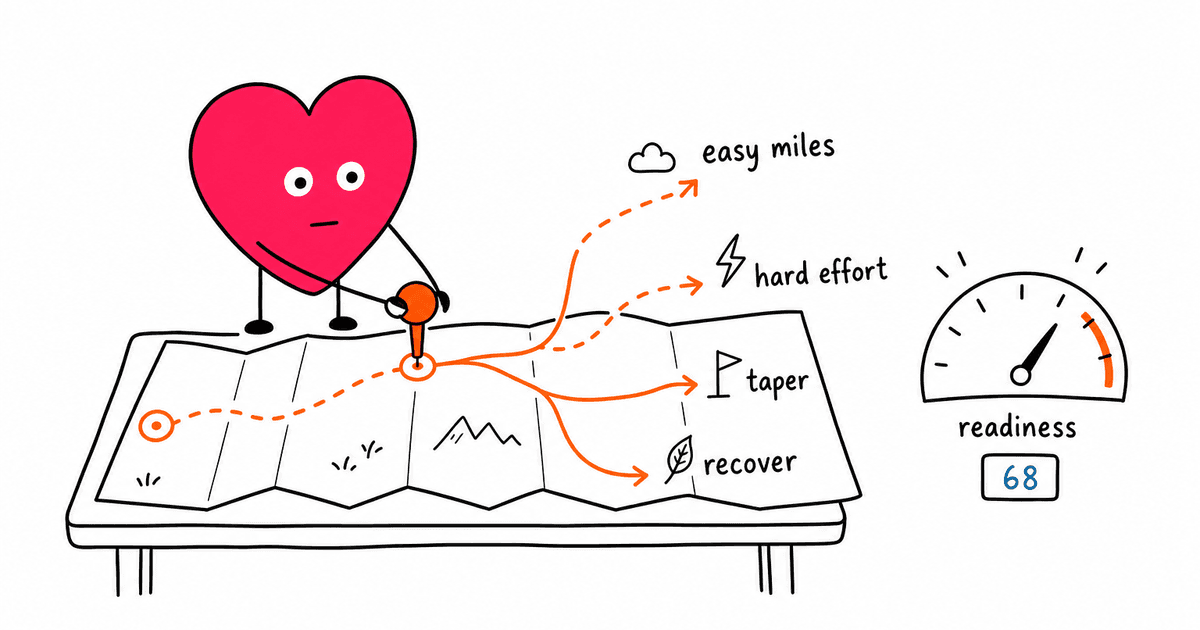
Trying to decode today's HRV number? Use the free interpreter first, then build a practical recovery plan. Interpret your HRV
Running produces some of the most dramatic shifts in HRV of any exercise. A single hard interval session can suppress your HRV for 24 to 72 hours, while a well-planned easy week can send it soaring above your baseline. The challenge for runners is knowing which day calls for intensity and which calls for rest, and that is exactly where HRV tracking becomes a game-changer.
Whether you are training for a 5K, a half marathon, or a full 26.2-mile race, HRV gives you an objective window into how your autonomic nervous system is handling the cumulative stress of your training. Instead of guessing whether your legs are ready for tempo work, you can check the data and make a smarter call.
What HRV Tells Runners That Pace and Mileage Cannot
Heart rate variability (HRV) measures the time variation between consecutive heartbeats, reflecting the balance between your sympathetic (fight-or-flight) and parasympathetic (rest-and-recover) nervous systems. For runners, this is significant because running stresses both systems in ways that pace and weekly mileage alone cannot capture.
Your training log might say you ran 40 miles last week at an average pace of 8:30 per mile. But it cannot tell you whether your body has absorbed that training or is still processing the stress from it. HRV fills that gap. A morning HRV reading at or above your personal baseline suggests your body has adapted and is ready for more stimulus. A reading well below baseline signals that recovery is still in progress, regardless of how your legs feel.
This matters because running injuries and performance plateaus often stem from the same root cause: applying training stress faster than the body can absorb it. If you are new to the metric, our beginner's guide to HRV covers the fundamentals.
How Running Affects Your HRV Acutely
Different types of runs produce different HRV responses, and understanding these patterns helps you interpret your daily readings.
Easy Runs and Recovery Runs
Low-intensity running at a conversational pace typically causes a mild, short-lived HRV dip. Most runners see their HRV return to baseline within 12 to 24 hours after an easy session. Over time, consistent easy running is one of the most effective ways to raise your baseline HRV because it strengthens parasympathetic tone without creating excessive sympathetic stress.
Tempo Runs and Threshold Work
Sustained efforts at lactate threshold produce a moderate HRV suppression that can last 24 to 48 hours. These runs are metabolically demanding and create significant autonomic stress, which is why most training plans schedule only one or two threshold sessions per week.
Interval Sessions and Speed Work
High-intensity intervals, such as 800-meter repeats at 5K pace, create the largest acute HRV drops. Research published in the European Journal of Applied Physiology has shown that intense interval training can suppress HRV markers like RMSSD for 48 to 72 hours in some runners. This is a normal and necessary part of training, but it means spacing your hard sessions appropriately.
Long Runs
The weekly long run, a staple of distance training, produces HRV suppression that scales with duration and intensity. A 90-minute easy long run may only suppress HRV for a day, while a 20-miler with race-pace miles at the end can take two to three days to recover from.
HRV-Guided Training: What the Research Shows
One of the most compelling applications of HRV for runners is using daily readings to decide workout intensity rather than following a rigid schedule.
A landmark study published in Physiology & Behavior compared professional endurance athletes who followed an HRV-guided training protocol to those who followed a traditional periodized plan. The HRV-guided group adjusted their daily intensity based on morning readings: when HRV was at or above their individual baseline, they performed high-intensity work; when it was below, they substituted easy running. The result was that the HRV-guided group achieved equal or superior cardiovascular improvements while reporting lower levels of fatigue.
A systematic review and meta-analysis in Sports Medicine confirmed these findings across multiple endurance sports, concluding that HRV-guided training enhances cardiac-vagal modulation and aerobic fitness at least as effectively as traditional programming, with the added benefit of individualized load management.
The practical takeaway is straightforward: rigid training schedules do not account for the variability in your day-to-day recovery, but HRV does.
How to Set Up HRV-Guided Running
Transitioning to HRV-guided training does not require abandoning your training plan. Instead, you layer HRV data on top of your existing structure.
Step 1: Establish Your Baseline
Measure your HRV every morning for at least two weeks before making any training decisions. Use the same method each day: first thing in the morning, before getting out of bed, in the same position (lying down or seated). Most running watches and wearables like the WHOOP or Oura Ring handle this automatically during sleep.
Your baseline is not a single number but a rolling average, typically calculated over 7 to 14 days. What matters is not the absolute value but where today's reading falls relative to your personal trend.
Step 2: Learn Your Traffic Light System
Most HRV apps and wearables use a simple framework:
| HRV Status | What It Means | Training Decision |
|---|---|---|
| Above baseline | Strong recovery, high readiness | Green light for hard sessions |
| Within normal range | Adequate recovery | Proceed with planned training |
| Below baseline | Incomplete recovery or added stress | Swap to easy running or rest |
| Significantly below (3+ days) | Possible overreaching | Reduce volume and consult your plan |
Step 3: Apply the Flex-Day Approach
Keep your weekly training structure (for example, two hard days, one long run, four easy days) but allow the specific days to shift based on HRV. If Tuesday is supposed to be intervals but your HRV is suppressed, swap it with Wednesday's easy run and try again the next day.
This approach preserves the training stimulus your plan was designed to deliver while respecting your body's actual recovery status.
HRV Through a Marathon Training Cycle
HRV trends tell a story across the weeks and months of a training block, and recognizing the typical patterns helps you stay on track.
Base Building Phase (Weeks 1 to 6)
During the early weeks of a training cycle, when mileage is increasing gradually, you should see your baseline HRV remain stable or trend slightly upward. This indicates your aerobic system is adapting to the increased volume. If your baseline starts dropping during base building, you are likely increasing mileage too quickly.
Build Phase (Weeks 7 to 12)
As intensity increases with tempo runs and longer intervals, expect your HRV baseline to dip modestly, perhaps 5 to 10 percent below your base-phase average. This is a normal response to purposeful overload. The key metric to watch is your HRV's day-to-day variability. Consistent suppression with little bounce-back between hard sessions is a warning sign of overtraining.
Peak Phase (Weeks 13 to 15)
The hardest weeks of training often produce the lowest HRV readings of the entire cycle. This is expected and acceptable as long as you have a taper planned. Research on marathon runners has shown that HRV typically reaches its nadir during peak training weeks, with the parasympathetic system under maximum load.
Taper Phase (Final 2 to 3 Weeks)
The taper is where HRV tracking becomes especially valuable. As you reduce training volume by 30 to 50 percent, your HRV should rebound, ideally reaching or exceeding your pre-training baseline by race week. A study on male marathon runners found that a three-week taper with a 33 percent volume reduction led to significant improvements in both HRV and subsequent race performance.
If your HRV has not rebounded during taper, consider extending your taper by a few days or reducing intensity further.
Race Week
On race morning, an HRV reading at or above your baseline is a strong indicator that your body is primed to perform. Some runners see a slight HRV dip the night before a race due to pre-race nerves, which is normal and does not predict poor performance. The trend across the taper matters more than a single morning reading.
Post-Race Recovery: What HRV Reveals
After a race, HRV provides objective data about your recovery timeline rather than relying on the traditional "one day of rest per mile raced" guideline.
Research on ultra-endurance runners has shown that HRV indices typically return to baseline within two days after a race, even when perceived fatigue and muscle soreness persist for five or more days. This suggests the autonomic nervous system recovers faster than the musculoskeletal system.
For most runners, the practical approach is:
- Days 1 to 3 post-race: Complete rest or very easy walking. HRV will be suppressed.
- Days 4 to 7: Light jogging only if HRV has begun trending upward.
- Week 2 and beyond: Gradually resume normal training as HRV returns to baseline.
The advantage of tracking HRV during recovery is that it removes the guesswork. Some runners bounce back in five days; others need two full weeks. Your autonomic data tells you which category you fall into.
Common HRV Patterns Runners Should Watch For
The Slow Baseline Drift Downward
A gradual decline in your 7-day HRV average over several weeks, even without any single alarming reading, often precedes burnout or illness. For runners, it can also be worth checking under-fueling, heavy mileage, or iron deficiency if fatigue is building. If your baseline drops more than 10 to 15 percent over a month, reduce training load proactively.
The Morning After a Night Run
Evening runs, especially hard ones, can suppress the next morning's HRV reading because your autonomic system is still recovering during sleep. If you frequently run in the evening, factor this into your interpretation and compare evening-run mornings to other evening-run mornings rather than to rest-day mornings.
Seasonal Shifts
Outdoor runners often see HRV fluctuations tied to weather. Running in heat causes greater cardiovascular strain and can suppress HRV more than the same workout in cool conditions. Staying hydrated becomes even more critical in warm weather. If you are training through summer, expect lower readings and adjust your targets accordingly.
The Pre-Race Spike
Some runners experience an HRV spike two to three days before a goal race, coinciding with full rest and reduced stress. This is a positive sign of peak readiness and a good indicator that your taper timing was correct.
Best Wearables for Runners Tracking HRV
Not all HRV trackers are equally suited to running. The best options for runners combine accurate HRV measurement with GPS tracking and running-specific metrics.
GPS Watches with Built-In HRV
The Garmin Forerunner 265 and Polar Vantage V3 both offer overnight HRV tracking alongside advanced running metrics like training load, recovery time estimates, and running dynamics. For runners who want a single device that handles everything, a GPS watch is the most practical choice.
The Garmin Fenix 8 is another strong option for trail and ultra runners who need durability and extended battery life alongside HRV tracking.
Dedicated Recovery Trackers
The WHOOP measures HRV continuously during sleep and calculates a daily recovery score that integrates HRV, resting heart rate, respiratory rate, and sleep quality. Its strain tracking feature is especially useful for runners managing weekly training load.
The Oura Ring provides overnight HRV trends in a lightweight, screen-free form factor. Many runners wear an Oura for sleep and recovery tracking and a GPS watch for actual runs.
Chest Straps for Maximum Accuracy
For runners who want the most accurate HRV readings, a chest strap like the Garmin HRM-600 paired with an app like HRV4Training or Elite HRV provides medical-grade R-R interval data. Optical wrist sensors are convenient but can introduce noise during movement.
Combining HRV with Other Running Metrics
HRV is most powerful when interpreted alongside other data points rather than in isolation.
HRV Plus Resting Heart Rate
Your morning resting heart rate and HRV often move in opposite directions: when HRV drops, resting heart rate rises. Tracking both provides a more complete picture. If your HRV is low but resting heart rate is normal, the suppression may be minor. If both are moving in the wrong direction, take the day off.
HRV Plus Heart Rate Recovery
Heart rate recovery, the speed at which your heart rate drops after stopping exercise, complements HRV by assessing cardiovascular fitness during activity rather than at rest. A runner with strong HRV trends and fast heart rate recovery is in excellent cardiovascular shape.
HRV Plus Training Load
Weekly training load, measured in time, distance, or training stress score, provides context for your HRV readings. A low HRV reading after a 60-mile week means something different than the same reading after a 30-mile week. If you add sled work, wall balls, or functional strength to your running, the recovery math changes again, which is why hybrid athletes should read our guide to HYROX and HRV. Apps like TrainingPeaks and Garmin Connect overlay these metrics automatically.
Practical Tips for Runners New to HRV
If you are just starting to use HRV in your running, these guidelines will help you get the most value.
- Measure consistently. Same time, same conditions, every day. Gaps in data make trend analysis unreliable.
- Focus on trends, not single readings. One low reading does not mean you are overtrained. A week of low readings might.
- Do not chase high numbers. Your goal is not to maximize HRV but to use it as a tool for better training decisions.
- Account for non-training stress. Poor sleep, work deadlines, travel, and illness all affect HRV. A low reading does not always mean you ran too hard.
- Give it time. You need at least two to four weeks of baseline data before HRV-guided decisions become reliable.
- Use Zone 2 running as your default easy day. When HRV says to go easy, truly go easy. Many runners make their easy days too hard, which blunts recovery and suppresses HRV.
Frequently Asked Questions
How quickly does running improve HRV?
Consistent aerobic running typically improves baseline HRV within 8 to 12 weeks. The improvement comes primarily from enhanced parasympathetic tone and cardiac efficiency. New runners often see the most dramatic gains, while experienced runners may see smaller but still meaningful improvements.
Should I skip a run if my HRV is low?
Not necessarily. A single low reading is normal and can result from poor sleep, a late meal, or mild dehydration. The better approach is to check your 7-day trend. If today's reading is low but your trend is stable, proceed with caution. If you have seen multiple days below baseline, swap your planned hard session for easy running.
What HRV number should runners aim for?
There is no universal target. HRV varies enormously by age, sex, fitness level, and genetics. A 25-year-old competitive runner might average an RMSSD of 80 to 120 ms, while a 55-year-old recreational runner might average 30 to 50 ms. Both can be perfectly healthy. Focus on your personal trend rather than comparing to others.
Can HRV predict a running injury?
Directly, no. But sustained HRV suppression often precedes overuse injuries because it signals that your body is not recovering between sessions. Runners who consistently ignore low HRV readings and push through hard workouts are at higher risk for stress fractures, tendinopathies, and muscle strains.
Is a chest strap better than a watch for HRV?
For morning resting measurements, modern GPS watches and rings provide sufficient accuracy for training decisions. Chest straps offer superior precision for real-time HRV during runs, but most runners do not need intra-run HRV data. Choose the device you will actually wear consistently.
Need a quick read on your HRV number first?
Enter your HRV value, age range, device, and recovery context for a plain-English interpretation before you decide what to do next.
Interpret Your HRV NumberBuild the 30-day plan