Heart Rate Recovery and HRV: Two Metrics That Reveal Your Cardiovascular Fitness
Trying to decode today's HRV number? Use the free interpreter first, then build a practical recovery plan. Interpret your HRV
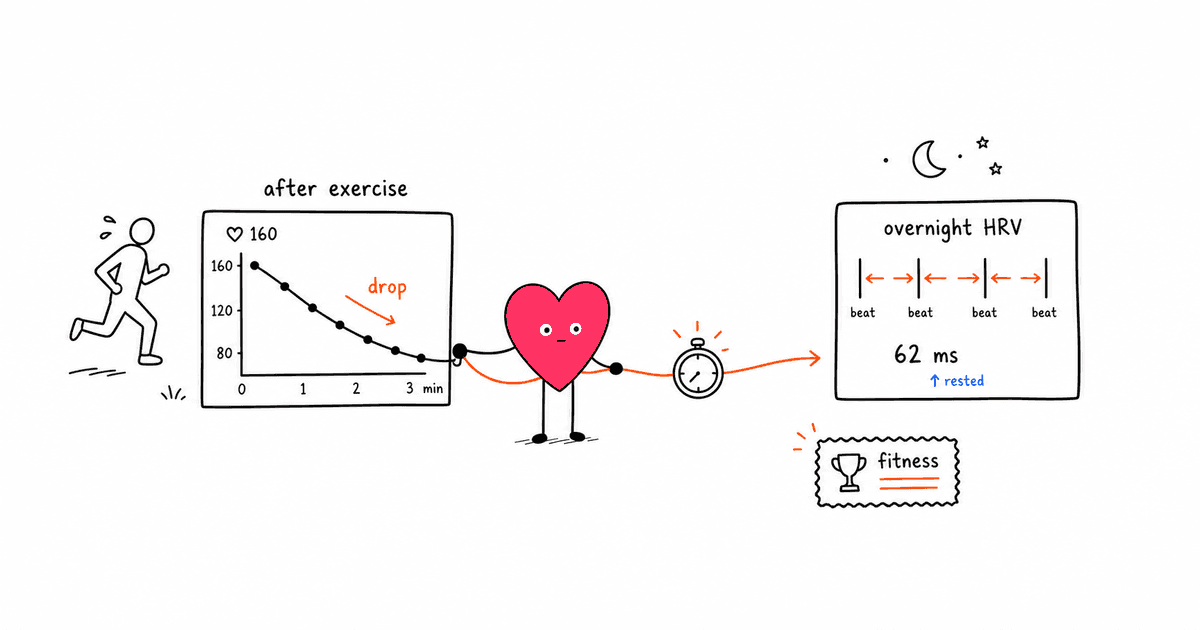
If you track your HRV, you already know it reflects how well your autonomic nervous system is functioning at rest. But there is another metric that reveals how your autonomic nervous system performs under pressure: heart rate recovery (HRR).
Together, HRV and HRR provide a more complete picture of cardiovascular fitness than either metric alone. One measures your baseline autonomic tone. The other measures how quickly your body shifts from "fight or flight" back to "rest and digest" after exertion.
What Is Heart Rate Recovery?
Heart rate recovery (HRR) is the measurable drop in heart rate within a specific time window after stopping exercise, typically one or two minutes. It reflects how quickly your parasympathetic nervous system reactivates to slow your heart down. A faster recovery indicates stronger vagal tone and better cardiovascular fitness.
For example, if your peak heart rate during a run is 175 bpm and your heart rate drops to 145 bpm one minute after stopping, your HRR1 (one-minute heart rate recovery) is 30 beats per minute.
How Heart Rate Recovery Works
During exercise, your sympathetic nervous system drives your heart rate up to meet the demands of physical activity. The moment you stop, a handoff occurs: your parasympathetic nervous system, primarily through the vagus nerve, takes over to bring your heart rate back down.
This parasympathetic reactivation happens in two phases:
- Fast phase (first 30-60 seconds): Driven almost entirely by vagal reactivation. This is the most telling window for cardiovascular health.
- Slow phase (1-5 minutes): Involves both continued vagal activity and gradual sympathetic withdrawal. Hormonal clearance (adrenaline, noradrenaline) also plays a role.
The speed of this transition is a direct reflection of your autonomic nervous system's flexibility, the same quality that HRV measures at rest.
What Counts as a Good Heart Rate Recovery?
HRR benchmarks vary depending on whether you measure at one minute or two minutes post-exercise. Here are the general ranges based on clinical research:
| Time Point | Below Average | Normal | Good | Excellent |
|---|---|---|---|---|
| HRR1 (1 min) | Less than 12 bpm | 12-20 bpm | 21-40 bpm | 40+ bpm |
| HRR2 (2 min) | Less than 22 bpm | 22-40 bpm | 41-60 bpm | 60+ bpm |
A landmark study published in the New England Journal of Medicine found that an HRR1 of less than 12 bpm after a peak exercise test was a strong predictor of mortality, independent of other risk factors. A meta-analysis in the Journal of the American Heart Association confirmed that attenuated HRR predicts fatal cardiovascular events and all-cause mortality even after adjusting for traditional risk factors.
These thresholds are guidelines, not absolutes. Age, fitness level, medication use, and the type of exercise all influence your numbers.
The Connection Between HRR and HRV
HRR and HRV are driven by the same underlying mechanism: parasympathetic (vagal) activity. This is why they tend to move together.
- High resting HRV typically correlates with faster heart rate recovery after exercise
- Low resting HRV often corresponds with slower heart rate recovery
Research published in PMC examining coronary artery disease patients found that HRR and HRV parameters decline in parallel. Patients with reduced HRV (lower RMSSD, SDNN, and HF power) also showed significantly impaired heart rate recovery at one, two, and three minutes post-exercise.
A study in Scientific Reports found that multi-day HRV averages (particularly RMSSD) correlated more strongly with HRR than single-day readings, suggesting that consistent tracking provides the most accurate picture of your autonomic fitness.
Where They Differ
Despite sharing a common mechanism, HRR and HRV capture different information:
| Aspect | HRV | HRR |
|---|---|---|
| When measured | At rest (typically morning) | After exercise |
| What it reflects | Baseline autonomic balance | Dynamic autonomic responsiveness |
| Primary driver | Parasympathetic tone at rest | Parasympathetic reactivation speed |
| Influenced by | Sleep, stress, recovery, lifestyle | Exercise intensity, fitness, cool-down protocol |
| Best for | Daily readiness monitoring | Tracking fitness adaptations over time |
Think of HRV as your autonomic nervous system's "resting state" score and HRR as its "performance under pressure" score. You can have a decent resting HRV but poor recovery if your body struggles to transition between states, or vice versa.
Why Heart Rate Recovery Matters for Health
Cardiovascular Risk Assessment
The research connecting HRR to mortality is remarkably consistent. A slow heart rate recovery is one of the strongest exercise-derived predictors of cardiovascular events and death.
The original landmark study by Cole et al. (1999) in the New England Journal of Medicine followed 2,428 adults for six years and found that those with an HRR1 below 12 bpm had a four-fold higher risk of death compared to those with normal recovery. Subsequent studies involving tens of thousands of participants have replicated this finding across different populations.
A 2017 meta-analysis in the Journal of the American Heart Association pooled data from over 150,000 participants across multiple prospective cohort studies. The results showed that impaired HRR independently predicted both cardiovascular mortality and all-cause mortality, underscoring the link between autonomic health and longevity.
Overtraining Detection
While HRV is widely used to detect overtraining, HRR adds another dimension. An athlete whose HRR slows over weeks of heavy training, even if morning HRV remains stable, may be accumulating fatigue that has not yet manifested at rest.
Tracking both metrics creates a more sensitive early warning system for overreaching.
Fitness Progress Tracking
As your cardiovascular fitness improves through regular exercise, both HRR and HRV tend to improve. HRR can be particularly useful for tracking the effectiveness of aerobic training programs because it responds directly to the same type of exercise you are using as your training stimulus.
How to Measure Heart Rate Recovery
Manual Method
- Complete a vigorous workout (running, cycling, rowing, or any sustained cardio)
- Note your peak heart rate at the moment you stop
- Start a timer
- Stand still or walk slowly (do not sit or lie down immediately, as this can artificially accelerate recovery)
- Check your heart rate at the one-minute mark
- Subtract: Peak HR minus HR at one minute = HRR1
A repeatable stair-climbing effort can work too, especially if you use the same staircase, pace, and recovery protocol each time.
Using a Wearable
Most modern fitness wearables calculate HRR automatically:
- Garmin watches display heart rate recovery in post-workout summaries, measuring at both one and two minutes
- Apple Watch shows "Cardio Recovery" in the Fitness app workout details
- Polar devices track recovery heart rate in their post-exercise reports
- Whoop focuses primarily on HRV-based recovery scores but captures the underlying heart rate data
- Oura Ring tracks resting heart rate trends but does not measure real-time exercise HRR (it excels at resting HRV instead)
For the most accurate HRR readings, use a device with optical or chest strap heart rate monitoring during your workout. Wrist-based sensors can lag slightly during rapid heart rate changes.
Standardizing Your Measurements
To track HRR trends meaningfully over time, keep these variables consistent:
- Exercise type: Compare HRR from similar workouts (do not compare a 5K run to a weightlifting session)
- Intensity: Aim for similar peak heart rate or perceived effort
- Cool-down protocol: Use the same approach each time (standing still vs. slow walking)
- Hydration and temperature: Both affect cardiovascular drift and recovery speed
How to Improve Heart Rate Recovery
Since HRR is driven by parasympathetic fitness, the strategies that improve HRV also tend to improve HRR. Here are the most evidence-backed approaches:
Consistent Aerobic Exercise
Regular endurance training is the single most effective way to improve both HRR and HRV. Research shows that long-term aerobic exercise increases parasympathetic control of the heart and reduces sympathetic activity during submaximal exercise.
Zone 2 training is particularly effective because it builds aerobic base fitness without overtaxing the autonomic nervous system.
Structured Cool-Downs
Active cool-downs (light walking or easy cycling for 5-10 minutes after intense exercise) facilitate a smoother parasympathetic transition. While this does not directly "train" your HRR, it supports better recovery between sessions, which compounds over time.
Prioritize Sleep and Recovery
Poor sleep impairs autonomic function across the board. If your HRR has stalled or declined, inadequate recovery is often the culprit. Aim for 7-9 hours of quality sleep and ensure you are not accumulating training load faster than your body can absorb it.
Manage Chronic Stress
Sustained psychological stress keeps your sympathetic nervous system elevated, making it harder for your body to shift into parasympathetic mode after exercise. Practices like meditation, breathing exercises, and time in nature can help restore autonomic balance.
Maintain a Healthy Body Composition
Excess body fat, particularly visceral fat, is associated with chronic low-grade inflammation and impaired autonomic function. Weight management through proper nutrition and exercise supports both HRR and HRV improvements.
Using HRR and HRV Together: A Practical Framework
Here is how to combine both metrics for a more complete picture of your autonomic and cardiovascular health:
Daily Check-In (HRV)
Take your morning HRV reading as your baseline readiness score. This tells you how recovered your autonomic nervous system is from yesterday's stressors, whether they were physical, mental, or emotional.
If your HRV is significantly below your personal baseline, consider reducing training intensity or taking a rest day.
Post-Workout Check (HRR)
After your harder training sessions, note your heart rate recovery. Track it over weeks and months rather than day to day, since individual sessions have too many variables.
Trend Analysis
Look for alignment or divergence between the two metrics:
- Both improving: Your cardiovascular fitness and autonomic health are trending in the right direction
- HRV improving, HRR stagnant: You may need more varied or intense aerobic stimulus
- HRR declining, HRV stable: Early sign of possible overreaching that has not yet affected resting measurements
- Both declining: Clear signal to prioritize recovery, sleep, and stress management
Red Flags
Consult a healthcare provider if you notice:
- HRR1 consistently below 12 bpm after vigorous exercise
- A sudden, sustained decline in HRR that does not recover with rest
- Low HRR combined with symptoms like unusual fatigue, dizziness, or chest discomfort
Frequently Asked Questions
Is heart rate recovery the same as HRV?
No. Heart rate recovery measures how quickly your heart rate drops after exercise (a dynamic response), while HRV measures the variation between heartbeats at rest (a baseline measurement). Both reflect parasympathetic nervous system function, but they capture different aspects of autonomic health.
What is a dangerous heart rate recovery?
An HRR1 below 12 bpm (measured one minute after peak exercise while standing or walking slowly) is considered abnormal and has been linked to increased cardiovascular risk. If you consistently measure below this threshold, discuss it with your doctor.
Can you have good HRV but poor heart rate recovery?
Yes. HRV reflects resting autonomic tone, while HRR reflects dynamic autonomic responsiveness. It is possible, though uncommon, for these to diverge. This can happen when someone has decent resting parasympathetic activity but impaired sympathetic-to-parasympathetic switching during exercise transitions.
How quickly does heart rate recovery improve with training?
Most people see measurable improvements in HRR within 4-8 weeks of consistent aerobic training. The rate of improvement depends on your starting fitness level, training volume, and overall recovery habits.
Do all wearables track heart rate recovery?
Most fitness-focused wearables (Garmin, Apple Watch, Polar, Fitbit) display HRR in post-workout summaries. Recovery-focused devices like Oura Ring and Whoop prioritize resting HRV over exercise-based HRR, though Whoop captures the underlying data. For dedicated HRR tracking, a GPS running watch with wrist or chest strap HR monitoring is ideal.
Need a quick read on your HRV number first?
Enter your HRV value, age range, device, and recovery context for a plain-English interpretation before you decide what to do next.
Interpret Your HRV NumberBuild the 30-day plan