Stair Climbing and HRV: The Small Daily Habit That Trains Your Heart
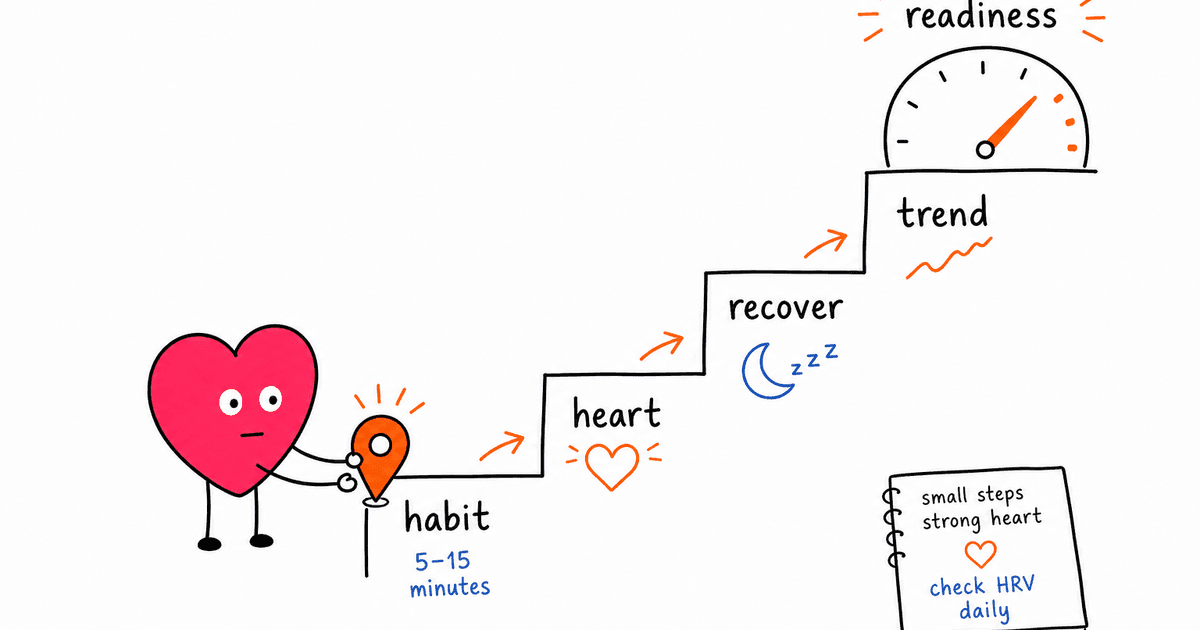
Trying to decode today's HRV number? Use the free interpreter first, then build a practical recovery plan. Interpret your HRV
Stair climbing sits in a useful middle ground between walking and more structured zone 2 cardio. It is simple, accessible, and surprisingly demanding. A few flights can raise your heart rate quickly, challenge your legs, and give your cardiovascular system a meaningful stimulus without requiring a gym session.
For heart rate variability, the story is more nuanced. Stairs are not a magic HRV booster. A hard stair session can temporarily lower HRV, just like HIIT, running, or strength training. Used intelligently, though, stair climbing can support the fitness, blood pressure, and recovery adaptations that tend to show up as better autonomic balance over time.
Does Stair Climbing Improve HRV?
Stair climbing can support better HRV over time by improving cardiorespiratory fitness, heart rate recovery, and cardiovascular resilience. The effect is indirect. HRV may dip after a hard stair workout, then rebound as your body adapts, especially if the training dose is consistent and recovery is adequate.
The practical takeaway is simple: stair climbing is best treated as a compact cardiovascular training tool. Your HRV can help you decide when to push, when to keep it easy, and when to skip the stairs entirely.
Why Stairs Hit Different Than Flat Walking
Walking is excellent for baseline movement, stress reduction, and metabolic health. Stairs add three extra demands:
- Vertical work: You lift your body weight against gravity with every step.
- Higher muscle recruitment: Glutes, quads, calves, and core all work harder than they do on flat ground.
- Faster heart rate rise: Even short stair bouts can reach moderate or vigorous intensity.
That makes stair climbing a strong option for people who want the health benefits of more intense exercise but do not have time for long workouts.
It also means stairs need more respect than they usually get. A casual two-minute stair push can be a real training stimulus, especially if you are sedentary, returning from illness, or already carrying high stress.
What the Research Says About Stair Climbing
Daily stair climbing and heart health
A large 2023 prospective cohort study in Atherosclerosis followed 458,860 adults from the UK Biobank for a median of 12.5 years. Compared with people who reported no stair climbing, those who climbed more than five flights per day, roughly 50 steps, had a lower risk of atherosclerotic cardiovascular disease.
This was observational research, so it cannot prove that stairs alone caused the lower risk. People who climb stairs may also differ in other ways, including fitness, body weight, diet, and overall activity level. Still, the finding supports a practical point: small daily movement patterns can matter.
Brief stair intervals can improve fitness
A study published in Medicine & Science in Sports & Exercise tested brief, intense stair climbing in previously untrained women. Participants performed stair intervals three days per week for six weeks. One protocol used three 20-second hard efforts, while another used three 60-second efforts on a single flight of stairs.
Both approaches improved peak oxygen uptake. In the 20-second protocol, cardiorespiratory fitness increased by about 12 percent. In the 60-second protocol, it increased by about 7 percent.
That matters because better cardiorespiratory fitness is consistently linked with healthier autonomic regulation and better recovery capacity.
Stair training in cardiac rehabilitation
A 2021 randomized trial looked at brief vigorous stair climbing in patients with coronary artery disease. Participants completed either traditional moderate-intensity exercise or a stair-climbing interval program as part of cardiac rehabilitation.
Both groups improved peak oxygen uptake. The stair group achieved similar fitness gains with much less total exercise time per session.
This does not mean people with heart disease should start sprinting stairs on their own. It does show that, when supervised and appropriately prescribed, stair climbing can be a legitimate cardiovascular training tool.
Stairs can reveal heart rate recovery
Heart rate recovery is the speed at which your heart rate falls after exercise. Faster recovery generally reflects stronger parasympathetic reactivation and better cardiovascular fitness.
A 2019 study explored whether wrist-worn devices could estimate heart rate recovery after stair climbing. The researchers described HRR after exercise as a convenient way to assess cardiovascular autonomic function and used stair climbing as a common daily activity that could produce a measurable recovery response.
For HRV users, this is useful framing. Stairs are not only exercise. They are also a repeatable real-world stress test.
How Stair Climbing May Support HRV
1. Better cardiorespiratory fitness
Higher fitness is one of the strongest lifestyle signals associated with healthier HRV. When the heart becomes more efficient, the same daily tasks require less relative effort.
Over time, this can show up as:
- Lower resting heart rate
- Faster heart rate recovery after exertion
- Better tolerance of training stress
- More stable morning HRV readings
This is why VO2 max and HRV are related but not interchangeable. VO2 max tells you about aerobic capacity. HRV tells you more about nervous system readiness and recovery.
2. Stronger parasympathetic rebound
During a stair climb, sympathetic activity rises. Heart rate increases, breathing deepens, and your body mobilizes energy.
After you stop, the goal is a smooth shift back toward parasympathetic dominance. That rebound is part of recovery. Repeating this cycle with an appropriate dose may help train the system to switch gears more efficiently.
This is one reason heart rate recovery and HRV belong in the same conversation. They are not the same metric, but both reflect how well your autonomic nervous system adapts to stress.
3. Improved blood pressure and vascular function
Stair climbing challenges both the heart and blood vessels. The repeated rise and fall in blood flow may help improve vascular function, while the fitness gains can support healthier blood pressure over time.
That matters because blood pressure and HRV are closely connected. Chronically elevated blood pressure is often linked with lower vagal tone and reduced autonomic flexibility.
Stairs are not a substitute for medical care, but they can be part of a heart-healthy movement pattern.
4. More exercise snacks, less sitting
Many people fail with exercise because they imagine it has to be a full workout. Stair climbing works well as an exercise snack: a short, intentional burst of movement inserted into the day.
Examples include:
- Taking one or two flights after lunch
- Climbing stairs before a meeting
- Doing three short stair bouts during a work break
- Choosing stairs for errands instead of elevators when practical
These tiny sessions can break up sitting time, raise daily energy expenditure, and make fitness feel less like a separate project.
How to Use HRV to Guide Stair Climbing
The best stair plan is not the hardest one. It is the one your body can recover from.
Green-light days
If your morning HRV is near or above baseline, resting heart rate is normal, sleep was decent, and you feel good, you can use stairs as a real training stimulus.
Try one of these:
- 5 to 10 minutes of steady stair climbing at a moderate pace
- 4 to 6 short climbs with full walking recovery
- 3 hard efforts of 20 to 30 seconds if you already tolerate vigorous exercise
Keep the first few sessions easier than your ego wants. Stairs punish overconfidence quickly.
Yellow-light days
If HRV is slightly below baseline, sleep was poor, or your legs feel heavy, keep stairs easy.
Good options include:
- One or two gentle flights during the day
- Slow stair walking with nasal breathing if comfortable
- Flat walking instead of stair intervals
- Mobility work if fatigue feels systemic
The goal is circulation, not heroics.
Red-light days
If HRV is sharply down, resting heart rate is elevated, you feel sick, or you are unusually sore, skip the stair workout.
Use the day for recovery:
- Easy walking
- Light stretching
- Earlier bedtime
- Hydration and regular meals
One skipped stair session will not hurt your fitness. Forcing intensity when your recovery metrics are screaming is how small stress becomes overtraining or a bigger recovery problem.
A Beginner Stair-Climbing Plan
This plan is for generally healthy adults who can climb stairs without chest pain, dizziness, or joint pain. If you have cardiovascular disease, unexplained shortness of breath, or medical restrictions, get clinician guidance first.
Week 1: Build the habit
Do this three days per week:
- Warm up with 3 to 5 minutes of easy walking.
- Climb one flight at a comfortable pace.
- Walk until breathing returns close to normal.
- Repeat for 5 to 8 total minutes.
- Stop while you still feel like you could do more.
Your HRV goal for week 1 is boring consistency. No dramatic dips. No sore calves for three days.
Week 2: Add controlled volume
Do this three days per week:
- Warm up with easy walking.
- Climb one to two flights at a moderate pace.
- Recover fully between climbs.
- Continue for 8 to 12 minutes.
- Keep effort around 6 out of 10.
If morning HRV drops for two days in a row, reduce volume rather than pushing through.
Week 3: Add optional intensity
On one day only, add short intervals:
- Warm up thoroughly.
- Climb for 20 to 30 seconds at a strong but controlled pace.
- Walk slowly for 90 to 120 seconds.
- Repeat 3 to 5 times.
- Cool down until breathing is calm.
Keep the other stair sessions easy or moderate. Intensity works best when it is surrounded by recovery.
How to Progress Without Overdoing It
Only change one variable at a time:
- Add one extra flight
- Add one extra interval
- Slightly increase pace
- Add one more day per week
- Shorten recovery by a small amount
Do not increase all of them at once. If your HRV trends down, sleep worsens, or resting heart rate creeps up, back off for a few days.
For most people, two to four stair sessions per week is plenty when combined with walking, strength training, and normal daily movement.
What to Track
Stair climbing pairs well with simple tracking. You do not need a complicated dashboard.
Track these five signals:
| Signal | What It Tells You |
|---|---|
| Morning HRV | Whether your nervous system is recovering |
| Resting heart rate | Whether baseline strain is rising |
| Heart rate recovery | How quickly you calm down after stairs |
| Perceived effort | Whether the same stairs feel easier over time |
| Leg soreness | Whether local fatigue is accumulating |
If the same staircase starts feeling easier at the same pace, that is progress. If your heart rate recovers faster after the same effort, that is also progress.
Who Should Be Careful
Get medical guidance before vigorous stair training if you have:
- Known heart disease
- Chest pain or unexplained shortness of breath
- Dizziness, fainting, or abnormal heart rhythms
- Uncontrolled high blood pressure
- Recent surgery or injury
- Significant knee, hip, ankle, or Achilles problems
For these groups, stairs may still be useful, but the dose and supervision matter.
The Bottom Line
Stair climbing is one of the simplest ways to make daily movement more cardiovascular. It can improve fitness, challenge heart rate recovery, and support the long-term adaptations that often go along with healthier HRV.
Use stairs like a tool, not a punishment. On good recovery days, they can provide a compact training stimulus. On low-recovery days, they can be reduced to easy movement or skipped.
That is the real HRV advantage: not blindly doing more, but matching the dose to what your body is ready to absorb.
FAQ
Is stair climbing better than walking for HRV?
Not better, just different. Walking is easier to recover from and works well for daily volume. Stair climbing is more intense and better suited for short cardiovascular training bouts. Most people benefit from both.
Why does my HRV drop after stair workouts?
A drop after hard stairs usually reflects training stress. Your sympathetic nervous system worked hard, your legs absorbed load, and your body needs recovery. If HRV rebounds within a day or two, the dose was probably reasonable.
How many flights of stairs should I climb per day?
There is no universal number. The 2023 UK Biobank study found lower cardiovascular risk among people climbing more than five flights per day, but that does not make five flights a prescription. Start with what you can recover from and build gradually.
Should I track HRV before or after climbing stairs?
Use your normal morning HRV reading for readiness. After stairs, heart rate recovery is often more useful than HRV because HRV during and immediately after exercise is harder to interpret.
Need a quick read on your HRV number first?
Enter your HRV value, age range, device, and recovery context for a plain-English interpretation before you decide what to do next.
Interpret Your HRV NumberBuild the 30-day plan