HIIT and HRV: How High-Intensity Interval Training Affects Your Heart Rate Variability
Trying to decode today's HRV number? Use the free interpreter first, then build a practical recovery plan. Interpret your HRV
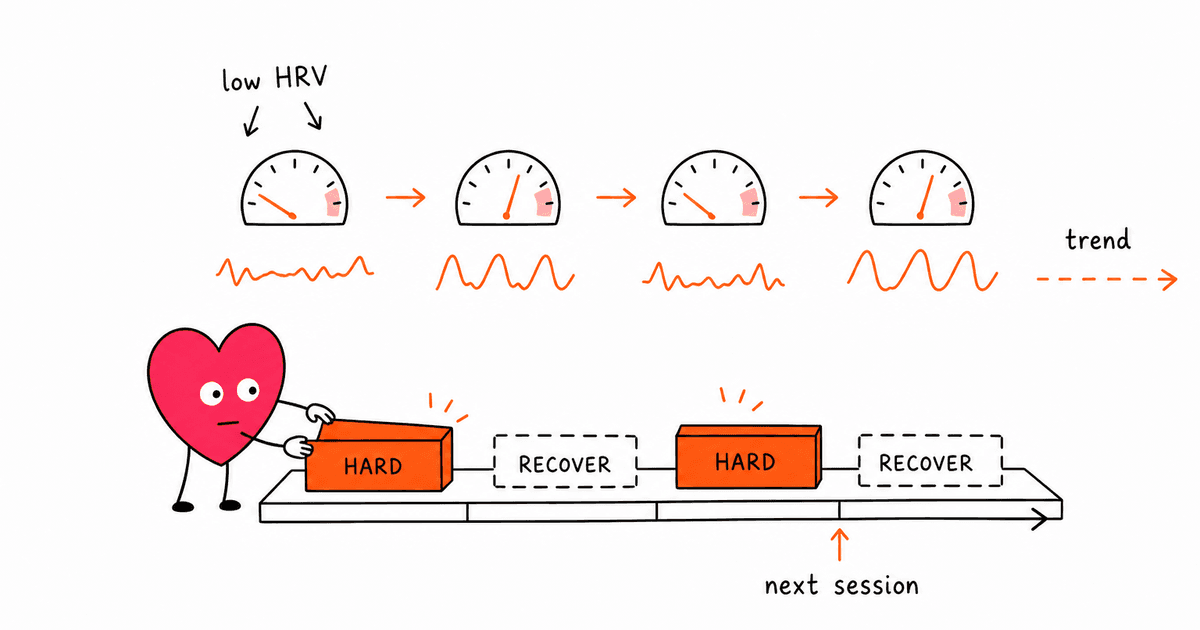
High-intensity interval training (HIIT) has become one of the most popular and time-efficient workout strategies in fitness. But if you track your HRV, you may have noticed something unsettling: your numbers can drop significantly after a tough HIIT session. That temporary dip is actually a normal part of the recovery process, and understanding it can help you train smarter and get stronger results.
What Happens to HRV During a HIIT Workout
During a HIIT session, your autonomic nervous system shifts heavily toward sympathetic ("fight or flight") dominance, causing HRV to drop sharply. Your heart rate spikes toward its maximum, stress hormones like adrenaline and cortisol surge, and parasympathetic activity is suppressed. This is completely expected and is not a sign of harm.
The intensity of the sympathetic response depends on the specific protocol. Shorter intervals (like Tabata-style 20 seconds on, 10 seconds off) produce intense but brief sympathetic spikes, while longer intervals (such as 4x4 minute efforts at 85-95% of max heart rate) create more sustained autonomic stress.
The Acute HRV Response: What Happens After HIIT
The more important question is what happens in the hours and days following a HIIT workout. Research shows a predictable pattern:
- 0-2 hours post-workout: HRV remains suppressed. Parasympathetic reactivation begins but is incomplete. A 2025 study in Applied Sciences found that the LF/HF ratio (a marker of sympathetic-parasympathetic balance) remained elevated for at least two hours after high-intensity training.
- 2-24 hours post-workout: HRV gradually recovers. Low-frequency HRV power increases at around 24 hours as the autonomic nervous system rebalances.
- 24-48 hours post-workout: For most people, HRV returns to baseline within this window. Research published in the Journal of Strength and Conditioning Research found that HRV markers normalized within 48 hours for trained individuals but took up to 72 hours for those with lower fitness levels.
- 48-72 hours post-workout: Full recovery, including high-frequency HRV (parasympathetic tone), typically returns to baseline or may even rebound slightly above pre-exercise levels.
This recovery timeline is why most experts recommend spacing HIIT sessions at least 48 hours apart.
HIIT vs. Steady-State Cardio: HRV Differences
HIIT and steady-state cardio (like zone 2 training) affect HRV in meaningfully different ways:
| Factor | HIIT | Zone 2 / Steady-State |
|---|---|---|
| Acute HRV drop | Large (significant suppression) | Mild to moderate |
| Recovery time | 24-72 hours | 12-24 hours |
| Long-term HRV improvement | Significant (SDNN and RMSSD) | Moderate |
| Sympathetic stress | High | Low |
| Best frequency | 2-3 sessions per week | 3-5 sessions per week |
A 2025 meta-analysis published in Frontiers in Cardiovascular Medicine found that HIIT had the most significant improvement on SDNN and RMSSD (two key time-domain HRV metrics) compared to other exercise modalities. However, this only holds true when adequate recovery is built into the training plan.
Why HIIT Improves HRV Over Time
Despite causing short-term HRV drops, consistent HIIT training leads to meaningful long-term HRV improvements. The mechanisms include:
Increased Vagal Tone
HIIT challenges the cardiovascular system intensely, which triggers adaptive responses. Over weeks and months, the vagus nerve becomes more efficient at restoring parasympathetic balance after stress. This manifests as higher resting RMSSD and HF power, contributing to the kind of long-term gains outlined in our guide to improving HRV.
Improved Cardiac Output and Structure
Research shows HIIT increases left ventricular wall thickness and cardiac output. A stronger, more efficient heart produces greater beat-to-beat variability at rest, which directly raises HRV.
Enhanced Baroreflex Sensitivity
The baroreceptor reflex (which helps regulate blood pressure) becomes more responsive with HIIT training. This improved sensitivity contributes to better autonomic regulation and higher HRV.
Reduced Resting Heart Rate
HIIT consistently lowers resting heart rate. A 2021 study in the Biomedical Journal found that just six weeks of whole-body HIIT significantly increased SDNN and RMSSD while reducing resting heart rate in previously inactive adults.
How to Use HRV to Guide Your HIIT Training
Rather than following a rigid schedule, HRV-guided training adjusts your workout intensity based on your daily autonomic readiness. Research shows this approach produces better results with less overall training volume.
The HRV-Guided Approach
- Measure your morning HRV using a wearable like the Oura Ring, Whoop, or Garmin before getting out of bed (see our best HRV monitors guide for recommendations).
- Calculate your 7-day rolling average (most apps do this automatically). This is more useful than any single reading.
- Compare today's reading to your baseline:
- HRV at or above baseline: Green light for a HIIT session.
- HRV slightly below baseline (within normal variation): Moderate-intensity training is appropriate.
- HRV significantly below baseline: Opt for low-intensity movement, walking, or rest.
What the Research Says About HRV-Guided HIIT
A randomized controlled trial published in the European Journal of Preventive Cardiology compared HRV-guided training to traditional fixed-schedule HIIT in cardiac rehabilitation patients. The findings were striking:
- The HRV-guided group achieved better blood pressure reductions (both systolic and diastolic)
- The HRV-guided group showed greater improvement in heart rate recovery
- The HRV-guided group had lower HRV variability (more stable autonomic function), a marker of better adaptation
- All of this was achieved with less total high-intensity training volume
In other words, training smarter by listening to your autonomic nervous system produced superior cardiovascular outcomes with less wear and tear.
Common HIIT Protocols and Their HRV Impact
Not all HIIT is created equal. Different protocols produce varying levels of autonomic stress:
Tabata Protocol (20s on / 10s off x 8)
- Duration: 4 minutes of work
- HRV impact: Moderate acute suppression
- Recovery: Typically 24-36 hours
- Best for: Time-pressed individuals looking for efficiency
Norwegian 4x4 Protocol (4 min on / 3 min off x 4)
- Duration: 16 minutes of high-intensity work
- HRV impact: Significant acute suppression
- Recovery: 48-72 hours recommended
- Best for: Endurance athletes and cardiovascular health
Sprint Intervals (30s all-out / 4 min rest x 4-6)
- Duration: 2-3 minutes of maximal effort
- HRV impact: Large acute suppression despite short work time
- Recovery: 48+ hours
- Best for: Trained athletes with strong recovery capacity
Stair Intervals
- Duration: 3-10 minutes of short climbs with full recovery
- HRV impact: Moderate to high acute suppression, depending on pace and total flights
- Recovery: Treat hard efforts like HIIT and watch next-day HRV before repeating
- Best for: People who want an equipment-free way to add intensity, assuming stairs are safe and joint-friendly
Brief stair-climbing intervals can feel deceptively simple, but they still count as a real training stimulus. Treat them like HIIT, not like casual steps.
Jump Rope Intervals
- Duration: 4-12 minutes of short bouts with generous rest
- HRV impact: Moderate to high acute suppression, especially for beginners
- Recovery: Watch calves, Achilles soreness, and next-day HRV before adding volume
- Best for: People who want compact cardio but can keep form relaxed under fatigue
Hard jump rope sessions are easy to underestimate because the equipment is simple. The nervous-system cost can still be real, especially when rope work is stacked on running, lifting, or sport practice.
CrossFit-Style HIFT (High-Intensity Functional Training)
- Duration: 10-20 minutes of varied movements
- HRV impact: Variable, depends on workout design
- Recovery: 24-72 hours depending on volume
- Best for: Those who prefer variety and functional strength
Signs You Are Doing Too Much HIIT
Overtraining from excessive HIIT is a real risk, and HRV is one of the best early warning systems. Watch for these patterns:
- Chronically suppressed morning HRV (consistently below your 30-day baseline for more than a week)
- Increased HRV coefficient of variation (your readings become erratic and unpredictable, swinging widely day to day)
- Elevated resting heart rate alongside low HRV
- Paradoxically high HRV in some cases, very high vagal HRV with fatigue symptoms can indicate parasympathetic saturation, a sign of non-functional overreaching
- Slow return to baseline after sessions (taking 72+ hours to recover)
If you notice these trends, reduce HIIT frequency, increase recovery days, and consider adding more low-intensity work to your program.
Building an HRV-Optimized HIIT Schedule
Based on the research, here is a framework for integrating HIIT into your training while protecting your HRV:
Beginner (New to HIIT or Low Baseline HRV)
- HIIT sessions: 1-2 per week
- Recovery between sessions: 72 hours minimum
- Complement with: Walking, light cycling, or yoga
- Priority: Build consistency before adding volume
Intermediate (6+ Months of HIIT Experience)
- HIIT sessions: 2-3 per week
- Recovery between sessions: 48-72 hours
- Complement with: Zone 2 cardio, strength training, mobility work
- Priority: Use HRV to auto-regulate intensity
Advanced (Trained Athletes)
- HIIT sessions: 3-4 per week (with periodization)
- Recovery between sessions: 48 hours minimum
- Complement with: Polarized training model (80% low intensity, 20% high intensity)
- Priority: Periodize across mesocycles, monitor HRV trends weekly
Lifestyle Factors That Affect HIIT Recovery and HRV
Your HRV recovery after HIIT does not happen in isolation. Several lifestyle factors directly influence how quickly your autonomic nervous system rebounds:
- Sleep quality: Poor sleep extends the HRV suppression window after HIIT. Aim for 7-9 hours.
- Nutrition: Post-workout nutrition matters. Adequate protein and carbohydrate intake supports faster parasympathetic reactivation.
- Hydration: Dehydration amplifies sympathetic stress and delays HRV recovery.
- Alcohol: Even moderate alcohol consumption after a HIIT session can extend HRV suppression by 24-48 additional hours.
- Stress: Psychological stress compounds the autonomic load of HIIT. High life stress periods may call for reduced HIIT frequency.
Tracking Your HIIT and HRV Relationship
To get the most out of HRV-guided HIIT training, track these metrics over time:
- Morning RMSSD (or your wearable's HRV score) before and for 2-3 days after each HIIT session
- Resting heart rate trends alongside HRV (see understanding HRV numbers for how to interpret these metrics together)
- Subjective readiness (rate your energy, motivation, and muscle soreness on a simple 1-5 scale)
- Performance metrics (are your interval times, power output, or heart rate at given efforts improving?)
After 4-6 weeks of consistent tracking, you will develop a clear picture of your individual recovery patterns. Some people bounce back in 24 hours. Others need a full 72. Knowing your pattern lets you build a training schedule that pushes adaptation without tipping into overtraining.
Frequently Asked Questions
Does HIIT lower HRV permanently?
No. HIIT temporarily suppresses HRV for 24-72 hours after a session, but over weeks and months of consistent training with adequate recovery, HIIT leads to significant long-term HRV improvements. Studies show it is one of the most effective exercise modalities for improving SDNN and RMSSD.
How many HIIT sessions per week are optimal for HRV?
For most people, 2-3 HIIT sessions per week with at least 48 hours of recovery between sessions produces the best balance of adaptation and recovery. HRV-guided training can help you personalize this further.
Should I skip HIIT if my HRV is low?
Not necessarily, but consider reducing intensity. If your HRV is significantly below your personal baseline, a moderate workout or active recovery session may be more productive than a full HIIT effort. Consistently ignoring low HRV readings increases overtraining risk.
Is HIIT or zone 2 better for improving HRV?
Both are valuable but work differently. HIIT produces larger long-term HRV improvements according to meta-analyses, but zone 2 training allows more frequent sessions with less recovery demand. The most effective approach combines both in a polarized training model.
Can beginners do HIIT safely based on HRV?
Yes, but start conservatively. Begin with one session per week, use longer rest intervals, and monitor your HRV recovery patterns before increasing frequency. If your HRV takes more than 72 hours to return to baseline, you may need more conditioning work first.
Need a quick read on your HRV number first?
Enter your HRV value, age range, device, and recovery context for a plain-English interpretation before you decide what to do next.
Interpret Your HRV NumberBuild the 30-day plan