Jump Rope and HRV: How Skipping Rope Trains Your Heart and Recovery
Trying to decode today's HRV number? Use the free interpreter first, then build a practical recovery plan. Interpret your HRV
Jump rope looks simple until you try to do it for more than a minute. A cheap rope, a little space, and a few minutes of rhythm can turn into a real cardiovascular workout fast.
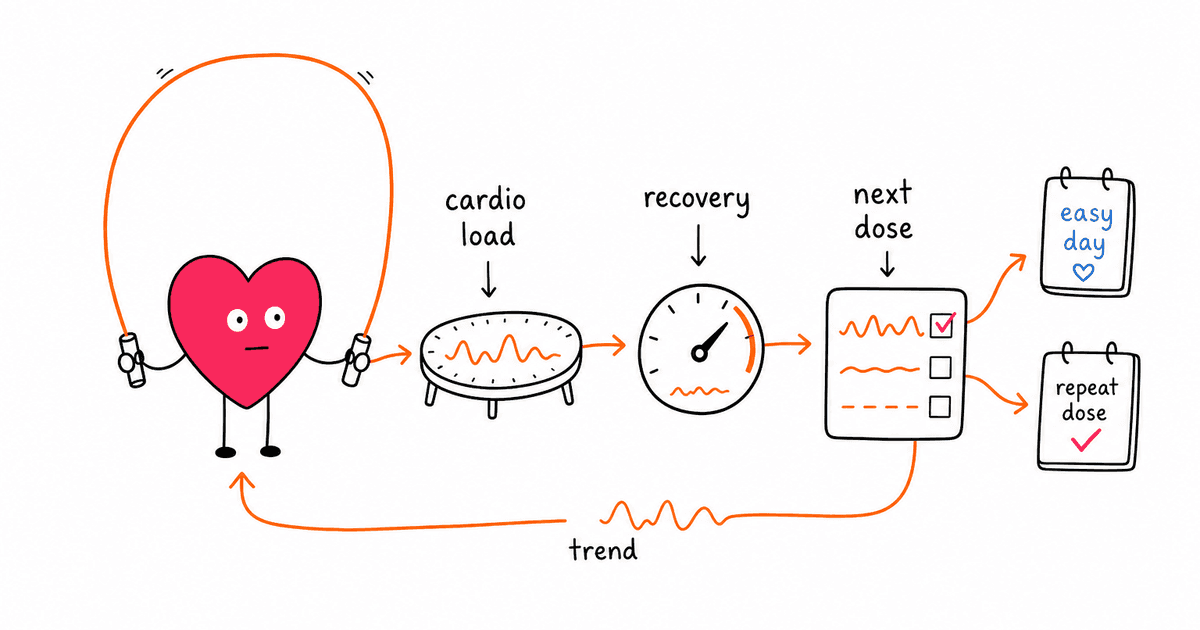
That makes it useful for heart health, but also easy to overdo. Jump rope can sit anywhere from low-pressure coordination practice to vigorous interval training. HRV helps you decide which version belongs in today's plan.
Does Jump Rope Improve HRV?
Jump rope may support better HRV over time by improving cardiorespiratory fitness, heart rate recovery, coordination, and training consistency. It is not a direct HRV hack. A hard skipping session can temporarily lower HRV, but the right dose can build fitness and recovery capacity linked with healthier autonomic balance.
The key is not doing more rope work every time. It is matching the session to your recovery status, then progressing gradually enough that your nervous system can adapt.
Why Jump Rope Is a Serious Cardio Tool
Jumping rope is often treated like playground exercise, but physiologically it can be demanding.
The American Heart Association lists jumping rope as a vigorous-intensity aerobic activity. That means it can count toward the weekly guideline of 75 minutes of vigorous activity or 150 minutes of moderate activity, depending on effort.
A jump rope session can challenge several systems at once:
- Cardiorespiratory fitness: Heart rate rises quickly, especially with continuous skipping or intervals.
- Coordination: Timing, foot strike, wrist rhythm, and posture all matter.
- Elastic strength: Calves, ankles, feet, and tendons absorb repeated low hops.
- Metabolic fitness: Short intervals can create a strong training stimulus in limited time.
- Recovery capacity: Your body has to downshift after each bout, which makes heart rate recovery useful to track.
For HRV users, that last point matters. Jump rope is not just exercise. It is a repeatable stressor you can scale up or down.
What the Research Says
Rope skipping can improve cardiorespiratory fitness
A 2025 randomized trial in the European Journal of Clinical Nutrition studied 59 healthy young adults who were not meeting physical activity guidelines. Participants were assigned to high-intensity interval rope skipping, moderate continuous rope skipping, or a control group.
The interval group performed 9 rounds of 2-minute bouts at about 80 percent of maximum heart rate with 1-minute active recoveries. The moderate group skipped continuously for 30 minutes at about 70 percent of maximum heart rate.
Both rope-skipping formats improved cardiorespiratory fitness and had comparable enjoyment. That matters because the best cardio plan is not always the most elegant one. It is the one people will repeat.
Rope skipping may support blood pressure and recovery
A 2023 randomized controlled trial tested progressive rope skipping in adolescents with moderate intellectual disability. The intervention ran for 8 weeks, with 50-minute sessions three times per week.
After the program, the rope-skipping group improved physical fitness measures, had lower systolic and diastolic blood pressure, and showed a lower area under the curve for heart rate during post-exercise recovery.
This was a specific population, so it should not be generalized too aggressively. Still, it supports the broader point: progressive rope skipping can be legitimate cardiovascular training, not just a novelty workout.
HRV-guided training can help manage intensity
Jump rope research does not yet give a clean answer like, "three skipping sessions per week raises HRV by X percent." That would be too tidy.
But HRV-guided training research is relevant. A 2021 systematic review and meta-analysis found that HRV-guided endurance training often used fewer moderate or high-intensity sessions than fixed plans, yet showed a positive effect on submaximal physiological markers. Effects on performance and VO2 peak were smaller and not statistically significant.
The practical lesson is simple: HRV is best used to regulate dose, not chase a daily score.
How Jump Rope Affects Your Nervous System
During a rope session, your sympathetic nervous system ramps up. Heart rate increases, breathing gets faster, and your body mobilizes energy.
After you stop, parasympathetic activity should gradually reassert itself. This is where heart rate recovery becomes useful. If your heart rate drops smoothly after the same rope interval over time, your recovery response may be improving.
Morning HRV gives you a different view. It reflects your baseline recovery state before the workout. Together, these two signals help you answer better questions:
- Am I recovered enough to do intervals today?
- Did yesterday's jump rope session cost more than expected?
- Is the same session getting easier at the same heart rate?
- Do I need easy movement before adding intensity?
That is much smarter than using jump rope as punishment cardio.
Why HRV May Drop After Jump Rope
A lower HRV reading after jump rope is not automatically bad. It depends on timing, magnitude, and recovery.
HRV may dip because of high sympathetic activation, calf or Achilles soreness, heat stress, poor sleep after a late hard session, too much intensity stacked with running, HIIT, or strength training, or not enough nutrition and hydration.
If HRV rebounds within a day or two and resting heart rate stays normal, the session was probably absorbed well. If HRV stays suppressed, resting heart rate rises, sleep worsens, or your legs feel beat up, the dose was too high.
The HRV-Guided Jump Rope Framework
Think of jump rope as having three modes: skill, cardio, and intervals.
1. Skill mode
Skill mode is low-pressure practice. You work on timing, posture, and relaxed rhythm without trying to crush your heart rate.
Use it when HRV is slightly below baseline, you are learning the movement, your calves or feet are sore, or you already trained hard this week. A simple session might be 5 to 10 minutes of easy practice with frequent breaks.
2. Cardio mode
Cardio mode is steady, moderate effort. You should breathe harder, but not feel like you are sprinting.
Use it when HRV is near baseline, resting heart rate is normal, sleep was decent, and you can maintain clean form. This can work like a shorter, bouncier cousin of zone 2 training, though many beginners will drift above zone 2 quickly.
3. Interval mode
Interval mode is hard work. It is where jump rope starts to resemble HIIT.
Use it when HRV is at or above baseline, resting heart rate is normal or low, you feel fresh, and you have no foot, ankle, calf, knee, or Achilles pain. Intervals are effective, but most people only need one or two hard jump rope sessions per week.
A Beginner Jump Rope Plan
This plan is for generally healthy adults. If you have heart disease, chest pain, dizziness, fainting, uncontrolled high blood pressure, recent surgery, or significant joint or tendon issues, get clinician guidance before vigorous skipping.
Week 1: Learn the rhythm
Do this three days per week:
- Warm up with 3 to 5 minutes of easy walking.
- Skip for 20 seconds at an easy pace.
- Rest for 40 to 60 seconds.
- Repeat for 8 to 12 rounds.
- Stop before form gets sloppy.
Your goal is relaxed timing, not fatigue.
Week 2: Build easy volume
Do this three days per week:
- Warm up thoroughly.
- Skip for 30 seconds.
- Rest for 30 to 60 seconds.
- Repeat for 10 to 15 rounds.
- Keep effort around 5 or 6 out of 10.
If morning HRV drops for two days in a row, cut the next session in half.
Week 3: Add controlled cardio
Do this two or three days per week:
- Warm up with walking, ankle circles, and easy hops.
- Skip for 60 seconds at a moderate pace.
- Rest for 60 seconds.
- Repeat for 8 to 12 rounds.
- Cool down until breathing is calm.
Do not add hard intervals yet if your calves are still getting sore after every session.
Week 4: Add optional intensity
If HRV, resting heart rate, sleep, and soreness all look good, add one interval day:
- Warm up for at least 5 minutes.
- Skip hard for 20 to 30 seconds.
- Walk or rest for 90 seconds.
- Repeat 4 to 6 times.
- Cool down with easy walking.
Keep any other rope sessions easy that week.
How to Progress Without Overtraining
Progress one variable at a time.
Good options include adding one or two rounds, adding 5 to 10 seconds per round, reducing rest slightly, adding one extra weekly session, or moving from easy skips to controlled moderate efforts.
Bad options include adding volume and intensity in the same week, doing intervals on back-to-back days, skipping through shin pain, treating every session like a test, or ignoring a multi-day HRV drop.
If you are already lifting, running, playing sports, or doing hard cardio, jump rope is additional stress. It does not exist in a separate recovery universe.
What to Track
A basic HRV setup is enough. A wearable can track overnight trends, while a chest strap like the Polar H10 can be useful for controlled heart rate or HRV spot checks.
| Signal | What It Tells You |
|---|---|
| Morning HRV | Whether your recovery baseline is stable |
| Resting heart rate | Whether overall strain is rising |
| Heart rate recovery | How quickly you downshift after a repeatable bout |
| Session RPE | How hard the same workout feels |
| Soreness | Whether tendons and lower legs are tolerating the load |
| Sleep quality | Whether late or hard sessions are disrupting recovery |
The best sign is not one heroic workout. It is the same rope session feeling easier with faster recovery and no multi-day HRV penalty.
Common Mistakes
Starting with too much bounce
Beginners often jump too high. Keep hops low, quiet, and relaxed. The rope only needs enough space to pass under your feet.
Using intervals before skill is ready
If you trip every few seconds, hard intervals are premature. Build rhythm first. Intensity layered on bad mechanics usually becomes calf pain.
Training on unforgiving surfaces
Concrete is rough on feet, shins, and tendons. Wood, rubber gym flooring, or a quality exercise mat is usually more forgiving.
Chasing calorie burn
Jump rope can burn energy quickly, but that is not the main point. For HRV, the goal is a recoverable cardiovascular stimulus.
Ignoring low-recovery days
A low HRV day does not require total rest every time. It does mean hard skipping is a poor default. Use skill practice, walking, mobility, or an easy recovery day instead.
Who Should Be Careful
Jump rope is not ideal for everyone.
Be cautious or get medical guidance if you have chest pain, fainting, unexplained shortness of breath, known heart disease, abnormal heart rhythms, uncontrolled high blood pressure, recent surgery, major ankle, knee, hip, foot, or Achilles problems, a history of stress fractures, severe shin splints, or balance issues that make tripping risky.
There are plenty of ways to improve HRV and heart health. If skipping does not fit your body, walking, cycling, swimming, rowing, and stair climbing can all be easier to scale.
The Bottom Line
Jump rope is a compact, inexpensive way to train your heart. It can improve cardio fitness, challenge heart rate recovery, and make vigorous exercise easier to fit into real life.
For HRV, the win is not doing the hardest rope session possible. It is using HRV, resting heart rate, soreness, and sleep to choose the right dose.
On high-readiness days, jump rope can be a powerful training tool. On low-readiness days, it should become skill practice, easy movement, or rest.
That flexibility is what turns a rope from a punishment device into a useful recovery-aware habit.
FAQ
Is jump rope good for HRV?
Jump rope can support HRV indirectly by improving cardiovascular fitness and recovery capacity. Hard sessions may temporarily lower HRV, especially if you are new to skipping or do too much too soon.
Why is my HRV lower after jump rope?
A lower reading usually reflects training stress. Your nervous system, muscles, and tendons are recovering. If HRV rebounds quickly, that is normal adaptation. If it stays low for several days, reduce volume or intensity.
Is jump rope better than running for HRV?
Not necessarily. Jump rope is more compact and coordination-heavy, while running is easier to sustain continuously. Both can help fitness. The better choice is the one you enjoy, tolerate, and recover from consistently.
How often should I jump rope?
Most beginners do well with two or three short sessions per week. More experienced people may tolerate three to five, but only one or two should be hard if HRV, sleep, or soreness starts trending the wrong way.
Should I jump rope on a low HRV day?
Avoid hard intervals on a low HRV day. If you feel okay, use easy skill practice or short relaxed bouts. If low HRV comes with fatigue, elevated resting heart rate, poor sleep, or illness symptoms, skip it.
Need a quick read on your HRV number first?
Enter your HRV value, age range, device, and recovery context for a plain-English interpretation before you decide what to do next.
Interpret Your HRV NumberBuild the 30-day plan