VO2 Max vs. HRV: What Each Metric Says About Fitness, Recovery, and Longevity
Trying to decode today's HRV number? Use the free interpreter first, then build a practical recovery plan. Interpret your HRV
If you use a Garmin, Apple Watch, Whoop, or Oura Ring, you have probably seen both HRV and VO2 max show up in your health data. They sound equally important, but they are not measuring the same thing.
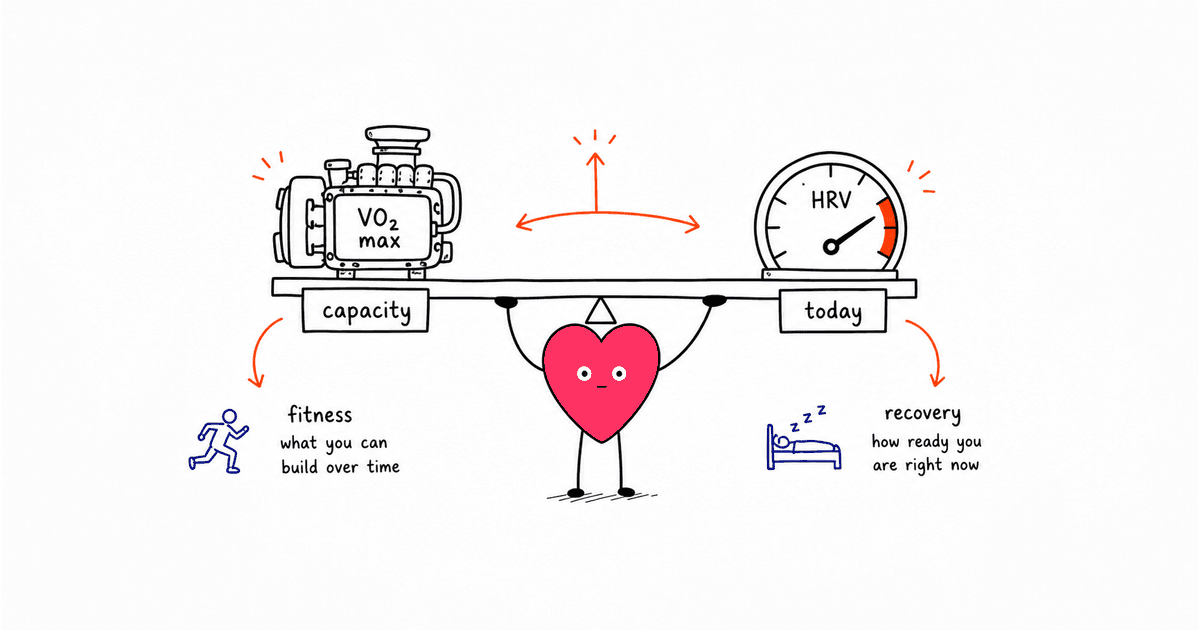
VO2 max tells you how big your aerobic engine is. HRV tells you how your nervous system is handling the load placed on that engine. One is mainly a fitness capacity metric. The other is mainly a recovery and adaptability metric.
They do overlap. Fitter people often have better autonomic function, and training that improves aerobic fitness can also improve HRV. But the relationship is not tight enough to treat one as a substitute for the other.
If you want the short version, use VO2 max to track long-term cardiovascular fitness and use HRV to guide day-to-day recovery and training decisions.
What Is VO2 Max?
VO2 max is the maximum amount of oxygen your body can take in, transport, and use during intense exercise. It is usually expressed in milliliters of oxygen per kilogram of body weight per minute (mL/kg/min).
In practical terms, VO2 max reflects your aerobic ceiling. The higher it is, the more work you can usually do before fatigue forces you to slow down.
VO2 max is influenced by:
- Heart size and stroke volume
- Blood volume and hemoglobin delivery
- Mitochondrial density and muscle oxidative capacity
- Training status, especially endurance training
- Age, sex, genetics, and body composition
A lab treadmill or cycle test with gas analysis is the gold standard. Most consumer wearables estimate VO2 max from pace, heart rate, power, and movement data during outdoor walking, running, or cycling.
What Is HRV?
Heart rate variability is the variation in time between one heartbeat and the next. A higher HRV generally reflects greater parasympathetic activity and more flexible autonomic regulation, while a lower HRV often signals fatigue, stress, illness, or inadequate recovery.
HRV is usually most useful when measured at rest, especially overnight or first thing in the morning under consistent conditions. If you are new to the metric, start with our guides on what HRV is and how to interpret your numbers.
Unlike VO2 max, HRV can move noticeably from one day to the next. A hard workout, a bad night of sleep, alcohol, psychological stress, travel, and illness can all shift it quickly.
VO2 Max vs. HRV: The Core Difference
Here is the simplest way to think about it:
| Metric | Main Question It Answers | Best Time Scale | What Changes It Most |
|---|---|---|---|
| VO2 max | How strong is my aerobic fitness? | Weeks to months | Endurance training, intervals, aging, detraining |
| HRV | How well is my body recovering and adapting right now? | Days to weeks | Sleep, stress, illness, training load, recovery habits |
VO2 max is closer to your capacity.
HRV is closer to your current state.
That distinction matters. You can have an excellent VO2 max and still wake up with suppressed HRV after a brutal training block, poor sleep, or high stress. You can also have decent HRV without having exceptional aerobic fitness.
How VO2 Max and HRV Are Related
VO2 max and HRV are linked through the autonomic nervous system and overall cardiovascular fitness.
In broad terms, people with stronger aerobic fitness often show better parasympathetic control at rest, lower resting heart rate, and healthier recovery patterns. Research also shows that exercise training can improve common HRV markers such as RMSSD, SDNN, and high-frequency power.
That said, the relationship is not perfectly linear.
A 2024 systematic review and meta-analysis in Cureus found that exercise training improved several HRV measures in healthy adults, especially RMSSD, SDNN, and HF power. A 2020 systematic review in the International Journal of Environmental Research and Public Health found that HRV-guided training had a small but positive effect on VO2 max in endurance athletes, with stronger results in amateur and female subgroups.
So yes, training that improves one metric can often help the other.
But it does not follow that a higher HRV means you automatically have a higher VO2 max, or that a lower HRV means your fitness is poor.
Why HRV Is Not a Proxy for VO2 Max
This is where many wearable users get tripped up.
HRV feels more dynamic, so people sometimes assume it is a live score for fitness. It is not.
A 2013 study in Frontiers in Physiology compared heart rate, HRV measures, and VO2 max in healthy young adults. Resting heart rate explained more of the variation in VO2 max than HRV did, and the authors concluded that HRV did not add much value as a direct indicator of aerobic fitness in that setting.
That matches real life. Your HRV can drop for reasons that have nothing to do with your aerobic ceiling, including:
- Poor sleep
- Dehydration
- Heavy strength training
- Emotional stress
- Alcohol intake
- Jet lag
- Illness or inflammation
Meanwhile, VO2 max usually changes slowly. You do not lose all your aerobic fitness because of one rough week, and you do not gain it from two great nights of sleep.
Why VO2 Max Matters So Much for Health
VO2 max is not just a performance metric for runners and cyclists. It is one of the strongest markers of long-term health and survival.
A 2024 overview of meta-analyses in the British Journal of Sports Medicine, covering more than 20.9 million observations, found that higher cardiorespiratory fitness was strongly associated with lower all-cause mortality, lower cardiovascular mortality, and lower incidence of heart failure and other chronic disease outcomes. The review reported that each 1-MET increase in cardiorespiratory fitness was associated with an 11% to 17% reduction in all-cause mortality in general populations.
That is a big deal.
If your goal is longevity, heart health, and resilience with aging, building aerobic fitness deserves serious attention. VO2 max is not the only thing that matters, but it is one of the clearest signals that your cardiovascular system is staying capable.
A related vascular marker is artery elasticity. If you want the blood-vessel side of cardiovascular aging, see arterial stiffness and HRV.
Why HRV Still Matters
VO2 max may be the bigger long-term health marker, but HRV is often more useful on a Tuesday morning.
HRV helps you answer questions like:
- Am I absorbing my training well?
- Am I digging a recovery hole?
- Is today a good day to push, or should I back off?
- Is my low energy more likely to be stress related than fitness related?
That is why HRV is so valuable for athletes, busy professionals, and anyone juggling training with real life. It gives you a window into how your nervous system is responding right now, not just what your cardiovascular ceiling might be in ideal conditions.
If your HRV is trending down for several days, that is often a cue to look at sleep, stress, alcohol, travel, or training load before assuming your fitness suddenly disappeared.
Which Metric Should You Care About More?
That depends on what problem you are trying to solve.
Prioritize VO2 Max if your goal is:
- Improving endurance performance
- Reducing long-term cardiovascular risk
- Tracking the result of aerobic training over months
- Understanding your overall cardiorespiratory fitness
Prioritize HRV if your goal is:
- Managing recovery day to day
- Adjusting training intensity based on readiness
- Spotting accumulating fatigue early
- Understanding how lifestyle habits affect your physiology
The best answer for most people
Use both, but do not ask them to do the same job.
Build VO2 max over months. Use HRV to manage the path you take to get there.
That is the sweet spot.
A Practical Framework for Using Both Metrics
Here is a simple way to combine them without overcomplicating your training.
1. Check HRV daily or several times per week
Look at trend, not noise. A single low reading means very little. Several days below your normal baseline is more meaningful.
2. Review VO2 max monthly, not obsessively
VO2 max estimates can bounce around based on sensor quality, workout type, heat, hills, and software quirks. What matters is the medium-term trend.
3. Match the metric to the decision
- Today’s training decision: HRV
- This block of training is working: VO2 max
- My recovery habits are slipping: HRV
- My aerobic fitness is improving: VO2 max
4. Add context from other signals
Neither metric should live alone. Resting heart rate, pace at a given effort, heart rate recovery, mood, sleep quality, and training volume all help you interpret the picture correctly.
How to Improve VO2 Max and HRV at the Same Time
The overlap is straightforward. The same habits that make you more aerobically fit also tend to support healthier autonomic function.
Build an aerobic base
Regular Zone 2 training, brisk walking, running, cycling, and rowing can improve cardiac output, mitochondrial capacity, and recovery efficiency.
Add some higher intensity work
VO2 max usually responds best when easy aerobic volume is paired with carefully dosed interval work. One or two hard sessions per week is enough for many people.
Short stair-climbing bouts can be a practical option here because they raise heart rate quickly without needing a gym or long workout window.
Do not stack intensity blindly. If HRV is suppressed for several days and fatigue is climbing, more intervals are not always the answer.
Sleep like it matters, because it does
Sleep loss can crater HRV quickly, even when fitness is solid. If your VO2 max trend looks stuck and your HRV is unstable, sleep debt may be the bottleneck.
Manage non-training stress
Psychological stress still counts as stress. If work pressure, anxiety, or constant overstimulation is dragging HRV down, your training may feel harder than it should. Meditation, breathing exercises, and time in nature can help restore parasympathetic balance.
Keep strength training in the mix
You do not need to choose between aerobic fitness and strength. Strength training supports metabolic health, body composition, and healthy aging. Just remember that heavy lifting can temporarily suppress HRV, especially when volume is high.
How Wearables Track VO2 Max and HRV
Not all devices handle these metrics equally well.
- Garmin is one of the best all-around options if you want both VO2 max estimates and ongoing HRV status.
- Apple Watch gives useful VO2 max estimates and overnight heart metrics, especially for walking and running focused users.
- Polar is strong on structured training and heart rate accuracy.
- Whoop leans heavily toward recovery and HRV, but it is less centered on VO2 max than GPS training watches.
- Oura Ring excels at overnight recovery signals and resting trends, not at exercise-based VO2 max testing.
For workouts that rely on accurate heart rate data, a Garmin HRM-600 chest strap can tighten up the signal compared with wrist sensors alone.
Common Mistakes People Make
Mistake 1: Treating HRV as a fitness score
HRV is a readiness and regulation signal, not a direct ranking of aerobic ability.
Mistake 2: Panicking over daily VO2 max changes
Wearable VO2 max estimates are useful, but they are still estimates. Watch the trend, not the random wobble.
Mistake 3: Trying to maximize HRV all the time
Training stress is supposed to lower HRV sometimes. A temporary dip after a hard block is normal. The goal is not permanently high HRV. The goal is a healthy baseline with good recovery from stress.
Mistake 4: Ignoring symptoms because the metrics look fine
No wearable metric overrides how you actually feel. If you have chest pain, dizziness, palpitations, unusual shortness of breath, or persistent fatigue, talk to a clinician.
The Bottom Line
VO2 max and HRV are both useful, but they belong in different lanes.
VO2 max tells you about aerobic capacity and long-term cardiovascular fitness. HRV tells you how well your body is recovering, adapting, and regulating stress right now.
If you confuse them, you will make worse decisions. If you use them together, they become much more powerful.
Build your aerobic engine with consistent training. Use HRV to keep that training sustainable.
That is a smarter way to get fitter without digging yourself into the ground.
Frequently Asked Questions
Is VO2 max more important than HRV?
For long-term cardiovascular fitness and mortality risk, VO2 max is usually the heavier hitter. For day-to-day recovery decisions, HRV is often more actionable. They matter for different reasons.
Can you have a high VO2 max and low HRV?
Yes. Endurance athletes can have excellent VO2 max and still show low HRV during heavy training, poor sleep, illness, or high life stress.
Does improving HRV increase VO2 max?
Not directly, but training guided by HRV may help some people organize training stress more effectively. Research suggests HRV-guided training can produce small positive effects on VO2 max in endurance athletes.
Which wearable is best for tracking both VO2 max and HRV?
A training-focused watch like Garmin or Polar is usually the strongest choice if you care about both metrics. Recovery-focused devices like Whoop and Oura Ring are stronger on HRV than VO2 max.
Should I skip training when HRV is low?
Not automatically. One low reading is weak evidence. Look for a consistent downward trend, fatigue, poor sleep, or other recovery red flags before changing your plan.
Need a quick read on your HRV number first?
Enter your HRV value, age range, device, and recovery context for a plain-English interpretation before you decide what to do next.
Interpret Your HRV NumberBuild the 30-day plan