Rowing and HRV: How the Ultimate Full-Body Workout Affects Heart Rate Variability
Trying to decode today's HRV number? Use the free interpreter first, then build a practical recovery plan. Interpret your HRV
Does Rowing Improve HRV?
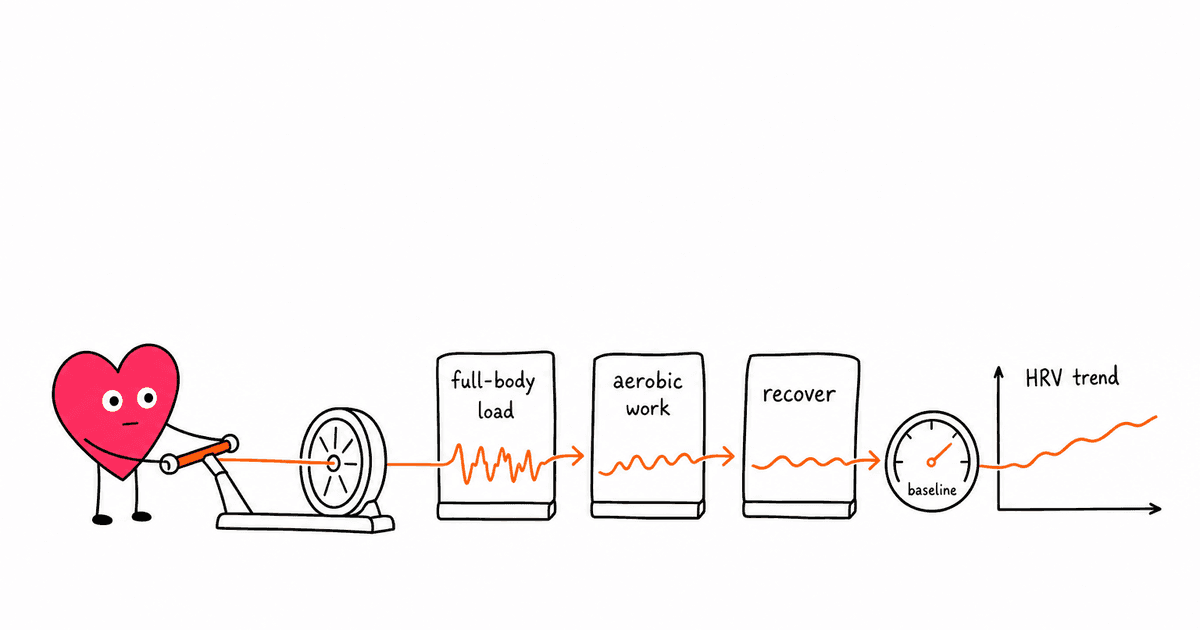
Yes, rowing improves HRV by building aerobic capacity, strengthening the cardiovascular system, and promoting parasympathetic recovery adaptations. Research on elite and recreational rowers shows that consistent rowing training leads to measurable improvements in HRV metrics, particularly when training intensity is properly managed. As a low-impact, full-body exercise, rowing offers unique advantages for autonomic nervous system development.
Rowing is one of the most complete workouts you can do. A single stroke engages approximately 86% of your muscles, from your legs and core to your back, shoulders, and arms. Unlike running or cycling, which primarily target the lower body, rowing distributes the cardiovascular load across your entire muscular system.
This matters for HRV because the adaptations you build from rowing translate directly into improved autonomic function and recovery capacity. And the research backs this up.
How Rowing Affects Your Autonomic Nervous System
Every rowing stroke involves a coordinated effort between your cardiovascular system and autonomic nervous system. When you pull the handle and drive with your legs, your heart rate increases to meet oxygen demands. Between strokes, your body initiates rapid parasympathetic recovery.
This constant oscillation between sympathetic activation and parasympathetic recovery is one reason rowing is so effective for autonomic training.
The Unique Cardiovascular Demand of Rowing
Research comparing rowing to treadmill running found an interesting difference: heart rate is lower during ergometer rowing than during treadmill running at equivalent exercise intensities. At a blood lactate concentration of 4 mmol/L, rowers averaged 170 beats per minute compared to 177 bpm for runners.
This may seem counterintuitive given that rowing uses more muscle mass. However, the seated position and coordinated rhythm of rowing appear to create a more efficient cardiovascular response. For HRV, this means rowing may allow you to accumulate significant training volume with less overall cardiac stress.
Full-Body Engagement and HRV
The full-body nature of rowing has implications for your autonomic nervous system:
- Leg drive: Provides 60% of the power, engaging the largest muscle groups
- Core activation: Transfers power and maintains posture throughout the stroke
- Upper body pull: Completes the movement, engaging back, shoulders, and arms
This distributed effort means your heart doesn't face the concentrated demand of pumping blood primarily to one muscle group. The cardiovascular system develops broader efficiency, which supports better HRV over time.
What the Research Shows About Rowers and HRV
Elite Rower Studies
A 2014 study examined the relationship between HRV and training intensity distribution in nine elite rowers during the 26-week build-up to the 2012 Olympic Games. The findings highlighted how HRV tracking can help optimize training for peak performance.
The researchers found that higher training volumes at low intensities (Zone 2) were associated with favorable HRV adaptations, while excessive high-intensity work correlated with HRV suppression. This aligns with what we know about Zone 2 training and HRV.
Two of the rowers in the study went on to win gold medals, and two won bronze, suggesting their training intensity distribution and HRV management contributed to Olympic-level performance.
Youth Rower Adaptations
A 2020 study published in the International Journal of Environmental Research and Public Health tracked HRV responses in female youth rowers across a 12-week training cycle. The researchers found that:
- Morning HRV measurements correlated with training load from the previous week
- Athletes who maintained higher HRV showed better 2,000m rowing performance
- HRV tracking helped identify early signs of overtraining
This research demonstrates that HRV monitoring is valuable not just for elite athletes, but for developing rowers at any level.
HRV as a Performance Predictor
A 2023 pilot study on elite female rowers preparing for U.S. National Selection Regattas found that autonomous HRV monitoring provided insight into both physiological and psychological readiness. The athletes achieved a 91% compliance rate with daily HRV measurements, showing that consistent tracking is practical even during intense competition periods.
The study emphasized that HRV combined with subjective measures of recovery provides a more complete picture than either metric alone.
Indoor Rowing vs. On-Water Rowing: HRV Considerations
Whether you're on an ergometer in your garage or sculling on open water, rowing offers HRV benefits. However, there are some differences worth noting:
Indoor Rowing (Ergometer)
Advantages for HRV:
- Controlled environment eliminates weather variables
- Consistent resistance allows precise intensity management
- Easy to maintain Zone 2 heart rate ranges
- Can row year-round regardless of conditions
Considerations:
- Lack of boat balance removes some neuromuscular demand
- Potentially higher monotony may affect motivation and stress
- No nature exposure benefits (see nature and HRV)
On-Water Rowing
Advantages for HRV:
- Nature exposure adds parasympathetic benefits
- Boat balance engages stabilizing muscles and proprioception
- Social aspect of crew rowing supports social connection and HRV
- More varied and engaging experience
Considerations:
- Weather and water conditions affect intensity
- Less precise heart rate zone control
- Requires access to water and equipment
Both forms of rowing build aerobic fitness and support HRV improvement. Choose based on your access, preferences, and goals.
How to Use Rowing to Improve Your HRV
Build an Aerobic Base First
Most of your rowing should be at low to moderate intensities. The research on elite rowers suggests that a polarized training approach (about 80% low intensity, 20% high intensity) supports the best HRV adaptations.
For most people, this means:
- 70-80% of rowing time: Zone 2 intensity, where you can hold a conversation
- 20-30% of rowing time: Higher intensities including interval work
If you're new to rowing, spend the first 4-6 weeks focusing exclusively on technique and low-intensity volume. Your HRV will thank you.
Monitor Your Recovery
Use morning HRV measurements to guide your training decisions:
- HRV above baseline: Green light for planned intensity
- HRV below baseline: Consider reducing intensity or taking a recovery day
- HRV significantly suppressed: Check for other factors like sleep, hydration, or illness
The research on rowers consistently shows that athletes who adjusted training based on HRV performed better and avoided overtraining.
Progress Gradually
Rowing is low-impact, but that doesn't mean your cardiovascular system can't be overloaded. Increase volume by no more than 10% per week, and schedule regular recovery weeks where volume drops by 30-50%.
Your HRV trend over 4-8 weeks will tell you whether your progression is sustainable.
Sample Rowing Workouts for HRV Optimization
Zone 2 Steady-State (Recovery Focus)
Duration: 30-45 minutes
Intensity: 60-70% max heart rate, conversational pace
Stroke rate: 18-22 strokes per minute
Purpose: Build aerobic base, promote parasympathetic adaptation
This should be your bread-and-butter workout. Keep the stroke rate low and focus on smooth technique. Your heart rate should stay consistent and your breathing should be comfortable.
Interval Pyramid (Mixed Intensity)
Duration: 25-30 minutes including warmup
Structure:
- 5 min warmup at easy pace
- 1 min hard / 1 min easy
- 2 min hard / 2 min easy
- 3 min hard / 3 min easy
- 2 min hard / 2 min easy
- 1 min hard / 1 min easy
- 5 min cooldown
Purpose: Improve cardiovascular capacity, challenge recovery between intervals
Monitor your heart rate recovery between hard efforts. If it's not dropping adequately, the intervals are too intense for your current fitness.
Long Slow Distance (Aerobic Development)
Duration: 60-90 minutes
Intensity: 55-65% max heart rate
Stroke rate: 16-20 strokes per minute
Purpose: Maximum aerobic development, mitochondrial adaptation
Once weekly or biweekly, extend your rowing time significantly at a very easy pace. This builds the aerobic foundation that supports both performance and HRV.
Why Rowing Is Ideal for HRV Improvement
Several characteristics make rowing particularly well-suited for building autonomic fitness:
Low Impact, High Reward
Unlike running, rowing places minimal stress on joints. This allows you to accumulate significant training volume without the orthopedic load that might otherwise limit recovery. For people with knee, hip, or ankle issues who want to improve cardiovascular fitness and HRV, rowing is often the best choice.
Rhythmic Nature
The cyclical rhythm of the rowing stroke, with its clear catch, drive, and recovery phases, may have inherent benefits for autonomic regulation. Similar to how breathing exercises use rhythm to influence the nervous system, the repetitive motion of rowing creates a meditative quality that many rowers describe as calming.
Scalable Intensity
You can row at 40% effort or 100% effort on the same machine. This scalability makes it easy to target specific heart rate zones and adjust based on your daily HRV readings.
Time Efficiency
Because rowing engages so much muscle mass simultaneously, you get more cardiovascular stimulus per minute than many other exercises. A 20-minute rowing session can deliver what might take 30-40 minutes on a treadmill.
Common Mistakes That Hurt HRV
Going Too Hard, Too Often
The most common mistake recreational rowers make is rowing at moderate-hard intensity every session. This "grey zone" training provides inadequate recovery stimulus while accumulating fatigue. Over time, HRV trends downward.
Commit to making easy sessions truly easy (Zone 2 or below) and hard sessions genuinely hard. The polarization is what drives adaptation.
Neglecting Technique
Poor rowing technique increases energy cost and creates inefficient movement patterns. Common issues include:
- Pulling with arms before legs drive
- Hunching the back
- Rushing the recovery phase
- Gripping the handle too tightly
Consider watching technique videos or getting coaching, especially when starting out. Efficient technique means less cardiovascular stress for the same power output.
Ignoring Recovery Signals
If your HRV drops for several days in a row, that's your body asking for rest. Pushing through consistently low HRV leads to deeper fatigue and potential overtraining. Use your HRV data to guide when to row hard, when to row easy, and when to take a day off.
Best HRV Monitors for Rowing
Tracking HRV during and around your rowing sessions helps you optimize training. Here are reliable options:
| Monitor | Best For | HRV Features |
|---|---|---|
| WHOOP 4.0 | 24/7 tracking, recovery scores | Continuous HRV, strain tracking, recovery coaching |
| Oura Ring | Sleep-focused HRV | Nighttime HRV, readiness scores, temperature |
| Garmin Forerunner 265 | Multisport athletes | Morning HRV, training status, recovery time |
| Apple Watch Ultra 2 | Apple ecosystem users | Sleep HRV, workout tracking, health app integration |
For rowing specifically, wrist-based monitors work well since they won't interfere with technique. Chest straps provide more accurate beat-to-beat data but can shift during the rowing motion.
Combining Rowing With Other Exercise
Rowing pairs well with other training modalities:
- Strength training: Rowing complements lifting by providing active recovery cardio
- Yoga: Mobility work balances the repetitive motion of rowing
- Walking: Low-intensity walking on rest days maintains movement without stress
- Swimming: Another low-impact option that uses different movement patterns
The key is overall volume management. More exercise isn't always better. Your HRV will tell you if your combined training load is sustainable.
The Bottom Line
Rowing offers a unique combination of full-body engagement, low impact, and cardiovascular challenge that makes it excellent for HRV improvement. The research on rowers at all levels, from youth athletes to Olympians, shows that consistent rowing builds the aerobic capacity and parasympathetic tone that translates to higher HRV.
The keys to success are:
- Build aerobic base: Most rowing should be Zone 2 steady-state
- Monitor recovery: Use morning HRV to guide intensity decisions
- Progress gradually: Increase volume slowly and include recovery weeks
- Prioritize technique: Efficient movement means better cardiovascular returns
Whether you row on water or an ergometer, in a crew or solo, the autonomic benefits compound over time. Your HRV data will show the progress as your body adapts to this complete, efficient form of exercise.
Need a quick read on your HRV number first?
Enter your HRV value, age range, device, and recovery context for a plain-English interpretation before you decide what to do next.
Interpret Your HRV NumberBuild the 30-day plan