Cycling and HRV: How Cyclists Can Use Heart Rate Variability to Ride Smarter
Trying to decode today's HRV number? Use the free interpreter first, then build a practical recovery plan. Interpret your HRV
Power meters, cadence sensors, and heart rate zones have transformed cycling training over the past two decades. But one metric sits above all of them when it comes to understanding how your body is actually responding to your training load: heart rate variability. While your power data tells you what you did on the bike, HRV tells you what that effort cost your nervous system and whether you are ready for more.
Cycling places unique demands on the autonomic nervous system. Long endurance rides, sustained threshold efforts, and high-cadence interval sessions each trigger distinct recovery patterns that a power file alone cannot reveal. Whether you ride outdoors on the road or indoors on a smart trainer, HRV tracking helps you answer the most important question in cycling training: should today be a hard day or an easy one?
Why Cyclists Should Track HRV
Heart rate variability (HRV) measures the time variation between consecutive heartbeats in milliseconds, reflecting how well your autonomic nervous system balances stress and recovery. For cyclists, this metric fills a critical blind spot that even the most sophisticated power-based training platforms miss.
Your Training Stress Score (TSS) or weekly volume in hours can estimate external load, but they cannot measure how your body is absorbing that load internally. Two cyclists can complete the same 200 TSS week and have completely different recovery profiles based on sleep quality, nutrition, life stress, and individual physiology. HRV captures all of those factors in a single morning reading.
Research published in Scientific Reports (2025) demonstrated that experienced cyclists who combined vagally-mediated HRV (vmHRV), resting heart rate, and subjective well-being scores to guide their training made more informed day-to-day decisions about intensity, leading to better load management without sacrificing performance gains.
How Different Types of Cycling Affect HRV
Not all rides create the same autonomic stress. Understanding these patterns helps you interpret your daily HRV readings and plan your training week accordingly.
Endurance Rides (Zone 2)
Long, steady rides at a conversational pace are the foundation of cycling fitness. These sessions primarily engage the aerobic system and create a mild, short-lived HRV suppression that typically resolves within 12 to 24 hours. Over weeks and months, consistent Zone 2 cycling is one of the most effective ways to raise your baseline HRV because it strengthens parasympathetic tone without overwhelming the sympathetic system.
A three-hour endurance ride at 60 to 70% of your functional threshold power (FTP) will produce a noticeably smaller HRV dip than a one-hour interval session at the same TSS. This is why endurance volume is the backbone of most periodized cycling plans.
Threshold and Sweet Spot Work
Sustained efforts between 88 and 105% of FTP, the bread and butter of time-trial fitness, create moderate HRV suppression lasting 24 to 48 hours. These sessions are metabolically demanding and generate significant sympathetic nervous system activation. Most well-structured cycling plans limit threshold work to two sessions per week, and HRV data can confirm whether that frequency is appropriate for your individual recovery capacity.
High-Intensity Intervals (VO2max and Anaerobic)
Short, maximal efforts like 30-second sprints, 3-minute VO2max intervals, or Tabata-style sessions produce the largest acute HRV drops. Research on endurance athletes has shown that high-intensity interval training can suppress RMSSD (the most common HRV metric) for 48 to 72 hours. For cyclists doing structured interval blocks, this means that two hard days in a row may be manageable for one rider but push another into accumulated fatigue.
Indoor vs. Outdoor Riding
A study published in Sensors examined HRV differences between indoor and outdoor ultra-distance cycling. Researchers found significant differences in RMSSD and other HRV indices between pre and post efforts in both environments, but indoor riding produced distinct patterns due to factors like heat buildup, reduced airflow, and the psychological monotony of stationary training. If you spend significant time on a smart trainer, your HRV data may reflect additional thermal and mental stress that outdoor riding of the same power output would not produce.
HRV-Guided Training for Cyclists
The traditional approach to cycling training uses a fixed weekly schedule: hard Tuesday, easy Wednesday, intervals Thursday, and so on. HRV-guided training replaces that rigidity with a responsive system that adapts to your actual recovery state.
How It Works
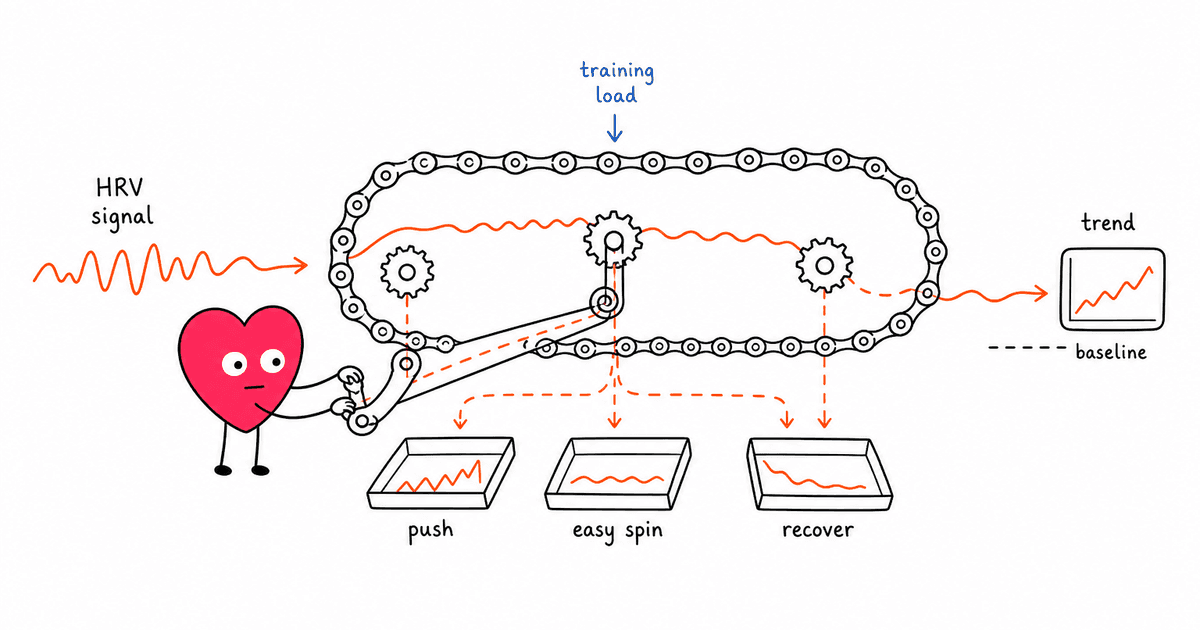
Each morning, you take a one-to-two-minute HRV reading before getting out of bed. Your app or device calculates your RMSSD and compares it to your rolling baseline (typically a seven-day average). Based on where your reading falls, you adjust your planned workout:
- At or above baseline: Your parasympathetic system is recovered. This is a green light for high-intensity work, threshold intervals, or race-pace efforts.
- Slightly below baseline: Recovery is still in progress. A moderate endurance ride or technique-focused session is appropriate.
- Well below baseline: Your body is signaling a need for rest. Substitute an easy spin, active recovery, or a complete rest day.
What the Research Says
A systematic review and meta-analysis in the International Journal of Sports Physiology and Performance examined HRV-guided training across endurance sports and found that athletes who adjusted intensity based on daily HRV readings achieved improvements in VO2max, peak power output, and cardiac-vagal modulation that were equal to or greater than those following traditional periodized plans. Critically, the HRV-guided athletes also reported lower perceived fatigue and fewer signs of non-functional overreaching.
A 2025 study in Scientific Reports specifically tested this approach with experienced cyclists. The researchers found that combining vmHRV with resting heart rate and subjective wellness scores created a more complete picture of readiness than any single marker alone. Cyclists who followed this combined protocol made better training decisions and maintained more consistent performance across a training block.
Practical Application
You do not need to abandon your training plan entirely. Most cyclists benefit from a hybrid approach:
- Keep your general weekly structure (two hard days, one long ride, recovery days)
- Use HRV to shift hard days forward or backward by a day when your readings suggest your body is not ready
- Track your seven-day HRV trend, not just single-day readings, to identify when accumulated fatigue is building
- Use consistently elevated HRV as a signal that you may be under-training and can add volume or intensity
Cycling-Specific HRV Patterns to Watch
Cyclists encounter several training scenarios where HRV data provides particularly valuable guidance.
Training Camps and High-Volume Weeks
Multi-day training camps with 15 to 25 hours of riding per week create progressive HRV suppression. It is normal to see your RMSSD drop steadily across a camp week. The key metric to watch is the speed of HRV recovery after the camp ends. A healthy athlete should see meaningful HRV rebound within three to five days. If your HRV remains suppressed for more than a week after a training block, it may signal that the load was excessive or that other recovery factors (sleep, nutrition, stress) need attention.
Some coaches recommend recording a brief HRV check each morning during a camp and comparing the trajectory to previous training blocks. If the suppression curve is steeper than usual for a similar volume, it can indicate that external stressors like travel, altitude, or heat are compounding the training load.
Tapering for Events
The two to three weeks before a goal event (a gran fondo, time trial, or stage race) are where HRV tracking becomes especially powerful. As you reduce training volume, your HRV should trend upward, reflecting improved parasympathetic recovery. Research on endurance athletes shows that peak performance correlates with HRV readings that reach or exceed the athlete's previous best baseline values. If your HRV is not rising during a taper, it may indicate that you are not reducing load enough, that life stress is interfering, or that illness is developing.
Overtraining Detection
Cycling's culture of "more is better" makes overtraining a genuine risk, particularly for time-crunched riders who compress high training loads into limited hours. The classic overtraining pattern in HRV data shows a progressive downward trend in RMSSD over weeks, often accompanied by increased resting heart rate and decreased HRV variability (your readings become both lower and more "flat"). Catching this pattern early, before performance declines and motivation drops, is one of the highest-value uses of HRV monitoring.
Commute and Recovery Ride Optimization
Many cyclists commute by bike and wonder whether their daily ride to work counts as training, recovery, or stress. HRV can answer this directly. If your morning HRV is suppressed and your commute involves hills or a brisk pace, it is adding training load rather than aiding recovery. On days with low HRV readings, keeping the commute genuinely easy (or driving) may be the smarter choice. Staying properly hydrated is also important for commuting cyclists who want to protect their HRV.
Conversely, a flat, relaxed 20-minute commute on a day when HRV is at baseline can serve as a genuine recovery spin, promoting blood flow without adding meaningful autonomic stress. The key is honestly assessing whether your commute is a gentle spin or a time trial in disguise.
Seasonal Transitions and Off-Season Planning
HRV data accumulated across a full season provides valuable insight for planning your off-season. Cyclists who track HRV year-round can identify the training phases where their body adapted well and the phases where fatigue accumulated faster than expected. This information helps structure the following season with better volume progression and more strategic placement of rest weeks. Techniques like breathing exercises and meditation can also accelerate recovery between seasons. During the off-season itself, a gradually rising HRV baseline confirms that your body is rebuilding its reserves.
Best Devices for Tracking HRV While Cycling
Accurate HRV measurement requires either a quality chest strap or a wearable with validated optical heart rate sensors. For a comprehensive breakdown, see our guide to comparing HRV monitors. Here are the best options for cyclists.
Chest Straps (Most Accurate)
Chest straps remain the gold standard for HRV accuracy because they measure the electrical signal of each heartbeat directly. The Garmin HRM-600 offers dual ANT+ and Bluetooth connectivity, making it compatible with cycling computers, smartwatches, and HRV apps simultaneously. For cyclists who already use a chest strap during training, adding a morning HRV reading takes minimal extra effort.
Wrist-Based and Ring Wearables
For overnight and morning HRV tracking without wearing a chest strap to bed, dedicated wearables offer convenience:
- Whoop 5: Designed for athletes, Whoop automatically calculates HRV during sleep and provides a daily recovery score. Read our full Whoop 5 review for details. Its slim profile fits comfortably under cycling gloves, and the app offers detailed strain tracking that pairs well with power meter data.
- Oura Ring 4: Tracks HRV overnight with clinical-grade accuracy. See our Oura Ring 4 review for a full breakdown. The ring form factor means you never have to worry about wearing it on the bike, and the morning readiness score gives a clear go/no-go signal.
- Garmin Forerunner 265: Combines wrist-based HRV tracking with full cycling metrics including power, cadence, and performance condition. A strong choice for cyclists who want everything on one device.
- Polar Vantage V3: Polar's nightly recharge feature tracks ANS recovery during sleep, and the watch doubles as a full-featured cycling computer with power meter support.
HRV and Cycling Periodization
Traditional cycling periodization divides the season into base, build, peak, and recovery phases. HRV data adds a layer of objective feedback to each phase.
During the base phase, your HRV baseline should gradually rise as aerobic fitness improves. If it stagnates or drops, you may be adding volume too quickly. During the build phase, expect more day-to-day HRV fluctuation as intensity increases. The key is that your weekly average remains relatively stable or shows a slight upward drift. If the weekly average drops for two or more consecutive weeks, it is time to insert an unplanned recovery week.
During the peak phase, reduced volume should produce the highest and most stable HRV readings of your season. This is the window where performance breakthroughs happen, and HRV can confirm that your taper is working. If HRV does not rise during a taper, consider whether you have truly reduced load enough or whether external stressors are masking your fitness.
Recovery phases should show the highest absolute HRV values and the lowest day-to-day variability, reflecting a nervous system that is fully at rest. Monitoring HRV during recovery prevents the common mistake of cutting the off-season short and jumping back into hard training before the body has fully recharged.
How to Start Using HRV as a Cyclist
Getting started with HRV-guided cycling is straightforward, but consistency in your measurement routine matters more than the specific device you choose.
Step 1: Establish Your Baseline
Measure your HRV every morning for at least two weeks before making training decisions based on the data. Use the same conditions each time: immediately upon waking, lying in bed, before coffee or phone use. If you are new to HRV, our beginner's guide covers the fundamentals. This establishes your personal normal range and gives your app enough data to calculate a meaningful rolling average.
Step 2: Learn Your Personal Patterns
During the baseline period, note how your HRV responds to different types of rides. After a hard interval session, how many days does it take for your HRV to return to baseline? After a long endurance ride? After a rest day? These individual patterns are more valuable than any generic guideline.
Step 3: Apply the Data
Once you have a baseline and understand your patterns, begin using the green/amber/red framework described earlier. Start conservatively: when in doubt, choose the easier option. As you gain confidence in your readings, you can make more nuanced adjustments.
Step 4: Track Trends, Not Single Days
A single low HRV reading does not mean you are overtrained. A single high reading does not mean you should do hill repeats. Look at three-to-seven-day trends. Consistent downward trends signal accumulated fatigue. Consistent upward trends signal positive adaptation. Day-to-day noise is normal and expected.
Common Mistakes Cyclists Make With HRV
Ignoring Context
An HRV reading is only meaningful in context. A low reading the morning after a hard criterium is expected and healthy. The same low reading after two rest days warrants investigation. Always interpret your number alongside what you did the previous day, how you slept, and what your recent training load has been.
Chasing High Numbers
A higher HRV is not always better. Some cyclists become anxious when their HRV dips, which ironically can suppress it further. The goal is not to maximize your daily number but to maintain a stable or gradually rising baseline over weeks and months, punctuated by normal training-induced dips.
Measuring Inconsistently
Taking your HRV at different times, in different positions, or after varying amounts of morning activity introduces noise that makes the data unreliable. Commit to the same routine every morning. If you miss a day, skip it rather than taking a reading under different conditions.
Not Accounting for Non-Training Stress
Work deadlines, poor sleep, alcohol, travel, and illness all suppress HRV independently of cycling. If your HRV drops and you have not been training hard, look at these factors before adjusting your riding.
Comparing Your Numbers to Others
HRV is highly individual. A resting RMSSD of 40 ms might be perfectly healthy for one cyclist and a sign of fatigue for another. Your baseline depends on genetics, age, fitness level, and numerous other factors. Comparing your numbers to other riders, or to generic "good" and "bad" thresholds found online, is misleading. The only meaningful comparison is to your own rolling average.
Combining HRV With Power Data
The real power of HRV for cyclists emerges when you combine it with your existing training data. Platforms like TrainingPeaks, Garmin Connect, and Whoop allow you to overlay HRV trends against training load metrics like TSS, chronic training load (CTL), and acute training load (ATL).
This combined view reveals patterns that neither metric shows alone. You might discover that your HRV drops disproportionately after indoor trainer sessions compared to outdoor rides of the same TSS, suggesting that heat or monotony is an added stressor for you. Or you might find that your HRV recovers faster from high-intensity, low-volume weeks than from moderate-intensity, high-volume weeks, information that can reshape how you structure future training blocks.
Over time, the relationship between your external training load and your HRV response becomes a personalized model of your physiology, one that grows more accurate and more useful the longer you track both metrics together.
The Bottom Line
Cycling training has become increasingly data-driven, with power meters, smart trainers, and analytics platforms providing granular detail about every pedal stroke. But all of that data describes what happened on the bike. HRV describes what is happening inside your body, making it the missing piece that connects training load to actual adaptation. Cyclists interested in cross-training can also explore how HRV applies to running, swimming, and strength training.
By tracking your morning HRV consistently and using it to make informed decisions about when to push and when to recover, you gain a training advantage that no amount of interval prescription can replicate. The cyclists who perform best over the long term are not always the ones who train hardest. They are the ones who train the smartest, and HRV is one of the most powerful tools available to help you do exactly that.
Need a quick read on your HRV number first?
Enter your HRV value, age range, device, and recovery context for a plain-English interpretation before you decide what to do next.
Interpret Your HRV NumberBuild the 30-day plan