Arterial Stiffness and HRV: What Vascular Health Reveals About Recovery
Does Arterial Stiffness Affect HRV?
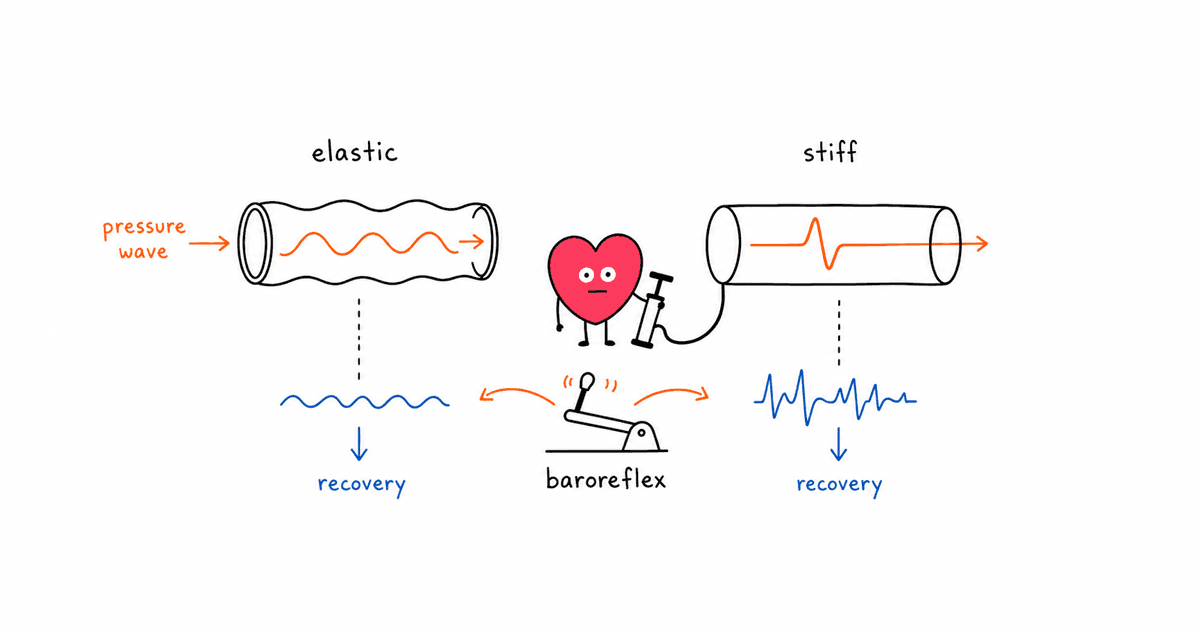
Yes, arterial stiffness is associated with lower HRV and slower autonomic recovery, but HRV does not directly measure your arteries. Stiffer vessels can make blood pressure control more demanding, reduce baroreflex sensitivity, and keep the autonomic nervous system closer to a sympathetic state. The useful move is to read HRV as one signal in a larger vascular health pattern, not as a standalone vascular test.
This matters because HRV is often treated as a recovery score, while arterial stiffness is often treated as a cardiovascular risk marker. In real life, those systems talk to each other all day. Your heart, blood vessels, blood pressure, and autonomic nervous system are one loop.
If you are new to the metric itself, start with what HRV is. This guide focuses on the vascular side: what arterial stiffness means, why it can affect HRV, and what patterns are worth paying attention to.
What Arterial Stiffness Means
Arterial stiffness describes how easily your arteries expand and recoil with each heartbeat.
Healthy arteries are elastic. When the heart ejects blood, the large arteries stretch slightly, absorb some of that pressure, then recoil to keep blood moving smoothly between beats. Stiffer arteries do not buffer pressure as well, so the heart and nervous system have to manage sharper pressure changes.
The most common research measure is pulse wave velocity, often shortened to PWV. It measures how quickly the pressure wave from a heartbeat travels through the arteries.
The basic rule is simple:
- Faster pulse wave velocity usually means stiffer arteries.
- Slower pulse wave velocity usually means more elastic arteries.
- Higher arterial stiffness is associated with higher cardiovascular risk.
Clinicians and researchers use several versions of PWV. Carotid-femoral PWV is often considered the gold standard for central arterial stiffness, while brachial-ankle PWV is widely used in large studies because it is simpler and faster to measure.
Arterial Stiffness vs HRV at a Glance
| Signal | What it reflects | Why it matters | What it cannot prove |
|---|---|---|---|
| Arterial stiffness | Vessel elasticity and pressure wave speed | Vascular aging, blood pressure load, cardiovascular risk | Daily recovery or nervous system state by itself |
| HRV | Beat-to-beat timing variation | Autonomic flexibility, stress load, recovery capacity | Arterial health by itself |
| Heart rate recovery | How quickly heart rate drops after exercise | Vagal reactivation and fitness | Full vascular health by itself |
| Blood pressure | Force of blood against artery walls | Hypertension risk and vascular load | Autonomic balance by itself |
The overlap is the autonomic nervous system. It helps regulate heart rate, vessel tone, and blood pressure responses. That is why arterial stiffness and HRV often move in related directions, even though they measure different things.
Why Stiffer Arteries Can Lower HRV
Arterial stiffness does not lower HRV through one single pathway. It is more like several small pressure points that add up.
1. The Baroreflex Has Less Room to Work
Your baroreflex is a pressure-sensing system that helps stabilize blood pressure from beat to beat.
When blood pressure rises, baroreceptors in major arteries signal the nervous system to slow the heart and relax blood vessels. When pressure falls, the system does the opposite. This constant adjustment contributes to beat-to-beat variability.
Stiffer arteries may blunt that feedback. If the vessel wall stretches less, the pressure sensors may receive a less flexible signal. That can reduce the nervous system's ability to fine-tune heart rate moment by moment, which can show up as lower HRV.
This is one reason HRV and blood pressure are so tightly connected. Blood pressure is not just a plumbing number. It is also an autonomic regulation problem.
2. Blood Pressure Swings Become More Costly
Elastic arteries smooth out the force of each heartbeat. Stiffer arteries transmit pressure waves more aggressively.
That can increase systolic pressure, widen pulse pressure, and make blood pressure regulation more demanding. The autonomic nervous system may respond by keeping sympathetic tone higher, especially when other stressors are present.
Higher sympathetic tone tends to reduce HRV. It is not always a dramatic crash. Sometimes it appears as a slow downward drift in your baseline, especially when paired with poor sleep, high stress, excess alcohol, smoking, or metabolic strain.
3. Vascular Aging and Autonomic Aging Travel Together
HRV typically declines with age. Arteries also become stiffer with age. Those two trends are not identical, but they often overlap.
As arteries lose elasticity, the cardiovascular system has less mechanical flexibility. As autonomic function becomes less responsive, the body has less regulatory flexibility. Together, that can reduce the dynamic range of heart rate, blood pressure, and recovery.
That is why age-based HRV charts can be useful but incomplete. Your number is shaped by more than birthdays. Fitness, blood pressure, sleep, inflammation, medication, smoking history, and metabolic health all influence your personal range. See HRV by age for the broader age pattern.
4. Inflammation and Metabolic Strain Affect Both Systems
Arterial stiffness is strongly linked with the same risk factors that tend to suppress HRV:
- Hypertension
- Insulin resistance and diabetes
- High triglycerides
- Smoking and nicotine exposure
- Chronic inflammation
- Poor cardiorespiratory fitness
- Poor sleep quality
- Chronic stress
That does not mean low HRV proves stiff arteries. It means a persistently low HRV baseline, especially alongside rising blood pressure or worsening metabolic markers, deserves a wider look.
What Recent Research Shows
Research generally supports a relationship between arterial stiffness and autonomic function, but the evidence should be interpreted carefully. Most studies show associations. They do not prove that arterial stiffness directly causes low HRV in every person.
A 2024 study in Scientific Reports analyzed 475 people who underwent treadmill exercise testing and same-day brachial-ankle pulse wave velocity measurement. Higher arterial stiffness was associated with poorer heart rate recovery one minute after exercise, even after adjustment for other factors. Heart rate recovery is not the same as HRV, but both reflect autonomic control, especially parasympathetic reactivation after stress.
A 2025 Scientific Reports study looked more directly at HRV in 1,132 people with essential hypertension. Researchers found that lower SDNN, a time-domain HRV metric, was independently associated with higher brachial-ankle pulse wave velocity. The relationship was strongest in participants under 65, which suggests vascular-autonomic changes are not only an older-adult issue.
A 2024 review on pulse wave velocity and HRV described the relationship as bidirectional and complex. That is the right framing. Stiffer arteries can change blood pressure dynamics and autonomic demand, while chronic autonomic imbalance may also contribute to vascular dysfunction over time.
The practical takeaway is not "check HRV to diagnose your arteries." It is this: if HRV, blood pressure, resting heart rate, fitness, and metabolic health are all moving in the wrong direction, they are probably telling a coherent story.
Can Your Wearable Detect Arterial Stiffness?
Usually, no.
Most HRV wearables estimate autonomic recovery from heart rhythm or pulse timing. They do not directly measure arterial stiffness. Some devices estimate related concepts, such as vascular age, pulse wave velocity, or pulse arrival time, but these consumer estimates vary widely and should not be treated like a clinical vascular test.
There is also a measurement wrinkle. Optical sensors measure pulse timing at the skin, not the heart's electrical signal. Vascular stiffness can affect the delay between the heartbeat and the pulse wave reaching the sensor. That is one reason ECG and PPG can differ for HRV, especially when blood flow, temperature, motion, or vascular tone changes.
If you want to monitor recovery, HRV trends can still be useful. If you want to assess vascular stiffness, talk with a clinician about blood pressure, lipid markers, diabetes risk, and whether formal vascular testing is appropriate.
HRV Patterns That May Point to Vascular Strain
HRV is noisy, so do not overread a single bad morning. Look for patterns.
A vascular strain pattern may look like this:
- HRV baseline gradually trends down over weeks or months.
- Resting heart rate trends up.
- Blood pressure readings are rising or already high.
- Exercise feels harder at the same pace or wattage.
- Heart rate stays elevated longer after workouts.
- Sleep quality is declining.
- Recovery feels worse despite no major change in training.
None of these signs diagnose arterial stiffness. But together, they suggest your cardiovascular system is carrying more load than usual.
The most important companion metric is blood pressure. If HRV is low but blood pressure is excellent, fitness is improving, and sleep is stable, the interpretation is very different from low HRV plus rising blood pressure and poor heart rate recovery.
What to Track Alongside HRV
For vascular health, HRV becomes more useful when paired with a few grounded measurements.
Blood Pressure
Home blood pressure is one of the most practical cardiovascular metrics. Take it correctly, use the same arm, sit quietly, and look at averages rather than isolated readings.
If your HRV is trending down while blood pressure is trending up, that is more meaningful than either number alone.
Resting Heart Rate
Resting heart rate and HRV often move in opposite directions. Rising resting heart rate with falling HRV usually suggests higher physiological strain.
This does not tell you whether the driver is stress, illness, heat, poor sleep, dehydration, overtraining, or vascular load. It tells you the system is working harder.
Heart Rate Recovery
Heart rate recovery is the drop in heart rate after exercise stops. Faster recovery generally reflects better parasympathetic reactivation.
If you already track workouts, note how quickly your heart rate falls in the first minute after a consistent effort. Do not compare a hill sprint to an easy walk. Use the same kind of session if you want a meaningful trend.
Waist, Glucose, and Lipids
Vascular stiffness is closely tied to metabolic health. Blood sugar, triglycerides, waist circumference, and cholesterol markers add context that HRV cannot provide alone.
For deeper background, see cholesterol and HRV and blood sugar and HRV.
How to Support Arterial Flexibility and HRV
You do not need a complicated vascular biohacking stack. The boring fundamentals are still the heavy hitters.
Build an Aerobic Base
Aerobic exercise is one of the best-supported interventions for arterial stiffness. A systematic review and meta-analysis in PLOS One found that aerobic training significantly improved pulse wave velocity, with stronger effects in people who started with stiffer arteries.
This does not mean every workout should be hard. In fact, consistent moderate-intensity work is usually the foundation. Zone 2 training, brisk walking, cycling, rowing, and easy running can all support both vascular health and HRV when dosed well.
If you are starting from a low fitness baseline, walking and HRV is the cleanest entry point.
Strength Train Without Turning Every Set Into a Max Effort
Strength training supports blood pressure, glucose control, muscle mass, and long-term metabolic health. It can also temporarily lower HRV when sessions are very heavy or close to failure.
That is not a problem. It just means the dose matters.
For vascular and recovery goals, keep most strength work consistent, progressive, and technically clean. Avoid turning every session into a nervous system test. See strength training and HRV for how to interpret post-lift HRV dips.
Keep Blood Pressure in Range
Blood pressure control is central to arterial stiffness. Chronically high pressure exposes artery walls to more mechanical stress, which can accelerate stiffening over time.
Lifestyle changes can help, but medication is sometimes necessary. If a clinician prescribes blood pressure medication, do not stop or adjust it because of a wearable HRV score.
Eat for Endothelial Function
Your endothelium is the inner lining of your blood vessels. It helps regulate vessel tone, nitric oxide production, inflammation, and blood flow.
A Mediterranean-style pattern is a strong default: vegetables, fruit, legumes, whole grains, fish, olive oil, nuts, and minimally processed foods. It is not magic. It simply lines up with the biology that supports blood pressure, lipid health, glucose control, and vascular flexibility.
For more detail, read Mediterranean diet and HRV and polyphenols and HRV.
Quit Smoking and Be Honest About Nicotine
Smoking is one of the clearest vascular stressors. It damages the endothelium, increases oxidative stress, raises sympathetic activity, and contributes to arterial stiffness.
Nicotine itself also increases heart rate and sympathetic tone. Even if the delivery method changes, the autonomic effect can still matter. The full breakdown is in smoking, nicotine, and HRV.
Protect Sleep and Recovery
Poor sleep lowers HRV quickly. Chronic poor sleep also pushes blood pressure, glucose regulation, appetite, and inflammation in the wrong direction.
If your HRV is low and your blood pressure is creeping up, sleep is not a side quest. It is part of the vascular intervention.
Reduce Environmental Load Where You Can
Air pollution, chronic noise, heat stress, and poor indoor air quality can all increase cardiovascular strain. You cannot control every exposure, but you can reduce the obvious ones: filter indoor air, avoid heavy outdoor exercise near traffic when pollution is high, and take heat seriously.
Start with air pollution and HRV if your environment is a likely contributor.
When to Talk With a Clinician
Talk with a healthcare professional if you notice:
- Repeated high blood pressure readings
- Chest pain, fainting, unusual shortness of breath, or palpitations
- A sudden major HRV drop without an obvious explanation
- Poor heart rate recovery that is new for you
- Strong family history of early cardiovascular disease
- Diabetes, kidney disease, or known heart disease
HRV is useful, but it is not a substitute for medical evaluation. Arterial stiffness sits in the same category. It can be informative, but it needs context.
The Bottom Line
Arterial stiffness and HRV are connected through autonomic regulation, blood pressure control, and vascular health.
Stiffer arteries can make cardiovascular regulation less flexible. Lower HRV can reflect a nervous system with less room to adapt. Neither number tells the whole story alone, but together they can point toward the same issue: your cardiovascular system may be carrying more load than it should.
The best response is not panic or gadget chasing. Build aerobic fitness, control blood pressure, sleep well, eat for vascular health, avoid nicotine, and use HRV as a trend signal rather than a diagnosis.
FAQ
Can HRV Diagnose Arterial Stiffness?
No. HRV can reflect autonomic strain, but it cannot diagnose arterial stiffness. Pulse wave velocity, blood pressure, clinical history, and cardiovascular risk markers are more direct tools.
Is Low HRV a Sign of Poor Vascular Health?
Sometimes, but not always. Low HRV can come from poor sleep, stress, illness, heavy training, alcohol, medication, or normal individual variation. It becomes more concerning when it is persistent and appears alongside high blood pressure, rising resting heart rate, poor fitness, or metabolic risk.
Does Aerobic Exercise Improve Both HRV and Arterial Stiffness?
Often, yes. Aerobic training can improve vascular function and may improve HRV over time when recovery is adequate. The key is consistency. Too much intensity without recovery can suppress HRV even if the long-term fitness plan is good.
Need a quick read on your HRV number first?
Enter your HRV value, age range, device, and recovery context for a plain-English interpretation before you decide what to do next.
Interpret Your HRV NumberBuild the 30-day plan