Air Pollution and HRV: How Dirty Air Affects Heart Rate Variability
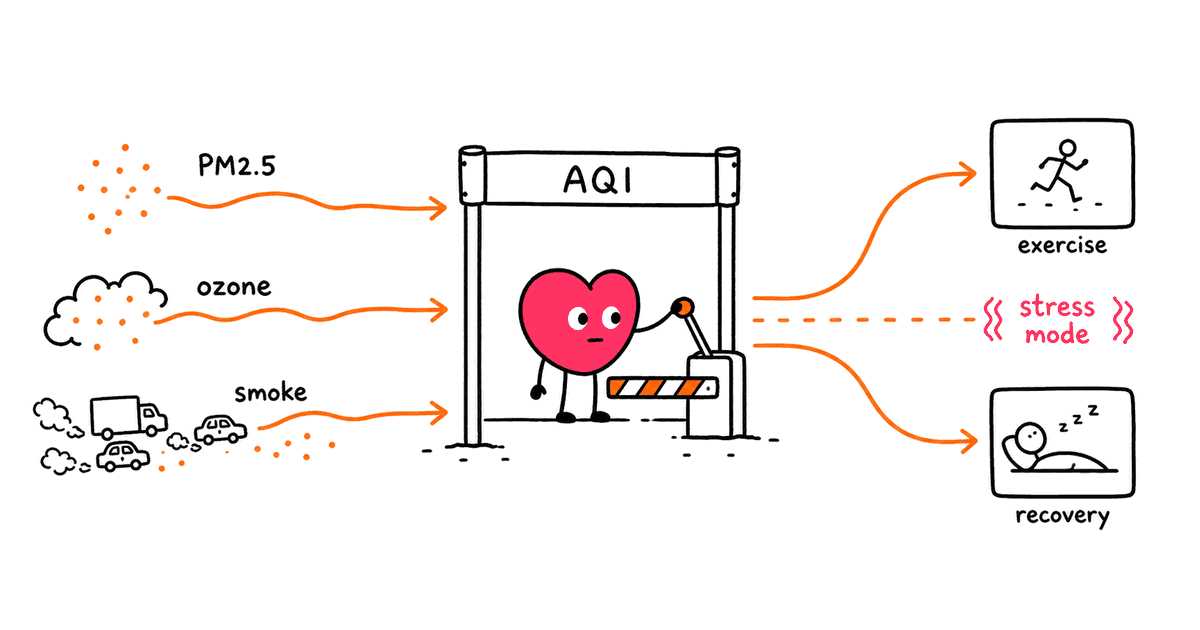
You can eat well, sleep enough, and train intelligently, then still wake up to a disappointing HRV score. Sometimes the missing variable is the air around you.
Air pollution, especially fine particulate matter (PM2.5), traffic-related pollution, ozone, and wildfire smoke, can push your nervous system toward sympathetic dominance. That matters because HRV is one of the clearest noninvasive signals of how well your autonomic nervous system is handling stress.
Does Air Pollution Lower HRV?
Yes. Air pollution is linked to lower HRV, especially with higher exposure to PM2.5 and other traffic-related pollutants. The pattern shows up across short-term exposure studies, longer-term observational research, and meta-analyses focused on cardiovascular risk.
A 2020 meta-analysis of 33 panel studies found that each 10 μg/m3 increase in PM2.5 exposure was associated with lower HRV across common markers including SDNN, RMSSD, HF, and LF. Another 2020 systematic review focused on older adults found similar results, with both short-term and long-term PM2.5 exposure associated with reductions in HRV measures.
That does not mean a single bad air day will wreck your health. It does mean repeated exposure can create a steady autonomic burden that shows up in recovery metrics.
Why Dirty Air Affects HRV
HRV reflects the balance between sympathetic activity, your fight-or-flight side, and parasympathetic activity, your rest-and-recover side. Air pollution appears to disrupt that balance through several overlapping pathways:
- Inflammation: fine particles can trigger systemic inflammatory responses that overlap with the patterns covered in our guide to inflammation and HRV
- Oxidative stress: polluted air increases biological stress that can damage vascular and nervous system function
- Autonomic imbalance: exposure is associated with reduced vagal tone and higher sympathetic activity
- Vascular strain: air pollution can impair endothelial function and raise cardiovascular load
- Respiratory irritation: breathing harder or dealing with airway irritation adds another layer of physiological stress
This is one reason HRV is useful here. It can pick up the downstream nervous system effect of a polluted environment even when you do not feel obviously sick.
The Main Pollutants to Know
PM2.5
PM2.5 refers to tiny particles less than 2.5 micrometers in diameter. They are small enough to penetrate deep into the lungs and can even enter the bloodstream. PM2.5 is the pollutant most consistently linked to reduced HRV in research.
Common sources include:
- vehicle exhaust
- wildfire smoke
- industrial emissions
- wood burning
- some cooking and indoor combustion sources
Some exposure categories overlap with plastic particles too. Tire wear, household dust, and degraded packaging are part of the broader microplastics and HRV question, though the HRV evidence is much stronger for PM2.5 than for microplastics specifically.
Ozone
Ground-level ozone tends to spike on hot, sunny days. It is more famous for irritating the lungs, but it can also increase overall physiological stress, especially during outdoor exercise.
Nitrogen dioxide and traffic pollution
Nitrogen dioxide and related traffic pollutants often travel with PM exposure in urban settings. Living or training near high-traffic roads may mean repeated low-level exposure that adds up over time.
What the Research Actually Suggests
The evidence is not just theoretical.
A 2012 meta-analysis published in Heart found that higher PM2.5 exposure was associated with lower HF and LF power, both commonly used HRV metrics. More recent work has reached a similar conclusion: air pollution exposure is associated with reduced autonomic flexibility, which is exactly what lower HRV reflects.
The World Health Organization also notes that ambient air pollution contributes substantially to cardiovascular disease burden, with ischemic heart disease and stroke making up a large share of pollution-related premature deaths worldwide. HRV is not the whole story, but it is a plausible mechanistic link between dirty air and worse cardiovascular outcomes.
Air Pollution, Exercise, and Recovery
This is where the topic gets practical.
Exercise is still good for you. The goal is not to become afraid of going outside. The goal is to make smarter calls when air quality is clearly poor.
EPA guidance on outdoor exercise and air pollution is basically this: it depends on the air pollution level, your health status, and the length and intensity of the activity. That is a sensible frame for HRV too.
If the AQI is elevated, especially because of smoke or particle pollution, a hard outdoor workout may pile training stress on top of environmental stress. For some people that can mean:
- lower overnight HRV
- higher resting heart rate
- slower recovery after training
- more breathing discomfort during the session
- more fatigue than the workout alone would predict
That is especially relevant for runners, cyclists, and anyone doing longer zone 2 training sessions outdoors.
How to Use AQI With Your HRV Data
The U.S. Air Quality Index, or AQI, is a practical tool for day-to-day decisions.
According to AirNow, AQI categories work like this:
- 0 to 50: Good
- 51 to 100: Moderate
- 101 to 150: Unhealthy for sensitive groups
- 151 to 200: Unhealthy
- 201 to 300: Very unhealthy
- 301+: Hazardous
AQI is not a perfect proxy for how your body will respond, but it is useful. If your HRV dips tend to line up with smoke days, heavy traffic training routes, or hot days with higher ozone, that pattern is worth taking seriously.
If you want a broader look at the indoor and outdoor side of this issue, see our companion guide on air quality and HRV. And if spring pollen is already dragging your recovery down, the overlap with allergies and HRV can make the same pattern more obvious.
A simple way to test this:
- Check AQI before outdoor training.
- Note whether the issue is PM2.5, ozone, or both.
- Compare your overnight HRV and resting heart rate after cleaner-air days versus polluted-air days.
- Look for repeatable patterns over a few weeks, not one-off noise.
Who Is Most Likely to Notice the Effect?
Some people are more likely to see an HRV hit from poor air quality:
- people with asthma or other respiratory disease
- people with cardiovascular disease or high blood pressure
- older adults
- people living near major roads
- outdoor workers and endurance athletes
- anyone exposed to wildfire smoke for days at a time
Even healthy people can show autonomic effects. But if you already have less recovery margin, the signal may be more obvious.
Wildfire Smoke and HRV: The Most Relevant Real-World Example
For many readers, wildfire smoke is the most noticeable air-pollution event affecting HRV.
Smoke can send PM2.5 levels sharply higher, sometimes for days. That combination of respiratory irritation, inflammation, heat, disrupted sleep, and reduced training quality can easily spill into your wearable data.
If your HRV tanks during smoky weeks, that is not necessarily a sign that your training plan failed or your routine suddenly stopped working. It may be your body responding to a real environmental stressor.
How to Protect HRV When Air Quality Is Bad
You cannot control outdoor air quality, but you can reduce exposure.
1. Move hard sessions indoors when AQI is poor
If particle pollution or smoke is high, an indoor workout in filtered air is often the smarter call than forcing a long outdoor session.
2. Change the timing of your training
On some days, pollution is worse at specific times. Traffic pollution may peak around commuting hours, while ozone often rises later on hot sunny days.
3. Choose routes away from traffic
A park path or residential side street can be meaningfully better than a shoulder next to heavy traffic, even if the total distance is the same. In many cases, that means you get some of the upside of nature exposure while cutting down one of the main environmental stressors.
4. Keep indoor air cleaner
During smoke events or consistently bad outdoor air, keep windows closed when appropriate and use indoor air filtration if you have it. This matters most at night, when poor air can undermine the same overnight recovery window you depend on for better sleep and HRV.
5. Reduce total stress load
If bad air is unavoidable, it may not be the best day to stack other big stressors on top. This is a good time to prioritize sleep, easier training, hydration, and lower-friction recovery habits.
6. Watch the trend, not a single reading
One low HRV score is not a crisis. A repeated pattern during bad-air periods is more useful and more actionable.
Should You Skip Outdoor Exercise Entirely?
Not always.
If air quality is moderate and you are healthy, the benefits of movement may still outweigh the risk of brief exposure. But when AQI moves into clearly unhealthy ranges, especially with wildfire smoke or heavy particle pollution, scaling down or moving indoors is usually the better move.
There is no trophy for doing intervals in dirty air.
What to Do if Your HRV Drops on Bad-Air Days
If you notice a drop in HRV during polluted periods, keep the interpretation simple:
- treat it as a recovery signal, not a moral failure
- reduce training intensity if the pattern is consistent
- prioritize cleaner-air environments when possible
- track whether HRV rebounds when air quality improves
That last part matters. Rebound after cleaner-air days is a clue that the issue may be environmental, not just sleep, training load, or illness.
The Bottom Line
Air pollution is an underappreciated HRV variable. Research consistently suggests that higher exposure to PM2.5 and related pollutants is associated with lower heart rate variability, likely through inflammation, oxidative stress, and autonomic disruption. It often travels with other urban stressors too, including noise pollution, which can compound the hit to recovery.
For everyday use, the practical takeaway is simple: if air quality is poor, especially during wildfire smoke or heavy traffic exposure, do not ignore it just because your lungs feel mostly fine. Your HRV may be telling you that your nervous system noticed.
Cleaner air is not a luxury variable. For recovery, cardiovascular health, and day-to-day resilience, it is part of the equation.
Need a quick read on your HRV number first?
Enter your HRV value, age range, device, and recovery context for a plain-English interpretation before you decide what to do next.
Interpret Your HRV NumberBuild the 30-day plan