Noise Pollution and HRV: How Environmental Noise Affects Your Autonomic Nervous System
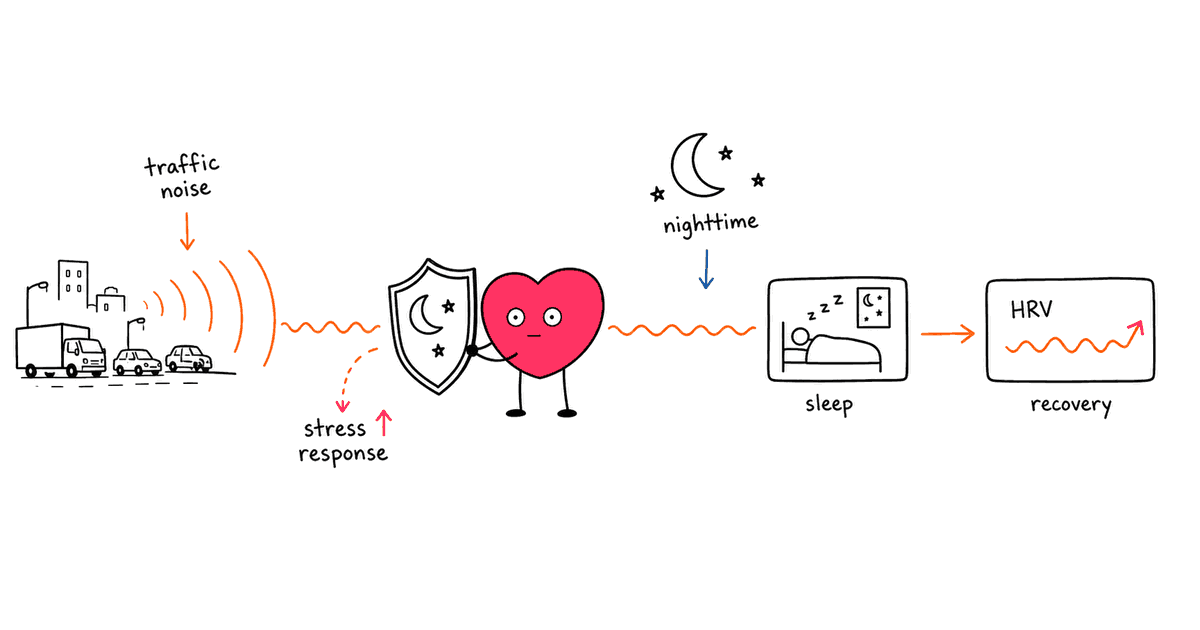
You optimize your sleep, dial in your nutrition, and track every workout. But there is an invisible factor dragging down your HRV that most people never consider: noise.
Environmental noise pollution, whether from traffic, construction, aircraft, or even a noisy neighbor, activates your sympathetic nervous system in ways that accumulate over time. The World Health Organization now recognizes transportation noise as an independent cardiovascular risk factor, and the mechanism behind that risk runs directly through the autonomic pathways that HRV measures.
Does Noise Pollution Lower HRV?
Yes, noise pollution lowers HRV by triggering sympathetic nervous system activation and suppressing parasympathetic tone. Research published in Frontiers in Public Health found that noise levels as low as 45 dB(A), just 10 dB above typical background noise, produce measurable shifts in autonomic balance. This effect compounds with chronic exposure, contributing to cardiovascular disease, metabolic dysfunction, and impaired recovery.
The mechanism is straightforward: your brain interprets unexpected or loud sounds as potential threats, activating the fight-or-flight response even when you are sleeping or consciously ignoring the noise. Your body cannot simply "tune out" noise at the autonomic level.
How Noise Activates Your Stress Response
When sound enters your auditory system, it reaches the amygdala (your brain's threat-detection center) before your conscious mind has time to evaluate it. This triggers a cascade of physiological responses:
- Cortisol and adrenaline release that shifts autonomic balance toward sympathetic dominance
- Increased heart rate and reduced beat-to-beat variability
- Blood pressure elevation from vascular constriction
- Reduced parasympathetic (vagal) tone, the primary driver of high HRV
- Inflammatory marker increases including C-reactive protein and IL-6
A 2020 review in the Annual Review of Public Health confirmed that these effects are not limited to extremely loud environments. Chronic moderate noise exposure (like living near a busy road) produces sustained autonomic imbalance that accumulates over months and years.
Nighttime Noise Is the Biggest Threat
While daytime noise is disruptive, nighttime noise exposure poses the greatest risk to your HRV and cardiovascular health. During sleep, your autonomic nervous system should shift toward parasympathetic dominance, producing the high HRV readings that indicate recovery and restoration.
Nighttime noise disrupts this process in several ways:
- Micro-arousals that fragment sleep architecture without fully waking you
- Suppressed deep sleep (N3), the stage most critical for physical recovery
- Reduced REM sleep, which supports cognitive restoration and emotional regulation
- Sustained cortisol elevation that persists into the following day
- Lower morning HRV that reflects incomplete overnight recovery
The WHO recommends nighttime noise levels below 40 dB for healthy sleep, with 55 dB as an interim target for areas where lower levels are not immediately feasible. For reference, a quiet bedroom typically measures 30-35 dB, while a busy road outside a closed window can reach 50-60 dB.
A 2025 study in SLEEP found that intermittent environmental noise (simulating traffic patterns) significantly reduced N3 deep sleep even at moderate levels of 45-65 dB, and that earplugs partially but not fully mitigated the effect.
Types of Noise and Their HRV Impact
Not all noise affects your autonomic nervous system equally. Research distinguishes between several types:
Traffic Noise
Road traffic is the most widespread source of noise pollution globally. The European Environment Agency estimates that over 100 million Europeans are exposed to road traffic noise above recommended thresholds. Studies consistently show that residential traffic noise exposure correlates with lower HRV, higher resting heart rate, and increased cardiovascular disease risk.
Aircraft Noise
Aircraft noise produces some of the most acute HRV responses due to its intermittent, high-intensity nature. Research from communities near airports shows that nighttime aircraft noise is particularly damaging, with each 10 dB increase in exposure associated with measurable drops in parasympathetic HRV markers.
Occupational Noise
Workers in manufacturing, construction, and transportation face chronic high-level noise exposure. Studies in Noise and Health show that occupational noise above 85 dB is associated with significantly reduced HRV and elevated cardiovascular risk, independent of hearing damage.
Urban Background Noise
Even the general ambient noise of urban environments (traffic hum, sirens, mechanical systems) creates a baseline of sympathetic activation compared to quieter rural or suburban settings. Urban areas also tend to have worse air quality, compounding the autonomic stress. This may partially explain why nature exposure produces such reliable HRV improvements: the absence of both urban noise and air pollution is itself restorative.
The Dose-Response Relationship
Research on noise and HRV reveals a clear dose-response pattern: more noise exposure means greater autonomic disruption.
| Noise Level (dB) | Typical Source | Autonomic Impact |
|---|---|---|
| 30-35 | Quiet bedroom | Minimal, supports parasympathetic dominance |
| 40-45 | Quiet residential area | Threshold where measurable HRV effects begin |
| 50-55 | Moderate traffic (windows closed) | Reduced HF-HRV, mild sympathetic activation |
| 60-70 | Busy road, open window | Significant HRV suppression, sleep disruption |
| 70-85 | Heavy traffic, construction | Sustained sympathetic dominance, elevated cortisol |
| 85+ | Industrial, concerts | Acute stress response, cardiovascular strain |
A study in Environmental Pollution using wearable sensors in real-world conditions found that personal noise exposure was associated with reduced HRV parameters across all four measured domains (SDNN, RMSSD, LF, HF), confirming that the laboratory findings translate to everyday life.
Noise and Sleep HRV: What Your Wearable Might Be Telling You
If you use an Oura Ring, Whoop, or Apple Watch to track overnight HRV, unexplained dips in your readings might be noise-related. Consider these patterns:
- Consistently lower HRV on weeknights compared to weekends (if you live near a road with weekday traffic patterns)
- Random HRV drops on nights with storms, neighborhood events, or construction
- Higher HRV when traveling to quieter environments, even without other lifestyle changes
- Gradual HRV decline after moving to a noisier neighborhood
Your wearable measures the downstream effect of noise exposure through autonomic function, even when you do not consciously notice the sound. This makes HRV tracking a valuable objective measure of your noise environment's impact on health.
How to Reduce Noise Impact on HRV
Optimize Your Sleep Environment
Your bedroom acoustic environment has the single largest impact on noise-related HRV suppression:
- Seal air gaps around windows and doors (noise travels through even small openings)
- Use heavy curtains or acoustic panels on walls facing noise sources
- Consider a white or pink noise machine to mask intermittent sounds (though research suggests earplugs are more effective for deep sleep preservation)
- Wear quality earplugs rated for at least 25 dB noise reduction
- Move your bed away from exterior walls facing roads or other noise sources
Manage Daytime Exposure
- Use noise-canceling headphones in open offices, during commutes, or while working near traffic
- Take quiet breaks in parks or indoor quiet spaces during the workday
- Limit recreational noise exposure (concerts, loud restaurants, headphone volume), especially if loud environments also trigger tinnitus-related stress
- Walk in parks rather than along busy roads when possible, combining the benefits of walking with reduced noise exposure
Monitor and Measure
- Use a decibel meter app to assess your bedroom, office, and commute noise levels
- Compare HRV data on nights with different noise conditions
- Track seasonal noise patterns (open windows in summer, holiday traffic) against your HRV trends
Consider Your Living Environment
If you are choosing where to live, noise exposure should be a factor in your health calculus:
- Bedrooms facing courtyards or quiet streets produce meaningfully better sleep HRV than those facing main roads
- Higher floors in apartment buildings typically experience less traffic noise
- Buildings with double-glazed windows and concrete construction attenuate more noise than older wood-frame structures
Noise, HRV, and Long-Term Cardiovascular Risk
The European Society of Cardiology now recommends that transportation noise be recognized as an independent cardiovascular risk factor in clinical guidelines. A 2024 review in the Journal of Exposure Science and Environmental Epidemiology summarized the evidence: chronic noise exposure contributes to hypertension, atherosclerosis, heart failure, and stroke through sustained autonomic imbalance, oxidative stress, and systemic inflammation.
For HRV trackers, this means that improving your acoustic environment is not just about comfort. It is a legitimate cardiovascular health intervention, potentially as impactful as dietary changes or exercise modifications for people living in high-noise environments.
Who Is Most Vulnerable to Noise-Related HRV Suppression?
While noise affects everyone's autonomic nervous system, certain groups show heightened sensitivity:
- People with existing anxiety or PTSD tend to have amplified amygdala responses to unexpected sounds, producing larger sympathetic spikes
- Older adults have reduced autonomic flexibility, meaning their nervous systems recover more slowly from noise-induced sympathetic activation
- Shift workers exposed to daytime sleep in noisy environments face compounded sleep disruption and HRV suppression
- People with lower baseline HRV have less parasympathetic reserve to buffer against noise-induced sympathetic surges
- Children may be particularly vulnerable to chronic noise exposure during developmental periods when autonomic regulation patterns are being established
If you fall into any of these categories, prioritizing acoustic environment optimization may produce outsized HRV improvements compared to other interventions.
The Hidden Cost of Open-Plan Offices
Workplace noise deserves special attention because most adults spend 8 or more hours per day in their work environment. Open-plan offices typically produce ambient noise levels of 60-70 dB, well above the threshold for autonomic effects. Research shows that workers in open offices have elevated cortisol levels and lower HRV compared to those in private offices or quiet work environments.
The cognitive load of filtering background conversation adds an additional layer of stress. Your brain must continuously suppress irrelevant auditory information, consuming mental resources and maintaining a low-grade sympathetic activation throughout the workday.
Practical solutions include noise-canceling headphones, scheduled quiet periods, and advocating for designated quiet zones in shared workspaces. Remote workers who control their acoustic environment may have an underappreciated health advantage.
Combining Noise Reduction with Other HRV Strategies
Noise reduction works synergistically with other HRV optimization strategies:
- Breathing exercises are more effective in quiet environments where you can focus on respiratory patterns
- Meditation practice benefits from reduced auditory distraction
- Sleep optimization efforts are undermined if your bedroom remains noisy
- Nature exposure provides both noise reduction and additional parasympathetic benefits simultaneously
Frequently Asked Questions
Can you adapt to noise over time?
Subjectively, yes. You stop noticing consistent noise after prolonged exposure. But research shows that autonomic responses persist even when conscious awareness fades. Your body continues to react to noise at the physiological level, meaning "getting used to it" does not protect your HRV or cardiovascular health.
Does white noise help or hurt HRV?
White and pink noise can mask disruptive intermittent sounds (like traffic spikes or sirens), which may improve sleep continuity. However, a 2025 study found that continuous noise, even pink noise, slightly reduced REM sleep compared to silence. The best approach is reducing noise at the source (earplugs, soundproofing) rather than adding masking noise.
How quickly does HRV improve after reducing noise exposure?
Most people see measurable HRV improvements within days of reducing nighttime noise exposure, since overnight recovery responds quickly to better sleep conditions. Chronic autonomic adaptations from years of noise exposure may take weeks to months to fully reverse.
What decibel level is safe for sleep?
The WHO recommends below 40 dB for nighttime noise. For optimal HRV recovery, aim for 30-35 dB, which is a typical quiet bedroom with windows closed and no mechanical noise sources.
Is music different from noise pollution?
Voluntary, pleasant music listening activates different neural pathways than involuntary noise exposure. Research shows that self-selected calming music can actually improve HRV, while involuntary exposure to the same volume of unwanted sound suppresses it. The key difference is control and predictability.
Need a quick read on your HRV number first?
Enter your HRV value, age range, device, and recovery context for a plain-English interpretation before you decide what to do next.
Interpret Your HRV NumberBuild the 30-day plan