Smoking, Nicotine, and HRV: How Tobacco, Vaping, and Nicotine Pouches Affect Your Autonomic Nervous System
Trying to decode today's HRV number? Use the free interpreter first, then build a practical recovery plan. Interpret your HRV
Nicotine is one of the most widely consumed psychoactive substances in the world. Whether delivered through traditional cigarettes, e-cigarettes, nicotine pouches, or patches, it has a direct and measurable impact on your autonomic nervous system. And if you track HRV, that impact shows up in your data almost immediately.
This guide breaks down what research tells us about how smoking, vaping, and other nicotine products affect HRV, why it matters for long-term health, and what the recovery timeline looks like when you quit.
How Nicotine Affects the Autonomic Nervous System
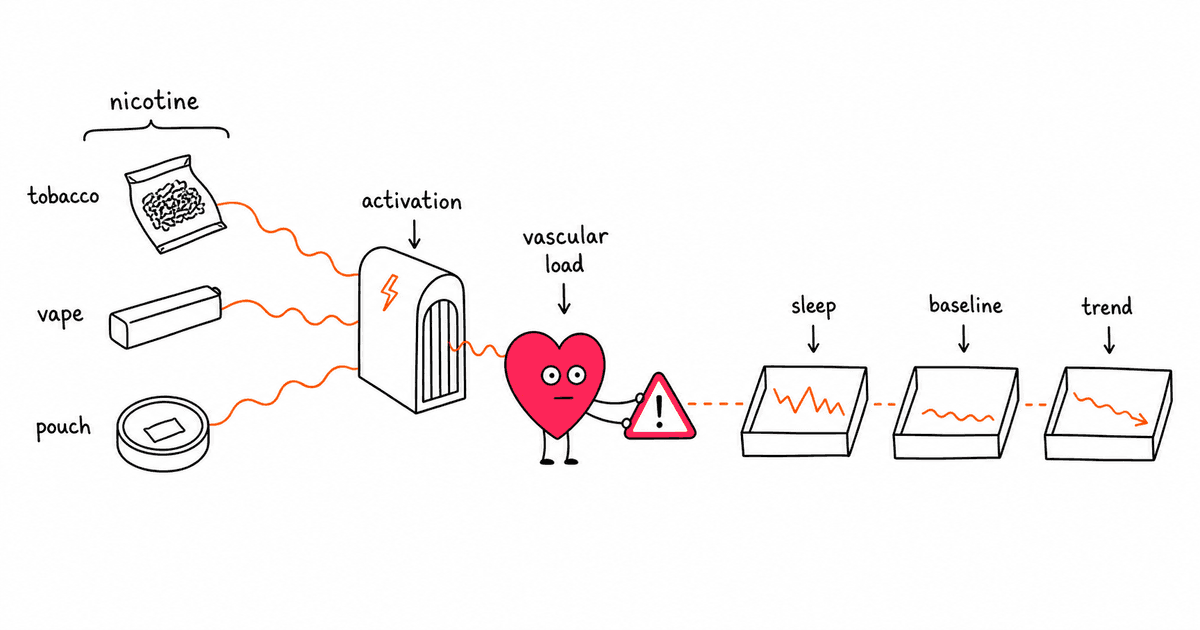
Nicotine stimulates the release of catecholamines (adrenaline and noradrenaline), which activate the sympathetic nervous system and suppress parasympathetic (vagal) activity. This shift reduces HRV by decreasing the natural beat-to-beat variation your heart relies on for adaptive regulation.
Within seconds of nicotine entering the bloodstream, it binds to nicotinic acetylcholine receptors in the brain and adrenal glands. This triggers a cascade of effects: elevated heart rate, increased blood pressure, and vasoconstriction. The parasympathetic branch, which drives higher HRV, gets pushed into the background.
This mechanism is consistent regardless of how nicotine is delivered. The route of delivery (lungs, mucous membranes, or skin) affects how quickly nicotine reaches the brain, but the autonomic disruption follows the same pattern.
What the Research Says About Smoking and HRV
Acute Effects of a Single Cigarette
A single cigarette produces measurable changes in HRV within minutes. Research published in the International Journal of Research in Medical Sciences (2022) confirmed that smoking increases heart rate while reducing both time-domain (SDNN, RMSSD) and frequency-domain (HF power) HRV metrics.
A study in Nicotine & Tobacco Research (2011) found that even a single 4 mg dose of oral nicotine in healthy nonsmokers caused significant HRV reduction, particularly in the high-frequency component associated with vagal tone. This suggests the suppressive effect is not just about combustion byproducts; nicotine itself is the primary driver.
Chronic Smoking and Long-Term HRV Suppression
The effects compound with chronic use. A large population-based study in PLOS ONE (2019), known as the CHRIS study, examined over 10,000 participants and found that current smokers had consistently lower HRV than both former smokers and people who had never smoked. The relationship was dose-dependent: heavier smokers showed greater HRV suppression.
Research published in Annals of Noninvasive Electrocardiology (2019) explored the dynamic influence of smoking on parasympathetic and sympathetic responses. The findings showed that chronic smokers had reduced vagal activity even during rest, and their autonomic response to challenges like deep breathing was blunted compared to non-smokers.
Beyond Nicotine: Combustion Byproducts
While nicotine drives the primary autonomic shift, traditional cigarettes deliver thousands of additional chemicals. Carbon monoxide reduces oxygen delivery, tar damages lung tissue, and oxidative stress from free radicals contributes to chronic inflammation. All of these factors compound the autonomic damage and make combustible tobacco the most harmful nicotine delivery method from an HRV perspective.
Vaping and E-Cigarettes: Are They Better for HRV?
The rise of e-cigarettes has led many to assume vaping is significantly safer for cardiovascular health. The HRV data tells a more nuanced story.
Acute Vaping Effects
A study published in the Journal of the American Heart Association (2017) found that vaping with nicotine-containing e-liquid shifted the sympathovagal balance toward sympathetic predominance. The LF/HF ratio, a marker of sympathetic-parasympathetic balance, increased significantly compared to nicotine-free vaping and sham controls. This confirms that nicotine, not the act of inhaling vapor, drives the HRV suppression.
Chronic E-Cigarette Use
Research in JAMA Cardiology found that habitual e-cigarette users showed increased cardiac sympathetic activity and elevated oxidative stress markers compared to non-users. The LF component was significantly higher (52.7 vs. 39.9 nu), indicating chronic sympathetic overactivation.
A 2024 animal study published in Toxicology and Applied Pharmacology found that e-cigarette aerosol altered cardiac rhythm and reduced HRV in the post-exposure period, suggesting lasting autonomic disruption beyond the immediate vaping session.
Vaping vs. Smoking: A 2025 Review
A comprehensive review in Antioxidants (December 2025) examined cardiac autonomic dysfunction across both conventional and electronic cigarette users. The conclusion: while e-cigarettes may expose users to fewer combustion byproducts, they still drive significant autonomic dysfunction through nicotine-mediated sympathetic activation and oxidative stress.
The bottom line: vaping is likely less harmful than smoking for overall health, but it is not neutral for your HRV or cardiovascular system.
Nicotine Pouches, Snus, and Oral Nicotine
Nicotine pouches (brands like ZYN, VELO, and others) have surged in popularity. Because they eliminate both combustion and inhalation, they are often perceived as a low-risk option. But the cardiovascular picture is not that simple.
What Research Shows
A 2024 cross-over study found that nicotine pouches containing 6 mg of nicotine increased systolic and diastolic blood pressure within 6 to 20 minutes of use, though values returned to baseline after about 40 minutes. Higher-dose pouches (up to 30 mg) produced more pronounced effects.
The American Heart Association published a policy statement in Circulation (2024) warning that smokeless oral nicotine products pose cardiovascular risks, including increased mortality risk in individuals with ischemic heart disease. A major European Heart Journal review (2025) reinforced this, describing nicotine in any form as a "growing threat to cardiovascular health."
While direct HRV studies on nicotine pouches are limited, the mechanism is clear: nicotine absorbed through oral mucosa activates the same sympathetic pathways as inhaled nicotine, leading to similar autonomic disruption.
How Pouches Compare
The advantage of pouches over cigarettes is the absence of combustion byproducts. Compared to vaping, they eliminate lung exposure entirely. But all nicotine delivery methods share the core issue: sympathetic activation and parasympathetic suppression, both of which lower HRV.
HRV Recovery After Quitting: What the Timeline Looks Like
One of the most encouraging aspects of HRV research on smoking is how clearly it demonstrates recovery after cessation.
The First Month
A study in the American Heart Journal (1998) tracked HRV during the first month of smoking cessation. Participants showed increased HRV almost immediately, with improvements persisting and strengthening over the 30-day observation period. Notably, this improvement occurred regardless of whether participants experienced withdrawal symptoms.
Three to Six Months
Research in Clinical Autonomic Research (2013) followed long-term male smokers through cessation. Those who successfully quit showed significantly higher SDNN, RMSSD, pNN50, LF, and HF values compared to those who relapsed. The improvements were primarily attributed to nicotine discontinuation rather than the removal of other tobacco components.
Long-Term Recovery
The most comprehensive recovery data comes from a study in Environmental Research (2015) that assessed HRV dynamics in an aging cohort. The findings revealed that light smokers who quit could fully recover their HRV within 15 years. Heavy smokers showed improvement but may retain some residual autonomic impairment depending on duration and intensity of use.
Recovery Timeline Summary
| Timeframe | What Happens |
|---|---|
| 20 minutes | Heart rate and blood pressure begin normalizing |
| 24-48 hours | Acute sympathetic overdrive starts to fade |
| 1 month | Measurable HRV improvement in time-domain and frequency-domain metrics |
| 3-6 months | Significant gains in SDNN, RMSSD, and vagal tone |
| 1-5 years | Cardiovascular risk drops substantially |
| 5-15 years | Light smokers may fully recover HRV to never-smoker levels |
Recovery timelines can vary based on age, overall fitness, and other lifestyle factors.
How to Track Your HRV Through Smoking Cessation
If you are planning to quit, HRV tracking can be a powerful motivational tool. Watching your numbers improve week over week provides tangible evidence that your body is healing.
Best Practices for Tracking
- Establish a baseline: Track your HRV for at least two weeks before your quit date so you have a clear starting point
- Measure consistently: Take readings at the same time each day, ideally first thing in the morning before getting out of bed
- Use a reliable device: Wearables like Oura Ring 4, Whoop, or Garmin Forerunner 265 provide continuous overnight HRV tracking
- Track trends, not daily values: Individual readings fluctuate. Focus on the 7-day and 30-day moving averages
- Account for withdrawal effects: The first one to two weeks may show increased variability as your nervous system recalibrates
What to Expect
Most people who quit nicotine see their resting heart rate drop within the first week. HRV improvements typically follow within two to four weeks, with the most dramatic gains in the first three months. If you use a wearable that tracks recovery scores (like Whoop's recovery metric or Oura's readiness score), expect those numbers to trend upward as your autonomic balance improves.
Nicotine and HRV in the Context of Exercise
Athletes and fitness enthusiasts who use nicotine often wonder whether it affects training adaptation. The answer is yes.
HRV-guided training relies on parasympathetic recovery signals to determine readiness. Nicotine suppresses those signals, which means your HRV-based training readiness may appear lower than it actually is, or worse, your body may genuinely be under-recovered due to chronic sympathetic activation. For more on using HRV to guide training, see our guide on HRV for athletes.
Research on overtraining and HRV shows that suppressed parasympathetic tone is a hallmark of overreaching. Nicotine use can mimic or exacerbate these patterns, making it harder to distinguish between training fatigue and nicotine-induced autonomic stress.
For athletes considering HRV-guided training, eliminating nicotine removes a significant confounding variable and allows your data to more accurately reflect your true recovery state.
Secondhand Smoke and Passive Exposure
The autonomic effects of smoking extend beyond the smoker. A study in Environmental Research found that chronic exposure to secondhand smoke is associated with reduced HRV in non-smokers. The mechanisms are similar: passive inhalation of nicotine and particulate matter triggers low-level sympathetic activation and oxidative stress.
This is particularly relevant for children and individuals with pre-existing cardiovascular conditions, whose autonomic systems are more vulnerable to environmental stressors. Air quality in general plays an important role in HRV, and secondhand smoke is one of the most significant indoor air pollutants.
Other Lifestyle Factors That Interact with Nicotine's HRV Effects
Nicotine does not act in isolation. Several lifestyle factors can amplify or partially buffer its impact on HRV:
- Alcohol: Combining nicotine and alcohol compounds sympathetic activation, producing larger HRV drops than either substance alone
- Caffeine: Both caffeine and nicotine stimulate the sympathetic nervous system, though caffeine's effects are typically milder
- Sleep deprivation: Poor sleep already suppresses HRV; adding nicotine to the mix creates a deeper parasympathetic deficit
- Exercise: Regular aerobic exercise is one of the most effective ways to boost parasympathetic tone and can partially offset nicotine's suppressive effects
- Meditation and breathing exercises: These practices activate the vagus nerve and can help restore some parasympathetic balance, even in active smokers. HRV biofeedback training can be particularly effective for building autonomic resilience
Practical Takeaways
If you use nicotine in any form and track HRV, here is what to keep in mind:
- All nicotine delivery methods suppress HRV through sympathetic activation, not just cigarettes
- Combustible tobacco is the worst option because it adds oxidative stress, inflammation, and carbon monoxide exposure on top of nicotine's effects
- Vaping and pouches are less harmful but not harmless from an HRV and cardiovascular perspective
- HRV recovers after quitting, with measurable improvements starting within the first month
- Tracking HRV during cessation can provide motivation and objective proof that your body is healing
- Nicotine confounds HRV-guided training, making it harder to interpret recovery data accurately
For a complete overview of strategies that can improve your HRV, including exercise, sleep, nutrition, and stress management, see our comprehensive guide.
Frequently Asked Questions
How quickly does nicotine lower HRV?
Within minutes. Research shows that a single dose of nicotine (equivalent to one cigarette or a 4 mg nicotine lozenge) produces measurable HRV suppression in under 10 minutes. The effect typically lasts one to two hours for a single dose.
Does vaping affect HRV as much as smoking?
The nicotine-driven HRV suppression is similar. However, traditional cigarettes deliver additional harmful compounds (carbon monoxide, tar, and thousands of chemicals) that cause further cardiovascular damage. Vaping eliminates most of these, but the core nicotine effect on autonomic balance remains.
Will my HRV fully recover if I quit smoking?
For most people, yes. Research shows that light smokers can fully recover HRV to never-smoker levels within 5 to 15 years. Heavy, long-term smokers show significant improvement but may retain some residual autonomic impairment. The majority of recovery happens in the first six months after quitting.
Do nicotine patches affect HRV?
Yes. Nicotine patches deliver a steady stream of nicotine through the skin, which maintains some degree of sympathetic activation. However, the delivery is more gradual than smoking, so the acute HRV dips may be less dramatic. Patches are generally used as a cessation aid, and the short-term autonomic trade-off is considered worthwhile for long-term quitting success.
Can exercise offset nicotine's effect on HRV?
Partially. Regular aerobic exercise is one of the strongest ways to boost parasympathetic tone and raise baseline HRV. Studies show that physically active smokers tend to have better HRV than sedentary smokers. However, exercise cannot fully counteract the sympathetic activation caused by nicotine, and quitting remains the most effective strategy for HRV recovery.
Need a quick read on your HRV number first?
Enter your HRV value, age range, device, and recovery context for a plain-English interpretation before you decide what to do next.
Interpret Your HRV NumberBuild the 30-day plan