HRV in Children: What Parents Need to Know About Heart Rate Variability
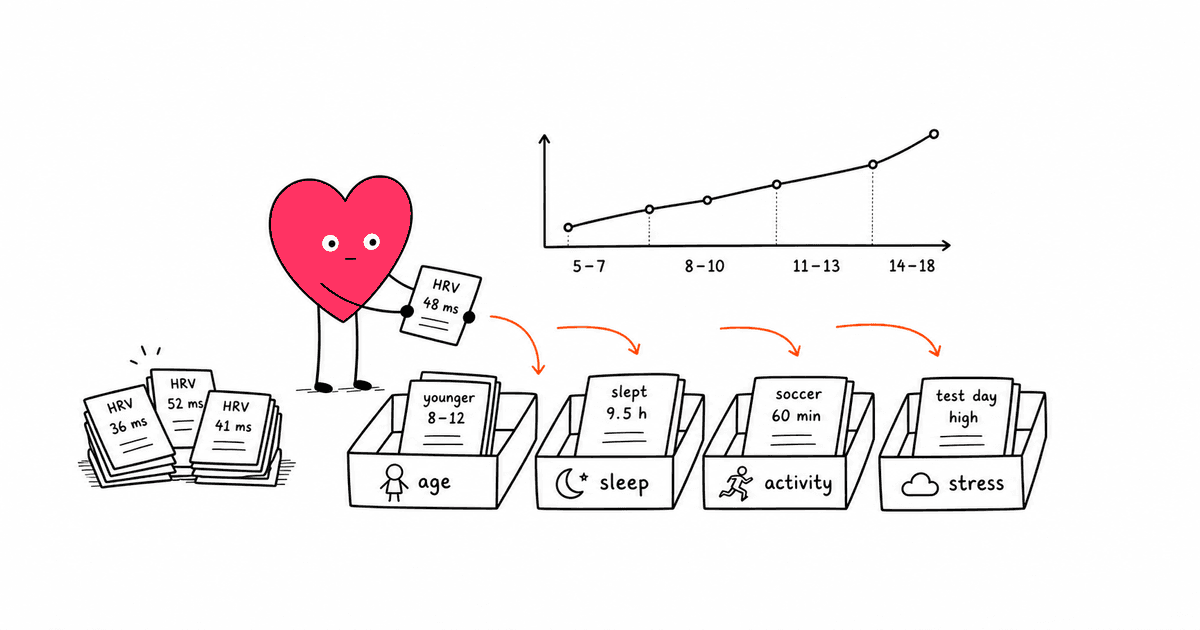
Trying to decode today's HRV number? Use the free interpreter first, then build a practical recovery plan. Interpret your HRV
What Is Normal HRV for Children?
Children typically have higher HRV than adults, with school-age children (6-12 years) showing the highest values across the lifespan. This is normal and reflects healthy parasympathetic nervous system development. HRV in children peaks around age 6, then gradually decreases through adolescence. Unlike adults, children's HRV should be interpreted relative to their age and heart rate, not compared to adult reference ranges.
Heart rate variability (HRV) research has exploded in recent years, with wearables making it easy to track this health metric. But most of what we hear about HRV focuses on adults. What about children?
As it turns out, pediatric HRV follows different patterns than adult HRV, and understanding these differences matters for parents, pediatricians, and researchers alike. Here's what the science tells us.
Children Have Higher HRV Than Adults
One of the most consistent findings in HRV research is that children typically have higher heart rate variability than adults. This might seem counterintuitive since we often associate high HRV with optimal health and fitness, but it reflects the normal development of the autonomic nervous system.
Research establishing reference values for HRV in children and adolescents has found that HRV metrics like SDNN and RMSSD are highest in school-age children and gradually decrease through adolescence into adulthood. Studies examining HRV in healthy children consistently show that parasympathetic activity (measured by high-frequency HRV) is significantly higher in children compared to adult reference values.
Why is children's HRV higher? The autonomic nervous system continues developing throughout childhood. In younger children, parasympathetic ("rest and digest") activity tends to dominate, resulting in greater beat-to-beat variation. As children mature, sympathetic nervous system activity increases, and overall HRV gradually decreases.
Importantly, researchers have found that heart rate itself significantly impacts HRV in pediatric populations and is the strongest independent determinant of all standard HRV indices. This means when comparing children's HRV across different ages, it's essential to account for the natural decrease in resting heart rate that occurs as children grow.
How HRV Changes From Infancy to Adolescence
HRV doesn't remain static throughout childhood. It follows a developmental trajectory that reflects autonomic nervous system maturation.
Infancy (0-1 year)
Newborns have relatively low HRV that increases rapidly in the first months of life. Notably, maternal HRV also undergoes significant changes. See our guide on HRV during pregnancy for how autonomic function shifts across trimesters and postpartum recovery. Research has documented significant HRV changes during the first six months, with both time-domain and frequency-domain measures increasing as the infant's autonomic nervous system matures.
Interestingly, reduced HRV in infants has been associated with increased risk of sudden infant death syndrome (SIDS). Studies have found that infants who later died of SIDS had lower HRV compared to healthy controls, contributing to our understanding of autonomic dysfunction in SIDS risk.
Early Childhood (1-5 years)
During toddler and preschool years, HRV continues to increase. The parasympathetic nervous system becomes increasingly dominant, and children show robust vagal tone (the activity of the vagus nerve, which slows heart rate).
Research tracking HRV development from birth to 15 years has found that most HRV parameters increase until around age 6, then begin a gradual decline.
School Age (6-12 years)
School-age children typically show the highest HRV values across the lifespan. This period represents peak parasympathetic activity before the hormonal and physiological changes of puberty.
A comprehensive 2018 study examining normative HRV values in school-aged children (ages 6-13) found that when accounting for differences in average heart rate, HRV actually decreases with age rather than remaining constant. This highlights how important it is to consider heart rate when interpreting children's HRV values.
Research has also found strong associations between HRV and stress reactivity in children, suggesting that HRV could be a useful biomarker for childhood stress even at young ages.
Adolescence (13-18 years)
Puberty brings significant changes to HRV. The hormonal shifts of adolescence are associated with declining HRV, particularly in the high-frequency (parasympathetic) range.
Meta-analyses of resting-state HRV across the lifespan have confirmed that HRV decreases during adolescence, continuing to decline through adulthood. For a complete picture of how HRV changes from your 20s through your 70s, see our guide on HRV by age. This decline is considered normal and reflects the maturation of autonomic balance.
Normal HRV Ranges in Children
Establishing "normal" HRV values for children is challenging because HRV varies by:
- Age
- Sex
- Measurement conditions (awake vs. asleep, resting vs. active)
- Measurement duration
- Average heart rate
- Specific HRV metric used
Recent research has emphasized that HRV values must be interpreted alongside average heart rate, particularly in children where heart rate varies significantly with age. Mathematical methods that correct for heart rate allow for more objective comparisons.
The table below summarizes approximate RMSSD values (the most common HRV metric) by age group based on published studies:
| Age Group | Typical RMSSD Range (ms) | Notes |
|---|---|---|
| Infants (0-1 yr) | 20-50 | Increases rapidly in first months |
| Toddlers (1-3 yrs) | 30-70 | High variability between children |
| Preschool (3-5 yrs) | 40-80 | Parasympathetic dominance increases |
| School age (6-12 yrs) | 50-100+ | Often highest values in lifespan |
| Adolescents (13-18 yrs) | 40-80 | Begins declining toward adult values |
Note: These ranges are approximate and based on resting measurements. Individual variation is significant, and these should not be used for diagnostic purposes.
How Children's HRV Differs From Adults
Beyond simply having higher values, children's HRV patterns differ from adults in several important ways:
1. Greater Day-to-Day Variability
Children's HRV tends to fluctuate more from day to day than adults'. This is partly because children's autonomic systems are still developing and are more responsive to environmental factors like sleep, activity, and emotional state.
2. Stronger Parasympathetic Dominance
The ratio of parasympathetic to sympathetic activity is higher in children. This is reflected in higher high-frequency (HF) HRV power relative to low-frequency (LF) power. As children age, this balance shifts toward greater sympathetic influence. Girls tend to show lower values than boys across several frequency-domain parameters.
3. Different Sleep Patterns
Children's HRV during sleep differs from adults, with more pronounced respiratory sinus arrhythmia (the natural increase in heart rate during inhalation and decrease during exhalation). Respiratory rate also declines from birth to early adolescence, which influences HRV measurements. For more on the sleep-HRV connection, see our guide on HRV and sleep quality.
4. Sex Differences Emerge Later
In adults, women typically have lower HRV than men. However, this sex difference is minimal in young children and only becomes apparent during puberty. Research has found that sex differences in HRV emerge primarily during adolescence.
What HRV Can Tell Us About Children's Health
Research has linked HRV in children to various health and developmental outcomes:
Emotional Regulation
Porges' Polyvagal Theory proposes that vagal tone (reflected in HRV) is connected to emotional regulation and social engagement. Studies have found that children with higher resting HRV tend to show better emotional regulation and fewer behavioral problems.
Recent 2024 research on preschool children's high-frequency HRV found connections between HRV patterns during emotional challenges and self-regulation abilities, though findings remain mixed and context-dependent.
Stress and Anxiety
Lower HRV has been associated with anxiety and stress in children. Research has found that children with anxiety disorders show reduced HRV compared to healthy controls. This mirrors the HRV-stress relationship seen in adults.
This has led researchers to explore whether HRV monitoring could help identify children struggling with chronic stress or anxiety, even before behavioral symptoms become obvious.
ADHD
Several studies have examined HRV in children with attention-deficit/hyperactivity disorder (ADHD). Findings have been mixed, but some research suggests that children with ADHD may show altered autonomic function, with lower overall HRV and reduced parasympathetic activity compared to controls.
HRV biofeedback has emerged as a potential complementary treatment for ADHD. A 2025 study in Frontiers in Human Neuroscience examined non-pharmacological interventions including respiratory biofeedback and HRV biofeedback for ADHD treatment, showing promise as part of multimodal approaches.
Autism
Research on autism and HRV points to differences in autonomic regulation, especially around sensory load, social stress, anxiety, and recovery. HRV should never be used to judge behavior or diagnose autism, but it may help caregivers and clinicians understand when a child's nervous system is carrying more load than it appears from the outside.
Obesity
Childhood obesity is associated with reduced HRV. Research has found that obese children have significantly lower HRV than normal-weight peers, with body weight being the strongest predictor for lower HRV. This suggests early autonomic dysfunction associated with excess weight. Nutrition plays a key role in both weight management and autonomic health.
Physical Fitness
Just as in adults, physical fitness is associated with higher HRV in children. Regular physical activity can improve HRV, suggesting that exercise benefits autonomic health even in young people. For more on HRV in active individuals, see our guide on HRV for athletes. Researchers note that active athletes may show different patterns and are often excluded from normative studies.
Congenital Heart Disease
Children with congenital heart disease often show reduced HRV, with the level of reduction depending on their functional status. Recent 2024 research has also found associations between HRV and cognitive functions in adolescents with complex congenital heart disease.
HRV Biofeedback for Children
HRV biofeedback, a technique that trains individuals to increase their heart rate variability through controlled breathing and relaxation, has shown promise in pediatric populations.
A 2021 systematic review published in the Journal of Child Psychology and Psychiatry examined all available studies using HRV biofeedback in children and adolescents. The results showed the efficiency of HRV biofeedback sessions with children and adolescents for reducing physical and mental health-related symptoms and enhancing well-being.
The review concluded that HRV biofeedback can serve as a valuable complement to more conventional behavioral and cognitive interventions to help children manage stress and/or pain. However, more standardized protocols and larger studies are needed.
Research suggests that children as young as 7-8 years old can benefit from HRV biofeedback for stress management and emotional regulation, though this should be done under professional guidance, particularly for children with anxiety or other conditions.
Should Parents Track Their Children's HRV?
Consumer HRV tracking has primarily been designed for adults, and there are several considerations for parents thinking about monitoring their child's HRV:
Potential Benefits
- Identifying stress: Consistently low HRV might indicate chronic stress that's worth addressing
- Understanding recovery: For young athletes, HRV can help optimize training and rest
- Concussion monitoring: For children in contact sports, HRV tracking can provide objective data during concussion recovery, where autonomic disruption in developing brains may persist longer than in adults
- Building awareness: Older children and teens might benefit from understanding their body's stress signals
Important Limitations
- Lack of pediatric norms in apps: Most HRV apps use adult reference ranges, which can lead to misleading interpretations for children. The average HRV score on platforms like Elite HRV is based predominantly on adult users.
- High normal variation: Children's HRV varies significantly day to day, making trends harder to interpret
- Limited research on tracking benefits: While HRV research in children is extensive, studies on consumer HRV tracking for kids are limited
- Potential for anxiety: Monitoring health metrics could potentially increase anxiety in some children
- Wrist-based accuracy concerns: Experts generally do not recommend wrist-based optical heart rate monitors for reliable HRV readings, as they are less accurate than chest straps for capturing the beat-to-beat precision HRV requires
Device Options for Children
While most HRV-focused wearables target adults (see our best HRV monitors guide for adult recommendations), there are some options for tracking children's activity and heart rate:
For HRV accuracy (older children/teens):
- Chest straps like the Polar H10 provide medical-grade accuracy for HRV measurements
- This requires pairing with a compatible app and is best suited for teens interested in athletic performance
For general activity tracking and connectivity:
- Garmin Bounce 2 (released 2025): An LTE-connected smartwatch for kids featuring two-way calling, text messaging, real-time location tracking, and activity monitoring. Priced around $300 plus monthly subscription.
- Fitbit Ace LTE: Designed for kids with gamified movement goals, step tracking, and parental controls. More expensive but includes engaging features to encourage activity.
Note that these kids' wearables focus on activity, communication, and location rather than HRV specifically. For accurate HRV data in children, medical-grade equipment or validated finger photoplethysmography (PPG) systems may be necessary, as a 2020 study found commercially available PPG systems can provide valid HRV measurements in children when properly validated.
Recommendations
If you're considering HRV tracking for your child:
-
Focus on trends, not numbers: Don't compare your child's HRV to adult norms or other children. Look for patterns over time.
-
Use appropriate devices: Chest straps provide more accurate readings than wrist-based devices. For children, the Polar H10 offers medical-grade accuracy.
-
Consult healthcare providers: If you're concerned about your child's autonomic health, talk to their pediatrician rather than relying solely on consumer devices.
-
Consider the context: A low HRV reading might simply mean your child had a restless night or is fighting off a mild cold.
-
Prioritize lifestyle over numbers: Good sleep, regular physical activity, limited screen time, and emotional support matter more than any metric. For lifestyle strategies that support HRV, see our guide on how to improve your HRV.
When to Be Concerned
While HRV varies widely in healthy children, certain patterns might warrant medical attention:
- Consistently very low HRV compared to previous baseline
- HRV that doesn't increase with age during early childhood
- Low HRV combined with other symptoms like fatigue, fainting, or exercise intolerance
- Sudden significant changes in HRV patterns
In these cases, a pediatric cardiologist can perform more comprehensive autonomic testing if needed.
The Bottom Line
Children's HRV follows a distinct developmental pattern, typically peaking in school age before declining through adolescence. While research on pediatric HRV has provided valuable insights into autonomic development and health, consumer HRV tracking for children remains an emerging area.
For most parents, the fundamentals matter more than metrics: ensure your child gets enough sleep, stays physically active, manages stress appropriately, and maintains a healthy weight. These factors support healthy autonomic development, which will be reflected in robust HRV.
If you're interested in learning more about HRV basics, check out our beginner's guide to heart rate variability.
Frequently Asked Questions
Is it normal for my child's HRV to be higher than mine?
Yes, this is completely normal. Children typically have higher HRV than adults, with values peaking around school age (6-12 years) before gradually declining through adolescence and adulthood.
Can I use my fitness tracker to measure my child's HRV?
While technically possible, most consumer HRV devices and apps are calibrated for adults. The reference ranges and interpretations may not apply to children. Wrist-based devices also tend to be less accurate for HRV than chest straps. Focus on trends rather than absolute numbers.
Does low HRV in children mean something is wrong?
Not necessarily. HRV varies widely based on age, fitness, sleep, and many other factors. A single low reading isn't cause for concern. However, consistently low HRV combined with other symptoms might warrant a discussion with your pediatrician.
At what age can children start HRV training or biofeedback?
Research suggests that children as young as 7-8 years old can benefit from HRV biofeedback for stress management and emotional regulation. A 2021 systematic review found HRV biofeedback to be effective in reducing physical and mental health symptoms in children and adolescents. However, this should be done under professional guidance, particularly for children with anxiety or other conditions.
How does screen time affect children's HRV?
While direct research is limited, screen time before bed has been associated with poorer sleep quality, which can negatively impact HRV. Maintaining healthy screen time limits and avoiding screens before bedtime supports overall autonomic health.
Need a quick read on your HRV number first?
Enter your HRV value, age range, device, and recovery context for a plain-English interpretation before you decide what to do next.
Interpret Your HRV NumberBuild the 30-day plan