ECG vs PPG for HRV: Which Heart Rate Variability Sensor Is More Accurate?
Ready to start tracking your HRV? Check out our top picks: Whoop | Oura Ring 5 | Polar H10
ECG vs PPG for HRV: The Short Answer
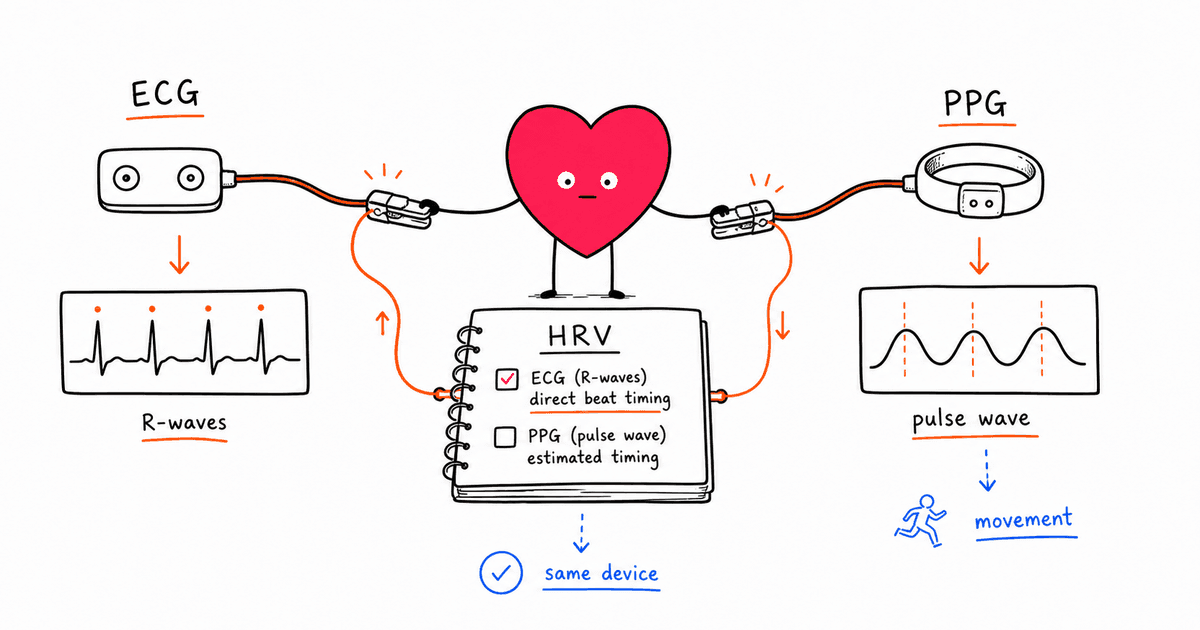
ECG is the more accurate way to measure HRV because it detects the heart's electrical R-waves directly. PPG can still be useful for daily HRV trends, especially during sleep, but it estimates pulse timing from blood flow at the skin rather than measuring heartbeats at the source.
That difference matters. A chest strap and a smart ring may both show an HRV number, but they are not always measuring the same physiological event. ECG measures heart rate variability. PPG usually measures pulse rate variability, which is closely related in quiet conditions but not identical.
If you are new to the metric itself, start with what HRV is and how to understand your HRV numbers. This guide focuses on the sensor question: when should you trust ECG, when is PPG good enough, and how should you compare data from different devices?
ECG vs PPG at a Glance
| Question | ECG | PPG |
|---|---|---|
| What it measures | Electrical timing of each heartbeat | Blood volume changes at the skin |
| Common devices | Chest straps, clinical ECGs | Rings, watches, optical armbands |
| Best for | Precision, short readings, exercise, research | Sleep trends, convenience, passive tracking |
| Main weakness | Less comfortable for all-night use | Sensitive to motion, skin contact, temperature, and blood flow |
| HRV signal type | Heart rate variability from R-R intervals | Pulse rate variability from pulse intervals |
| Best user | Someone who wants accuracy first | Someone who wants consistency and daily adherence |
What to Buy Based on This
| Need | Best fit |
|---|---|
| Cleanest controlled HRV reading | Polar H10 or Garmin HRM-600 |
| Passive sleep and recovery trends | Oura Ring 4 or WHOOP 5.0 |
| Smartwatch plus useful HRV | Apple Watch or Garmin |
| A quick interpretation of one number | Use the free HRV interpreter first |
The cleanest answer is not "ECG good, PPG bad." It is this: ECG is better for measurement precision, while PPG is often better for real-world habit formation. The best sensor depends on what decision you are trying to make.
What ECG Measures
ECG stands for electrocardiography. It measures the electrical activity that triggers each heartbeat. For HRV, the key event is the R-wave, the tall spike in the QRS complex.
HRV algorithms use the timing between normal beats, often called R-R intervals or NN intervals, to calculate metrics like rMSSD, SDNN, and frequency-domain measures. The classic 1996 Task Force standards for HRV measurement were built around ECG-based recordings, which is why ECG remains the reference method in clinical and research settings.
For consumer use, ECG usually means a chest strap such as the Polar H10 or Garmin HRM-600. A strap sits close to the heart and detects electrical activity through electrodes on the chest.
That makes ECG especially useful when you want a clean morning reading, a controlled comparison, or a reliable signal during movement. It is not perfect, but its errors are usually easier to detect and correct than optical errors from a wrist sensor.
What PPG Measures
PPG stands for photoplethysmography. It uses light to estimate changes in blood volume under the skin. Your device shines light into the tissue, measures how much light returns, and turns the pulse wave into timing data.
This is how most smartwatches, smart rings, and optical armbands estimate heart rate and HRV. PPG is the reason devices like Oura Ring 4, Whoop 5.0, Garmin watches, and Apple Watch can collect recovery data without a chest strap.
The tradeoff is that PPG does not detect the heartbeat itself. It detects the pulse wave after blood leaves the heart and travels through the arteries. That delay is tiny, but it can vary based on blood pressure, vascular tone, body position, temperature, sensor placement, and movement.
That is why researchers often call PPG-derived variability pulse rate variability, or PRV, rather than true HRV.
HRV and PRV Are Related, Not Identical
In calm, stable conditions, HRV and PRV can track closely. If you are lying still in bed, warm, relaxed, and not moving, the pulse timing detected by a ring may be very close to the heartbeat timing detected by a chest strap.
But the relationship weakens when conditions change. Movement, poor skin contact, cold fingers, tattoos, darker ambient light leakage, loose bands, vascular stiffness, arrhythmias, and changes in blood pressure can all widen the gap between ECG and PPG readings.
A 2025 paper in Frontiers in Physiology put the issue bluntly: pulse rate variability is not the same as heart rate variability. That does not make PPG useless. It means PPG data should be interpreted as a practical estimate, not as a perfect substitute for ECG in every context.
What Recent Wearable Research Shows
Consumer wearables have improved a lot. The best PPG devices can produce useful HRV trends, especially when they measure overnight rather than during the day.
A 2025 Physiological Reports validation study compared nocturnal HRV and resting heart rate from Oura Generation 3, Oura Generation 4, Polar Grit X Pro, Garmin Fenix 6, and Whoop 4.0 against a Polar H10 ECG chest strap across 536 nights of sleep. Oura devices showed the strongest HRV agreement in that study, while Whoop showed acceptable agreement. Garmin Fenix and Polar Grit X Pro showed weaker agreement for HRV in that dataset.
That does not mean every ring always beats every watch. It does mean the measurement site matters. Fingers tend to give cleaner optical signals than wrists during sleep because blood vessels are close to the surface and the device moves less.
It also supports a broader point from our best HRV monitors of 2026: device validation matters more than marketing language. "Tracks HRV" is not the same as "tracks HRV accurately in the conditions you care about."
Why ECG Usually Wins for Accuracy
ECG has three big advantages.
1. ECG Detects the Heartbeat Directly
The electrical R-wave occurs before the pulse wave reaches your wrist or finger. Because ECG captures the event at the source, it avoids many timing errors created by vascular changes.
2. ECG Handles Exercise Better
PPG struggles during movement because muscle contraction, arm swing, impact, and sensor shifting can all contaminate the optical signal. This is why athletes often use chest straps during workouts even if they wear a watch the rest of the day.
If you are tracking training load, interval sessions, or recovery from hard exercise, ECG has a strong advantage. For broader training context, see HRV for athletes and heart rate recovery vs HRV.
3. ECG Is Easier to Validate
Researchers can inspect ECG waveforms and identify missed beats, ectopic beats, and artifacts. PPG waveforms can also be inspected, but consumer devices usually hide the raw signal and only show the final score.
That makes ECG better when you need confidence in a single reading rather than a long-term trend.
Why PPG Still Belongs in HRV Tracking
PPG wins on adherence. The most accurate device is not useful if you stop using it.
A ring or watch can collect data passively during sleep, which gives you more nights of measurement and less friction. For many people, that consistency is worth more than the theoretical precision of a chest strap they forget to use.
PPG is also good at answering trend questions:
- Is your overnight HRV lower than your usual baseline?
- Did travel, alcohol, poor sleep, or illness change your recovery?
- Is your HRV rebounding after a deload week?
- Are your resting heart rate and HRV moving in opposite directions?
For trend-based health tracking, a validated PPG wearable can be useful, especially if you compare the device against itself and avoid obsessing over single-night changes. If data starts creating anxiety, read HRV tracking anxiety and orthosomnia before adding more sensors.
Chest Strap vs Smart Ring vs Smartwatch
| Device type | Sensor | Best use | Watch-out |
|---|---|---|---|
| Chest strap | ECG | Highest accuracy, morning readings, workouts | Less comfortable for sleep |
| Smart ring | PPG | Overnight HRV and recovery trends | Not ideal for exercise HRV |
| Smartwatch | PPG | Convenience, activity ecosystem, daily health tracking | Wrist motion and fit can affect HRV |
| Optical armband | PPG | Better workout heart rate than many watches | Still not ECG for HRV precision |
If you want the cleanest single HRV reading, use a chest strap. If you want the easiest daily trend, use a validated ring or wearable. If you already own an Apple Watch, use it consistently before assuming you need another device. The Apple Watch HRV guide explains how to make its readings more useful.
For product-level comparisons, see Whoop vs Oura vs Apple Watch, the Oura Ring 4 review, the Whoop 5.0 review, and the Polar H10 review.
When ECG Is the Better Choice
Choose ECG if you care about measurement precision more than convenience.
ECG is the better fit when:
- You are running controlled morning HRV tests.
- You are comparing interventions like sleep changes, supplements, or training blocks.
- You want HRV data during or immediately after exercise.
- You have unusually high HRV and want cleaner beat detection.
- You are doing coaching, research, or clinical-adjacent monitoring.
- Your wearable readings look erratic despite a consistent routine.
For most people, a 2 to 5 minute morning reading with a chest strap is enough. Use the same posture, same app, same breathing pattern, and same time window. HRV is noisy, so consistency matters almost as much as hardware.
When PPG Is Good Enough
Choose PPG if you care about effortless trend tracking.
PPG is usually good enough when:
- You are tracking overnight recovery trends.
- You want passive data without a morning routine.
- You are not making medical decisions from the number.
- You compare readings only within the same device.
- Your device has been independently validated for HRV.
- You care more about behavior change than perfect signal purity.
A good PPG wearable can help you notice patterns from sleep, stress, alcohol, caffeine, and training. It should not be treated as a diagnostic ECG.
The Biggest Mistake: Comparing Different HRV Devices
Do not compare your Oura rMSSD directly with your Apple Watch SDNN, your Garmin overnight HRV, and your chest strap morning reading as if they are interchangeable.
They may differ because of:
- Sensor type
- Body location
- Time of day
- Recording length
- Algorithm design
- Artifact filtering
- HRV metric reported
- Sleep stage or posture
This is why a device switch can make your HRV look like it suddenly improved or crashed when your physiology barely changed. The device changed the measurement pipeline.
If you change devices, treat the first 2 to 4 weeks as a new baseline period. Your old baseline may not transfer.
How to Get Cleaner HRV Data
1. Measure in the Same Context
Morning readings should happen at the same time, before caffeine, after using the bathroom if needed, and in the same posture. Overnight readings should be compared against other overnight readings from the same device.
2. Avoid Movement During Short Readings
If you use a chest strap or optical sensor for a manual reading, stay still. Talking, shifting, checking your phone, and changing breathing depth can all affect the result.
3. Track Trends, Not Isolated Numbers
A single low HRV reading is not a crisis. Look for multi-day patterns, especially when HRV drops while resting heart rate rises. For context, see resting heart rate vs HRV.
4. Use the Same Metric
rMSSD, SDNN, and frequency-domain metrics are not interchangeable. If your device reports only one, do not compare it to another app's different metric without understanding the difference.
5. Be Careful With Arrhythmias
Atrial fibrillation, frequent ectopic beats, and other rhythm issues can distort HRV. If those irregular beats show up as fluttering, pounding, or skipped beats, the separate guide to heart palpitations and HRV explains why the number can spike or crash for the wrong reason. If you have known or suspected rhythm problems, use consumer HRV as a conversation starter with a clinician, not as a medical interpretation tool. Our guide to atrial fibrillation and HRV explains why this gets tricky.
Practical Recommendation
For most HRV users, the best setup is simple:
- Use a validated wearable for passive overnight trends.
- Use an ECG chest strap when you want a cleaner controlled reading.
- Do not mix device baselines.
- Do not make health decisions from one score.
- Pay more attention to repeatable patterns than to the highest possible HRV number.
If you only want one device, choose based on your behavior. Pick ECG if you will actually do consistent morning readings. Pick PPG if passive sleep tracking is the only routine you will maintain.
Accuracy matters, but adherence wins the long game.
FAQ
Is ECG better than PPG for HRV?
Yes. ECG is generally better for HRV accuracy because it measures the heart's electrical activity directly. PPG estimates pulse timing from blood flow, which can be accurate in stable conditions but is more vulnerable to motion, skin contact, temperature, and vascular changes.
Can a smartwatch measure HRV accurately?
A smartwatch can measure useful HRV trends, especially overnight, but accuracy varies by device, fit, algorithm, and measurement timing. Wrist PPG is usually less reliable than ECG and may be less consistent than finger-based PPG during sleep.
Is Oura HRV ECG or PPG?
Oura uses PPG. It estimates HRV from optical pulse signals at the finger during sleep. Recent validation research suggests Oura can perform well for nocturnal HRV, but it is still not the same measurement method as ECG.
Is Apple Watch HRV ECG or PPG?
Apple Watch usually derives HRV from optical PPG readings, although Apple Watch also has an ECG app for spot rhythm recordings on supported models. The HRV values shown in Apple Health should not be treated as continuous medical ECG data.
Should I use a chest strap or wearable for HRV?
Use a chest strap if you want the cleanest short reading or HRV data around exercise. Use a wearable if you want convenient overnight trends. The best choice is the one you can use consistently without turning HRV into another source of stress.
Ready to improve your health with HRV monitoring?
We've tested and compared the top HRV monitors on the market. Find the right one for you.
See Our Top Picks for 2026