Resting Heart Rate vs. HRV: What Each Metric Tells You About Recovery, Fitness, and Heart Health
Trying to decode today's HRV number? Use the free interpreter first, then build a practical recovery plan. Interpret your HRV
If you use a Garmin, Apple Watch, Whoop, Oura Ring, or Polar, you have probably noticed that your wearable shows both resting heart rate and HRV. They sound similar. They are not.
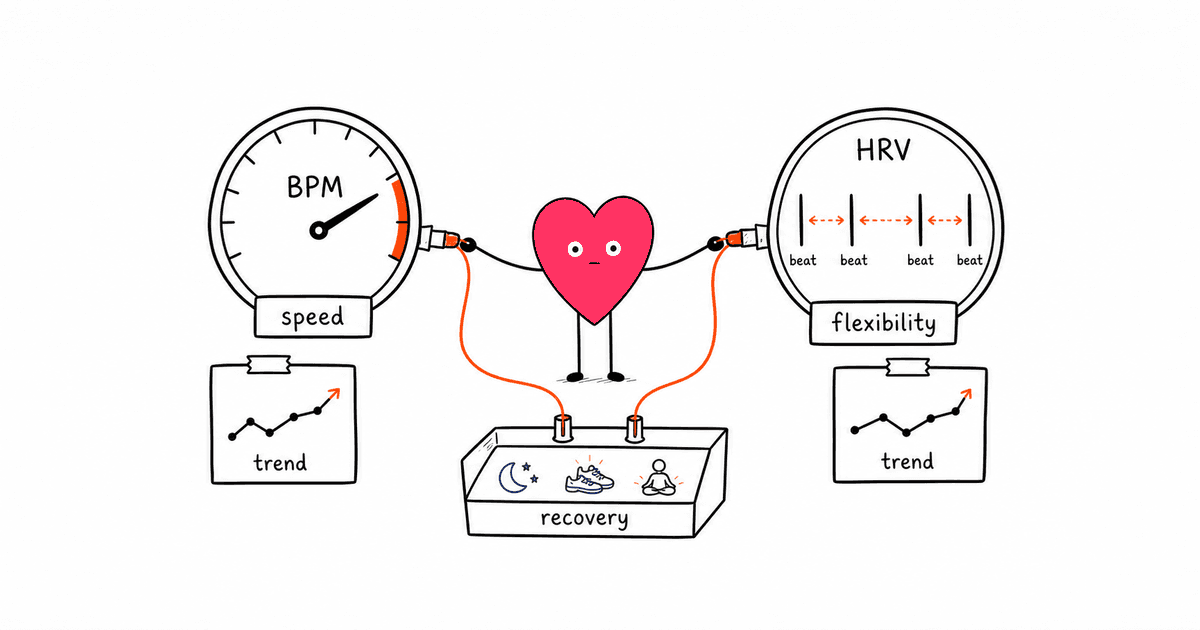
Resting heart rate tells you how fast your heart is beating at rest. HRV tells you how much time varies between beats. One is a simple speed metric. The other is a nervous system and recovery metric.
If you want the short version, use resting heart rate for broad trend watching and use HRV for a more sensitive view of recovery, stress, and adaptability.
| Metric | Main Question It Answers | Best Time Scale | Most Useful For |
|---|---|---|---|
| Resting heart rate | How hard is my cardiovascular system working at baseline? | Weeks to months | Fitness trends, illness flags, basic heart health context |
| HRV | How flexible is my autonomic nervous system right now? | Days to weeks | Recovery, training readiness, stress load |
What Is Resting Heart Rate?
Resting heart rate is the number of times your heart beats per minute when you are calm, awake, and not exerting yourself. In most adults, a normal resting heart rate falls somewhere between 60 and 100 beats per minute, though trained athletes and very fit people are often lower.
Resting heart rate is simple, familiar, and clinically useful.
In general, a lower resting heart rate often reflects better aerobic fitness, higher stroke volume, or greater parasympathetic tone. But lower is not automatically better in every situation. Medications, genetics, thyroid issues, dehydration, illness, and conduction problems can all affect it. For example, beta blockers can lower resting heart rate and change how your HRV trend should be interpreted.
That is why resting heart rate works best as a trend, not a score to brag about.
What Is HRV?
Heart rate variability, or HRV, is the small variation in time between one heartbeat and the next, usually measured in milliseconds. Higher HRV generally reflects more flexible autonomic regulation and stronger parasympathetic influence, while lower HRV often shows up with fatigue, stress, illness, poor sleep, or heavy training.
HRV is not the same as an irregular heartbeat. It is a normal feature of a healthy nervous system.
Unlike resting heart rate, HRV can shift fast. A rough night of sleep, alcohol, hard training, travel, illness, or emotional stress can move it noticeably by the next morning. If you are new to the metric, start with our guides on what HRV is and how to interpret HRV numbers.
Resting Heart Rate vs. HRV: The Core Difference
The cleanest way to think about it is this:
- Resting heart rate is a speed metric
- HRV is a flexibility metric
A lower resting heart rate often means your heart can pump more blood with each beat, so it does not need to beat as often at rest.
A higher HRV often means your autonomic nervous system can shift more fluidly between demand and recovery.
These can move together, but they are not interchangeable.
You can have a low resting heart rate and still wake up with suppressed HRV after poor sleep, high stress, illness, or a brutal training block. You can also have a decent HRV without having elite aerobic fitness.
How Resting Heart Rate and HRV Are Connected
Resting heart rate and HRV are linked through the autonomic nervous system.
When parasympathetic activity is stronger, your heart usually beats more slowly and the spacing between beats tends to become more variable. When sympathetic drive is higher, heart rate tends to rise and beat-to-beat variability often narrows.
There is also a mathematical twist. A 2014 review in Annals of Noninvasive Electrocardiology explained that HRV is influenced not only by autonomic regulation but also by the nonlinear relationship between heart rate and RR intervals. In plain English, slower average heart rates can mechanically allow more room for beat-to-beat variation.
That matters because a high HRV is not always telling you exactly the same thing as a low resting heart rate. They overlap, but each still adds information the other can miss.
What Resting Heart Rate Is Better At
Resting heart rate is useful because it is stable, easy to understand, and relatively easy to measure well.
It is especially helpful for:
- Tracking medium-term changes in aerobic fitness
- Noticing when illness or accumulated fatigue may be pushing baseline strain upward
- Giving context to training adaptations over weeks and months
- Providing a basic cardiovascular vital sign that clinicians already understand
If your resting heart rate rises 5 to 10 beats above your usual baseline for several days, that can be a useful yellow flag. It does not tell you exactly why something is off, but it tells you to pay attention.
What HRV Is Better At
HRV is the more sensitive metric.
It is especially helpful for:
- Detecting changes in recovery before resting heart rate noticeably shifts
- Showing how sleep, stress, alcohol, and travel affect your physiology
- Guiding day-to-day training decisions
- Revealing whether your nervous system looks resilient or overloaded
That sensitivity is why athletes and recovery-focused wearable users get so interested in HRV. It often reacts faster than resting heart rate.
The downside is that HRV is also noisier. Measurement timing, device algorithm, breathing pattern, posture, illness, and even how restless you slept can all change the number.
Which Metric Matters More for Long-Term Heart Health?
Both matter, but they are useful in different ways.
A 2016 meta-analysis in CMAJ pooled 46 prospective studies and found that every 10 beat per minute increase in resting heart rate was associated with a 9% higher risk of all-cause mortality and an 8% higher risk of cardiovascular mortality. People with resting heart rates above 80 beats per minute had substantially higher risk than those in the lowest categories.
That does not mean a resting heart rate of 81 is a diagnosis. It means resting heart rate is a real population-level signal, not just gym trivia.
HRV also has meaningful long-term relevance. A 2022 systematic review and meta-analysis in Neuroscience & Biobehavioral Reviews included 38,008 participants and found that lower HRV values predicted higher mortality across different ages, sexes, and populations. In a five-minute RMSSD analysis, the lowest quartile was associated with a 56% higher mortality risk compared with the other quartiles.
So which metric wins?
For simplicity and clinical familiarity, resting heart rate has the edge.
For richer information about autonomic health and recovery capacity, HRV has the edge.
For overall cardiovascular risk reduction, cardiorespiratory fitness, blood pressure, smoking status, body composition, sleep, stress, and exercise habits still matter more than obsessing over either number in isolation.
Which Metric Matters More for Day-to-Day Recovery?
HRV, easily.
If your goal is to decide whether today should be a hard training day, an easy day, or a rest day, HRV usually gives you more actionable information than resting heart rate alone.
Resting heart rate can help confirm the picture, especially if it is trending upward at the same time. But HRV is usually the earlier mover.
That is one reason HRV is central to Whoop, Oura Ring, and training platforms that focus on readiness.
How to Read Common Resting Heart Rate and HRV Patterns
High resting heart rate plus low HRV
This is the classic “something is off” pattern.
Common reasons include:
- Poor sleep or sleep deprivation
- Alcohol intake the night before
- Illness or brewing infection
- Heavy training load
- Travel fatigue
- High psychological stress
- Dehydration
If this pattern lasts several days, it is usually smart to reduce training intensity and look at recovery habits first.
Normal resting heart rate plus falling HRV
This often shows up before your resting heart rate reacts.
It can mean your body is under strain, but not yet enough to change your baseline heart rate. This is one reason HRV is helpful as an early warning signal.
Low resting heart rate plus low HRV
This can confuse people.
A low resting heart rate by itself can look “fit,” but if HRV is suppressed relative to your normal baseline, the full picture may be less impressive. You might still be carrying fatigue, stress, or under-recovered from training.
This is why a low resting heart rate is not a free pass.
Low resting heart rate plus high HRV
This is often a good pattern, especially if it is normal for you.
It may suggest strong aerobic fitness, good recovery, and healthy autonomic flexibility. Still, do not compare your numbers with someone else’s. Personal baseline matters far more than leaderboard thinking.
Which Metric Should You Trust When They Disagree?
Do not force one metric to win every argument.
Use this rule instead:
- For short-term recovery decisions: lean more on HRV
- For medium-term fitness trend watching: lean more on resting heart rate
- When both worsen together: take the signal seriously
- When both improve over time: your habits are probably moving in the right direction
If you need another tie-breaker, add heart rate recovery, sleep quality, training performance, mood, and how you actually feel.
A Practical Framework for Using Both Metrics
1. Measure under consistent conditions
Overnight data from a wearable is usually the easiest approach. If you take manual morning readings, do it at the same time, in the same position, before caffeine.
2. Compare against your own baseline
Do not compare your HRV with a friend, a pro athlete, or a random chart on social media.
Resting heart rate is somewhat easier to compare across people, but even then, age, sex, medication use, genetics, and training history matter.
3. Watch trends, not one-off readings
One weird night means very little.
Three to seven days of suppressed HRV, rising resting heart rate, poor sleep, and worse workout performance is a much stronger signal.
4. Match the metric to the decision
- Should you push hard today? HRV matters more
- Is your aerobic fitness improving over months? Resting heart rate matters more
- Did last night’s habits affect recovery? HRV matters more
- Is your baseline physiological strain drifting higher? Resting heart rate matters more
5. Use context from training and lifestyle
The numbers make more sense when you view them alongside Zone 2 training, walking, running, workload, alcohol, stress, and sleep.
Metrics without context are how people end up spiraling over perfectly normal fluctuations.
How to Improve Resting Heart Rate and HRV at the Same Time
The nice part is that many of the same habits support both.
Build aerobic fitness
Regular aerobic training often lowers resting heart rate over time and improves autonomic regulation.
Brisk walking, cycling, running, rowing, and Zone 2 work are especially useful here.
Recover well enough to absorb training
Hard training can temporarily suppress HRV. That is normal. The goal is not to avoid all dips. The goal is to recover from them.
If HRV keeps falling and resting heart rate keeps creeping up, more intensity is probably not the answer.
Protect sleep
Sleep is one of the fastest ways to improve the signal from both metrics.
A few nights of short or fragmented sleep can suppress HRV and raise resting heart rate quickly. If your numbers are drifting the wrong way, sleep quality is one of the first things to audit.
Manage alcohol and life stress
Alcohol, work stress, anxiety, and travel can push resting heart rate up and HRV down. These are not side issues. They are part of the physiology.
That is why stress management, meditation, breathing exercises, and reducing alcohol can have measurable effects.
Stay consistent with measurement
You do not need perfect data. You need comparable data.
A pretty good reading taken the same way every day beats a “perfect” reading taken under random conditions.
Best Devices for Tracking Resting Heart Rate and HRV
If you want to track both metrics well, the best choice depends on how you live.
- Garmin is one of the strongest all-around options for people who want training data, resting heart rate trends, and ongoing HRV status in one ecosystem.
- Apple Watch is a solid choice if you want broad health tracking, notifications, and reliable resting heart rate trends, though HRV interpretation often benefits from third-party apps.
- Oura Ring is excellent for overnight trends, sleep context, and passive recovery tracking.
- Whoop is built around recovery, strain, and readiness, with HRV and resting heart rate as core signals.
- Polar remains a strong pick for heart rate accuracy and structured training use.
For workouts or spot checks where heart rate accuracy matters most, a Garmin HRM-600 chest strap can provide cleaner heart rate data than wrist sensors alone.
One more important caveat: do not compare HRV across brands too casually. Devices may use different collection windows, algorithms, and underlying HRV metrics.
Common Mistakes People Make
Mistake 1: Treating resting heart rate as a score to drive as low as possible
A lower resting heart rate is often good. Chasing the lowest possible number is not.
Extremely low resting heart rate, especially with symptoms like dizziness, fatigue, or fainting, deserves medical attention.
Mistake 2: Treating HRV as a competition
Higher is not always better in every moment, and a temporary drop after hard training is not a failure.
The real question is whether your HRV is behaving normally for you.
Mistake 3: Overreacting to one morning of weird data
A single bad reading can come from restless sleep, a late meal, alcohol, allergies, or measurement noise.
Look for patterns, not drama.
Mistake 4: Ignoring symptoms because your wearable looks fine
No metric overrides chest pain, palpitations, dizziness, unusual shortness of breath, or persistent fatigue. If something feels wrong, talk to a clinician.
The Bottom Line
Resting heart rate and HRV are related, but they answer different questions.
Resting heart rate tells you how fast your heart is beating at baseline. HRV tells you how flexible and responsive your autonomic nervous system appears to be.
If you want a simple, stable long-term trend, resting heart rate is excellent.
If you want a more sensitive window into recovery, stress, and adaptability, HRV is more useful.
For most people, the smartest move is not choosing one over the other.
It is using resting heart rate to understand the broader trend, using HRV to manage the day-to-day picture, and interpreting both in the context of sleep, stress, training, and overall health.
Frequently Asked Questions
Is resting heart rate better than HRV?
Not across the board. Resting heart rate is simpler and more stable, which makes it useful for long-term tracking. HRV is more sensitive and often more useful for day-to-day recovery decisions.
Can HRV drop while resting heart rate stays normal?
Yes. That happens all the time. HRV often reacts faster to stress, poor sleep, alcohol, and heavy training than resting heart rate does.
What is more important for athletes, resting heart rate or HRV?
Both matter, but HRV is often more actionable for daily training decisions. Resting heart rate is still useful for watching longer-term adaptation and spotting unusual strain or illness.
Is a low resting heart rate always a sign of good health?
No. It can reflect strong fitness, but it can also be influenced by medication, genetics, or medical issues. Symptoms always matter more than the number alone.
Can wearables measure resting heart rate and HRV accurately?
For trend tracking, many wearables do a solid job, especially when you wear them consistently overnight. For medical decision-making or the most accurate exercise heart rate data, clinical testing and chest strap monitoring are still the higher standard.
Need a quick read on your HRV number first?
Enter your HRV value, age range, device, and recovery context for a plain-English interpretation before you decide what to do next.
Interpret Your HRV NumberBuild the 30-day plan