Beta Blockers and HRV: What Metoprolol and Propranolol Do to Heart Rate Variability
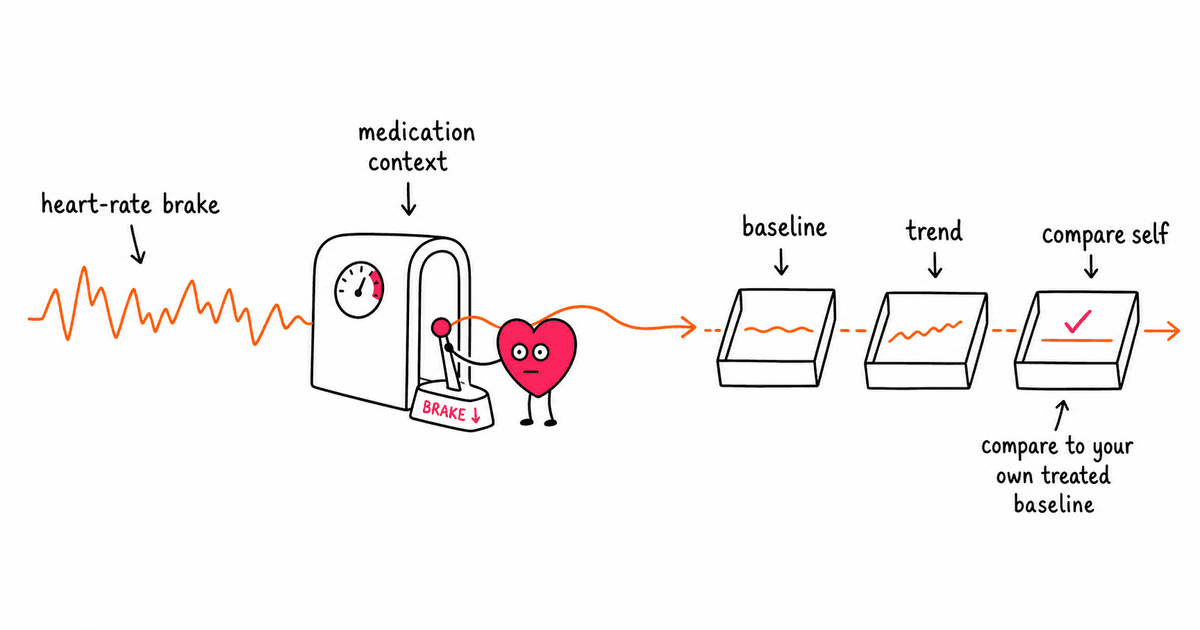
If you started a beta blocker and your wearable suddenly shows a lower resting heart rate, a higher HRV, or a totally different recovery pattern, the shift may be real, but it does not always mean your fitness changed overnight.
That is what makes beta blockers tricky in the HRV world. They can improve important cardiovascular outcomes in the right patients, while also changing the raw signals that wearables use to estimate recovery and autonomic balance.
The result is a number that may look better, worse, or just unfamiliar, depending on the medication, the dose, the reason you take it, and the device you use.
Does Taking Beta Blockers Affect HRV?
Yes, beta blockers can change HRV, often by slowing heart rate and altering how strongly your body responds to adrenaline. In many studies, beta blockers are linked to higher HRV markers such as RMSSD and SDNN, or high-frequency power, especially in cardiac patients. But that does not automatically mean your nervous system is healthier in every practical sense, or that your wearable score should be read as a simple win.
That distinction matters because heart rate variability is a useful biomarker, not a standalone verdict on your health.
What Beta Blockers Do to Your Nervous System
Beta blockers reduce the effect of stress hormones such as epinephrine and norepinephrine on the heart.
That usually means a slower heart rate, less forceful contraction, and a blunted response to physical or emotional stress. Clinically, that can be exactly the point. Beta blockers are commonly used for high blood pressure, certain arrhythmias, coronary artery disease and heart failure, migraine prevention, tremor, and performance anxiety.
They slow heart rate
This is the change most people notice first.
If your medication lowers your resting heart rate, the spacing between beats becomes longer. Since HRV reflects variation between beats, that shift alone can change the numbers your device reports. This is one reason resting heart rate and HRV often move in opposite directions.
They blunt sympathetic drive
Beta blockers also dampen some of the fight-or-flight response.
In theory, that can tilt your physiology away from excessive sympathetic activation and toward a calmer autonomic profile. In real life, the effect is not always clean because underlying disease, fitness, sleep, stress, and dose timing still matter.
They can change HRV without changing fitness
This is the part wearable users need to understand.
A medication can make HRV metrics look different without changing your aerobic capacity, recovery habits, or underlying resilience very much. So if your overnight HRV rises after starting metoprolol, that does not necessarily mean you suddenly became fitter or more recovered.
It may mean the drug changed the signal your wearable is measuring.
What the Research Actually Shows
The best available evidence suggests beta blockers often increase common HRV markers, especially in people with cardiovascular disease.
Older trials found higher HRV markers
A 1994 randomized crossover trial in the Journal of the American College of Cardiology studied men with stable coronary artery disease taking metoprolol, atenolol, or placebo. Compared with placebo, beta blockade significantly increased several HRV measures, including high-frequency power, RMSSD, and SDNN.
That matters because lower HRV is common in coronary disease, and the increase suggested better autonomic modulation, at least on the ECG metrics being measured.
Newer data points in the same direction
A 2023 study in Scientific Reports looked at people with heart failure with preserved ejection fraction and found that those taking beta blockers had higher RMSSD, pNN50, and high-frequency power during parts of the day, especially during higher-risk morning hours.
Again, that points toward improved parasympathetic tone on paper.
Why the evidence is still limited
There are two big caveats.
First, most of the research is in cardiac patients, not healthy people wearing Oura, Whoop, Garmin, or Apple Watch devices at home.
Second, HRV metrics can be influenced by the simple fact that beta blockers slow heart rate. That means the number may change partly because the physiology changed, and partly because the measurement context changed.
So the honest conclusion is this: beta blockers often raise traditional HRV markers, but the practical meaning of that change depends on the person and the reason for treatment.
How Common Beta Blockers May Affect Your Data
Not every beta blocker feels the same, and not every HRV trend will look the same.
Metoprolol
Metoprolol is one of the most common cardioselective beta blockers.
If you take metoprolol, you may notice:
- a lower resting heart rate
- a smaller heart-rate response to exercise or stress
- a possible rise in overnight HRV
- recovery scores that look better than they did before treatment
That does not mean the data is useless. It means your baseline changed.
Propranolol
Propranolol is nonselective and is often used for performance anxiety, tremor, migraine prevention, and some cardiovascular indications.
Because some people take propranolol only in certain situations, the effect on HRV can be less stable from day to day. If you use it before presentations, flights, or anxiety-provoking events, your wearable trend may reflect dose timing as much as overall recovery.
Atenolol and others
Atenolol, bisoprolol, carvedilol, and nebivolol can all shift heart rate and autonomic tone, but the exact effect depends on receptor selectivity, dose, timing, and your underlying condition.
The practical takeaway is simple: do not compare your HRV on one beta blocker to someone else's HRV on a different one.
What You May Notice on Your Wearable
Most people do not start with a Holter monitor and a cardiologist's interpretation. They start with a ring, watch, strap, or recovery app.
Lower resting heart rate
This is common and usually expected.
If your resting heart rate falls after starting a beta blocker, that fits the medication's basic mechanism. It may also make your wearable recovery profile look calmer than before.
Higher overnight HRV
Some people see this within days or weeks.
If your device emphasizes overnight RMSSD or other parasympathetic-leaning metrics, beta blockers may push the trend up. That can be reassuring, but it should be interpreted in context.
Lower exercise heart rate
This is where people get tripped up.
Beta blockers can make your usual training heart-rate zones feel wrong because your heart rate may not climb as high during exercise, and they can make heart rate recovery harder to interpret. That is one reason strict zone targets can become less useful after starting these medications. If you train regularly, pair HRV with pace, power, breathing, and perceived effort rather than chasing the same numbers you used before.
Recovery scores that reset after dose changes
A dose increase can shift your baseline again.
If your clinician raises the dose, expect your resting heart rate, exercise response, and recovery metrics to potentially move together. That is not necessarily a red flag. It often means your old baseline no longer applies.
How to Use HRV Wisely on Beta Blockers
HRV can still be useful while taking beta blockers. You just need to use it differently.
Build a new baseline
Do not compare your current numbers to your pre-medication numbers forever.
Once the dose is stable, give yourself a few weeks and treat that period as your new normal. The more useful question is not "Is my HRV higher than before beta blockers?" It is "What does my HRV do relative to my current baseline when I am stressed, sick, sleep deprived, or training hard?"
Use symptoms and blood pressure too
If your HRV looks great but you feel dizzy, faint, unusually fatigued, or exercise-intolerant, the wearable is not the whole story.
Pair the number with symptoms, blood pressure, resting heart rate, sleep quality, and how you actually feel.
Use effort, pace, and power for exercise
This is especially important for athletes and active adults.
If beta blockers blunt your heart-rate response, your old zone 2 training targets may no longer fit. Rate of perceived exertion, pace, power output, breathing pattern, and talk test cues often become more valuable.
Do not chase a higher HRV number
This is a classic trap.
If beta blockers raise your HRV, that does not mean you should interpret every higher score as better recovery, better fitness, or lower cardiovascular risk. Medication-driven improvement in a metric is not the same thing as improved physiology across the board.
When to Talk With Your Clinician
A changing HRV trend alone is usually not a reason to panic. Symptoms matter more.
Talk with your clinician if you notice:
- dizziness or near-fainting
- unusual shortness of breath
- worsening exercise tolerance
- chest discomfort or new palpitations
- a resting heart rate that feels too low for you
- fatigue that is getting worse instead of better
Do not stop a prescribed beta blocker just because a wearable number changed. Medication decisions should be made with the clinician who prescribed it.
Are Beta Blockers Good or Bad for HRV?
Neither label is quite right.
Beta blockers may be good for HRV if the question is, "Do they often raise common HRV markers?" In many patients, yes.
Beta blockers may be misleading for HRV if the question is, "Does a higher score now mean I am automatically fitter, healthier, or more recovered?" Not necessarily.
They can also be clearly beneficial overall even if your wearable becomes harder to interpret. That is especially true in people using beta blockers for heart disease, arrhythmias, or blood pressure control, where the real goal is clinical protection, not a prettier dashboard.
The Bottom Line
Beta blockers can increase HRV, lower resting heart rate, and make recovery data look different, sometimes quickly. That does not make HRV useless, but it does change how you should read it.
The smartest approach is to build a new baseline after your dose stabilizes, compare against your own current trend, and use symptoms, sleep, blood pressure, and exercise tolerance as context. If your wearable says you are thriving but your body says otherwise, trust the fuller picture.
Frequently Asked Questions
Do beta blockers increase HRV?
Often, yes. Studies in cardiac patients have found increases in HRV markers such as RMSSD, SDNN, and high-frequency power after beta-blocker treatment. But the increase does not always translate into better day-to-day fitness or recovery in the way wearable users might assume.
Why did my HRV go up after starting metoprolol?
Metoprolol can slow heart rate and alter autonomic signaling. That combination may push overnight HRV higher, especially on wearables that rely heavily on parasympathetic-leaning metrics.
Can you still use Whoop or Oura on beta blockers?
Yes. The data can still be useful, but you should compare it to your post-medication baseline, not your old one. Trends still matter, especially when you are sick, stressed, under-recovered, or changing dose.
Do beta blockers make zone 2 heart rate targets useless?
Not useless, but often less reliable. Because beta blockers can blunt exercise heart rate, many people need to lean more on pace, power, breathing, or talk test cues instead of older heart-rate targets.
Is propranolol bad for HRV?
Not necessarily. Propranolol may raise some HRV markers just like other beta blockers. The main challenge is interpretation, especially if you take it situationally rather than every day, because timing can make your trend noisier.
Need a quick read on your HRV number first?
Enter your HRV value, age range, device, and recovery context for a plain-English interpretation before you decide what to do next.
Interpret Your HRV NumberBuild the 30-day plan