Migraine and HRV: Can Heart Rate Variability Help Predict Attacks?
Trying to decode today's HRV number? Use the free interpreter first, then build a practical recovery plan. Interpret your HRV
If you get migraines, you already know the hard part is not just the pain. It is the unpredictability. Some days you feel normal, then a shift in sleep, stress, hormones, or routine seems to tip your nervous system over the edge.
That is why interest in heart rate variability keeps growing in the migraine world. HRV cannot diagnose migraine, and it cannot replace a neurologist or headache specialist. But it can give you a usable signal about how stressed, recovered, or dysregulated your autonomic nervous system may be before and after an attack.
Can HRV Help Predict a Migraine?
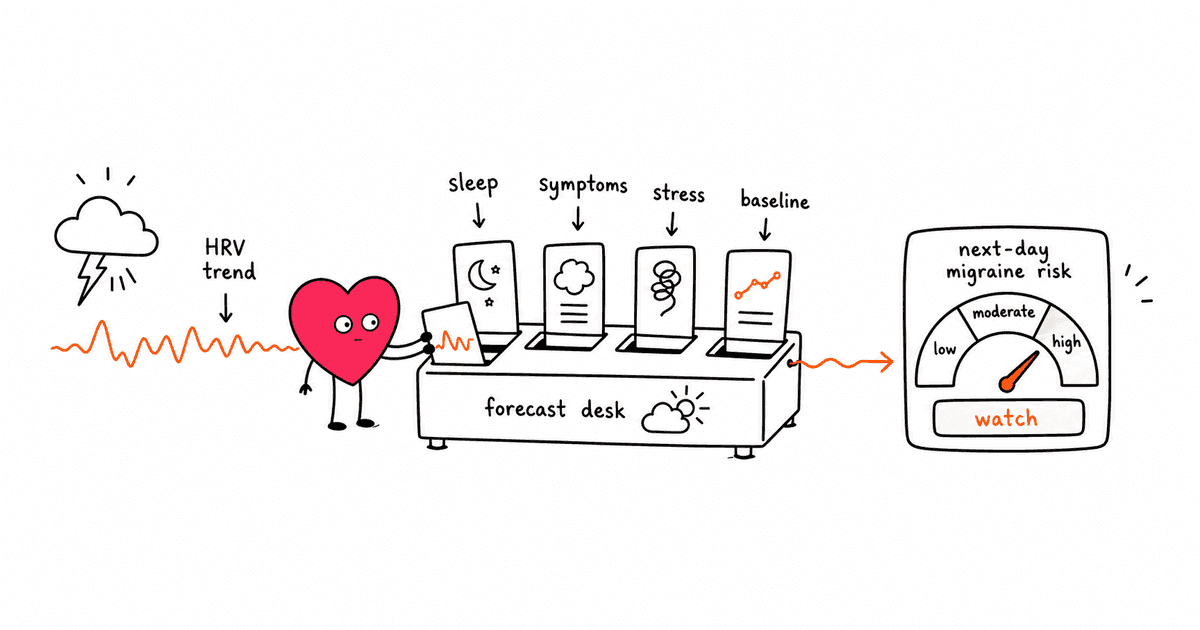
Yes, HRV can sometimes help predict a migraine, but only as part of a broader pattern, not as a standalone alarm. Research suggests autonomic changes often show up before or during migraine attacks, and newer wearable studies suggest overnight HRV-related signals may help forecast next-day risk in some people. The catch is that HRV is noisy, highly individual, and easily influenced by sleep, alcohol, illness, training load, and stress. The same caution applies to HRV and seizures: autonomic signals can be useful, but they are not reliable stand-alone alarms.
Why Migraines Affect HRV
Migraine is not just a bad headache. It is a neurological disorder that involves the brain, blood vessels, sensory processing, inflammation, and the autonomic nervous system. HRV matters here because HRV reflects how flexibly your body shifts between sympathetic activation and parasympathetic recovery.
When a migraine is building, your nervous system often becomes less adaptable. That can show up as lower vagal tone, higher resting heart rate, poorer sleep quality, and a drop in overnight HRV.
Sympathetic activation often rises
Many people feel wired, restless, nauseated, or unusually sensitive before a migraine. Those changes fit with a system that is leaning harder on sympathetic output, the same fight-or-flight side that tends to push HRV down.
Parasympathetic recovery can weaken
Parasympathetic activity helps with recovery, digestion, relaxation, and sleep quality. When that recovery side is suppressed, HRV often falls. That is one reason migraine attacks are so commonly linked with disrupted sleep, poor stress tolerance, and slower next-day recovery.
Triggers stack on the same system
Common migraine triggers like sleep disruption, stress, alcohol, caffeine changes, dehydration, skipped meals, and hormonal shifts also affect HRV. In practice, that means HRV may reflect both the migraine process and the trigger load pushing you toward it.
What the Research Actually Shows
The research is promising, but it is not clean enough to justify overconfident claims. That nuance matters.
HRV usually drops during the attack itself
A 2021 cross-sectional study in Frontiers in Neurology compared 18 people with episodic migraine against 18 matched controls and found the clearest HRV differences during the migraine attack itself. In the ictal phase, 24-hour SDNN was far lower in the migraine group than in controls, 56.94 ms vs 135.78 ms, and low-frequency power was also lower. The same study found pain intensity was negatively correlated with HRV measures, meaning worse migraine pain was associated with lower HRV. That is useful because it supports the basic idea that migraine attacks come with measurable autonomic disruption. It also suggests HRV is more informative around attacks than as a static personality trait.
Between attacks, the picture is mixed
That same 2021 study did not find a significant difference between episodic migraine patients and controls during the interictal period, the window between attacks. In plain English, HRV may look fairly normal on some migraine-free days, especially in episodic migraine.
Chronic migraine looks different. A 2023 study in Cephalalgia compared 81 preventive-naive chronic migraine patients with 58 healthy controls and found reduced HRV in the chronic migraine group, consistent with ongoing autonomic dysfunction. Patients with more preserved HRV also had a better response to 12 weeks of preventive treatment, with a larger drop in monthly headache days.
The practical takeaway is simple: if you have frequent migraines, your HRV baseline may stay suppressed more often. If your migraines are occasional, the clearest signal may appear before, during, or right after attacks rather than every single day.
Wearables may help with next-day prediction
A 2025 wearable study followed 10 adults with episodic or chronic migraine using an overnight smartwatch that captured pulse rate variability, electrodermal activity, respiratory rate, and sleep metrics. Group-level trends were not strong enough to cleanly separate migraine days from non-migraine days, but individualized models did better.
For next-day migraine prediction, 5 of 10 participants had better-than-random performance, and the best-performing model reached an AUROC of 0.68. For next-day headache prediction more broadly, the strongest model reached 0.81. Sleep duration, minimum pulse rate variability, and electrodermal activity were among the most influential features. That is not good enough to treat a wearable like a crystal ball. It is good enough to say this field is getting interesting, especially for people willing to track their own data carefully.
HRV biofeedback may help some people, but adherence matters
A 2021 randomized controlled trial tested an 8-week app-based HRV biofeedback program in 52 people with migraine. Overall quality-of-life improvements were not significantly different from the waitlist control group. But higher users of the biofeedback system did show better migraine-specific quality-of-life improvement than low users.
That is a familiar pattern in migraine care. Tools that improve breathing control, autonomic regulation, and stress reactivity can help, but only if they are used consistently enough to matter.
How HRV May Change Before, During, and After a Migraine
Your own data may not follow this pattern exactly, but this is the most useful framework.
Before a migraine
Some people notice a subtle drop in overnight HRV 12 to 48 hours before an attack. Others see a rising resting heart rate, shorter sleep, or more nighttime awakenings before the pain starts.
This is where HRV can be genuinely useful. Not because it tells you with certainty that a migraine is coming, but because it can flag that your system is under more strain than usual.
During a migraine
During the attack, HRV often drops more clearly. Pain, nausea, stress, sleep disruption, reduced food intake, and reduced movement all feed into the same autonomic picture.
If you only look at HRV during the attack, the interpretation is usually straightforward: your body is under stress. The more important question is what happened before that drop.
After a migraine
Recovery patterns matter. Some people rebound quickly after sleep, hydration, and food. Others stay suppressed for a day or two, especially after severe migraine, vomiting, medication side effects, or poor sleep.
If your HRV stays low after the headache resolves, it may suggest your nervous system is still recovering, even if the worst symptoms have passed.
How to Track Migraine With HRV Without Fooling Yourself
A lot of people get excited about wearables and then make bad decisions from random data. The fix is boring but effective.
Use overnight data first
Overnight HRV is usually more reliable than daytime spot checks because it is less distorted by meetings, exercise, caffeine, meals, and posture changes. Devices like the Oura Ring 4, Whoop 5, and Apple Watch Series 11 are most useful when you focus on sleep-based trends rather than scattered daytime readings.
Track symptoms alongside the numbers
Your HRV app is not enough. Keep a migraine log with:
- Headache timing
- Aura or prodrome symptoms
- Sleep duration and sleep quality
- Menstrual cycle timing, if relevant
- Alcohol, caffeine, and meal irregularity
- Exercise load
- Stress level
- Medications used
Patterns get much clearer when HRV is tied to context instead of treated like a score you pass or fail.
Focus on trends, not one bad morning
One low reading means almost nothing. What matters is whether your HRV is running below your baseline for several days, whether it tends to drop before attacks, and how fast it recovers after them.
A rolling 7-day trend is usually more useful than obsessing over a single number in the app.
Compare HRV with resting heart rate and sleep
Migraine tracking gets more useful when you combine signals. A lower HRV plus a higher resting heart rate plus shorter sleep is a much stronger warning pattern than low HRV by itself.
Review your baseline every few weeks
Your baseline can shift with season, training, stress, illness, or changing migraine frequency. Revisit your averages regularly so you are comparing against your current reality, not an old version of it.
Best Wearables for Migraine-Related HRV Tracking
The right wearable will not diagnose migraine, but it can make pattern detection easier.
Oura Ring 4 for sleep-first pattern tracking
The Oura Ring 4 is strong if you care most about overnight HRV, resting heart rate, temperature trends, and sleep regularity. It is especially useful for people whose migraines are tightly linked to sleep disruption, travel, or hormonal shifts.
Whoop 5 for recovery and behavior patterns
Whoop 5 is good for people who want a stronger recovery dashboard and more behavior tracking around strain, sleep debt, and lifestyle inputs. It is not a migraine device, but it is useful for spotting the kind of stacked stress load that often precedes attacks.
Apple Watch Series 11 for broad daily context
The Apple Watch Series 11 gives you HRV, resting heart rate, sleep, activity, and app ecosystem flexibility in one place. If you want migraine logging, calendar context, medication reminders, and smartwatch features without adding another subscription, it is the most flexible mainstream option.
If you want a broader device breakdown, see the best HRV monitors for 2026, the Apple Watch HRV guide, Whoop 5 review, and Oura Ring 4 review.
What Else to Track Besides HRV
HRV is useful, but migraine patterns get clearer when you pair it with other metrics.
Resting heart rate
If HRV drops while resting heart rate rises, that usually means recovery is getting worse, not better.
Sleep duration and consistency
Even one short night can change HRV. Repeated sleep disruption can make migraine frequency worse over time, especially if your circadian rhythm is already unstable.
Menstrual cycle timing
For some women, migraine risk clusters around hormonal shifts. If that applies to you, tracking your menstrual cycle and HRV can be more useful than staring at HRV alone.
Training load and exercise tolerance
A hard workout can lower HRV even when it was good for you overall. This is why context matters. If you are training hard, compare migraine risk with both HRV and recent exertion, not HRV in isolation.
Nutrition and hydration consistency
Skipped meals, underfueling, and dehydration can all drag HRV down and make migraines more likely. If you already know blood sugar swings are a trigger, it helps to watch blood sugar and HRV patterns together.
What Can Lower Your HRV Besides a Migraine
This is the part people miss most often. Low HRV does not automatically mean a migraine is coming.
Poor sleep
Even one rough night can pull HRV down the next morning.
Alcohol
Alcohol reliably lowers HRV and also triggers migraines in some people, which makes it an easy confounder.
Illness or inflammation
If you are fighting off a virus, allergies, or some other inflammatory stressor, HRV may fall before you ever feel obvious symptoms.
Heavy training or travel
Travel and jet lag, intense training, and routine disruption can all create the same low-HRV signal you might otherwise blame on migraine prodrome.
High psychological stress
Mental load counts. Work stress, family stress, and poor emotional recovery can all suppress HRV even without any headache at all.
Practical Ways to Use HRV to Reduce Migraine Burden
HRV is most useful when it changes what you do.
Protect sleep when HRV drops
If your HRV is down and migraine risk feels higher, protect the next night of sleep aggressively. That usually means a consistent bedtime, less light exposure late at night, and less temptation to push through fatigue.
Reduce avoidable trigger load
On low-HRV days, it may help to keep meals regular, stay hydrated, limit alcohol, avoid stacking hard exercise with poor sleep, and manage caffeine carefully instead of making abrupt changes.
Scale training instead of forcing it
If you already use HRV for recovery, migraine-prone days are a good time to shift from intense effort to easier movement. That might mean walking, mobility work, or shorter zone 2 instead of high intensity intervals.
Use breathing or biofeedback as a recovery tool
HRV biofeedback training, slow breathing, and other down-regulation practices are not magic. They are useful because they directly target autonomic balance. That makes them a sensible option when your metrics and symptoms both suggest you are trending in the wrong direction.
Bring the data to your clinician
If you notice that HRV consistently drops before attacks, bring that pattern to a headache specialist. It will not replace diagnosis, but it can improve the conversation around triggers, timing, prevention, and treatment response.
When to Talk to a Clinician
HRV is a tracking tool, not a substitute for medical evaluation. Get medical advice if:
- Your headaches are new, rapidly worsening, or changing in pattern
- You get neurological symptoms you have not had before
- Migraine attacks are becoming more frequent or harder to control
- You have fainting, chest pain, or sustained palpitations along with low HRV
- Your symptoms are disrupting work, sleep, or basic daily function
A good clinician can help you separate migraine from other issues that may also affect HRV, including medication effects, dysautonomia, sleep disorders, or cardiovascular problems.
FAQ
Is low HRV a sign a migraine is coming?
Sometimes, but not reliably enough on its own. Low HRV is better treated as a warning that your system is under strain, not proof that a migraine is inevitable.
Can Oura or Whoop detect migraines?
Not directly. They can track patterns in HRV, resting heart rate, sleep, and recovery that may cluster around your attacks, but they are not diagnostic tools.
Should you cancel exercise if HRV drops before a migraine?
Not always. The better move is usually to adjust intensity. Easy movement may still help, while hard training on a low-sleep, low-HRV day may backfire.
The Bottom Line
Migraine and HRV are connected through the autonomic nervous system, and that connection is real enough to be useful. HRV can help you spot rising stress load, notice pre-attack patterns, and understand whether you are actually recovering after a migraine.
What HRV cannot do is diagnose migraine, predict every attack, or replace clinical care. The smart use case is narrower than that: use HRV as a pattern-tracking tool, combine it with sleep and symptom data, and make calmer, better-timed decisions when your nervous system starts to drift off course.
Need a quick read on your HRV number first?
Enter your HRV value, age range, device, and recovery context for a plain-English interpretation before you decide what to do next.
Interpret Your HRV NumberBuild the 30-day plan