Circadian Rhythm and HRV: How Your Body Clock Shapes Heart Rate Variability
Trying to decode today's HRV number? Use the free interpreter first, then build a practical recovery plan. Interpret your HRV
If you track your HRV, you have probably noticed your readings fluctuate throughout the day. A morning measurement might look completely different from an evening one. This is not random noise. It is your circadian rhythm at work.
Your body's internal clock governs far more than when you feel sleepy. It orchestrates hormonal cycles, body temperature, blood pressure, and, critically, the autonomic nervous system that controls your heart rate variability.
What Is the Circadian Rhythm?
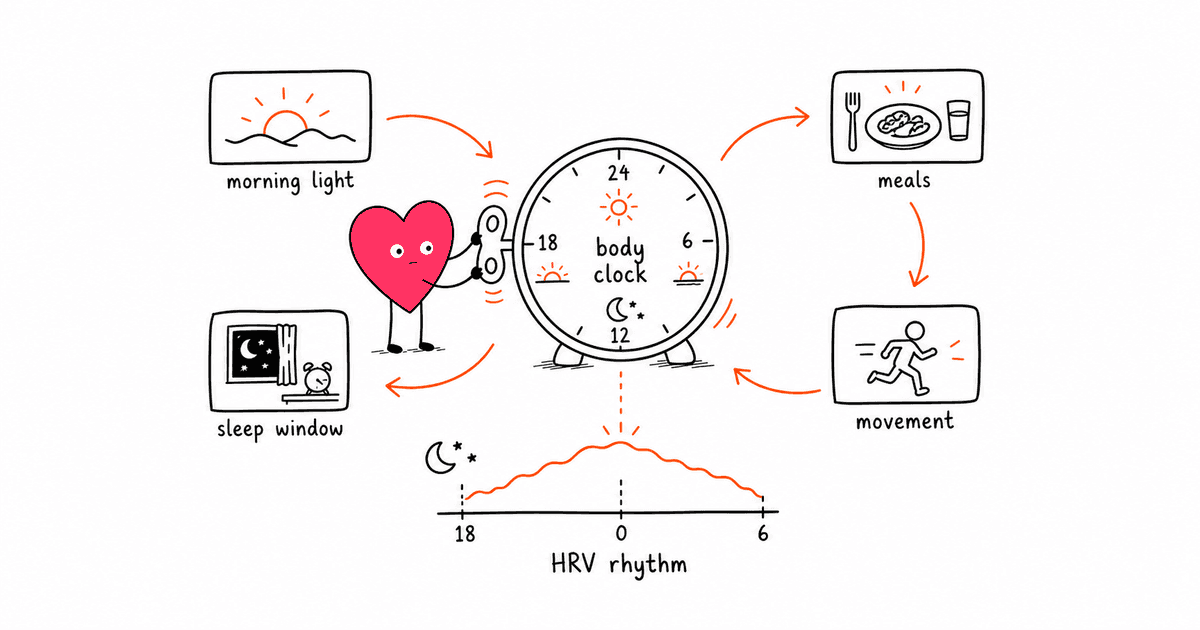
The circadian rhythm is your body's internal 24-hour clock that regulates sleep-wake cycles, hormone release, body temperature, and autonomic nervous system activity. It is primarily controlled by the suprachiasmatic nucleus (SCN) in the hypothalamus, which responds to light and dark signals from the environment.
This master clock synchronizes nearly every biological process in your body, from cortisol release in the morning to melatonin production at night.
How Your Circadian Rhythm Controls HRV
Your autonomic nervous system has two branches: the sympathetic ("fight or flight") and parasympathetic ("rest and digest") systems. Your circadian rhythm shifts the balance between these branches in a predictable pattern throughout each 24-hour cycle.
Research published in Frontiers in Physiology (2025) confirmed that all HRV features exhibit both 12-hour and 24-hour circadian rhythms, with consistent patterns across different days for each individual.
Here is what a typical day looks like for your autonomic nervous system:
Morning (6 AM to 12 PM)
Cortisol peaks shortly after waking, and sympathetic nervous system activity ramps up. HRV tends to be lower during the morning as your body shifts into an alert, active state. This is also when cardiovascular events are statistically most common, partly due to this sympathetic surge.
Afternoon (12 PM to 6 PM)
HRV often dips to its lowest point in the early afternoon. Research from Scientific Data (2025) found that SDNN, a key HRV metric, tends to decrease during this period. This aligns with the natural post-lunch dip in energy many people experience.
Evening (6 PM to 10 PM)
As your body begins winding down, parasympathetic activity increases and HRV typically starts to rise. This transition period is important for setting the stage for quality sleep. A short nap in the early afternoon can also help bridge the midday HRV dip if your schedule allows.
Night (10 PM to 6 AM)
HRV generally reaches its highest values during deep sleep, when parasympathetic activity dominates. This is why most wearables focus on overnight or morning HRV measurements for the most consistent and meaningful data.
Why Time of Day Matters for HRV Tracking
If you measure your HRV at random times throughout the day, you will get wildly inconsistent data. A reading taken during a stressful afternoon meeting is not comparable to one taken while relaxing before bed.
This is why consistency matters more than the specific time you measure. Pick one time and stick with it. Most experts recommend morning measurements (within five minutes of waking) because:
- Parasympathetic activity is still elevated from sleep
- You have not yet introduced variables like caffeine, exercise, or stress
- Morning readings show the strongest correlation with overall autonomic health. For a complete measurement guide, see our HRV beginner's guide
The Connection Between Light Exposure and HRV
Light is the most powerful signal for setting your circadian rhythm. Your retinas contain specialized cells (intrinsically photosensitive retinal ganglion cells) that detect light intensity and send timing signals to the SCN.
Morning Light
Getting bright light exposure within 30 to 60 minutes of waking helps anchor your circadian rhythm. This triggers cortisol release, suppresses melatonin, and sets the clock for when melatonin production will begin that evening. Research suggests that consistent morning light exposure improves sleep quality, which in turn supports higher nighttime HRV.
Evening Light
Blue light from screens and artificial lighting in the evening can delay melatonin production and shift your circadian rhythm later. This disruption has downstream effects on HRV, as delayed or fragmented sleep reduces the parasympathetic recovery window your body needs overnight.
7 Ways to Align Your Circadian Rhythm for Better HRV
1. Get Morning Sunlight Within 30 Minutes of Waking
Step outside for 10 to 15 minutes of natural light exposure. On cloudy days, aim for 20 to 30 minutes. This is one of the most impactful habits for circadian health.
2. Keep a Consistent Sleep Schedule
Going to bed and waking up at the same time every day (including weekends) strengthens your circadian rhythm. Even a one-hour shift on weekends, often called "social jet lag," can disrupt your HRV patterns for days.
3. Time Your Meals
Eating at consistent times helps synchronize peripheral clocks in your liver, gut, and other organs. Try to finish your last meal at least three hours before bedtime. Intermittent fasting can also support circadian alignment when timed properly.
4. Exercise at the Right Time
Morning or early afternoon exercise reinforces your circadian rhythm. Late-night intense workouts can raise core body temperature and cortisol at a time when both should be declining, potentially lowering your overnight HRV. Even gentle activities like yoga or stretching are better evening choices than high-intensity training.
5. Dim Lights After Sunset
Reduce screen brightness, use blue-light filtering modes, and switch to warm, dim lighting in the evening. This supports natural melatonin production and the parasympathetic shift that boosts nighttime HRV.
6. Control Your Temperature
Your body temperature drops in the evening as part of the circadian cycle. Support this by keeping your bedroom cool (65 to 68 degrees Fahrenheit), which research links to better sleep and higher overnight HRV.
7. Limit Caffeine After Early Afternoon
Caffeine blocks adenosine receptors and can delay circadian timing. Its half-life of five to six hours means an afternoon coffee can still interfere with evening melatonin production and reduce your overnight HRV.
Circadian Disruption and Its Effects on HRV
When your circadian rhythm is disrupted, the effects on HRV are measurable and significant. Common disruptors include:
Shift Work
Night-shift workers consistently show lower HRV compared to day-shift workers. The mismatch between their internal clock and their activity pattern creates chronic autonomic stress.
Jet Lag
Travel across time zones temporarily disrupts circadian alignment. HRV typically drops for several days after crossing multiple time zones and may take one day per time zone crossed to fully recover.
Daylight Saving Time
The spring and fall clock changes force an abrupt one-hour shift in your circadian schedule. Research shows measurable HRV suppression for several days following the spring transition, along with increased cardiovascular event risk.
Irregular Sleep Patterns
Even without shift work or travel, inconsistent sleep timing fragments your circadian rhythm. This shows up as reduced RMSSD and SDNN values, the key markers of parasympathetic health. Chronic sleep disruption can lead to the same HRV suppression seen in sleep deprivation studies.
Screen Time at Night
Excessive screen time before bed suppresses melatonin by up to 50%, according to some studies. This delays sleep onset, shortens deep sleep, and reduces the overnight HRV recovery window.
How Wearables Track Circadian HRV Patterns
Modern HRV wearables are designed to account for circadian variation. Here is how the leading devices handle it:
- Oura Ring 4: Measures HRV during sleep, focusing on nighttime readings when parasympathetic activity peaks. Reports your lowest overnight HRV as the baseline.
- WHOOP 5: Calculates HRV from the final slow-wave sleep period, providing a recovery score that accounts for circadian timing.
- Apple Watch: Takes HRV readings throughout the day and night, allowing you to observe your full circadian pattern.
- Garmin: Uses overnight HRV data to calculate an HRV status trend, filtering out daytime variability.
Seasonal Changes and Circadian HRV
Your circadian rhythm shifts with the seasons as day length changes. During winter months, shorter daylight exposure can weaken circadian signals, leading to lower HRV in some individuals. This is particularly relevant for people living at higher latitudes.
Strategies to maintain strong circadian signaling during winter include using a light therapy lamp (10,000 lux) for 20 to 30 minutes each morning, spending time outdoors during peak daylight hours, supplementing with vitamin D when sun exposure is limited, and maintaining consistent meal and sleep timing even as daylight shortens.
The Bottom Line
Your HRV is not just a static number. It follows a daily rhythm shaped by your circadian clock, rising during sleep and dipping during active hours. Understanding this pattern helps you interpret your data more accurately and take targeted steps to improve your readings.
The most effective strategy is simple: strengthen your circadian rhythm through consistent light exposure, sleep timing, meal timing, and exercise habits. When your body clock runs smoothly, your autonomic nervous system follows, and your HRV reflects that balance. For a broader look at actionable techniques, see our guide on how to improve your HRV.
Frequently Asked Questions
What time of day is HRV highest?
HRV is typically highest during deep sleep in the early hours of the morning (roughly 2 AM to 5 AM), when parasympathetic nervous system activity peaks. This is why overnight measurements provide the most reliable baseline.
Does daylight saving time affect HRV?
Yes. The one-hour shift during daylight saving transitions can temporarily disrupt circadian alignment. Studies have shown measurable drops in HRV for several days following the spring "forward" shift, with effects being less pronounced in the fall. See our full guide on daylight saving time and HRV for recovery strategies.
Should I measure HRV at the same time every day?
Absolutely. Because HRV fluctuates with your circadian rhythm, measuring at different times introduces variability that has nothing to do with your actual health or recovery status. Morning measurements within five minutes of waking are the gold standard.
Can night-shift workers improve their HRV?
Night-shift workers face a significant challenge because their schedule conflicts with natural circadian signals. However, strategic light exposure during shifts, blackout curtains for daytime sleep, consistent meal timing, meditation, and breathing exercises can help mitigate some of the HRV impact.
Need a quick read on your HRV number first?
Enter your HRV value, age range, device, and recovery context for a plain-English interpretation before you decide what to do next.
Interpret Your HRV NumberBuild the 30-day plan