Screen Time and HRV: How Your Phone and Devices Affect Heart Rate Variability
Trying to decode today's HRV number? Use the free interpreter first, then build a practical recovery plan. Interpret your HRV
The average adult spends over seven hours a day looking at screens. That is nearly half of waking life devoted to phones, laptops, tablets, and TVs. While screens are unavoidable in modern life, growing research suggests that excessive screen time takes a measurable toll on your autonomic nervous system and HRV.
Understanding this connection gives you a powerful reason (and practical tools) to manage your digital habits for better health.
How Screen Time Affects Your Autonomic Nervous System
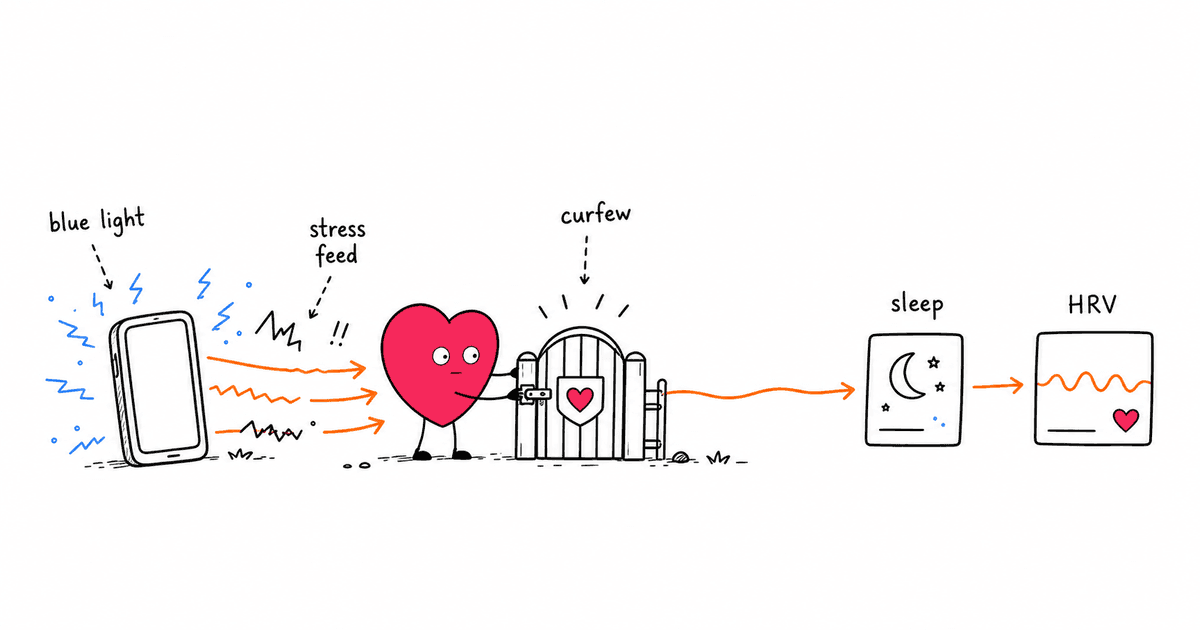
Excessive screen time lowers HRV by chronically activating the sympathetic nervous system through psychological stress, blue light exposure, poor posture, and disrupted sleep patterns. The result is a nervous system stuck in a low-grade fight-or-flight state, even when you are "relaxing" on the couch.
Multiple pathways connect screen use to autonomic dysfunction. Each one compounds the others, creating a cycle that can be difficult to break without intentional changes.
The Stress Response From Digital Content
Not all screen time is equal. Scrolling social media, reading news alerts, and checking work emails trigger distinct stress responses that can contribute to burnout. Research shows that content-driven stress activates the hypothalamic-pituitary-adrenal (HPA) axis and increases cortisol, both of which suppress parasympathetic activity and lower HRV. This mirrors the chronic stress and HRV connection seen in anxiety research.
A 2025 randomized controlled trial published in Health Psychology and Behavioral Medicine found that university students who reduced smartphone use to under two hours per day reported improved mental health scores for depression, stress, wellbeing, and sleep quality. Interestingly, their HRV initially declined during the reduction period, a pattern researchers compared to withdrawal from behavioral addiction, suggesting the nervous system had become dependent on constant stimulation.
Blue Light and Your Circadian System
Screens emit blue light in the 450-490nm wavelength range. This light suppresses melatonin production and disrupts your circadian rhythm, particularly when used in the evening. While blue light's direct effect on HRV during daytime use appears modest, the downstream impact on sleep quality is significant.
A study in Chronobiology International found that bright, blue-enriched light influenced autonomic nervous system modulation of HRV, with stronger effects under bright light conditions. The practical takeaway: evening screen use disrupts the natural parasympathetic shift that should happen as you wind down for sleep.
Screen Time and Sleep Disruption
This is where the HRV impact becomes most measurable. Sleep is the primary recovery window for your autonomic nervous system, and screen time before bed undermines it in three ways:
- Melatonin suppression: Blue light delays sleep onset by 30-60 minutes
- Cognitive arousal: Engaging content keeps your brain in a stimulated state
- Delayed sleep timing: The "just one more scroll" effect shortens total sleep duration
Sleep deprivation is one of the most potent HRV suppressors. Even one night of poor sleep can reduce RMSSD by 10-20%. Chronic evening screen use creates a nightly HRV deficit that compounds over weeks and months.
Smartphone Addiction and Autonomic Dysregulation
A 2025 study in Psychophysiology examined the relationship between HRV patterns and mobile phone addiction in adolescents. Researchers found that individuals with lower resting high-frequency HRV (a marker of parasympathetic tone) were more susceptible to problematic phone use, suggesting a bidirectional relationship.
Lower HRV makes you more vulnerable to compulsive phone checking, and compulsive phone checking further lowers your HRV. This vulnerability may be amplified in people with ADHD, who already tend to have lower baseline HRV and greater difficulty with impulse regulation. Breaking this cycle requires addressing both the behavior and the underlying nervous system state.
Posture and Sedentary Behavior
Extended screen use often means prolonged sitting with forward head posture. This compressed position restricts diaphragmatic breathing and can stimulate sympathetic activity through mechanical compression of the vagus nerve pathway in the neck and chest.
Sedentary behavior independently lowers HRV. When combined with the stress and blue light effects of screen content, the compound impact is greater than any single factor alone. If your screen time also means hours at a desk, our guide to sitting all day and HRV covers why uninterrupted sitting becomes its own recovery problem. For broader strategies to counteract these effects, see our guide on how to improve your HRV.
How Much Screen Time Is Too Much
There is no universal threshold, but research points to some benchmarks:
- Under 2 hours of recreational screen time: Associated with better mental health outcomes in the smartphone reduction trial
- No screens 60-90 minutes before bed: Allows melatonin production and parasympathetic activation to proceed naturally
- Breaks every 30-45 minutes: Standing, stretching, or brief movement resets postural stress and sympathetic activation
The key distinction is between active and passive screen use. Creative work, video calls with friends, or learning something new are less autonomically stressful than passive scrolling, news consumption, or social comparison. Active engagement also supports cognitive performance, while passive scrolling undermines it.
Practical Strategies to Protect Your HRV
Set a Digital Curfew
Stop using screens 60-90 minutes before your target bedtime. This single change can improve sleep onset, sleep quality, and overnight HRV. Replace screen time with reading, breathing exercises, meditation, yoga, or conversation.
Use Night Mode Settings
Enable blue light filters (Night Shift, Night Light) on all devices after sunset. While not as effective as avoiding screens entirely, these settings reduce blue light exposure by 40-60% and partially preserve melatonin production. This is especially important for shift workers whose schedules already disrupt circadian rhythms.
Track Your Screen Time
Most smartphones now have built-in screen time tracking. Set daily limits for social media and news apps. Awareness alone often reduces usage by 15-20%.
Create Phone-Free Zones
Keep your phone out of the bedroom. Use a dedicated alarm clock instead. This removes the temptation for late-night scrolling and early-morning phone checking before your body has fully transitioned from sleep.
Practice Active Screen Use
When you do use screens, be intentional. Choose activities that are engaging but not stress-inducing. Passive scrolling is the worst combination: low engagement with high stress exposure.
Take Movement Breaks
Every 30-45 minutes of screen use, stand up and move for 2-3 minutes. A brief walk, some stretching, or even standing and taking a few deep breaths can reset your autonomic state.
Measuring the Impact With Your Wearable
Use your HRV tracker to run a personal experiment. The Oura Ring 4 and Whoop 5 both track overnight HRV trends that respond to behavioral changes.
Try this two-week protocol:
- Week 1: Track your normal screen habits and overnight HRV
- Week 2: Implement a 90-minute pre-bed screen curfew and 2-hour daily recreational limit
- Compare: Look at average overnight RMSSD, sleep latency, and recovery scores
Most people see meaningful improvements within the first week of reduced evening screen time.
Screen Time and Children's HRV
The effects are even more pronounced in children and adolescents, whose nervous systems are still developing. Excessive screen time in young people has been linked to lower baseline HRV, poorer stress regulation, and disrupted sleep architecture.
For parents tracking their child's activity with devices like the Garmin Bounce 2 or Fitbit Ace, setting consistent screen time limits is one of the most impactful interventions for autonomic health.
The Bigger Picture: Digital Wellness and Autonomic Health
Screen time is not inherently harmful. The problem is volume, timing, and content quality. A mindful approach to digital habits supports your autonomic nervous system rather than undermining it.
Combined with other lifestyle factors like regular exercise, quality nutrition, and stress management, managing screen time becomes part of a comprehensive approach to optimizing HRV and overall health.
Key Takeaways
- Excessive screen time lowers HRV through stress activation, blue light disruption, poor posture, and impaired sleep
- Evening screen use is the most damaging due to melatonin suppression and sleep disruption
- Reducing recreational screen time to under 2 hours daily improves mental health outcomes
- A 60-90 minute pre-bed screen curfew is the single most impactful change for overnight HRV
- The relationship between phone use and low HRV is bidirectional, creating a cycle that requires intentional intervention
- Use your HRV wearable to measure your personal response to digital habit changes
Frequently Asked Questions
Does screen time directly lower HRV?
Yes, through multiple mechanisms. Stress-inducing content activates the sympathetic nervous system, blue light disrupts circadian rhythms, sedentary posture impairs vagal function, and disrupted sleep reduces overnight recovery. The combined effect is measurably lower HRV, especially with heavy evening use.
How long before bed should I stop using screens?
Research suggests 60-90 minutes before your target bedtime. This allows melatonin production to begin naturally and gives your nervous system time to shift toward parasympathetic dominance. If that feels too long, start with 30 minutes and gradually extend.
Are e-readers better than phones for evening use?
E-ink readers (like Kindle Paperwhite) emit significantly less blue light than phones or tablets and do not have the notification-driven stress of smartphones. They are a much better option for pre-sleep reading, though physical books remain the gold standard for sleep hygiene.
Need a quick read on your HRV number first?
Enter your HRV value, age range, device, and recovery context for a plain-English interpretation before you decide what to do next.
Interpret Your HRV NumberBuild the 30-day plan