Intermittent Fasting and HRV: What the Research Says About Fasting and Your Nervous System
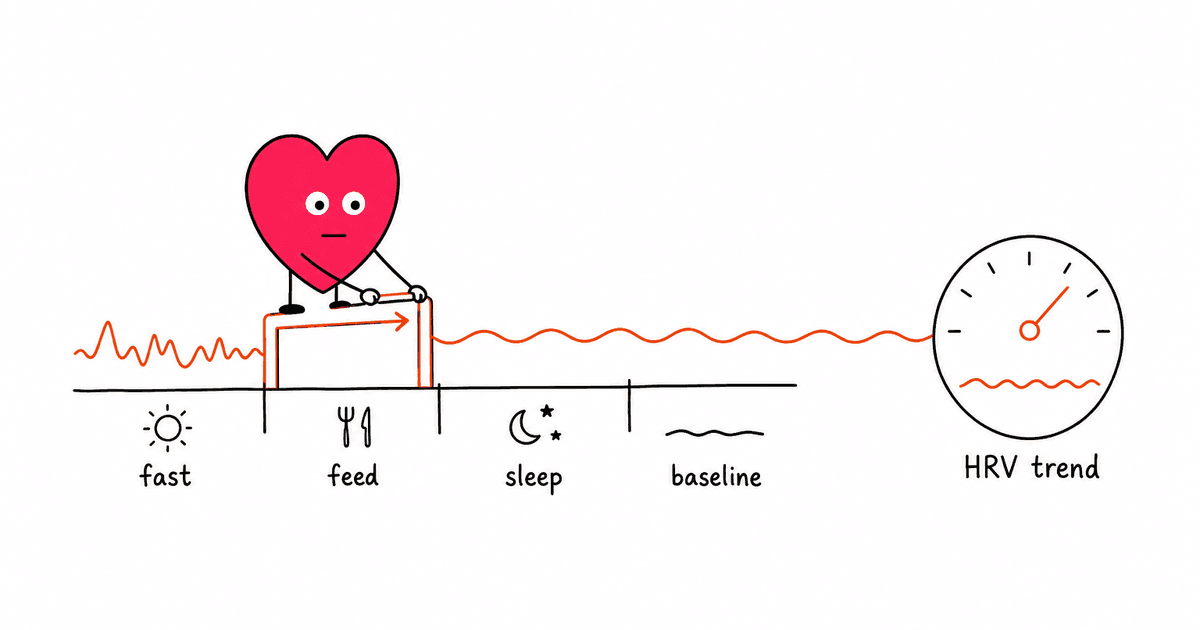
Trying to decode today's HRV number? Use the free interpreter first, then build a practical recovery plan. Interpret your HRV
Does Intermittent Fasting Improve HRV?
Yes, intermittent fasting significantly improves HRV by enhancing parasympathetic nervous system activity and reducing sympathetic dominance. Multiple studies show that 8 to 12 weeks of a 16:8 fasting protocol increases SDNN by 26 to 37%, RMSSD by 27 to 51%, and high-frequency HRV power, while lowering the LF/HF ratio. These changes indicate stronger vagal tone and better autonomic balance.
Intermittent fasting (IF) has become one of the most popular health interventions of the past decade, primarily for weight management and metabolic health. But there is a growing body of research showing that fasting does something many people do not expect: it improves your heart rate variability.
If you are tracking your HRV with a wearable device, you may notice higher readings on days when you ate within a shorter window or skipped a meal. That is not a coincidence. Fasting triggers specific physiological changes that shift your autonomic nervous system toward parasympathetic dominance, and the effects are measurable within weeks.
How Intermittent Fasting Affects Your Nervous System
Your autonomic nervous system has two branches: the sympathetic ("fight or flight") and the parasympathetic ("rest and digest"). The balance between these two systems determines your HRV. Higher parasympathetic activity means higher HRV, which is generally associated with better health, lower cardiovascular risk, and stronger stress resilience.
Intermittent fasting improves this balance through several interconnected mechanisms.
Reduced Insulin Resistance
When you fast, your body becomes more sensitive to insulin. Chronically elevated insulin (a hallmark of the modern Western diet) is associated with sympathetic nervous system overactivation and reduced HRV. By improving insulin sensitivity, intermittent fasting removes one of the key drivers of autonomic imbalance.
Lower Oxidative Stress and Inflammation
Oxidative stress and chronic inflammation impair vagal function and reduce HRV. Fasting activates cellular cleanup processes like autophagy, reduces inflammatory markers, and lowers oxidative stress. A 2025 study published in the International Journal of Medical and Pharmaceutical Research specifically noted that reduced oxidative stress is one of the primary mechanisms through which fasting improves vagal function.
Ketone Body Production
During the fasting window, your body shifts from burning glucose to burning fat, producing ketone bodies (primarily beta-hydroxybutyrate). Ketones have neuroprotective effects and support autonomic regulation. Research suggests this metabolic shift enhances vagal tone and contributes to the HRV improvements seen with fasting.
Circadian Rhythm Reset
Time-restricted eating helps synchronize your body's internal clock. Your autonomic nervous system follows a circadian pattern, with parasympathetic activity naturally increasing at night. When your eating window aligns with daylight hours, it reinforces this natural rhythm, leading to better sleep quality and stronger parasympathetic activity during rest.
What the Research Shows: HRV Numbers
Multiple studies have now quantified the HRV improvements from intermittent fasting. Here are the key findings.
8-Week 16:8 Protocol (2025, Healthy Adults)
A controlled study of 60 healthy adults (ages 20 to 40) compared a 16:8 intermittent fasting group with a control group over 8 weeks. The fasting group showed significant improvements:
| HRV Parameter | Before IF | After 8 Weeks | Change |
|---|---|---|---|
| SDNN | 48.5 ms | 61.3 ms | +26% |
| RMSSD | 35.2 ms | 44.6 ms | +27% |
| Resting Heart Rate | 74.8 bpm | 68.2 bpm | -9% |
The researchers concluded that intermittent fasting "significantly improved cardiovascular autonomic regulation in healthy adults, as reflected by enhanced HRV and reduced resting heart rate."
12-Week 16:8 Protocol (2025, Indian Adults)
A larger study of 100 adults following the same 16:8 protocol for 12 weeks found even more pronounced improvements:
| HRV Parameter | Baseline | After 12 Weeks | Change |
|---|---|---|---|
| SDNN | 36.2 ms | 49.5 ms | +37% |
| RMSSD | 25.7 ms | 38.9 ms | +51% |
| pNN50 | 9.8% | 14.5% | +48% |
| HF Power | 320 ms² | 455 ms² | +42% |
| LF/HF Ratio | 2.9 | 1.8 | -38% |
The decrease in LF/HF ratio is particularly significant. It indicates a shift from sympathetic dominance toward parasympathetic activity, which is the autonomic profile associated with better cardiovascular health and lower disease risk.
Additionally, 68% of participants reported improved sleep quality and 55% reported better concentration and less fatigue, with no adverse effects.
The GENESIS Fasting Study (2025, Nature)
A study published in the International Journal of Obesity (Springer Nature) examined HRV during a 12-day modified fasting protocol. Using Polar H10 chest straps for daily HRV measurements, the researchers found:
- RMSSD increased from 27.16 ms to 32.92 ms (p < 0.001), indicating enhanced parasympathetic activity
- Sympathetic activity decreased significantly (p < 0.001)
- Mental well-being improved significantly (p < 0.05)
- An initial rise in sympathetic activation during the first days of fasting, followed by a sustained parasympathetic shift
This study is notable because it tracked the day-by-day progression, showing that the autonomic benefits build progressively during fasting.
Acute Fasting Effects (2024, ScienceDirect)
A study published in Biological Psychology found that even a single 16-hour fast produced measurable HRV changes. RMSSD increased after fasting, and participants showed improved interoceptive accuracy (the ability to sense your own heartbeat), which is linked to better emotional regulation and body awareness.
How to Practice Intermittent Fasting for HRV
Based on the research, here is a practical guide to using intermittent fasting to improve your HRV.
The 16:8 Method (Most Studied)
This is the most researched IF protocol for HRV improvement. Fast for 16 hours per day and eat all meals within an 8-hour window.
Example schedule:
- Last meal by 8:00 PM
- First meal at 12:00 PM the next day
- Eating window: 12:00 PM to 8:00 PM
During the fasting window, you can consume:
- Water
- Black coffee (no sugar or cream)
- Green tea
- Herbal tea
Timeline for HRV Improvement
| Timeframe | What to Expect |
|---|---|
| Days 1 to 3 | Adjustment period. You may feel hungry. HRV may temporarily dip as your body adapts. |
| Weeks 1 to 2 | Hunger stabilizes. You may notice slightly better morning HRV readings. |
| Weeks 4 to 6 | Measurable HRV improvements in most people. Sleep quality often improves. |
| Weeks 8 to 12 | Significant improvements in SDNN, RMSSD, and resting heart rate based on study data. |
Important Considerations
Who should avoid intermittent fasting:
- Pregnant or breastfeeding women
- People with a history of eating disorders
- Those with type 1 diabetes (consult your doctor)
- People on medications that require food intake
- Children and teenagers
Who may benefit most:
- Adults with metabolic syndrome risk factors
- People with chronically low HRV
- Those with high baseline stress levels
- Anyone looking to improve sleep quality and recovery
Combining Intermittent Fasting with Other HRV Strategies
Intermittent fasting works well alongside other evidence-based HRV interventions. Here is how to stack them effectively.
IF + Exercise
Zone 2 training and intermittent fasting complement each other well. Exercise during the fasted state may enhance the metabolic benefits of both interventions. However, if you do intense training, consider timing it closer to your eating window so you can recover with proper nutrition.
If you are an athlete tracking HRV, monitor your readiness scores carefully during the adaptation phase. Some athletes find their HRV temporarily dips when combining IF with heavy training loads. Adjust as needed.
IF + Breathing Exercises
Slow breathing practices can amplify the parasympathetic effects of fasting. Try a 5-minute breathing session (5 to 6 breaths per minute) during your fasting window, especially in the morning. This combination targets autonomic balance through two different mechanisms simultaneously.
IF + Sleep Optimization
One of the clearest benefits of time-restricted eating is improved sleep. Finishing your last meal at least 3 hours before bedtime allows your body to enter the fasting state during sleep, which supports parasympathetic activation and deeper rest. For more strategies, see our guide on HRV and sleep.
IF + Cold Exposure
Both cold exposure and intermittent fasting activate parasympathetic pathways, but through different mechanisms. Some people find that a cold shower in the fasted state produces a particularly strong parasympathetic rebound. Start conservatively and listen to your body.
Tracking Your Progress
To see how intermittent fasting affects your personal HRV:
-
Establish a baseline. Track your morning HRV for at least 7 to 14 days before starting IF. Use a consistent device like an Oura Ring, Whoop, or Garmin watch for reliable readings.
-
Log your eating windows. Note when you start and stop eating each day. Many HRV trackers allow you to add journal entries. This helps you correlate eating patterns with HRV changes.
-
Track your resting heart rate too. Both studies showed significant RHR reductions alongside HRV improvements. A declining RHR combined with rising HRV is a strong signal that fasting is improving your autonomic health.
-
Watch your sleep HRV. Nighttime HRV is often the most sensitive indicator. If your sleep HRV trends upward over weeks, the fasting protocol is working.
-
Look at 7-day and 30-day trends. Day-to-day HRV fluctuates based on dozens of factors. The meaningful signal is in the trend. Compare your 30-day average before and after 8 weeks of IF.
For a deeper dive into what your numbers mean, check our guide on understanding HRV numbers.
Intermittent Fasting vs. Other Dietary Approaches for HRV
How does IF compare to other dietary strategies that may affect HRV?
| Approach | HRV Impact | Evidence Level | Ease of Adherence |
|---|---|---|---|
| 16:8 Intermittent Fasting | Significant improvement | Strong (multiple studies) | Moderate |
| Mediterranean Diet | Moderate improvement | Moderate | High |
| Reducing alcohol | Significant improvement | Strong | Varies |
| Omega-3 supplementation | Moderate improvement | Strong | High |
| Magnesium supplementation | Moderate improvement | Moderate | High |
| Reducing caffeine | Varies by individual | Moderate | Moderate |
| Nutrition optimization | Moderate improvement | Moderate | Moderate |
The advantage of intermittent fasting is that it does not require changing what you eat, only when you eat. This makes it relatively easy to combine with other dietary improvements for compounding benefits.
Common Questions
Will fasting lower my HRV at first?
Possibly. Some people experience a brief dip in HRV during the first few days as their body adjusts to the new eating schedule. This is normal and typically resolves within a week. If your HRV drops significantly and does not recover, consider a gentler approach like a 14:10 window before progressing to 16:8.
Does it matter when my eating window is?
Research suggests that aligning your eating window with daylight hours produces better results for metabolic health and circadian rhythm. An eating window of approximately 10 AM to 6 PM or 12 PM to 8 PM appears most common in the studies. Very late eating windows may disrupt sleep and reduce HRV benefits.
Can I exercise during the fasting window?
Yes, and some research suggests fasted exercise may enhance certain metabolic adaptations. Light to moderate exercise (walking, zone 2 training) is well tolerated during fasting. Intense training may be better timed near your eating window for recovery purposes.
How does IF compare to caloric restriction?
Intermittent fasting and caloric restriction both improve autonomic function, but they work through partially different mechanisms. IF provides the additional benefit of extended fasting periods that trigger autophagy and ketone production, even when total caloric intake remains the same. Studies suggest IF may be more sustainable long-term than continuous caloric restriction.
Is the 16:8 method the only option?
No, but it is the most studied protocol for HRV. Other approaches like 5:2 (eat normally for 5 days, restrict calories for 2) and alternate-day fasting also show promise, but the 16:8 method has the strongest evidence for autonomic nervous system benefits and the highest adherence rates.
The Bottom Line
Intermittent fasting is one of the simplest and most effective lifestyle changes you can make to improve your heart rate variability. The 16:8 method, which involves fasting for 16 hours and eating within an 8-hour window, has been shown to increase SDNN by 26 to 37%, RMSSD by 27 to 51%, and high-frequency HRV power by over 40% within 8 to 12 weeks.
The mechanisms are well understood: improved insulin sensitivity, reduced oxidative stress and inflammation, increased ketone production, and better circadian rhythm alignment all contribute to enhanced parasympathetic activity and autonomic balance.
Start with a consistent 16:8 schedule, track your HRV with a reliable monitor, and give it at least 8 weeks. Combine it with other evidence-based strategies like breathing exercises, quality sleep, and regular exercise for the best results.
Your autonomic nervous system responds to how you eat, not just what you eat. And the data is clear: giving your body regular breaks from digestion is one of the most powerful things you can do for your heart health.
Need a quick read on your HRV number first?
Enter your HRV value, age range, device, and recovery context for a plain-English interpretation before you decide what to do next.
Interpret Your HRV NumberBuild the 30-day plan