Polar H10 Review (2026): Still the Best Chest Strap for HRV?
Ready to start tracking your HRV? Check out our top picks: Whoop | Oura Ring 5 | Polar H10
If you care about raw HRV accuracy more than convenience, the Polar H10 is still the chest strap to beat.
That has been true for years, and it is still true in 2026. The bigger question is whether that accuracy advantage actually matters for your use case.
If you want passive overnight tracking, sleep staging, and a polished recovery score, a wearable like Oura Ring 4, Whoop 5, or an Apple Watch makes more sense. If you want the cleanest possible signal for morning spot checks, HRV biofeedback, or structured training, the Polar H10 remains one of the easiest recommendations in the category.
Quick Verdict
| Category | Verdict |
|---|---|
| HRV accuracy | Excellent |
| Workout heart rate accuracy | Excellent |
| Comfort | Good for training, mediocre for all-day wear |
| Battery life | Excellent |
| App experience | Functional, not premium |
| Best for | Morning HRV readings, athletes, biofeedback, people who want accuracy without a subscription |
| Skip if | You want passive 24/7 tracking or detailed lifestyle coaching |
Best buying reason: choose the Polar H10 when you want the cleanest controlled HRV reading without a subscription. Choose Oura or WHOOP instead if you want passive overnight tracking and coaching.
What Makes the Polar H10 Stand Out
The Polar H10 is not exciting in the way newer wearables are exciting. It does not give you a readiness score, a sleep score, or a stream of coaching prompts. It is basically a specialist tool.
That is exactly why it still matters.
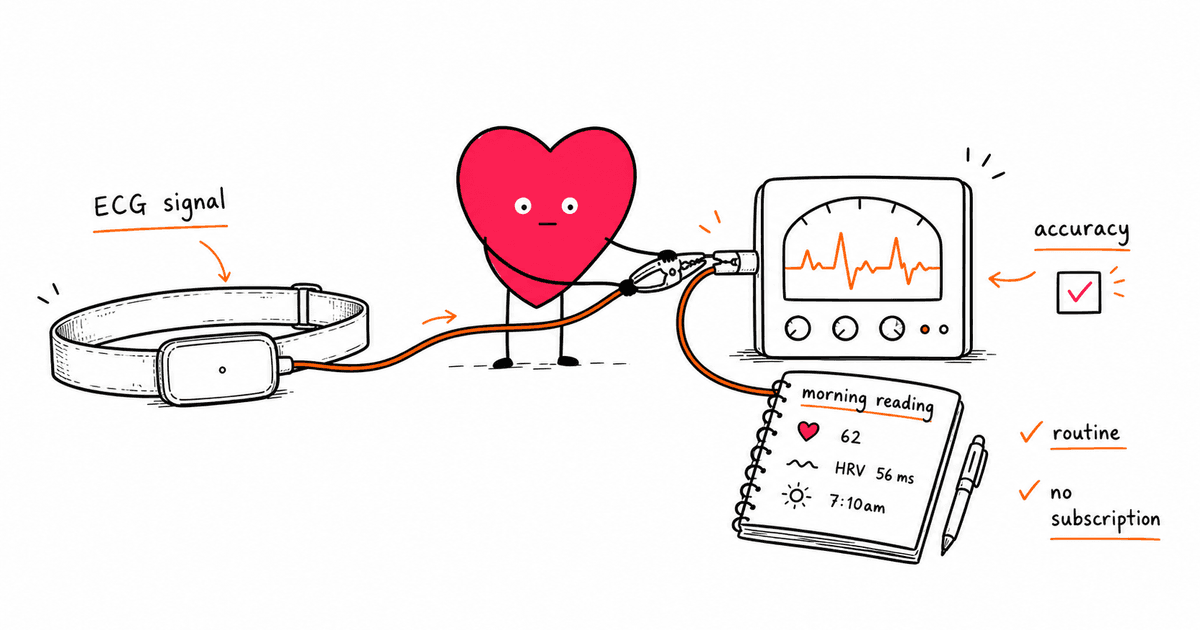
The H10 uses ECG-style electrical sensing from the chest rather than optical sensing from the wrist or finger. If you want the sensor-level explanation, our ECG vs PPG for HRV guide breaks down why chest straps and optical wearables can disagree. For heart rate and RR interval accuracy, that is still a very strong setup. It is also why the H10 keeps showing up as the benchmark device in validation work and comparison testing.
For people learning what HRV is, this distinction matters. HRV is not just a single number your wearable spits out. It depends on capturing tiny differences between beats. Cleaner beat-to-beat data usually means cleaner HRV data.
Polar H10 Accuracy: Still the Main Reason to Buy It
This is the whole story.
A 2022 validation study published in Sensors found that linear HRV measurements from the Polar H10 showed strong agreement and small bias compared with ECG recordings at rest and during incremental exercise. A newer 2026 Sensors paper also found extremely high agreement between the H10 and a gold-standard ECG system for continuous heart rate measurement.
That does not mean every reading is magically perfect. Strap placement, dry electrodes, poor skin contact, and bad battery health can all create bad data. But when the H10 is set up correctly, it remains one of the most reliable consumer devices for HRV spot checks.
In practical terms, the Polar H10 is especially strong for:
- morning HRV measurements with apps like Elite HRV or HRV4Training
- biofeedback sessions
- exercise sessions where wrist sensors often struggle with motion
- creating a more trustworthy baseline when you are comparing wearables
If your goal is the most accurate possible morning reading, I would still choose the Polar H10 over almost any wrist-based option.
Design and Comfort
The Polar H10 is a chest strap, which means comfort is always going to be relative.
Compared with older chest straps, it is solid. The strap is washable, the sensor pod is compact, and the fit is secure when the strap is tightened properly. During workouts, that is usually enough.
During sleep or long casual wear, the story changes. Most people will not want to wear a chest strap all night just to get HRV data they could capture with a one-minute morning reading. That is one reason the H10 works best as a precision tool, not a lifestyle wearable.
A few setup details matter more than people realize:
- Wet the electrodes before use
- Tighten the strap enough to prevent shifting
- Rinse the strap after sweaty sessions
- Replace the battery before it gets unreliable
If you skip those basics, you can turn a very accurate device into an annoying one.
Connectivity and App Support
This is one of the H10's most underrated strengths.
According to Polar's current spec sheet, the H10 supports Bluetooth LE, dual Bluetooth connections, ANT+, built-in recording mode, and a broadcast range up to 295 feet. That gives it far more flexibility than many casual buyers expect.
You can use it with:
- Polar Beat and Polar Flow
- many sports watches and bike computers
- gym equipment that supports heart rate broadcasting
- third-party HRV and training apps
That flexibility is a big reason the H10 stays relevant. You can use it as a simple HRV tool today, then pair it with a training watch later without replacing the sensor.
If you are comparing ecosystems, our Garmin vs Polar for HRV guide goes deeper on the tradeoffs.
Battery Life and Durability
This part is refreshingly boring, which is a compliment.
Polar lists the H10 at up to 400 hours of battery life on a replaceable CR2025 coin cell, plus water resistance to 30 meters. There is also onboard memory for one training session, up to 30 hours, which is useful if you do not want to carry a phone for every workout.
That means the H10 avoids two common wearable frustrations:
- daily or near-daily charging
- subscription pressure tied to a premium app experience
You buy it, replace the battery occasionally, wash the strap, and keep using it.
That simplicity is part of the appeal.
Price and Value
The Polar H10 usually sells for about $90 in the US, though sale pricing moves around.
That still looks very good in 2026. You are getting a highly accurate sensor with no required subscription, long battery life, and compatibility with a wide range of apps and devices.
That said, value depends on how you plan to use it. If you want passive sleep tracking and recovery scores, the H10 can start to feel like the wrong kind of bargain because you are saving money on hardware while giving up convenience.
If your priority is accurate HRV and heart rate data, though, the value case is still strong.
What the Polar H10 Does Not Do Well
The H10 is easy to recommend, but only if you are honest about its limits.
1. It is not a passive recovery wearable
The H10 will not sit quietly on your finger or wrist and build a full lifestyle dashboard around your sleep, stress, activity, and recovery. It is a sensor, not a coaching platform.
2. It creates more friction than a ring or band
To get value from the H10, you need a routine. That usually means putting it on in the morning, opening an app, taking a reading, and then actually looking at the trend.
That is not hard, but it is still more effort than wearing a ring to bed.
3. The app experience is fine, not exceptional
Polar Flow and Polar Beat are useful, but they are not why people buy the H10. If you want deep behavior tagging, polished readiness insights, and daily habit coaching, Whoop and Oura are better lifestyle products.
4. It is overkill for some users
If all you want is a rough recovery trend and some sleep context, a modern ring or watch may be good enough. The H10's main advantage shows up when accuracy actually matters.
Polar H10 vs Oura, Whoop, and Apple Watch
This is the most useful way to think about the H10.
Choose Polar H10 if you want:
- the cleanest HRV signal you can reasonably get as a consumer
- a low ongoing cost
- a device for spot checks and training sessions
- a strong reference device for comparing other wearables
Choose Oura or Whoop if you want:
- passive overnight data collection
- sleep and recovery scores in one place
- more context around behavior and trends
- less friction day to day
Choose Apple Watch or Garmin if you want:
- smartwatch or training-watch features first
- broader daily utility beyond HRV
- notifications, GPS, apps, and ecosystem perks
For most people, convenience beats precision. That is why chest straps are not dominant consumer wearables.
But if you are serious about understanding your HRV numbers, convenience is not always the right priority.
If you are still comparing options, start with our best HRV monitors of 2026 roundup and our Whoop vs Oura vs Apple Watch comparison.
Who Should Buy the Polar H10 in 2026?
The H10 makes the most sense for four groups.
1. People who want the most accurate morning HRV readings
If your goal is a simple, repeatable morning baseline, the H10 is still one of the best tools you can buy.
2. Athletes who care about training quality
During intervals, tempo work, and high-motion exercise, chest straps still have an edge. If you train seriously and use HRV alongside workload, recovery, or heart rate zones, the H10 fits well. Our guide to HRV for athletes covers how to use that data without overreacting to every dip.
3. People doing HRV biofeedback
For real-time breathing or nervous system training, cleaner signal quality matters. The H10 is a very practical choice for biofeedback work.
4. Buyers who hate subscriptions
This one is simple. The H10 is still one of the strongest no-subscription options in the category.
Who Should Skip It?
You should probably skip the Polar H10 if:
- you want automatic overnight HRV without any manual routine
- you care more about sleep coaching than signal quality
- you do not want to wear a chest strap under any circumstances
- you want one device that also acts like a smartwatch
That is not a knock on the H10. It just means it solves a narrower problem than devices like Whoop or Oura Ring 4.
Is the Polar H10 Worth It in 2026?
Yes, if you are buying it for the right reason.
The Polar H10 is still worth it in 2026 because it does one job extremely well: accurate heart rate and HRV measurement without unnecessary complexity.
It is not the best wearable for most people. It is the best sensor for a specific kind of user.
If you want a recovery lifestyle product, buy something else.
If you want a dependable chest strap for HRV, training, and biofeedback, the Polar H10 is still one of the easiest buys in the category.
Bottom Line
The Polar H10 remains the best chest strap for HRV for most people who prioritize accuracy, flexibility, and low long-term cost.
Its weaknesses are obvious: it is less convenient than passive wearables, less polished than subscription platforms, and less comfortable than a ring or band. But none of that changes the main point.
When you want reliable beat-to-beat data, the H10 still deserves its reputation.
Want help deciding whether a chest strap is the right fit? Read our guides to what HRV is, how to improve HRV, and best HRV monitors of 2026.
Ready to improve your health with HRV monitoring?
We've tested and compared the top HRV monitors on the market. Find the right one for you.
See Our Top Picks for 2026