Sitting All Day and HRV: How Sedentary Time Affects Heart Rate Variability
Trying to decode today's HRV number? Use the free interpreter first, then build a practical recovery plan. Interpret your HRV
Does Sitting All Day Lower HRV?
Yes, too much uninterrupted sitting can work against healthy HRV, especially when long sitting bouts become a daily pattern. Research suggests prolonged sedentary time is linked with lower parasympathetic activity, while reducing continuous sitting time may improve sleep-time high-frequency HRV, a marker of vagal activity.
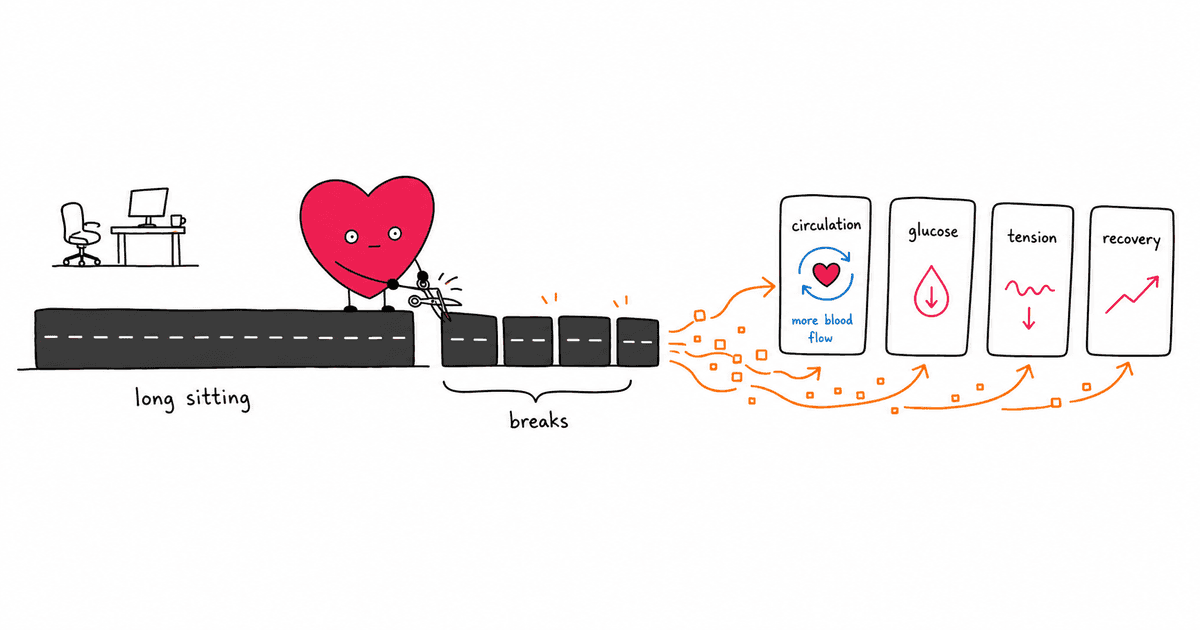
That does not mean every desk job automatically wrecks your nervous system. It means the pattern matters. If you sit for hours without standing, walking, or changing positions, you create a lifestyle context that often overlaps with worse blood sugar control, poorer circulation, more stiffness, and lower overall movement. All of those can push your autonomic nervous system in the wrong direction. Your posture matters here too, because long desk days often combine inactivity with shallow breathing and neck or shoulder tension.
Why Sedentary Time Matters for HRV
HRV reflects how flexibly your autonomic nervous system shifts between stress and recovery. In general, higher HRV is associated with better recovery capacity, stronger parasympathetic tone, and greater resilience to physical and psychological stress.
When you stay seated for long stretches, several things can happen at once:
- Blood flow slows, especially in the lower body
- Muscular activity drops sharply
- Energy expenditure stays very low
- Blood sugar handling often worsens after meals
- Mental fatigue and stress may accumulate during screen-heavy work
This combination does not always show up as a dramatic one-day HRV crash. More often, it acts like a slow background drain on recovery, especially when sitting all day is paired with poor sleep, low step count, or the kind of chronic work stress that drives burnout.
What the Research Says
The evidence is still developing, but a few patterns stand out.
A 2021 meta-analysis in Frontiers in Physiology reviewed 21 articles and found that a single bout of prolonged sitting did not consistently produce a significant HRV change across studies. That is important because it means one long meeting or one travel day does not automatically show up in your metrics.
But short-term null results do not mean sedentary time is harmless.
In a 2021 PLOS ONE study of adults with cardiovascular risk factors, people who reduced their continuous daytime sitting time over six months showed significantly higher high-frequency HRV during sleep compared with people whose sitting time increased. In simple terms, cutting back long sitting bouts appeared to support parasympathetic activity at night.
That lines up with a broader 2021 systematic review and meta-analysis in the International Journal of Environmental Research and Public Health, which reported that higher sedentary time was generally associated with less favorable resting heart rate and HRV patterns in adults.
The practical takeaway is straightforward:
- One isolated sitting session may not move HRV much
- A chronically sedentary routine is more concerning
- Breaking up sitting is likely more important than obsessing over one workday
Why Sitting Can Hurt Recovery Even If You Exercise
One of the biggest myths in health is that a hard workout cancels out an otherwise sedentary day.
Exercise matters, a lot. But it does not make 9 to 11 hours of sitting irrelevant.
You can still hit the gym in the morning and spend the rest of the day in a low-movement state that works against recovery. This is especially true if your routine looks like this:
- Early workout
- Long commute
- Desk work for most of the day
- Meals eaten sitting down
- Evening screen time on the couch
That pattern compresses most of your daily movement into a small window. From an HRV perspective, the issue is not just training load. It is how much total autonomic and metabolic support you give your body across the other 14 to 16 waking hours.
The Main Pathways Linking Sitting and HRV
Reduced Parasympathetic Support
Regular movement helps reinforce parasympathetic tone. Long periods of stillness, especially when paired with mental stress, can reduce the conditions that support higher vagal activity.
Worse Blood Sugar Control
Prolonged sitting after meals can worsen post-meal glucose excursions. Poorer glucose control tends to increase sympathetic stress and can contribute to lower HRV over time. This is one reason short post-meal walks are so effective for both metabolic health and recovery.
If you want a deeper look at that connection, see Blood Sugar and HRV.
Lower Circulation and Vascular Function
Sitting for hours at a time can reduce lower-body blood flow and contribute to vascular dysfunction. Since healthy blood vessel function and autonomic regulation are tightly linked, this is one likely pathway connecting sedentary behavior with worse recovery markers.
More Musculoskeletal Tension
Desk work often creates neck, jaw, hip, and low-back tension. That tension is not the same thing as a hard training stimulus, but it can still add stress load, worsen breathing mechanics, and make your body feel less recovered.
Higher Cognitive Fatigue
Many sedentary days are not restful. They are mentally demanding. A screen-heavy workday packed with deadlines, notifications, and context switching can leave you physically inactive but sympathetically activated.
That combination is exactly why some people see disappointing HRV after a day that felt "easy" on paper.
Signs Your Desk Routine May Be Affecting HRV
Sedentary time is more likely to be part of the problem if you notice patterns like:
- HRV tends to run lower on long office days than on active weekends
- Your resting heart rate drifts higher after several low-step days
- You feel wired and stiff by evening even though you did not exercise hard
- Your sleep score drops after heavy screen-based workdays
- Your body feels better on days with walking breaks, errands, or standing time
None of these signs prove sitting is the only culprit. But they are useful clues.
How Often Should You Break Up Sitting?
There is no single perfect interval, but most people do well with movement breaks every 30 to 60 minutes.
That does not mean you need a workout every hour. A useful break can be as simple as:
- Standing up for 2 to 5 minutes
- Walking to refill water
- Taking a short lap around your home or office
- Doing 10 bodyweight squats
- Walking during phone calls
- Taking a 10-minute walk after lunch
The key is not intensity. It is interruption.
A 2025 umbrella review in The Lancet Public Health found that workplace strategies such as sit-to-stand desks and gamified activity interventions can meaningfully reduce sedentary behavior. Some environmental interventions reduced sitting time by roughly 40 to 100 minutes per 8-hour workday.
For HRV, that matters because less continuous sitting usually means more low-level movement, better circulation, and a healthier autonomic rhythm across the day.
The Best Types of Movement Breaks for HRV
1. Easy Walking
Walking is the simplest and most reliable option. It raises energy expenditure without adding much recovery cost.
A few minutes of easy walking can:
- Increase circulation
- Lower post-meal glucose spikes
- Reduce stiffness
- Shift your nervous system away from prolonged static work
Related: Walking and HRV
2. Standing With Purpose
Standing alone is not magic, but it is better than remaining motionless for hours. The best approach is to pair standing with light movement, such as calf raises, pacing, or desk stretches. If your desk setup leaves you stiff or collapsed forward, our guide to posture and HRV explains why body position changes both HRV readings and recovery.
3. Mobility Snacks
Short mobility sessions can reduce the physical strain of desk work. Good options include:
- Thoracic extensions
- Hip flexor stretches
- Ankle mobility drills
- Shoulder rolls
- Gentle spinal rotation
These are especially helpful if your sedentary time shows up as stiffness more than fatigue. A short stretching routine can also help you reset breathing mechanics and reduce the muscle tension that builds up during long seated work.
4. Post-Meal Walks
If you only change one habit, start here. A 10 to 15 minute walk after lunch or dinner can support both glucose control and recovery.
A Simple HRV-Friendly Desk-Day Plan
If you work at a computer, this routine is realistic for most people:
| Time | Action | Why It Helps |
|---|---|---|
| Start of workday | 5-minute walk before sitting down | Creates an active baseline |
| Every 45-60 minutes | Stand and move for 2-5 minutes | Breaks up continuous sitting |
| Mid-morning | Take one walking call | Adds steps without extra time |
| After lunch | 10-15 minute walk | Supports blood sugar and afternoon energy |
| Mid-afternoon | Mobility break or stairs | Reduces stiffness and mental fatigue |
| Evening | Light walk instead of more couch time | Improves recovery without taxing HRV |
This is not an all-or-nothing system. Even two or three movement breaks a day can be meaningful if you are currently sitting almost nonstop.
Can a Standing Desk Improve HRV?
A standing desk can help, but only if it changes your behavior.
Simply standing in one position for hours is not ideal either. Many people swap one static posture for another and expect a big health payoff. A standing desk works best when it helps you:
- Alternate between sitting and standing
- Move more often
- Walk away from the desk regularly
- Avoid marathon sitting blocks
Think of it as a cue for movement, not a complete solution.
How to Track Whether Sitting Is Affecting Your HRV
The most useful approach is to watch patterns over 2 to 4 weeks, not day-to-day noise.
What to Track
- Morning HRV
- Resting heart rate
- Daily steps
- Hours seated, if your wearable tracks it
- Days with post-meal walks
- Work-from-home vs office days
What to Look For
You may find that HRV is higher when:
- Your step count stays above a personal threshold
- You take at least one midday walk
- You interrupt long sitting bouts
- You finish work feeling physically looser and less mentally fried
If you need a sustainable place to start, our full guide to walking and HRV lays out how step count and low-intensity movement improve autonomic balance over time.
Wearables such as the Oura Ring 4, Whoop 5, Apple Watch Series 11, or a Garmin Forerunner 265 can help you spot these trends, especially when paired with notes about your workday structure.
When Low HRV Is Probably Not From Sitting Alone
If your HRV is chronically low, look beyond sedentary time too. Common drivers include:
- Poor sleep
- High training load
- Illness or inflammation
- Alcohol use
- Under-fueling
- Chronic stress
- Shift work
Sitting may still contribute, but it is rarely the only variable.
Related reading:
The Bottom Line on Sitting All Day and HRV
Sitting all day is not just a posture problem. It is a recovery problem.
A single long sitting session may not tank your HRV, and the research on acute changes is mixed. But a chronically sedentary routine appears to push your physiology away from the conditions that support better heart rate variability, especially when long sitting bouts become a daily habit.
The good news is that the fix is not complicated.
You do not need intense workouts every hour. You need fewer long unbroken sitting blocks, more light movement through the day, and at least one or two anchor habits like walking breaks and post-meal walks.
If you want better HRV, do not just ask how hard you trained. Ask how often you moved between the workouts.
FAQ
Does sitting all day always lower HRV?
No. One sedentary day does not always lead to a noticeable HRV drop. The bigger concern is a chronic pattern of long, uninterrupted sitting combined with low daily movement and high stress.
Is a standing desk enough to improve HRV?
Not by itself. A standing desk is most useful when it helps you change position more often and move throughout the day.
What is the best break for desk workers who want better HRV?
A short walk is usually the best option because it improves circulation, supports blood sugar control, and adds very little recovery cost.
Can I have good HRV if I still work a desk job?
Yes. Many people with desk jobs maintain good HRV by training consistently, sleeping well, managing stress, and breaking up sitting throughout the day.
Need a quick read on your HRV number first?
Enter your HRV value, age range, device, and recovery context for a plain-English interpretation before you decide what to do next.
Interpret Your HRV NumberBuild the 30-day plan