HYROX and HRV: How to Train for Hybrid Fitness Racing Without Burning Out
Trying to decode today's HRV number? Use the free interpreter first, then build a practical recovery plan. Interpret your HRV
Can HRV Help HYROX Training?
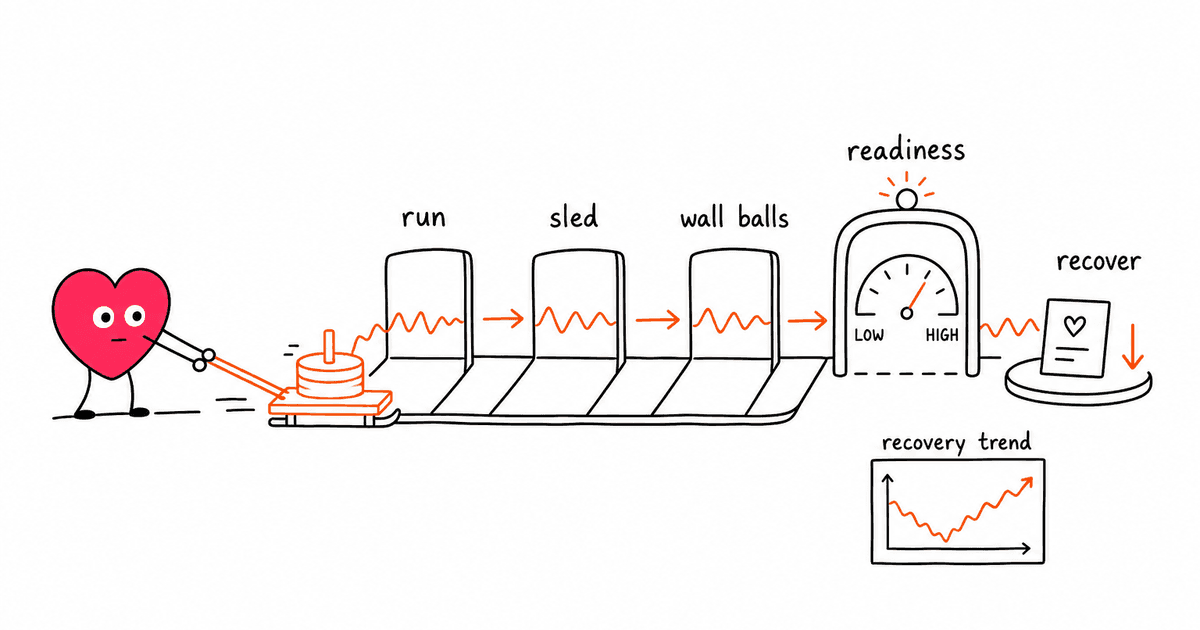
Yes, HRV can help HYROX athletes train harder without turning every week into a recovery problem. HYROX combines running, sled work, carries, lunges, rowing, skiing, and wall balls in a repeatable race format. That mix creates a unique load on your cardiovascular system, muscles, grip, and nervous system. HRV gives you a daily read on how well your body is absorbing that load.
HYROX is popular because it feels measurable. The race format is consistent: according to HYROX's official race description, athletes complete a 1 km run followed by one functional workout station, repeated eight times. That means every race includes 8 km of running plus eight stations, all indoors and under fatigue.
That structure is exactly why HRV matters. A runner can track mileage. A lifter can track strength training volume. A HYROX athlete has to track both, plus the cost of doing strength work while already breathing hard. HRV is not a perfect readiness score, but it can keep your training honest.
Why HYROX Is So Demanding on Recovery
HYROX is not just a hard workout with a race bib. It stacks several stressors into one event:
- Aerobic demand: 8 km of total running creates a meaningful endurance load.
- Muscular endurance: Sled pushes, sled pulls, lunges, wall balls, and carries create local fatigue that can linger for days.
- High heart rate work: Stations often happen while your heart rate is already elevated from the previous run.
- Grip and trunk fatigue: Farmer's carries, pulls, and loaded movements can make later running feel less efficient.
- Indoor race stress: Heat and humidity, crowd noise, nerves, and pacing mistakes can raise sympathetic activation.
For HRV, the key point is simple: your body does not care whether stress came from intervals, heavy sleds, poor sleep, work deadlines, or race anxiety. Your nervous system sees the total load.
That is why a HYROX plan built only around workouts can look good on paper while slowly pushing your HRV down. The better approach is to combine planned progression with daily recovery feedback.
What HYROX Training Does to HRV
A hard HYROX session can lower HRV for 24 to 72 hours. That is normal. Acute HRV suppression after intense training does not mean the workout was bad. It usually means your sympathetic nervous system is elevated and your parasympathetic recovery system has not fully rebounded yet.
The bigger question is what happens over weeks.
When training is well managed, HYROX can support better HRV by improving aerobic fitness, stroke volume, metabolic flexibility, and recovery capacity. When training is poorly managed, it can drive chronically low HRV, higher resting heart rate, poor sleep, mood changes, and stalled performance.
A 2021 systematic review on HRV-guided training found that HRV-guided plans were better for improving vagal-related HRV indices, while group-level performance advantages were generally small. Translation: HRV is probably more useful as a load-management tool than as a magic performance hack.
That fits HYROX well. You are not using HRV to avoid hard work. You are using it to decide when hard work will actually land.
The Best HRV Metrics for HYROX Athletes
Do not overcomplicate this. For HYROX, the most useful signals are:
1. Your HRV Baseline
Track your morning or overnight HRV against your own rolling baseline, not against someone else's number. A single low reading is not a crisis. A multi-day drop below baseline matters more, especially if it comes with poor sleep, heavy legs, or rising resting heart rate.
If you are new to tracking, read our guide to understanding HRV numbers before making big training decisions from the data.
2. Resting Heart Rate
Low HRV plus a higher-than-normal resting heart rate is a stronger warning sign than low HRV alone. It often means your body is under strain from training, illness, dehydration, heat, alcohol, travel, or poor sleep.
This is especially useful during HYROX blocks because functional fitness athletes can normalize feeling tired. Your resting heart rate is harder to rationalize.
3. Heart Rate Recovery
Heart rate recovery tells you how quickly your heart rate drops after hard efforts. In HYROX, this matters because you repeatedly need to recover enough to run after a station and work after a run.
If your heart rate recovery is getting worse across similar sessions, you may be carrying more fatigue than your plan acknowledges.
4. Subjective Readiness
HRV should not override lived reality. Pair it with simple questions:
- Did I sleep well?
- Do my legs feel unusually heavy?
- Is my motivation flat or irritable?
- Is my warmup heart rate higher than normal?
- Am I sore in a way that changes movement quality?
The best HYROX athletes are not slaves to the score. They use HRV as one vote in the decision.
How to Adjust HYROX Training Based on HRV
Use a simple traffic-light model.
Green: HRV Near or Above Baseline
If HRV is normal or elevated, resting heart rate is normal, and you feel decent, follow the plan.
Good options:
- Race-pace compromised running
- Threshold intervals
- Heavy sled work
- Wall ball volume
- Full HYROX simulation blocks
This is when quality work belongs. Do not waste green days on junk volume if you have a performance goal.
Yellow: HRV Slightly Low or Mixed Signals
If HRV is mildly below baseline but you feel mostly fine, reduce the cost of the workout without skipping training.
Good adjustments:
- Keep the session, but cap intensity at RPE 6 to 7
- Replace intervals with Zone 2 training
- Practice station technique instead of chasing pace
- Cut total volume by 20 to 30%
- Keep strength work submaximal and crisp
Yellow days are where HRV is most useful. You still train, but you avoid turning manageable fatigue into a hole.
Red: HRV Clearly Low, Resting Heart Rate High, and Symptoms Present
If HRV is clearly suppressed, resting heart rate is elevated, and you feel off, change the plan.
Better choices:
- Full rest day
- Easy walk
- Mobility work
- Light technique only
- Short recovery bike or row at conversational pace
This is not weakness. It is load management. The point is to protect the next three to five sessions, not to prove you can suffer through today's workout.
A Sample HRV-Smart HYROX Training Week
Here is a simple structure for an intermediate athlete training four to five days per week.
Monday: Aerobic Base + Technique
- 40 to 60 minutes Zone 2 running, cycling, or rowing
- 10 to 15 minutes easy sled technique or wall ball mechanics
- Keep this boring on purpose
This supports the aerobic engine that makes every station less expensive.
Tuesday: Strength and Station Capacity
- Sled push or pull strength work
- Farmer's carries
- Lunges
- Core work
- Finish with easy mobility, not a death circuit
This is not the day to sneak in another race simulation. Build the pieces.
Wednesday: Recovery or Easy Conditioning
Use HRV to decide:
- Green: 30 to 45 minutes easy Zone 2
- Yellow: walk and mobility
- Red: rest
The goal is to arrive ready for Thursday, not to win Wednesday.
Thursday: Compromised Running
Example session:
- Warm up 10 to 15 minutes
- 4 to 6 rounds of 800 m run + functional station
- Keep most rounds controlled, with only the last one near race effort
- Cool down until breathing fully settles
This is the most HYROX-specific session of the week, so protect it with recovery before and after.
Friday: Rest or Mobility
If HRV is suppressed after Thursday, take the hint. Recovery days are not empty space. They are when adaptation happens.
Saturday: Longer Mixed Session
Alternate weekly:
- Week A: longer Zone 2 run with short station skills
- Week B: partial HYROX simulation at controlled effort
- Week C: strength endurance circuit with no maximal running
You do not need a full race simulation every weekend. Most athletes recover better when they save all-out simulations for key checkpoints.
Sunday: Off or Easy Walk
If you are training seriously for HYROX, a true off day is often more productive than another medium-hard workout.
How Often Should HYROX Athletes Do Hard Sessions?
Most recreational HYROX athletes do best with two hard days per week, sometimes three during a focused build if sleep, nutrition, and recovery are strong.
The mistake is treating every class, run, and station session as moderate-to-hard. That creates a gray-zone week where nothing is easy enough to recover from and nothing is fresh enough to be high quality.
A 2021 study on HRV-guided high-intensity functional training found that participants using HRV to reduce intensity achieved similar improvements in cardiovascular function, body composition, and fitness while spending significantly fewer days at high intensity. That is the lesson for HYROX: fewer hard days can still work if the hard days are placed well.
HYROX, CrossFit, and the Recovery Trap
HYROX overlaps with functional fitness, but it is not the same as random high-intensity training. The race rewards repeatability, pacing, and aerobic control.
That matters because research on CrossFit-style athletes suggests a possible autonomic cost when high-intensity mixed training dominates. A 2022 study comparing CrossFit athletes with endurance athletes found lower parasympathetic modulation at rest and slower later-stage heart rate recovery in the high-intensity mixed training group.
That does not mean CrossFit is bad or HYROX is unsafe. It means athletes should be careful about stacking too many high-intensity sessions without enough aerobic base and low-intensity work.
If your HRV is trending down while your training feels heroic, the plan may be too dramatic and not effective enough.
Race Week: How to Use HRV Without Panicking
HRV can get weird during race week. Travel, excitement, carb changes, nerves, poor hotel sleep, and schedule disruption can all move the number.
Use these rules:
- Do not chase fitness in race week. You will not build meaningful capacity in the final few days.
- Watch trends, not single readings. One low number before a race is common.
- Prioritize sleep timing. Even if sleep quality is imperfect, keep your schedule predictable.
- Keep movement light. Short shakeouts help, but avoid testing yourself.
- Do not make device changes. Race week is a bad time to switch wearables or measurement timing.
If HRV is low but you feel excited and physically normal, you may simply be sympathetically aroused. If HRV is low, resting heart rate is high, and you feel sick or unusually flat, respect that signal.
Common HYROX HRV Mistakes
Mistake 1: Treating HRV Like a Permission Slip
A green score does not mean every session should become a personal record attempt. It means your body is likely ready for the planned load.
Mistake 2: Ignoring Low-Intensity Work
HYROX looks intense, but the athletes who handle it well usually have strong aerobic bases. Easy running, cycling, rowing, and ski erg work are not filler. They are what make the hard parts repeatable.
Mistake 3: Doing Too Many Full Simulations
Full HYROX simulations are expensive. Use them sparingly. Most weeks should build components: running economy, station strength, transitions, pacing, and recovery.
Mistake 4: Blaming Every Low HRV Reading on Training
Low HRV can come from sleep loss, stress, dehydration, illness, heat, alcohol, travel, or under-fueling. Training is only one piece.
Mistake 5: Forgetting That Better Fitness Can Lower Race Stress
The goal is not to keep HRV high every day. The goal is to become fit enough that the same workload costs less. Over time, a well-built aerobic base should make race-pace work feel less chaotic.
Who Should Be Careful With HYROX Training?
HYROX can be scaled, but it is still demanding. Be cautious if you have known cardiovascular disease, uncontrolled blood pressure, unexplained chest pain, fainting, severe dizziness, or a recent illness that has not resolved. Get medical guidance before starting high-intensity training if any of those apply.
For everyone else, the smart approach is gradual progression. Start with technique, easy aerobic work, and basic strength. Add intensity after your body proves it can recover.
The Bottom Line
HYROX rewards athletes who can repeat hard efforts without falling apart. HRV helps you see whether your body is adapting to that challenge or just surviving it.
Use HRV to protect quality sessions, keep easy days easy, and avoid stacking high-intensity work when your nervous system is already strained. The best HYROX plan is not the hardest one. It is the one you can recover from long enough to get fitter.
Need a quick read on your HRV number first?
Enter your HRV value, age range, device, and recovery context for a plain-English interpretation before you decide what to do next.
Interpret Your HRV NumberBuild the 30-day plan