Rucking and HRV: Can Weighted Walking Improve Fitness Without Crushing Recovery?
Trying to decode today's HRV number? Use the free interpreter first, then build a practical recovery plan. Interpret your HRV
Does Rucking Help or Hurt HRV?
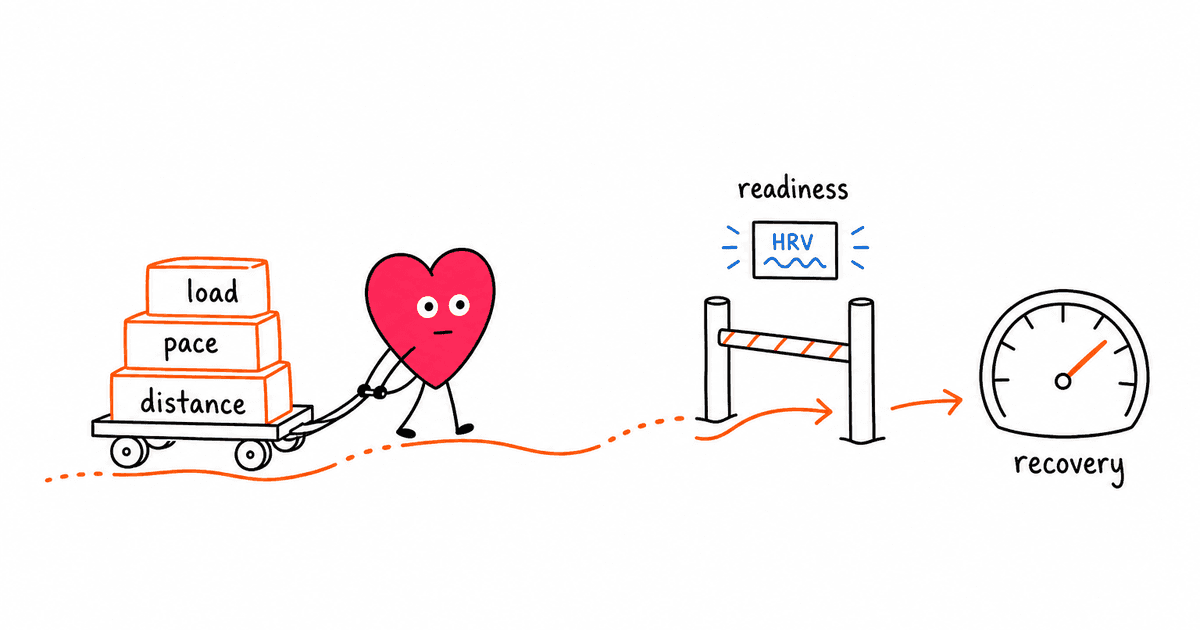
Rucking can improve your baseline HRV over time if the load and volume are appropriate, but it can also suppress HRV in the short term when the session is too heavy, too long, or stacked on top of other stress.
That is the real answer. Rucking is not automatically good or bad for heart rate variability. It is a training stress, and HRV helps you decide whether that stress is building fitness or quietly digging a recovery hole.
Compared with ordinary walking, rucking adds meaningful cardiovascular and musculoskeletal demand. That can be useful if you want a bigger training effect without doing the same volume of high-impact running. But the same added load that makes rucking effective also makes it easier to overshoot.
If you already track heart rate variability, rucking is a great example of why HRV matters. It gives you a simple way to answer a practical question: Did this session make me fitter, or just more tired?
What the Research Actually Says
There is a lot of enthusiasm around rucking right now, but direct studies on rucking and HRV are still limited. That matters. It would be sloppy to pretend otherwise.
What we do have is a useful mix of adjacent evidence:
- Research on regular walking and HRV shows that consistent low to moderate intensity walking can support parasympathetic activity and improve autonomic balance over time
- Load carriage studies show that adding weight raises heart rate, oxygen demand, and overall physiological strain, sometimes quickly
- Exercise recovery research consistently shows that harder sessions can temporarily lower HRV while your nervous system and muscles recover
A 2021 Applied Ergonomics study on U.S. Army soldiers found that heavier backpack loads pushed peak heart rate substantially higher and reduced walking speed, showing how quickly carrying weight increases physiological cost. A separate 2021 Ergonomics study found that load carriage increased physiological and perceptual strain as load rose, even during relatively short walking trials.
That fits what most people see in the real world. A brisk 45-minute walk and a 45-minute ruck do not hit the body the same way.
On the autonomic side, a PubMed-indexed study on HRV during spontaneous walking found that walking shifts autonomic control differently than simple standing, suggesting walking can support a more favorable autonomic profile. The key question with rucking is whether the added load keeps the session in a productive zone or tips it into a recovery problem.
Why Rucking Can Improve HRV Over Time
When done well, rucking combines several things that tend to support long-term HRV.
1. It can build aerobic fitness without the pounding of running
The American Heart Association highlights walking as one of the simplest ways to lower heart disease risk and improve overall health. Rucking keeps the basic advantages of walking while increasing the workload.
For people who cannot tolerate lots of running, that matters. You may be able to get a stronger cardiovascular stimulus from weighted walking while keeping impact relatively low.
Better aerobic fitness often translates to a stronger parasympathetic rebound, better recovery between efforts, and higher baseline HRV over time. That is one reason steady aerobic work like zone 2 training tends to pair well with better recovery trends.
2. It trains work capacity
Rucking sits in an interesting middle ground between cardio and strength-endurance work. Your heart, lungs, trunk, hips, and postural muscles all have to do more.
That can be helpful for people who want a time-efficient way to improve fitness, especially if normal walking feels too easy but high-intensity intervals feel too disruptive.
3. It is easy to make sustainable
One reason some people get good results from rucking is simple adherence. It is accessible, outdoors-friendly, and less technically demanding than many gym-based workouts.
A training method you can repeat consistently usually beats a theoretically perfect plan you abandon after ten days.
4. It may reduce the "all or nothing" exercise trap
A lot of adults bounce between sedentary stretches and overly aggressive workouts. Rucking can be a useful middle option, hard enough to drive adaptation, but often easier to recover from than repeated HIIT sessions or hard runs.
That matters because chronically overreaching training tends to drag HRV down, not lift it.
Why Rucking Can Lower HRV in the Short Term
This is the part people underestimate.
Rucking often feels deceptively manageable because it is still "just walking." But once you add load, hills, heat, pace, and duration, the recovery cost can climb fast.
Here are the main reasons HRV may drop after rucking:
Heavy load
More weight means more muscular tension, more bracing, more mechanical stress, and a higher heart rate. The military load carriage literature makes this very clear. As external load increases, the cost rises disproportionately.
For recreational fitness, this is the big mistake. People start too heavy because the workout looks simple.
Too much duration
A light ruck for 20 to 30 minutes is one thing. A loaded 90-minute weekend march is another. Long sessions can create a lot of fatigue even if the pace never feels dramatic.
Terrain and heat
The 2017 European Journal of Applied Physiology paper on load carriage found that gradient had an even bigger effect on oxygen consumption and heart rate than backpack load in some conditions. Translation: hills matter, a lot.
Heat and humidity matter too. Hot weather raises cardiovascular strain and fluid loss, which can push HRV down further, especially if hydration is poor.
Interference with other training
Rucking is most useful when it complements your week. It becomes a problem when it quietly piles onto already demanding training.
If you lift hard, run hard, sleep badly, and then add two heavy rucks because they seem "low impact," your HRV and overtraining data may disagree with your self-assessment.
How to Use HRV to Dose Your Rucking
This is where the topic gets practical.
Do not use HRV to obsess over single readings. Use it to spot patterns.
Green light pattern
Rucking is probably well-dosed if most of the following are true:
- Morning HRV is stable or gradually improving relative to your baseline
- Resting heart rate is stable
- Leg and back soreness clear within a day or so
- Your sleep is not getting worse
- Your next workouts still feel normal
In that case, your current load, pace, and frequency are probably fine.
Yellow light pattern
Adjust before problems stack up if you notice:
- HRV trending down for several days
- Resting heart rate creeping up
- Unusual heaviness in your calves, hips, low back, or feet
- More irritability, poor sleep, or flat motivation
- Your easy rucks suddenly feeling harder than expected
Usually the fix is simple: reduce load, shorten duration, flatten the route, or take an extra recovery day.
Red light pattern
Back off more aggressively if you see a combination of:
- HRV well below baseline for multiple mornings
- Elevated resting heart rate
- Lingering soreness or joint pain
- Performance dropping in other training
- Poor sleep, unusual fatigue, or a sense that you are grinding through sessions
At that point, do not be stubborn. Switch back to normal walking, recovery work, or full rest until your metrics and legs settle down.
A Smart Beginner Rucking Progression
If your goal is better fitness and better HRV, your best rucking plan is probably lighter than social media makes it look.
A simple starting approach:
- Start with regular walking first if your baseline activity is low
- Begin with a very light load, often around 5 to 10 pounds, or even an unloaded pack if you are deconditioned
- Keep the first sessions short, around 20 to 30 minutes
- Use flat terrain first before adding hills
- Increase one variable at a time, either load, duration, or terrain, not all three at once
- Hold the pace conversational for most sessions
That approach is boring, which is exactly why it works.
The Cleveland Clinic's guidance on rucking is similarly conservative: ease in, use a sturdy pack, and resist the urge to jump straight to heavy loads. For most people, the limiting factor is not grit. It is tissue tolerance.
How Often Should You Ruck If You Care About HRV?
For most recreational exercisers, 1 to 3 rucks per week is a sensible range.
That is enough to create a meaningful stimulus without turning every walk into a recovery event.
A good default looks like this:
- 1 day per week: Great if you already run, lift, or play sports
- 2 days per week: A solid sweet spot for general fitness
- 3 days per week: Usually best reserved for lighter loads and people who are already adapting well
Daily heavy rucking is where things often go sideways.
If you want daily movement, blend rucks with ordinary walks. That usually gives you better long-term HRV than making every session loaded.
Rucking vs Walking for HRV
If your only goal is raising HRV, plain walking is still hard to beat.
Walking is easier to recover from, easier to do consistently, and less likely to backfire. That is why it remains one of the best baseline habits for autonomic health.
Rucking makes more sense when you want extra challenge, more muscular demand, or a stronger conditioning effect without turning to high-impact cardio.
A useful rule:
- Choose walking when stress is high, sleep is shaky, or recovery is already compromised
- Choose rucking when you are sleeping well, handling training fine, and want a bigger stimulus
That kind of flexible decision-making is exactly what HRV is good for.
Who Should Be Careful With Rucking?
Rucking is not a free pass just because it is trendy.
Use extra caution if you have:
- A history of low back, neck, knee, or foot pain
- Stress fracture history or low bone tolerance
- Balance issues
- Cardiovascular disease or uncontrolled blood pressure
- Very low current activity levels
If that is you, start lighter, progress slower, and consider checking with a clinician before loading up a pack.
The Best Way to Track Whether Rucking Is Helping
Subjective feel matters, but wearables make this much easier.
A device like the Oura Ring 4, Whoop 5, Apple Watch Ultra, or Garmin wearables can help you track morning HRV, resting heart rate, sleep, and overall recovery trends.
That does not mean you need perfect data. You just need enough consistency to notice whether your ruck routine is building resilience or quietly reducing it.
If you are still deciding which platform to use, our best HRV monitors guide, Apple Watch HRV guide, and Whoop 5 review can help.
Bottom Line
Rucking can be good for HRV, but only when it is programmed like training instead of treated like a harmless walk with extra weight.
The upside is real: more cardiovascular demand than ordinary walking, useful strength-endurance benefits, and a practical option for people who want more challenge without constant high-impact exercise.
The downside is also real: too much load, too much duration, or poor recovery can push HRV down and leave you more depleted than expected.
Start lighter than your ego wants, progress slower than social media suggests, and let your HRV trend tell you whether the dose is working.
That is how rucking becomes a useful health tool instead of just another way to accumulate fatigue.
Need a quick read on your HRV number first?
Enter your HRV value, age range, device, and recovery context for a plain-English interpretation before you decide what to do next.
Interpret Your HRV NumberBuild the 30-day plan