HRV Explained for Dummies: A Plain-English Guide
Trying to decode today's HRV number? Use the free interpreter first, then build a practical recovery plan. Interpret your HRV
Heart rate variability sounds like a lab metric. It is not. Once you strip away the jargon, HRV is just a way to see how stressed, recovered, or adaptable your body is.
This guide explains HRV in plain English: what it means, why it goes up or down, what a good number is, and how to use it without obsessing over every morning score.
What Is HRV in Simple Terms?
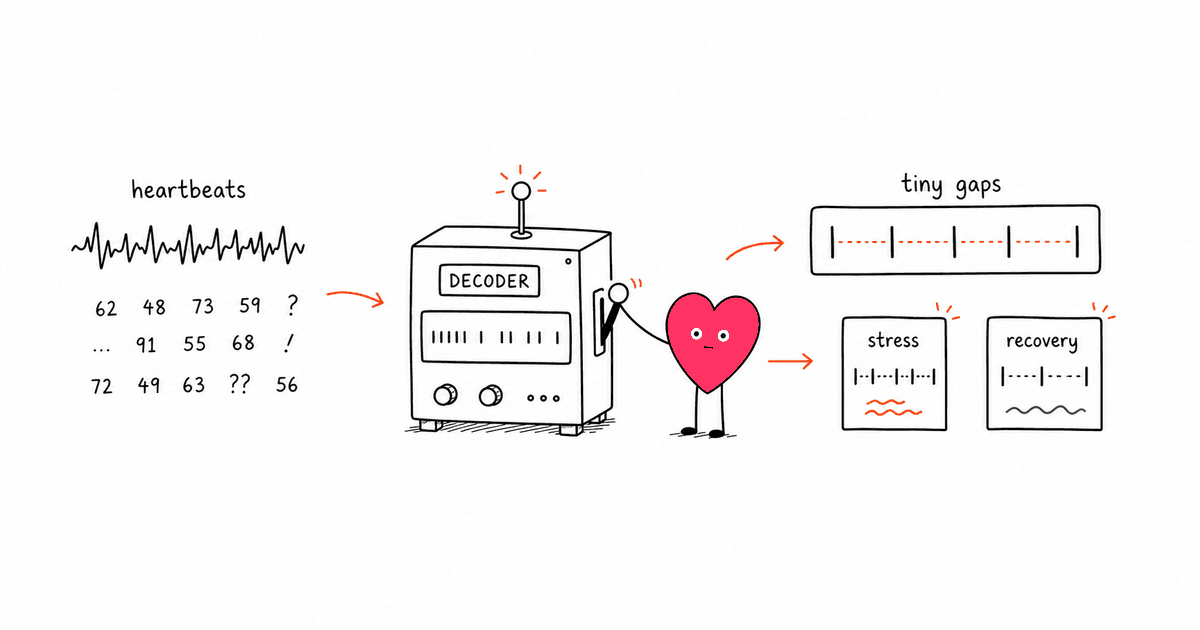
Heart rate variability (HRV) is the tiny difference in time between one heartbeat and the next, measured in milliseconds. A higher HRV usually means your body is more adaptable and recovered. A lower HRV usually means your body is carrying more stress, fatigue, illness, or strain.
The key idea: your heart is not supposed to beat like a perfect clock.
If your heart rate is 60 beats per minute, that does not mean your heart beats exactly once every second. The timing might look more like this:
- Beat 1 to beat 2: 0.92 seconds
- Beat 2 to beat 3: 1.08 seconds
- Beat 3 to beat 4: 0.97 seconds
That tiny variation is HRV. A healthy body constantly adjusts, and HRV is one way to measure that adjustment.
HRV vs Heart Rate
Heart rate and HRV are related, but they are not the same thing.
| Metric | What it measures | Simple meaning |
|---|---|---|
| Heart rate | Beats per minute | How fast your heart is beating |
| HRV | Timing variation between beats | How flexible your nervous system is |
Heart rate tells you speed. HRV tells you adaptability.
A low resting heart rate can be a sign of fitness. A high HRV can be a sign that your body is handling stress and recovery well. But neither number is useful without context. If you want the practical side-by-side version, read resting heart rate vs. HRV.
For the deeper science version, start with what HRV is and how it works.
Why HRV Matters
HRV matters because your heart is controlled by your autonomic nervous system, the system that manages things you do not consciously control, like breathing, digestion, blood pressure, and heart rhythm.
It has two main branches:
- Sympathetic nervous system: fight-or-flight mode
- Parasympathetic nervous system: rest-and-digest mode
When your body is calm, recovered, and flexible, your heart rhythm usually has more variation. When your body is stressed, tired, sick, dehydrated, or overtrained, your rhythm often becomes more rigid.
That is why HRV is useful. It gives you a signal about how much strain your body is carrying.
What Does High HRV Mean?
A high HRV usually means your body is in a better recovery state.
In plain English, high HRV often suggests:
- You slept well
- You are not fighting much stress
- Your body recovered from recent training
- Your nervous system can shift gears smoothly
- Your cardiovascular system is adapting well
Higher is generally better, but only compared with your own normal range. A 35 ms HRV might be normal for one person and unusually low for another.
What Does Low HRV Mean?
Low HRV usually means your body is dealing with strain.
Common reasons HRV drops include poor sleep, alcohol, illness, dehydration, hard workouts, travel, mental stress, emotional stress, late meals, and not enough recovery.
A low HRV day is not automatically bad. If you trained hard yesterday or slept poorly, a lower number makes sense. Your body is doing its job.
What matters is whether low HRV keeps showing up for several days, especially when you do not know why. For a more detailed breakdown, see what your HRV numbers mean and what a low HRV number means.
What Is a Good HRV?
There is no single good HRV number for everyone.
HRV depends on age, fitness, genetics, sleep, stress, medication, device type, and measurement method. Younger people often have higher HRV. Athletes often have higher HRV. Some healthy people naturally run lower than others.
A rough adult RMSSD range might look like this:
| HRV range | Plain-English interpretation |
|---|---|
| Under 20 ms | Often low, especially if this is below your baseline |
| 20 to 40 ms | Common for many adults, especially with age or stress |
| 40 to 70 ms | Often a solid range for healthy adults |
| 70 ms and above | Often high, more common in younger or very fit people |
Do not treat this table like a diagnosis. It is a loose orientation tool. For age-specific context, use the HRV by age chart.
Your Baseline Matters More Than the Number
The most important HRV rule is simple: compare yourself to yourself.
If your usual HRV is 42 ms and you wake up at 29 ms, that is meaningful. If your usual HRV is 28 ms and you wake up at 31 ms, that might be a good day for you.
Your baseline is your normal range after a few weeks of consistent tracking. Good HRV tracking is not about asking, "Is my number better than someone else's?"
It is about asking:
- Is my HRV normal for me?
- Is it trending up or down?
- Does the change match how I feel?
- Is there an obvious reason for the change?
That is where HRV becomes useful.
Why HRV Changes Every Day
HRV is supposed to move around. That is the point.
The most common reasons are straightforward:
- Sleep: Short, fragmented, or low-quality sleep can lower HRV. See HRV and sleep.
- Stress: Work pressure, conflict, anxiety, grief, and constant stimulation can all tax the nervous system. See HRV and stress.
- Exercise: Training can raise HRV over time, but hard workouts can lower it temporarily. If hard training keeps driving your trend down, see HRV and overtraining.
- Alcohol and late meals: Alcohol commonly lowers HRV, especially at night. Heavy late meals can also keep your body working when it should be recovering. For the deeper breakdown, read how alcohol affects HRV.
- Illness: HRV often drops when your body is fighting infection. It is not diagnostic, but it can be an early warning signal.
If your HRV changes, start by looking at the last 24 to 48 hours. The explanation is usually there.
How to Measure HRV
You can measure HRV with a wearable, chest strap, watch, ring, or app. The most important thing is consistency.
Popular options include WHOOP for recovery and strain tracking, Oura Ring for sleep and overnight recovery, Garmin watches for training metrics, and Polar chest straps for accurate spot measurements.
For device tradeoffs, see the best HRV monitors guide and the HRV monitor comparison.
The Best Time to Check HRV
For most people, the best HRV measurement is either overnight while sleeping or first thing in the morning before caffeine, exercise, or work stress.
Do not compare a morning reading to an afternoon reading. Do not compare a five-minute chest strap reading to an overnight wearable average and expect them to match.
Pick one method and stick with it.
How to Use HRV Without Overthinking It
HRV is useful when it helps you make better decisions. It becomes useless when it turns into another thing to panic about.
Use this simple framework:
| HRV pattern | What to do |
|---|---|
| Normal or higher than usual | Train and live as planned |
| Slightly lower than usual | Look for obvious causes, but do not overreact |
| Much lower for several days | Reduce strain and prioritize sleep, hydration, and recovery |
| Low plus concerning symptoms | Talk to a healthcare professional |
HRV should reduce guesswork, not add pressure.
What HRV Cannot Tell You
HRV is helpful, but it is not magic.
HRV cannot tell you exactly what illness you have, whether you are healthy or unhealthy by itself, whether one workout is guaranteed to be good or bad, or whether one supplement is working after one day.
It is one signal. Treat it like a dashboard light, not a judge.
Simple Ways to Improve HRV
If you want better HRV, start with the boring basics. They work better than hacks.
- Sleep more consistently: Go to bed and wake up at similar times. Keep your room cool and dark.
- Build aerobic fitness: Walking, cycling, running, swimming, and other steady aerobic work can support HRV over time. For a simple endurance framework, see Zone 2 training and HRV.
- Recover from hard training: Hard workouts need easy days. If HRV keeps falling, recovery may not be matching training load. You can also compare HRV with heart rate recovery to understand fitness and fatigue from two angles.
- Use slow breathing: Calm breathing with longer exhales can activate the parasympathetic nervous system. See breathing exercises for HRV.
- Limit alcohol: Skip alcohol for two weeks and watch your trend. It is one of the clearest HRV experiments.
- Manage stress like it is physical: Walks, sunlight, social connection, meditation, and downtime can all help.
For a full list, read how to improve HRV.
Common HRV Mistakes
The big beginner mistakes are comparing your HRV to other people, chasing a perfect score, panicking over one low day, ignoring how you feel, and switching devices while comparing the numbers as if they are identical.
Your friend's 82 ms and your 38 ms do not mean much without age, device, baseline, and context. Your body gets a vote, too. If your HRV says you are recovered but you feel awful, do not blindly follow the app.
HRV Explained in One Sentence
HRV is a measure of how flexibly your heart responds to stress and recovery, and your personal trend matters more than any single number.
That is the whole thing.
Track it consistently. Use it as a nudge. Do not let it become another source of stress.
Frequently Asked Questions
Is HRV the same as heart rate?
No. Heart rate measures how many times your heart beats per minute. HRV measures the tiny timing differences between beats.
Is high HRV good?
Usually, yes, especially when it is high compared with your own baseline. But context matters. HRV should be interpreted alongside sleep, stress, training, symptoms, and how you feel.
Is low HRV bad?
Not always. HRV can drop after hard exercise, poor sleep, alcohol, travel, or stress. A low reading matters more if it is unusual for you, lasts several days, or comes with symptoms.
What is a normal HRV?
Normal HRV varies widely. Many adults fall somewhere between 20 and 70 ms for RMSSD, but age, fitness, genetics, and device type all matter. Your baseline is more useful than a population average.
Should beginners track HRV?
Yes, if it helps you make calmer decisions about sleep, stress, and recovery. No, if it makes you anxious or obsessive. HRV should reduce guesswork, not add pressure.
Need a quick read on your HRV number first?
Enter your HRV value, age range, device, and recovery context for a plain-English interpretation before you decide what to do next.
Interpret Your HRV NumberBuild the 30-day plan