Oura Ring 5 Review: Is the HRV Upgrade Worth It?
Ready to start tracking your HRV? Check out our top picks: Whoop | Oura Ring 5 | Polar H10
Oura Ring 5 Review: Quick Verdict
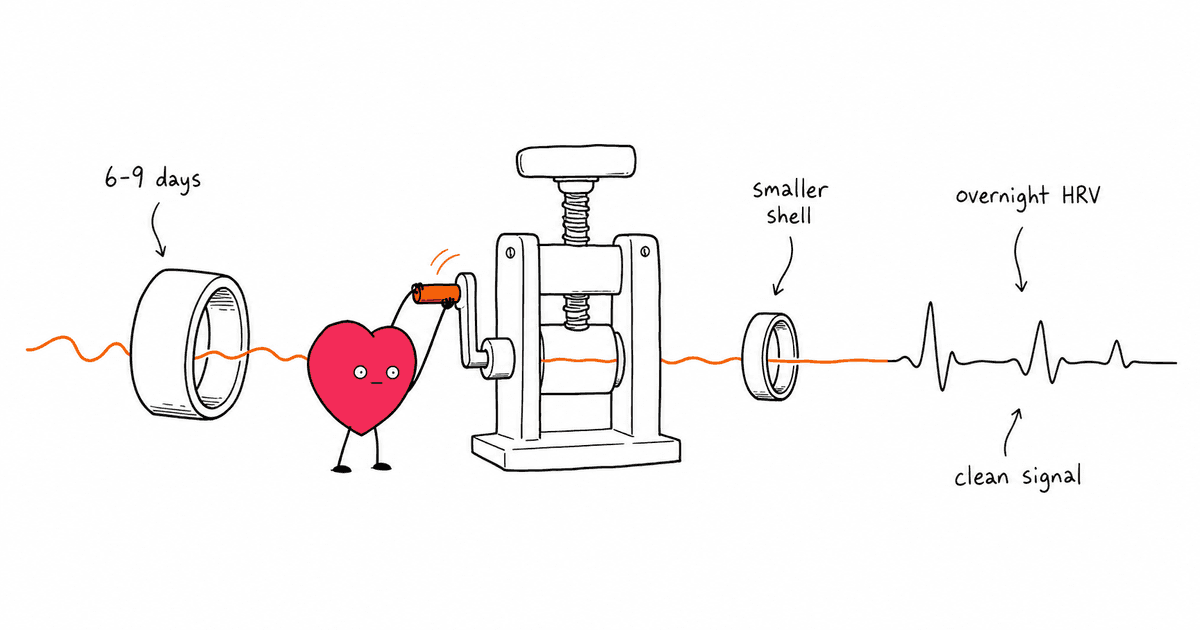
Oura Ring 5 is worth considering if you want passive sleep and recovery tracking in the smallest Oura hardware yet. Its strongest upgrades are comfort, 6 to 9-day battery life, and Oura's reported 12% improvement in overnight HRV accuracy. Ring 4 owners with clean, consistent data do not need to rush.
Oura announced Ring 5 on May 28, 2026, and began shipping it on June 4. It starts at $399 for Black or Silver, while the four premium finishes cost $499. The ring still requires an Oura Membership to unlock the full trend and insight experience.
This assessment uses Oura's published specifications and performance data. Manufacturer accuracy claims are labeled as such rather than presented as independent hands-on findings.
Check the current Oura Ring 5 price and availability on Amazon.
Oura Ring 5 at a Glance
| Specification | Oura Ring 5 |
|---|---|
| Starting price | $399 in the US |
| Premium finishes | $499 in the US |
| Release date | June 4, 2026 |
| Battery rating | 6 to 9 days |
| Width | 6.09 mm |
| Thickness | 2.28 mm |
| Weight | From 2 grams, depending on size |
| Sizes | 6 to 13, whole sizes only |
| Water resistance | 100 meters, IP68 |
| Materials | Titanium interior and exterior |
| Sensors | Red, infrared, and green LEDs; photodetectors; temperature sensor; accelerometer |
| Compatibility | iOS and Android |
| Membership | $5.99 monthly or $69.99 annually in the US |
The dimensions, sensor list, battery range, and water-resistance rating come from Oura's official Ring 5 specifications. Prices and availability can change by region and finish.
What Is New in Oura Ring 5?
A Much Smaller Ring
Ring 5 is 6.09 mm wide and 2.28 mm thick. Oura says that gives it 40% less volume than Ring 4, which is 7.9 mm wide and about 2.88 mm thick.
That reduction matters because a recovery wearable only works when you keep wearing it. A slimmer ring should create less friction during sleep, typing, and normal daily movement. It may also suit people who rejected earlier smart rings because they looked or felt too bulky.
Oura moved to low-profile sensor domes and a redesigned optical system rather than simply shrinking the Ring 4 architecture. Ring 5 uses 12 signal pathways intended to maintain skin contact across different fingers and skin tones.
Better Overnight HRV Accuracy, According to Oura
The headline MyHRV upgrade is Oura's claim that Ring 5 delivers 12% more accurate overnight HRV than Ring 4 for the average member. Oura also reports a 24% improvement in workout-heart-rate signal quality and a 19% accuracy improvement for activities such as walking, running, and cycling.
Those figures come from Oura's own Ring 5 engineering comparison. They are useful generation-on-generation evidence, but they do not mean every nightly HRV value will be 12% closer to an ECG for every user.
Fit still matters. A loose ring, cold hands, movement, pressure on the ring, and poor skin contact can all create missing or noisy optical data. Better hardware reduces measurement friction, but it does not remove it.
Longer Rated Battery Life
Oura rates Ring 5 for 6 to 9 days per charge, compared with 5 to 8 days for Ring 4. Actual battery life varies by ring size, feature settings, activity, temperature, and battery age.
The included size-specific charger takes about 80 minutes for a full charge. An optional charging case can provide portable charging, but it is sold separately.
More Durable Finishes
All six finishes use a titanium interior and exterior with a harder PVD coating. Oura positions this as more scratch resistant than the previous generation.
That does not make the ring scratch-proof. Metal bars, dumbbells, and other hard surfaces can still mark a wearable ring and may make gripping uncomfortable. Removing it for heavy lifting remains sensible.
How Oura Ring 5 Measures HRV
Oura uses photoplethysmography, or PPG, to detect pulse-wave timing at the finger. Green and infrared LEDs shine into the skin, photodetectors measure the reflected light, and the system estimates changes in the time between beats.
The app emphasizes nighttime HRV because sleep offers a relatively controlled measurement window. It reports HRV using rMSSD, a common time-domain measure of short-term beat-to-beat variation. If that term is unfamiliar, see our guide to understanding HRV numbers.
Oura then combines HRV with resting heart rate, sleep, temperature trends, recent activity, and other signals to calculate Readiness. The result is designed to help you compare recovery against your own baseline, not against a universal ideal.
What the 12% Accuracy Claim Actually Means
The reported improvement is most relevant if Ring 4 gives you gaps, implausible spikes, or inconsistent overnight readings. Cleaner data can produce a steadier personal baseline and reduce false recovery signals.
It does not make Ring 5 a diagnostic ECG. It also does not make one low reading medically meaningful. HRV is sensitive to sleep, illness, alcohol, training load, stress, travel, hydration, and ordinary day-to-day variation.
Use the ring to answer trend questions:
- Is your seven-day HRV trend moving away from your normal range?
- Did resting heart rate, sleep quality, or temperature change at the same time?
- Was there a plausible cause such as hard training, poor sleep, alcohol, or illness?
- Does the pattern recover when the stressor resolves?
Our HRV interpreter can help put a current reading in the context of your age, baseline, device, sleep, and recent stressors.
Oura Ring 5 vs. Oura Ring 4
| Feature | Oura Ring 5 | Oura Ring 4 |
|---|---|---|
| Starting price | $399 | $349 |
| Width | 6.09 mm | 7.9 mm |
| Thickness | 2.28 mm | About 2.88 mm |
| Battery rating | 6 to 9 days | 5 to 8 days |
| Sizes | 6 to 13 | 4 to 15 |
| On-ring data storage | Up to 3 days | Up to 7 days |
| Overnight HRV | Oura reports 12% better accuracy | Previous-generation baseline |
| Water resistance | 100 meters, IP68 | 100 meters |
| Software access | Current Oura platform | Most new features also supported |
Oura's generation comparison reveals two tradeoffs that are easy to miss.
First, Ring 5 only comes in sizes 6 through 13. Ring 4 remains the better fit for people who need sizes 4, 5, 14, or 15.
Second, Ring 5 stores up to three days of data on the ring, down from seven days on Ring 4. This is unlikely to matter if you sync regularly, but it matters for travel or long periods away from your phone.
Should Ring 4 Owners Upgrade?
Upgrade from Ring 4 when at least one of these is true:
- Ring 4 feels bulky enough that you remove it at night.
- You regularly see missing or implausible overnight HRV data despite a correct fit.
- An extra day of rated battery life would improve consistent wear.
- Your current size falls within Ring 5's narrower size range.
- You value the lighter, jewelry-like profile enough to justify the cost.
Keep Ring 4 when:
- It is comfortable and produces stable overnight trends.
- You need a size outside 6 through 13.
- You sync infrequently and value seven days of on-ring storage.
- You mainly want new app features rather than new hardware.
Most software introduced alongside Ring 5, including Oura's newer health insights, is also intended for Ring 4 and Gen3 members. Hardware comfort and data quality are therefore better upgrade reasons than software alone. For more on the older model, read our Oura Ring 4 review.
Sleep, Readiness, and Activity Tracking
Sleep and Recovery
Oura remains a sleep-first wearable. The app combines sleep duration, timing, stages, latency, disturbances, resting heart rate, HRV, and other signals into Sleep and Readiness scores.
The ring form factor is the main advantage. There is no screen, vibration, or bulky watch body competing for attention in bed. The smaller Ring 5 design should make continuous overnight wear easier, which is essential for building a useful sleep and HRV baseline.
Activity Tracking
Ring 5 tracks movement, steps, workouts, and activity trends, and Oura says workout-heart-rate accuracy has improved. It still is not a direct replacement for a sports watch when you need a screen, maps, detailed training fields, or on-device controls.
For recovery-oriented users, activity data is context for HRV and sleep. For performance-oriented athletes, a chest strap or sports watch may remain the better primary training tool.
Temperature and Blood Oxygen
The digital temperature sensor measures changes relative to your personal baseline. Red and infrared LEDs support blood-oxygen measurements. These signals can add context to recovery changes, but they should not be used to diagnose illness or sleep disorders.
Price and Membership Cost
Ring 5 costs $399 in Black or Silver. Gold, Deep Rose, Brushed Silver, and Stealth cost $499 in the US at launch.
Oura Membership is separate. Oura's current US membership pricing is $5.99 per month or $69.99 per year after one included month. Regional prices and taxes vary.
Without an active membership, the ring has limited value because the personalized insights, detailed trends, and full app experience are the product. Budget for the recurring cost rather than treating the hardware price as the total cost of ownership.
Sizing and Fit
Ring 5 uses its own sizing kit and comes in whole sizes 6 through 13. Oura sizing differs from standard jewelry sizing and from Ring 4 sizing.
Oura recommends wearing a sizing ring for at least 24 hours, including overnight. Fingers change size with temperature, activity, sleep, and salt intake, so a quick fitting can be misleading.
A correct fit should remain snug enough for steady sensor contact without causing pressure, numbness, or difficulty removing the ring. Oura recommends the index, middle, or ring finger.
Oura Ring 5 Pros and Cons
Pros
- Much smaller and lighter than Ring 4
- Strong focus on overnight HRV, sleep, and recovery trends
- Oura-reported improvement in overnight HRV accuracy
- 6 to 9-day rated battery life
- No distracting screen or notifications
- Titanium construction and 100-meter water resistance
- Works with both iOS and Android
Cons
- $399 starting price is $50 higher than Ring 4
- Full value still depends on a recurring membership
- Narrower size range than Ring 4
- Only three days of on-ring data storage
- Manufacturer accuracy claims still need individual real-world validation
- Less useful than a sports watch for live training data
- Rings can be awkward during strength training
Who Should Buy Oura Ring 5?
Ring 5 is a strong fit for:
- People who care most about sleep and passive recovery tracking
- Users who want HRV trends without wearing a watch to bed
- Ring 4 users whose current hardware feels bulky or produces signal gaps
- People willing to pay for Oura's long-term trend and insight platform
- Users who will change sleep, training, or recovery behavior based on the data
It is a weaker fit for:
- Athletes who need live pace, maps, or detailed on-device workout data
- People who dislike subscriptions
- Anyone who needs sizes 4, 5, 14, or 15
- Users who only want steps or a basic sleep score
- People who cannot comfortably wear a ring overnight
For alternatives, compare Whoop, Oura, and Apple Watch for HRV or review our best HRV monitors of 2026.
Is Oura Ring 5 Worth It?
Yes, for a new buyer who prioritizes sleep, recovery, comfort, and consistent overnight HRV. No, for a satisfied Ring 4 owner whose current ring already fits well and produces clean data.
The upgrade is about reducing friction. Smaller hardware may improve wear consistency, and cleaner sensing may improve trust in the nightly trend. Those benefits are meaningful because an HRV tracker becomes useful through repeated measurements, not one impressive specification.
The value is harder to justify if you want workout guidance on your wrist, dislike recurring fees, or rarely act on recovery data. In that case, a watch, chest strap, or subscription-free ring may be a better match.
Final Verdict
Oura Ring 5 is a focused refinement rather than a completely different recovery platform. It makes the hardware smaller, extends the rated battery range, and targets the most important measurement for MyHRV readers: consistent overnight HRV.
The best reason to buy it is not a new score or app screen. It is the combination of easier 24-hour wear and Oura's reported improvement in signal accuracy. That combination can make a personal baseline more complete and easier to trust.
New Oura buyers should choose Ring 5 when the size range fits and the membership cost is acceptable. Existing Ring 4 owners should upgrade only when comfort, battery life, or data quality is a real limitation.
Shop Oura Ring 5 on Amazon, check the current specifications, sizes, and finishes, then learn how to improve your HRV without overreacting to one night's score.
Ready to improve your health with HRV monitoring?
We've tested and compared the top HRV monitors on the market. Find the right one for you.
See Our Top Picks for 2026